

Most startups fail at the backend before they fail at the business. Not because the technology is too hard, but because the founders who commission it do not understand what they are buying, what it should cost, or how to evaluate whether it was built correctly backend development services.
Backend development services sit at the foundation of every serious software product. The databases that store your user data, the servers that process every request, the APIs that connect your app to payment processors, analytics tools, and third-party platforms — all of it is backend. None of it is visible to your users. All of it determines whether your product works.
This guide covers everything a non-technical founder needs to understand about backend development services in 2026 — what they include, what they cost, when to outsource, which technologies matter, how to choose the right agency, and when a managed platform is smarter than building from scratch.
What backend development services actually cover
The most common mistake founders make when engaging a backend team is assuming that “backend development” is a self-contained, universally understood scope. It is not. What backend development services include varies significantly between vendors, and the gap between what you assume is covered and what is actually in scope is where most budget overruns begin.
At its core, a backend system is responsible for four things: storing and retrieving data, applying business logic, managing communication between your application and external services, and handling the infrastructure that keeps everything running.
Data storage means designing and managing the databases where your product’s information lives — user accounts, transactions, content, behavioral data. Business logic is the set of rules that govern how your application behaves: who can access what, how a calculation gets applied, when a notification fires. Communication happens through APIs, the structured interfaces that allow your frontend, your mobile app, and your third-party tools to exchange information with your server. Infrastructure is the hosting, deployment, and monitoring layer that keeps your backend available, performant, and secure.
A complete backend development engagement covers all four of these layers. Many proposals cover only some of them — and the gaps are rarely disclosed upfront backend development services.
Frontend development, product design, DevOps, and mobile app development are typically separate disciplines with separate scopes. Understanding exactly where backend ends and these adjacent functions begin is essential before you sign any contract.
The full breakdown of every layer — including what is commonly excluded from backend proposals and why those exclusions matter — is in the detailed guide to what backend development services actually include.
How much backend development services cost in 2026
Backend development cost is one of the least transparent pricing areas in the technology services market. Quotes for what appears to be the same project can vary by a factor of ten, and most founders have no reliable benchmark to evaluate whether a number is reasonable.
Three variables drive the majority of that variance.
The first is scope definition. Vague requirements produce inflated quotes, because vendors pad estimates to cover risk they cannot measure. The more precisely you define your data model, your integration requirements, and your expected traffic, the tighter and more comparable your quotes become.
The second is hiring model. A freelance backend developer, a development agency, and a full-time in-house hire carry fundamentally different cost structures — not just different hourly rates, but different risk profiles, different management overhead, and different long-term cost trajectories.
The third is geography. A senior backend developer in New York and an equally skilled developer in Warsaw or Medellín represent a three-to-five times difference in base rate for comparable output quality.
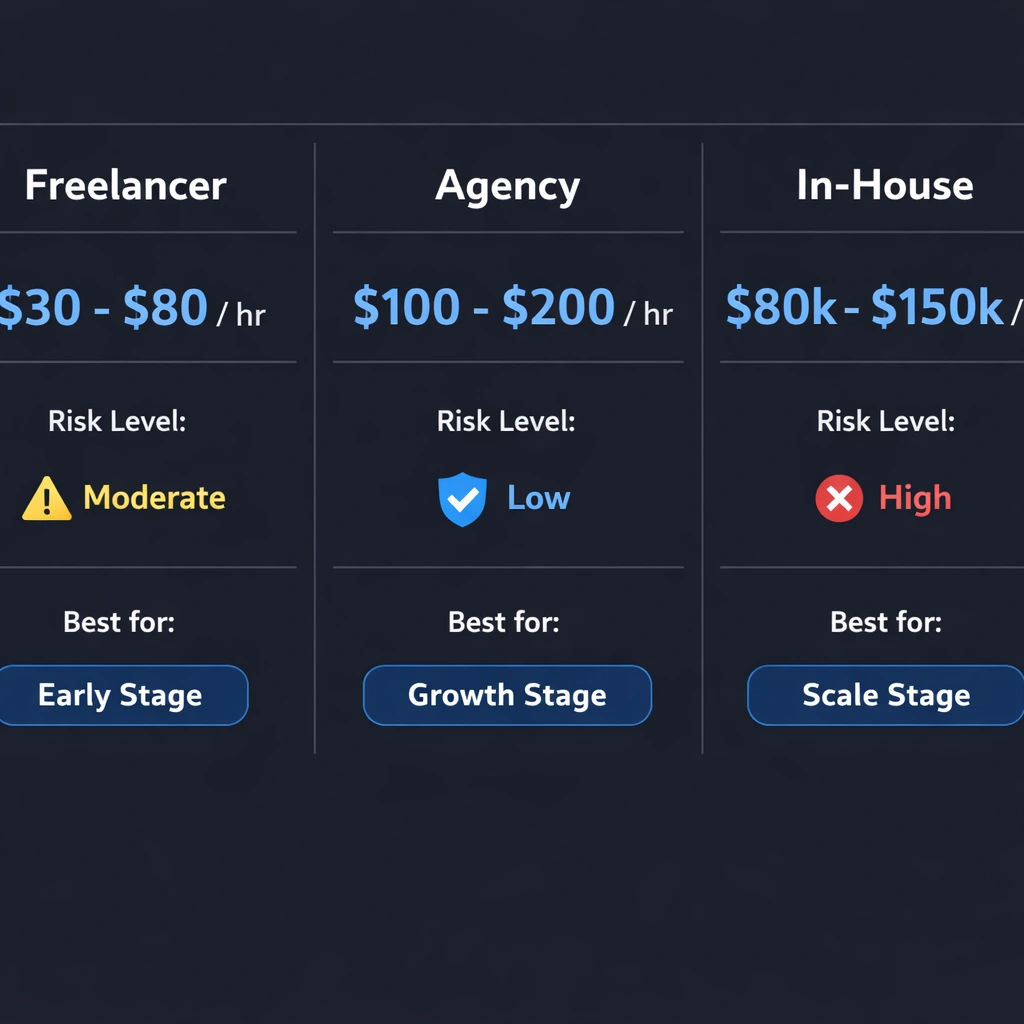
For a production-ready SaaS MVP backend — authentication, database schema, REST API, and two or three third-party integrations — realistic budget ranges run from $15,000 on the low end with a skilled offshore freelancer to $80,000 or more with a mid-market agency. Enterprise-grade builds with compliance requirements, high-availability architecture, and deep integration work routinely exceed $150,000.
Beyond the build cost, founders consistently underestimate four recurring expense categories: cloud infrastructure hosting, third-party service subscriptions, ongoing maintenance and iteration, and technical debt remediation after a fast early build.
The complete pricing breakdown by hiring model, project type, and hidden cost category is in the backend development cost guide for 2026.
When to outsource backend development and when not to
The decision to outsource backend development is one of the highest-stakes choices an early-stage founder makes — and it is frequently made on instinct rather than framework.
Outsourcing works well in three specific situations. When you are building a defined MVP with a bounded scope and a clear timeline, an experienced external team delivers faster than an in-house hire you have not yet made. When your founding team has frontend or product strength but no backend depth, outsourcing the server-side layer fills the gap without a permanent headcount commitment. And when market conditions create pressure to ship fast, an organized external team that is already equipped and already practiced removes months from your timeline.
Outsourcing creates problems in three equally specific situations. When your backend is your core product differentiator — when the technical architecture is what makes your product uniquely valuable — placing it outside your organization is a strategic vulnerability. When your requirements are still being discovered and will change frequently, an external team priced on scope will either overcharge for uncertainty or underdeliver when direction shifts. And when you have no internal technical oversight, you lose the feedback mechanism that catches quality problems before they become structural ones.
The model of outsourcing also matters. Project-based engagements suit bounded MVP builds. Dedicated team models suit products under active, ongoing development. Staff augmentation suits founders who already have technical leadership in place and need execution capacity.
Regardless of model, four structural protections apply to every outsourced engagement: own the repository from day one, require documented architecture decisions, build in milestone-based reviews, and ensure every third-party credential is registered to your company — not the vendor.
The complete framework for evaluating whether to outsource and how to structure it safely is in the guide to outsourcing backend development without losing control.
Which backend technologies actually matter in 2026
Technology stack decisions are business decisions, not just engineering preferences. The backend technologies your team builds on determine your hiring pool, your infrastructure costs, your development velocity, and your ability to scale without a full rewrite.
Among programming languages, Node.js remains the dominant choice for startups prioritizing development speed and frontend-to-backend continuity. Python holds strong for data-heavy products and SaaS applications with significant workflow automation. Go has gained serious traction for performance-critical systems where latency and concurrency are core requirements. Ruby on Rails, though less prominent than its peak, remains a productive choice for small teams building CRUD-heavy SaaS products where development velocity is the primary constraint.
Framework selection follows language choice and shapes daily development experience. Express.js offers maximum flexibility with minimal opinion. NestJS provides enterprise-grade structure for larger teams. Django delivers a batteries-included approach for data-heavy Python applications. FastAPI handles modern API-first development with native support for asynchronous operations.
Database selection carries the longest-lasting consequences of any stack decision. PostgreSQL is the correct default for most new SaaS products in 2026 — open source, feature-rich, and exceptionally well-supported. MongoDB suits products where data structure is variable or evolving rapidly. Redis serves most effectively as a caching layer rather than a primary database, storing frequently accessed data in memory to reduce load and improve response times.
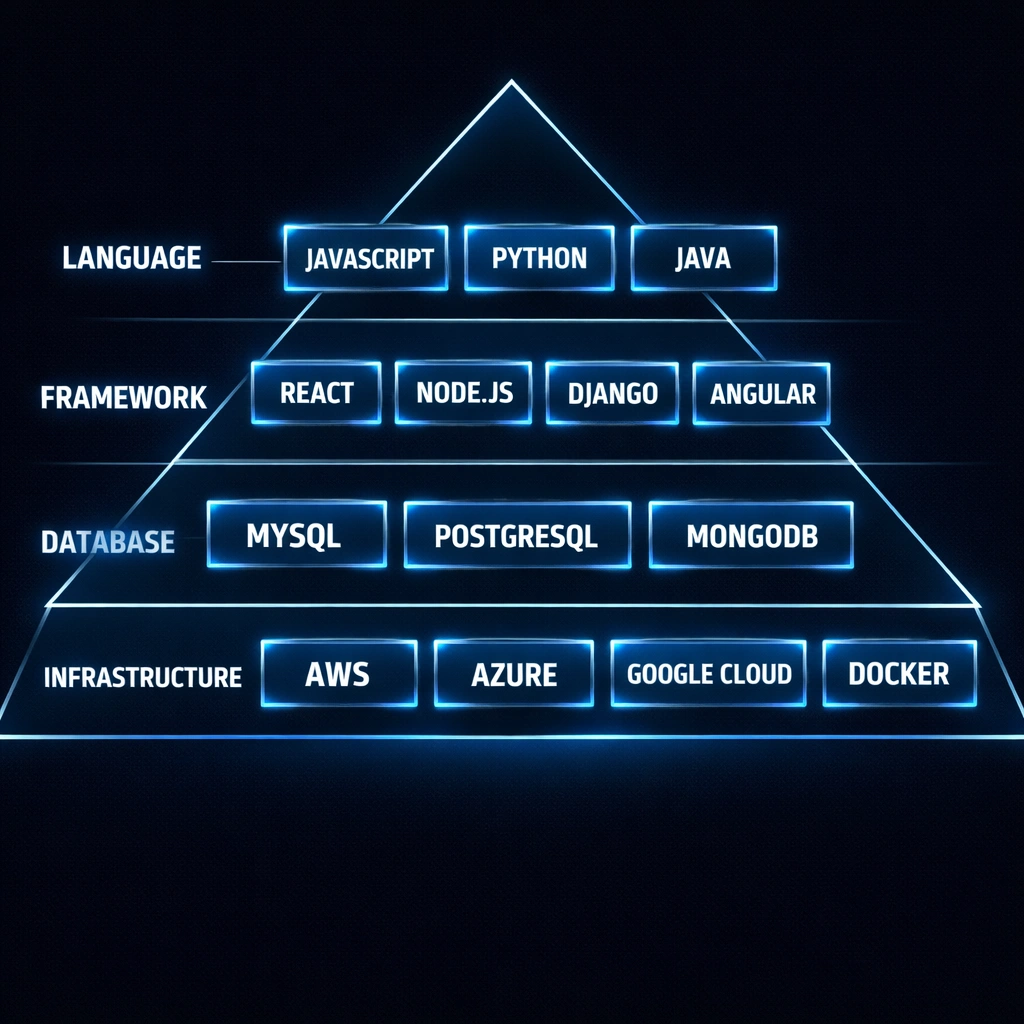
Infrastructure choices increasingly favor platforms that reduce operational complexity without sacrificing control. AWS remains the most comprehensive option for teams with dedicated infrastructure expertise. Railway, Render, and Fly.io have become viable production platforms for early-stage startups that want deployment-grade reliability without a dedicated DevOps function.
The full stack-by-stack comparison — including how to match technology choices to your specific product requirements, team capabilities, and hiring market — is in the breakdown of backend technologies worth using in 2026.
How to choose a backend development agency
Most founders evaluate agencies on the wrong signals. Portfolio aesthetics, client logo walls, and hourly rates are the most visible variables and among the least predictive of engagement quality.
A backend development agency becomes a co-author of your product architecture. The decisions made during an agency engagement — about database design, API structure, authentication patterns, infrastructure configuration — outlast the engagement itself by years. Evaluating an agency correctly means evaluating its process, not its presentation.
Seven criteria separate reliable backend development agencies from expensive ones. Relevant technical depth means demonstrated experience with the specific technologies your product requires — not logos on a capabilities page, but projects where meaningful architectural decisions were made and can be discussed in detail. A structured discovery process before proposal means the agency uses your actual requirements to inform their recommendation, not a standard template applied to every client. Code quality standards mean documented workflows for code review, automated testing, and handoff documentation that are enforced consistently, not applied selectively.
Communication structure means a defined cadence of updates, a named technical contact, and a documented process for handling scope changes. Ownership clarity means IP assignment language in the contract that leaves no ambiguity about who owns the code, the credentials, and the architecture documents. Post-launch support terms mean a defined warranty period, a documented knowledge transfer process, and clear commercial terms for ongoing maintenance. Reference quality means clients willing to speak specifically and candidly about an engagement similar to yours in scope.
The red flags that predict poor outcomes are equally consistent: proposals submitted within 24 hours of a vague brief, resistance to milestone-based payment structures, technology recommendations made without explaining why they fit your use case, and an inability to name a technical point of contact on your project.
The full evaluation framework — including how to structure the final decision between shortlisted agencies and how to protect yourself contractually — is in the guide to choosing a backend development agency without regrets.
Backend as a service vs. custom backend development
The decision between a managed backend platform and a custom-built backend is one of the most consequential early product choices a founder makes — and the right answer is stage-dependent, not absolute.
Backend as a service platforms — Firebase, Supabase, AWS Amplify, Appwrite — provide pre-built authentication, database access, file storage, and serverless functions through a managed interface. They eliminate the need for backend engineering expertise at early stage and compress the time from idea to working product dramatically. For pre-revenue validation, small teams without backend depth, and products whose competitive advantage lives entirely outside the backend layer, BaaS is often the objectively correct choice.
Custom backend development wins when the product’s business logic is complex or proprietary, when performance requirements exceed what a managed platform can optimize for, when compliance and data sovereignty requirements make shared infrastructure untenable, and when the long-term cost trajectory of a managed platform becomes unfavorable at scale.
The hybrid model — using BaaS for commodity functionality like authentication and file storage while building a custom API layer for proprietary business logic — represents the most pragmatic path for startups moving from validation to growth. It captures the speed advantages of managed infrastructure without surrendering control of the layers where the product’s technical value actually lives.
Four questions frame the decision cleanly. What is your current stage? Where does your product’s technical differentiation live? What are your compliance and data requirements? And what does your technical team look like? The answers rarely point in different directions simultaneously.
The complete comparison — including a stage-by-stage analysis of where each model wins and a breakdown of the hybrid architecture pattern — is in the honest guide to backend as a service vs. custom development.
Conclusion
Backend development services are not a commodity purchase. They are a series of interconnected decisions — about scope, cost, team structure, technology, and architecture — that compound over the life of your product. Get them right early and every subsequent build decision becomes easier. Get them wrong and the cost of correction grows with every sprint.
The founders who navigate this landscape successfully share a common approach. They invest time in understanding what they are buying before they buy it. They define requirements precisely enough to hold vendors accountable. They structure engagements with milestone-based accountability rather than trust-based assumptions. And they treat technical decisions as business decisions — because that is exactly what they are.
Backend development does not reward the founder who moves fastest without context. It rewards the founder who moves deliberately with enough understanding to ask the right questions, evaluate the answers, and make decisions that hold up at scale.
The path through this landscape starts with knowing what backend development services actually cover — every layer, every boundary, every common exclusion. It runs through an honest assessment of what the work should cost, which hiring model fits your stage, and which technologies give your product the right foundation for where you are going. It includes a clear-eyed evaluation of any agency or outsourced team before a contract is signed. And it ends with a deliberate choice between managed infrastructure and custom development that is grounded in your product requirements, not general opinion.
Every section of this guide connects to a deeper resource on each decision point. The most immediate next step for most founders reading this is understanding the full scope of what they are commissioning — because every other decision builds on that foundation.