

Pricing for backend work is one of the least transparent areas in tech hiring, and most founders either overpay or underbuy. Backend development cost varies dramatically depending on whether you hire freelancers, agencies, or build in-house — and the difference can run from $5,000 to $500,000 for what looks like the same deliverable.
Before you request a single quote, understanding the full pricing landscape behind backend development services for growing startups gives you real leverage at the negotiating table and protects your runway.
Backend development cost: why it is so hard to pin down
Unlike a logo design or a copywriting project, backend development has no natural price ceiling. The scope can expand indefinitely — more integrations, more logic, more data complexity, more infrastructure layers. And because most founders are not technical, they have no reliable internal benchmark to validate whether a quote is reasonable.
Three variables drive most of the backend development cost variance you will see in the market.
Scope definition — vague requirements produce inflated quotes. A vendor who cannot clearly scope your project will pad the estimate to cover unknown risk. The more precisely you can describe your data model, your integrations, and your expected traffic, the tighter and more comparable your quotes will be.
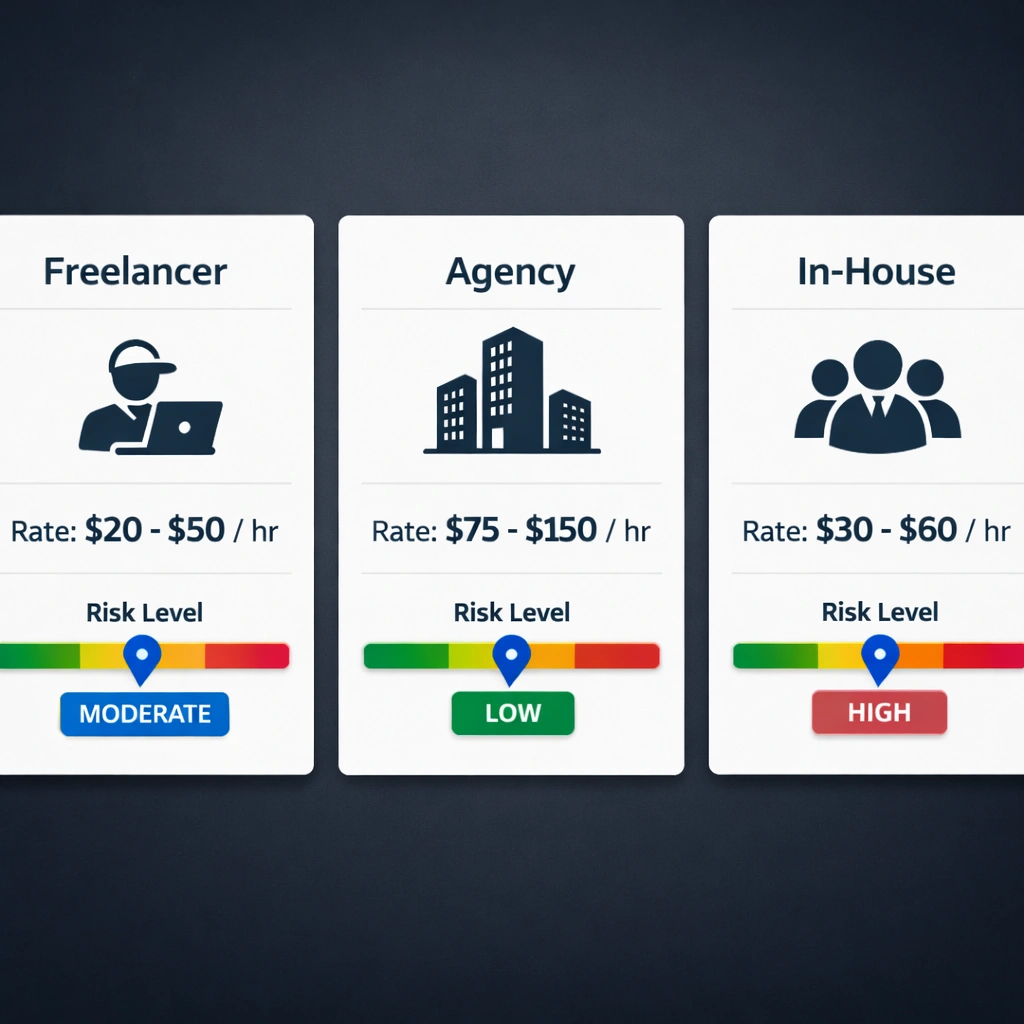
Hiring model — freelancer, agency, or in-house each carry fundamentally different cost structures, not just different hourly rates.
Geography — a senior backend developer in New York charges differently than an equally skilled developer in Eastern Europe or Southeast Asia. The gap can be three to five times the base rate for comparable output.
Backend development cost breakdown by hiring model
Freelance backend developers
Freelancers are the most flexible option and typically the lowest entry point for early-stage projects. On platforms like Toptal, Upwork, or Arc.dev, backend development cost by region breaks down like this.
Junior to mid-level freelancers based in Latin America or Eastern Europe typically charge between $35 and $75 per hour. Senior developers in the same regions run $75 to $120 per hour. US or Western Europe-based senior freelancers commonly charge $120 to $200 per hour or more.
For a typical MVP backend — user authentication, a core database schema, a REST API, and one or two third-party integrations — expect 150 to 400 hours of work depending on complexity. That puts a realistic freelance MVP engagement somewhere between $15,000 and $60,000.
The risk with freelancers is continuity. A single developer leaving mid-project can stall your entire timeline, and knowledge transfer is rarely clean.
Agency backend development cost
Agencies price by project, retainer, or time-and-materials. A project-based engagement for a production-ready backend — including architecture, database design, API development, and deployment — typically ranges from $25,000 to $150,000 for a mid-complexity SaaS product.
Retainer models, where you pay a monthly fee for ongoing development and maintenance, generally run $8,000 to $25,000 per month for a small dedicated team.
The advantage of an agency is process. They have project managers, code review workflows, and bench depth. The trade-off is margin — you are paying for that infrastructure, and agency backend development cost reflects it.
If you are still deciding whether an agency is the right fit for your stage, the guide to choosing a backend development agency without regrets breaks down exactly what to look for before you sign.
In-house backend development cost
Hiring full-time is the most expensive model upfront and the most cost-efficient at scale. In the United States, a mid-level backend engineer commands a base salary between $110,000 and $145,000 per year. Senior engineers in major tech markets regularly earn $150,000 to $200,000 or more, before equity, benefits, and employer taxes.
Add 20 to 30 percent on top of base salary for total employment cost, and a single senior backend hire in the US represents a $180,000 to $260,000 annual commitment.
For a pre-revenue or early-revenue startup, this model only makes sense when backend development is a core, ongoing function — not a one-time build.
Backend development cost by project type
Rates tell part of the story. Project complexity tells the rest. Here is how backend development cost typically breaks down across 4 common project types.
Simple CRUD application — a basic create, read, update, delete application with user authentication and a standard relational database. Estimated backend development cost: $8,000 to $25,000.
SaaS MVP backend — multi-tenant architecture, subscription billing integration, role-based access control, and a documented API. Estimated backend development cost: $30,000 to $80,000.
Marketplace or two-sided platform — complex user roles, transaction logic, payout systems, and search infrastructure. Estimated backend development cost: $60,000 to $150,000.
Enterprise-grade backend — custom infrastructure, compliance requirements such as HIPAA or SOC 2, high-availability architecture, and deep third-party integrations. Estimated backend development cost: $150,000 and above.
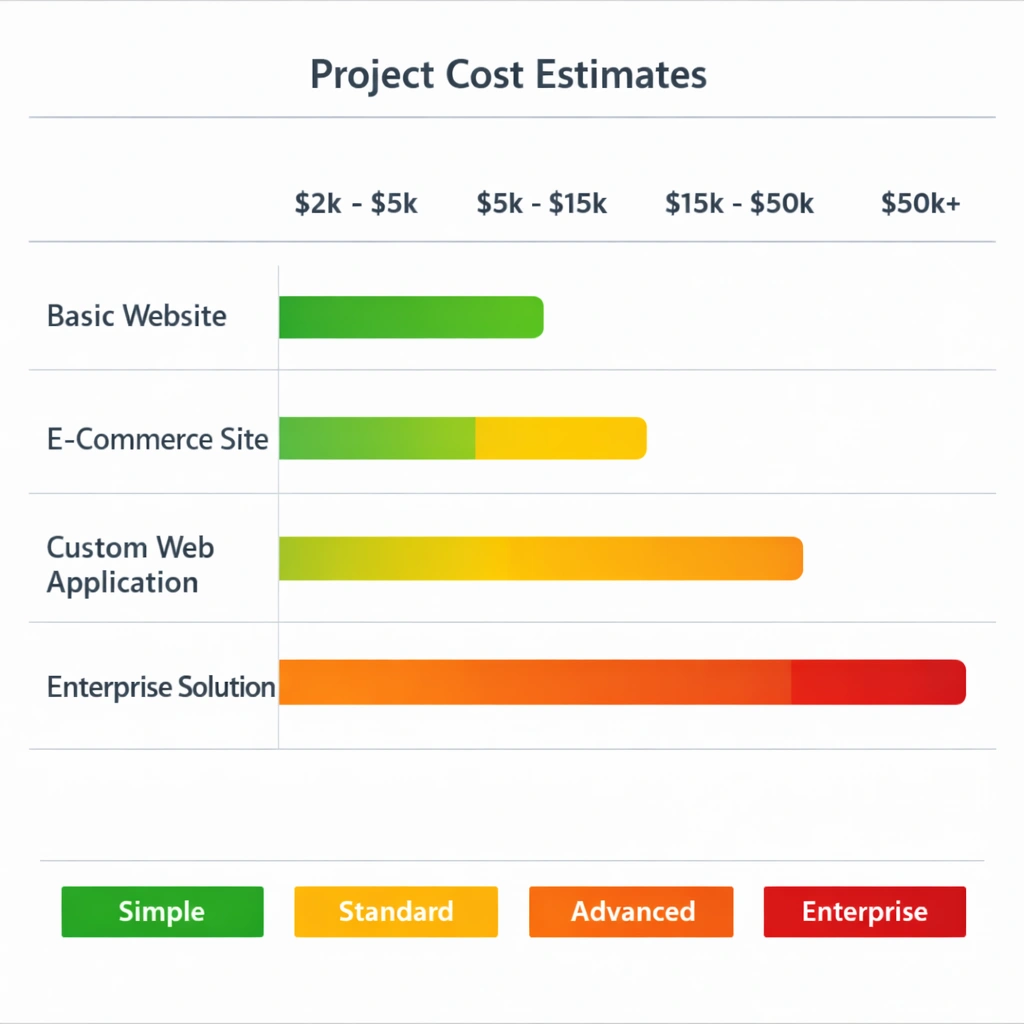
These ranges assume a production-quality build — not a prototype. If a vendor quotes significantly below these ranges for a complex scope, the gap is usually explained by offshore rates, reduced testing, or deferred infrastructure decisions that become your problem later.
4 hidden backend development costs most founders overlook
The quoted price is rarely the final price. Several cost categories consistently catch founders off guard.
Infrastructure and hosting — your backend has to run somewhere. AWS, Google Cloud, and Azure costs for a production SaaS application start around $200 to $500 per month at early stage and scale with usage. This is a recurring backend development cost entirely separate from your build budget.
Third-party service fees — payment processors, authentication providers, email delivery platforms, and monitoring tools each carry their own subscription or usage costs. Budget $300 to $1,000 per month for a standard SaaS stack of external services.
Maintenance and iteration — a backend is not a one-time purchase. After launch, bugs surface, integrations break when third-party APIs update, and new features require backend changes. Plan for 10 to 20 percent of your initial backend development cost annually for ongoing maintenance.
Technical debt remediation — if your MVP was built fast and cheap, scaling it often requires refactoring foundational decisions. This is not a failure; it is a predictable cost of moving fast early. Budget for it before you need it.
How to evaluate whether a backend development cost estimate is fair
When you receive a proposal, four questions will tell you most of what you need to know.
First, is the scope document detailed enough to hold the vendor accountable? Vague deliverables create unlimited revision cycles that inflate your final backend development cost well beyond the original quote.
Second, does the quote include testing, documentation, and deployment — or just code delivery? A quote that excludes these items is cheaper on paper and more expensive in practice.
Third, what is the payment structure? Milestone-based payments aligned to deliverables protect you far better than large upfront retainers.
Fourth, what happens after launch? Understand the handoff process, whether documentation is included, and what ongoing support looks like.
If you want to understand the technical decisions that drive a significant portion of backend development cost — particularly around infrastructure and stack choices — the breakdown of backend technologies worth using in 2026 gives you the context to have more informed conversations with any vendor you evaluate.
Conclusion
Backend development cost is not fixed — it is a function of scope, model, geography, and the specific decisions your team makes before anyone writes a line of code. The founders who get the best outcomes are not the ones who find the cheapest quote. They are the ones who understand enough to evaluate what they are actually buying.
Get your requirements tight, ask the right questions, and treat the pricing conversation as a diagnostic — not just a transaction.