

The stack you choose in month one will follow your product for years. Backend technologies — the programming languages, frameworks, and infrastructure tools your team builds on — determine how fast you can ship, how much you pay to scale, and how easily you can hire. Choosing the wrong one early is expensive to undo.
The broader context of backend development services for growing startups makes clear why stack decisions and service decisions are impossible to separate, and why founders who understand both make better product bets.
Why backend technologies matter more than most founders realize
Most non-technical founders treat the technology stack as a developer preference — something to leave entirely to the engineering team. That instinct is understandable but costly. The backend technologies your team selects have direct consequences for your hiring pool, your infrastructure costs, your time to market, and your ability to scale without a full rewrite.
A startup that builds on an obscure or overly complex stack creates a recruiting problem the moment the founding developer leaves. A team that selects a framework without considering its performance ceiling builds technical debt into the foundation of the product.
Backend technology decisions are business decisions. Understanding the landscape well enough to ask the right questions is a founder responsibility, not just a technical one.
The core categories of backend technologies
Before evaluating specific tools, it helps to understand what you are actually choosing between. Backend technologies fall into four distinct categories, each representing a different layer of your system.
Programming languages — the foundational choice that determines everything downstream: available frameworks, developer availability, performance characteristics, and ecosystem maturity.
Frameworks — structured toolkits built on top of a language that accelerate development by providing pre-built patterns for routing, database interaction, authentication, and more.
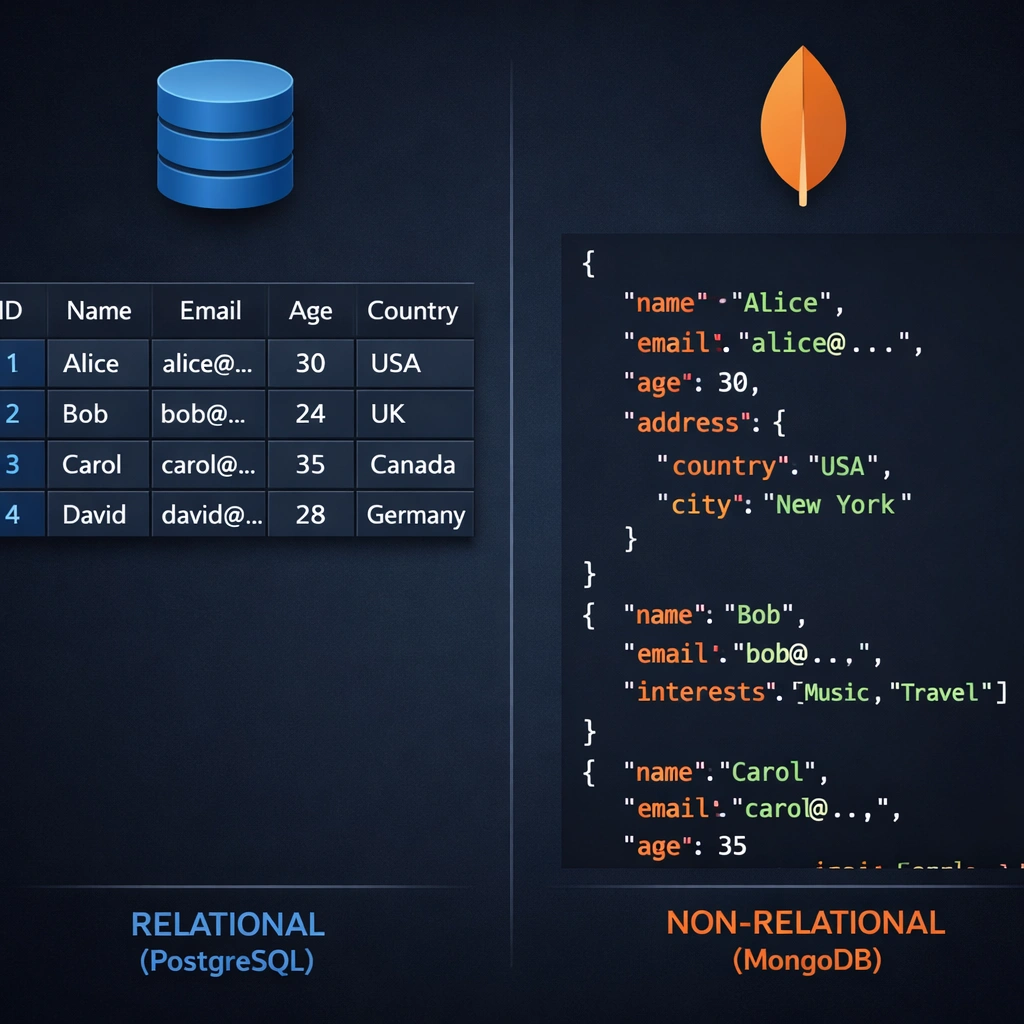
Databases — the storage layer where your application data lives. The choice between relational and non-relational databases, and between specific engines within those categories, has long-term implications for query performance, data integrity, and scalability.
Infrastructure and deployment tools — the platforms and services that host your backend, manage deployments, monitor performance, and handle scaling. This layer sits beneath your application code and increasingly determines your operational costs.
Backend programming languages worth using in 2026
Node.js and JavaScript
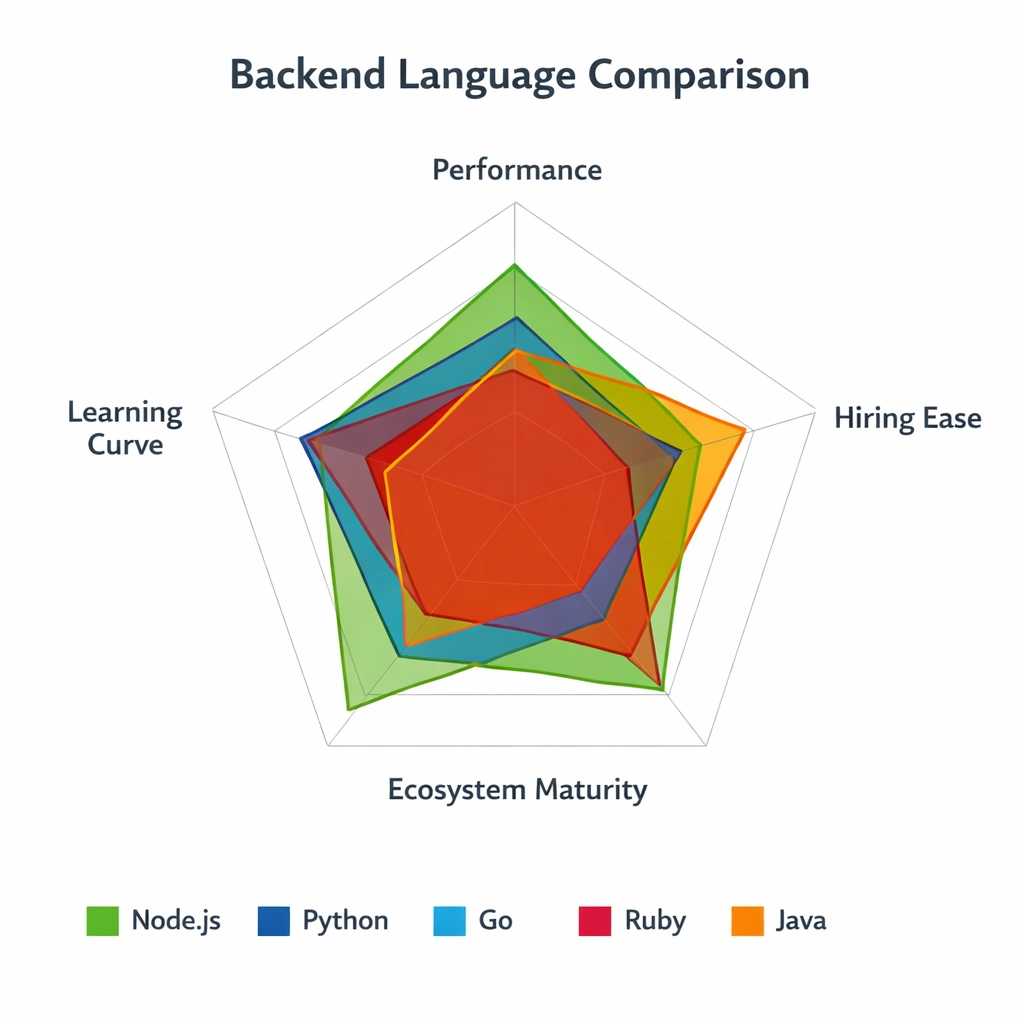
Node.js remains one of the most widely adopted backend technologies in 2026, particularly among startups. Its non-blocking architecture, the ability to use JavaScript across both frontend and backend, and a vast ecosystem of packages through npm make it a practical default for many product types.
It excels in real-time applications — chat systems, live dashboards, collaborative tools — where handling many simultaneous connections efficiently is a core requirement. It is less well-suited for computationally heavy workloads where raw processing speed matters more than concurrency.
Hiring is straightforward. JavaScript developers are abundant, and the transition from frontend to backend work is relatively accessible for experienced JavaScript engineers.
Python
Python’s dominance in data-heavy applications, scripting, and automation has made it a natural choice for SaaS products that involve any degree of data processing, analytics, or workflow automation. Frameworks like Django and FastAPI have matured significantly, and Python’s readability makes onboarding new developers faster than most alternatives.
The trade-off is performance. Python is not the fastest language for raw throughput, and at high traffic volumes, infrastructure costs can run higher than equivalent Node.js or Go implementations. For most early-stage SaaS products, this trade-off is acceptable. At scale, it becomes a real consideration.
Go
Go, developed by Google, has gained serious traction as a backend language for performance-critical systems. It compiles to a single binary, starts fast, handles concurrency natively, and produces infrastructure that runs lean. Companies building high-throughput APIs, microservices architectures, or systems where latency directly affects user experience increasingly reach for Go.
The hiring pool is smaller than JavaScript or Python, and the learning curve is steeper for developers coming from interpreted languages. For a startup at MVP stage, Go is often overkill. For a startup that knows it is building for extreme scale from the outset, it is worth the investment.
Ruby
Ruby, primarily through the Rails framework, remains a productive choice for startups prioritizing development speed over raw performance. Rails enforces strong conventions that let small teams move quickly, and its ecosystem is mature and well-documented.
Its adoption has declined relative to its peak, which has implications for hiring in some markets. But for founders who need to build fast and iterate faster, Rails is still a legitimate choice — particularly for CRUD-heavy SaaS products where the business logic is more complex than the infrastructure requirements.
Backend frameworks to evaluate in 2026
Frameworks sit on top of your language choice and shape the day-to-day development experience. Here is how the major options compare across the languages most relevant to startups.
Express.js (Node.js) — minimal and unopinionated. Gives developers maximum flexibility at the cost of requiring more architectural decisions upfront. Best for teams that know what they are building and want control over structure.
NestJS (Node.js) — opinionated and structured, inspired by enterprise patterns. Strong choice for larger teams or complex SaaS products where consistency and maintainability matter more than startup speed.
Django (Python) — batteries-included framework with built-in authentication, admin interfaces, and ORM. Strong default choice for data-heavy applications and teams that value convention over configuration.
FastAPI (Python) — modern, fast, and built for API-first development. Handles asynchronous operations natively and produces automatic API documentation. Increasingly popular for SaaS products with complex API layers.
Ruby on Rails — as discussed above, the gold standard for rapid SaaS development when development velocity is the primary constraint.
Database technologies: the decision that outlasts everything else
Of all backend technology choices, database selection tends to have the longest-lasting consequences. Migrating a production database at scale is one of the most operationally painful exercises in software engineering.
Relational databases
PostgreSQL is the dominant choice for new SaaS products in 2026. It is open source, handles complex queries efficiently, supports JSON storage for flexible data structures, and has exceptional tooling and community support. For most startup use cases, PostgreSQL is the correct default.
MySQL remains widely used, particularly in legacy systems and within the WordPress ecosystem, but new projects increasingly choose PostgreSQL for its feature depth and standards compliance.
Non-relational databases
MongoDB is the most widely adopted non-relational database, suited for applications where data structure is variable or evolving rapidly. It stores data as documents rather than rows, which makes schema changes less painful during early product development.
Redis, a fast in-memory data store, is used less as a primary database and more as a caching layer — storing frequently accessed data in memory to reduce load on your primary database and accelerate response times.
Infrastructure and deployment: the layer most founders underestimate
Your backend code runs on infrastructure, and the infrastructure decisions you make early determine your operational costs, your deployment complexity, and your ability to scale without incident.
AWS remains the most comprehensive cloud platform available, with the broadest service catalog and the deepest documentation. For startups with technical teams comfortable navigating its complexity, AWS offers unmatched flexibility. For teams without dedicated infrastructure experience, its breadth can become a liability.
Google Cloud Platform offers strong performance for data-intensive workloads and deep integration with data and analytics services. A natural fit for products built heavily on Python and data pipelines.
Railway, Render, and Fly.io represent a newer generation of deployment platforms designed to reduce infrastructure complexity without sacrificing control. For early-stage startups that want production-grade deployment without a dedicated DevOps function, these platforms have become increasingly viable alternatives to raw AWS or GCP.
Understanding how infrastructure choices affect your total backend development cost is covered in depth in the backend development cost breakdown for 2026, including how cloud platform selection affects your monthly operating expenses as you scale.
How to choose backend technologies for your specific product
The right stack is not the most popular stack. It is the one that best matches your product requirements, your team’s existing skills, your hiring market, and your growth trajectory.
Four questions sharpen the decision.
What are your performance requirements at scale? If you are building a real-time system or expect high concurrent user volumes early, this should drive language and framework selection before anything else.
What does your hiring market look like? A technically superior stack that is difficult to hire for is a strategic liability. Choose technologies with strong developer communities in the markets where you recruit.
What is your team’s current expertise? The best backend technologies are often the ones your team already knows well. A productivity advantage from familiarity frequently outweighs marginal technical advantages from switching.
What does your data model look like? The structure, volume, and relationships in your data should drive your database selection — not convention, and not the recommendation of a vendor with a preferred tool.
If you are working with an outsourced team and want to evaluate whether their technology recommendations align with your product requirements, the guide to outsourcing backend development without losing control gives you the framework to have that conversation on equal footing.
Conclusion
Backend technologies are not interchangeable, and the decision is not purely technical. The stack your product runs on shapes your hiring strategy, your infrastructure costs, your development velocity, and your ability to scale. Understand the landscape well enough to evaluate the choices being made on your behalf — even if you never write a line of code yourself.