

Choosing between building internally and going external is one of the highest-stakes decisions a non-technical founder will make. When you outsource backend development without a clear framework, you risk losing control of your codebase, your timelines, and your technical roadmap. But done right, it can compress your time to launch by months.
The decision framework behind backend development services for growing startups shows exactly where outsourcing wins and where it quietly drains your budget before you notice.
Why founders choose to outsource backend development
The decision to outsource backend development is rarely about laziness or cutting corners. For most early-stage founders, it is a rational response to three real constraints.
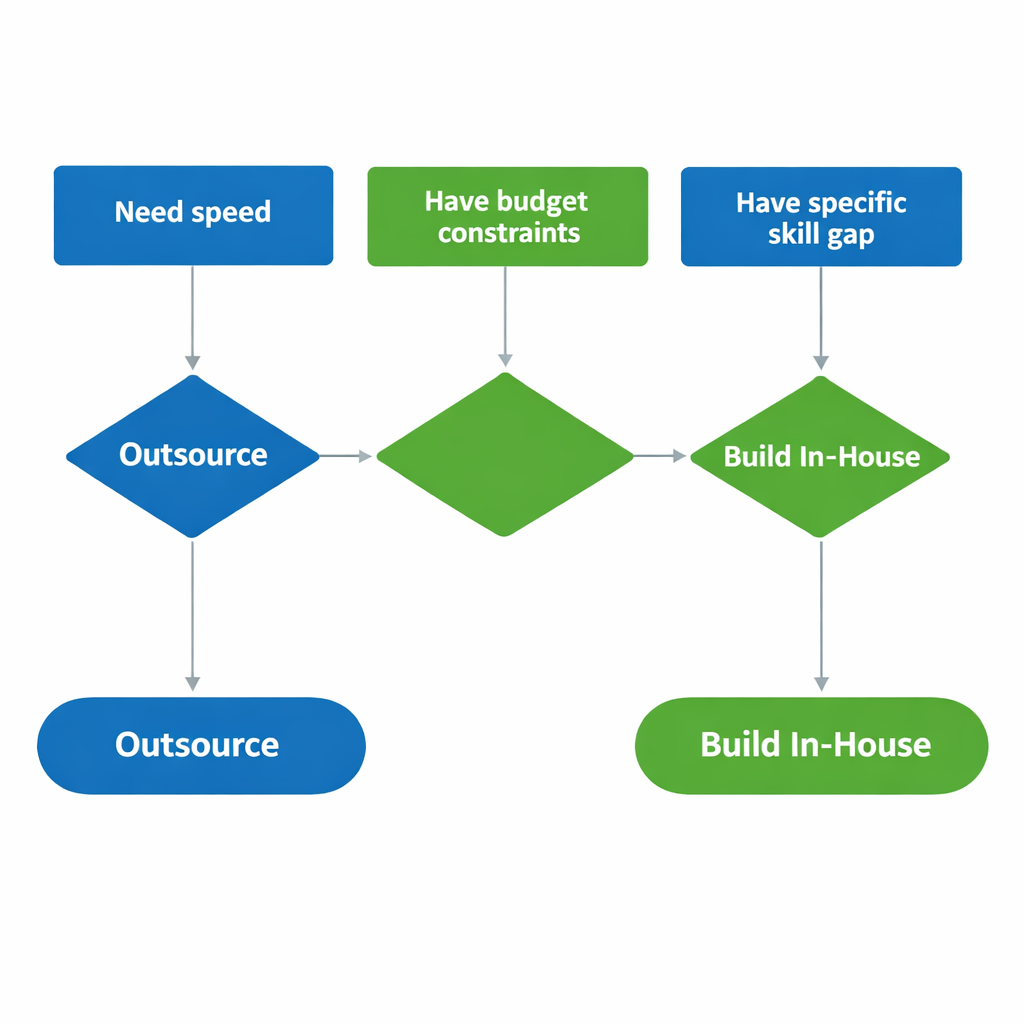
Speed — building an internal engineering team takes months. Recruiting, interviewing, onboarding, and ramping up a backend developer in-house adds three to six months before a single line of production code ships. An experienced outsourced team can start within weeks.
Cost efficiency at early stage — as covered in the backend development cost breakdown for 2026, a senior backend engineer in the US costs $150,000 to $200,000 per year before benefits. An outsourced team delivering the same output often runs at a fraction of that cost, particularly when working with talent in Eastern Europe, Latin America, or Southeast Asia.
Access to specialized skills — some backend problems require expertise that is genuinely rare. Payment infrastructure, real-time systems, high-availability architecture — finding this talent locally, affordably, and quickly is often not realistic for a startup that is not yet at Series A.
These are legitimate reasons. The risk is not in the decision to outsource. The risk is in how it is executed.
When it makes sense to outsource backend development
Not every startup should outsource, and not every project type is equally well-suited to an external team. Here is where outsourcing backend development tends to deliver strong results.
Building a defined MVP
If you have a clear product specification, a fixed feature set, and a defined timeline, outsourcing is well-suited to the task. The scope is bounded, the deliverable is concrete, and the engagement has a natural endpoint. This is where outsourced teams operate most efficiently.
Filling a specific technical gap
If your in-house team has frontend strength but no backend depth, outsourcing the backend layer specifically — API development, database architecture, or infrastructure setup — is a clean and practical model. You maintain ownership of the product direction while bringing in execution capacity where you need it.
Launching in a compressed timeline
When market conditions or investor timelines create pressure to ship fast, outsourcing gives you access to a team that is already organized, already equipped, and already practiced at delivering backend systems. The ramp-up time is weeks, not months.
When you should not outsource backend development
The decision to outsource backend development deserves the same scrutiny as the decision to hire. There are situations where outsourcing creates more problems than it solves.
When your backend is your core product differentiator
If the technical architecture of your backend is what makes your product uniquely valuable — a proprietary data processing engine, a custom matching algorithm, a novel infrastructure approach — outsourcing it means your competitive advantage lives outside your organization. That is a strategic vulnerability, not just an operational inconvenience.
When requirements are undefined or rapidly changing
Outsourced teams price and plan based on scope. If your product direction is still being discovered, an external team will either over-charge to cover scope uncertainty or under-deliver when requirements shift. Both outcomes are expensive. Outsourcing works best when you know what you are building.
When you have no internal technical oversight
This is the most common and most costly mistake founders make. Outsourcing backend development without anyone internally capable of reviewing code quality, assessing architectural decisions, or catching scope creep is a significant risk. You do not need a full-time CTO, but you need someone who can ask the right questions and evaluate the answers.
The 3 outsourcing models and what each one actually means
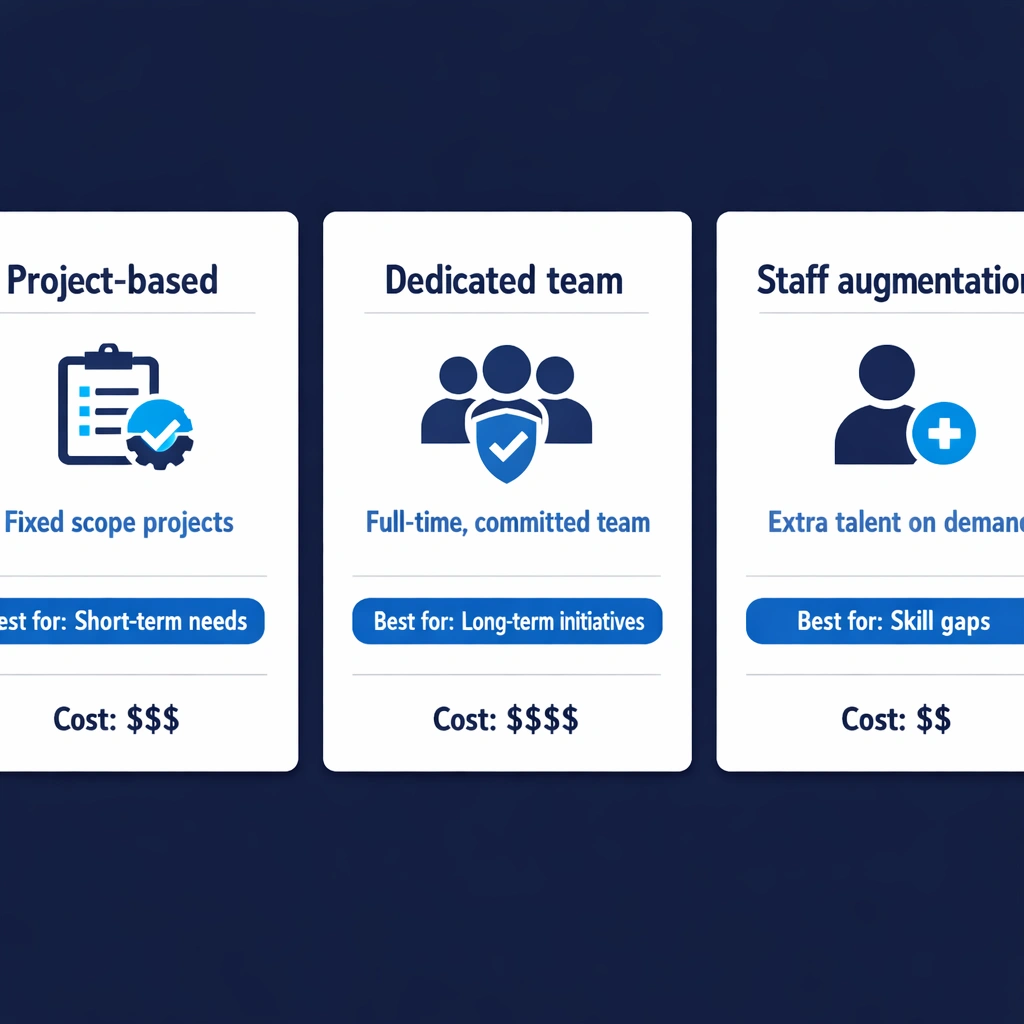
When people say they want to outsource backend development, they are often describing three very different arrangements.
Project-based outsourcing — you define a deliverable, agree on a price, and the vendor delivers. Clean handoff, fixed budget, defined timeline. Works well for MVPs and standalone backend builds. Risk: if the spec is loose, the output will be too.
Dedicated team model — you contract a team of developers who work exclusively on your product, managed either by the vendor or by you. More flexible than project-based, more expensive, and better suited for products under active development. This is effectively a remote in-house team with less administrative overhead.
Staff augmentation — you bring in individual developers to work alongside your existing team on a contract basis. You get flexibility and speed without committing to a full-time hire. Works best when you already have technical leadership in place to direct the work.
How to outsource backend development without losing control
Control is the central concern for every founder who has considered and then hesitated on outsourcing. Here is how to structure the engagement so that control stays with you.
Own the repository from day one. Your codebase should live in a version control system — GitHub, GitLab, or Bitbucket — that you own and administer. The vendor contributes to your repository. You never work in theirs.
Require documented architecture decisions. Every significant technical choice — database selection, API design pattern, authentication approach — should be documented in writing before it is built. This protects you during handoffs and gives you a record of the reasoning behind each decision.
Build in milestone-based reviews. Do not wait until the end of an engagement to evaluate quality. Structure your contract around two-week delivery cycles with defined outputs at each milestone. This surfaces problems early, when they are still cheap to fix.
Define ownership of third-party credentials. Every API key, cloud account, and service subscription used in your backend should be registered to your business — not to the vendor. This is non-negotiable.
If you are evaluating specific vendors and want a structured framework for the selection process, the guide to choosing a backend development agency without regrets walks through every criterion worth applying before you sign a contract.
What to look for in an outsourced backend development partner
Not all outsourced teams are created equal, and the signals that matter are not always the most visible ones.
A strong outsourced backend team will ask detailed questions about your data model and traffic expectations before quoting. They will propose a discovery phase before committing to a fixed price. They will have a documented process for code review, testing, and deployment. And they will be able to explain their technology recommendations in plain language without deflecting technical questions.
A team that quotes immediately based on a one-paragraph brief, cannot explain why they recommend a specific stack, or has no documented handoff process is telling you something important about how the engagement will go.
For founders who also want to evaluate whether the technologies being proposed are current and appropriate for their product stage, the breakdown of backend technologies worth using in 2026 gives you the reference points to have that conversation with confidence.
Conclusion
The decision to outsource backend development is not inherently risky — poorly structured outsourcing is. When you enter the engagement with a defined scope, clear ownership of your assets, milestone-based accountability, and at least some internal technical oversight, outsourcing becomes a legitimate growth accelerator rather than a liability.
Know what you are building, know what you are signing, and know who owns what when the engagement ends.