

Choosing between backend as a service and custom backend development is one of the most consequential early product decisions a founder makes — and most get it wrong not because they chose poorly, but because they chose without a clear framework backend as a service .
The full picture of backend development services for growing startups makes clear that this is not a question of which option is better in the abstract. It is a question of which option is better for your specific product, at your specific stage, with your specific constraints.
What backend as a service actually means
Backend as a service, commonly abbreviated as BaaS, refers to cloud-based platforms that provide pre-built backend infrastructure as a managed service. Instead of building your own server logic, database architecture, and authentication system from scratch, you connect to a platform that handles those layers for you through an SDK, a software development kit that gives your frontend app direct access to backend functionality.
The most widely used BaaS platforms in 2026 include Firebase, Supabase, AWS Amplify, and Appwrite. Each provides some combination of the following out of the box: user authentication, real-time database access, file storage, serverless functions, and hosting.
The core value proposition is speed. A frontend developer with no backend experience can connect a BaaS platform to a React or Flutter app and have user authentication, data storage, and file uploads working in hours — not days or weeks.
What custom backend development actually means
Custom backend development means building your server-side infrastructure from the ground up, using a programming language and framework chosen to match your product requirements. Your team — in-house or outsourced — designs the database schema, writes the API logic, implements the authentication system, and manages the infrastructure backend as a service.
Nothing is pre-built. Everything is intentional.
The trade-off for that intentionality is time and cost. A custom backend takes longer to build than a BaaS implementation. It requires more technical expertise to architect correctly. And it carries more early-stage risk, because the quality of what you end up with is directly proportional to the quality of the decisions made along the way.
The payoff is control, flexibility, and a system that can be shaped precisely to your product requirements — without the constraints that every managed platform eventually imposes.
Where backend as a service genuinely wins
BaaS platforms are not a compromise. For specific use cases and product stages, they are the objectively correct choice.
Early-stage validation
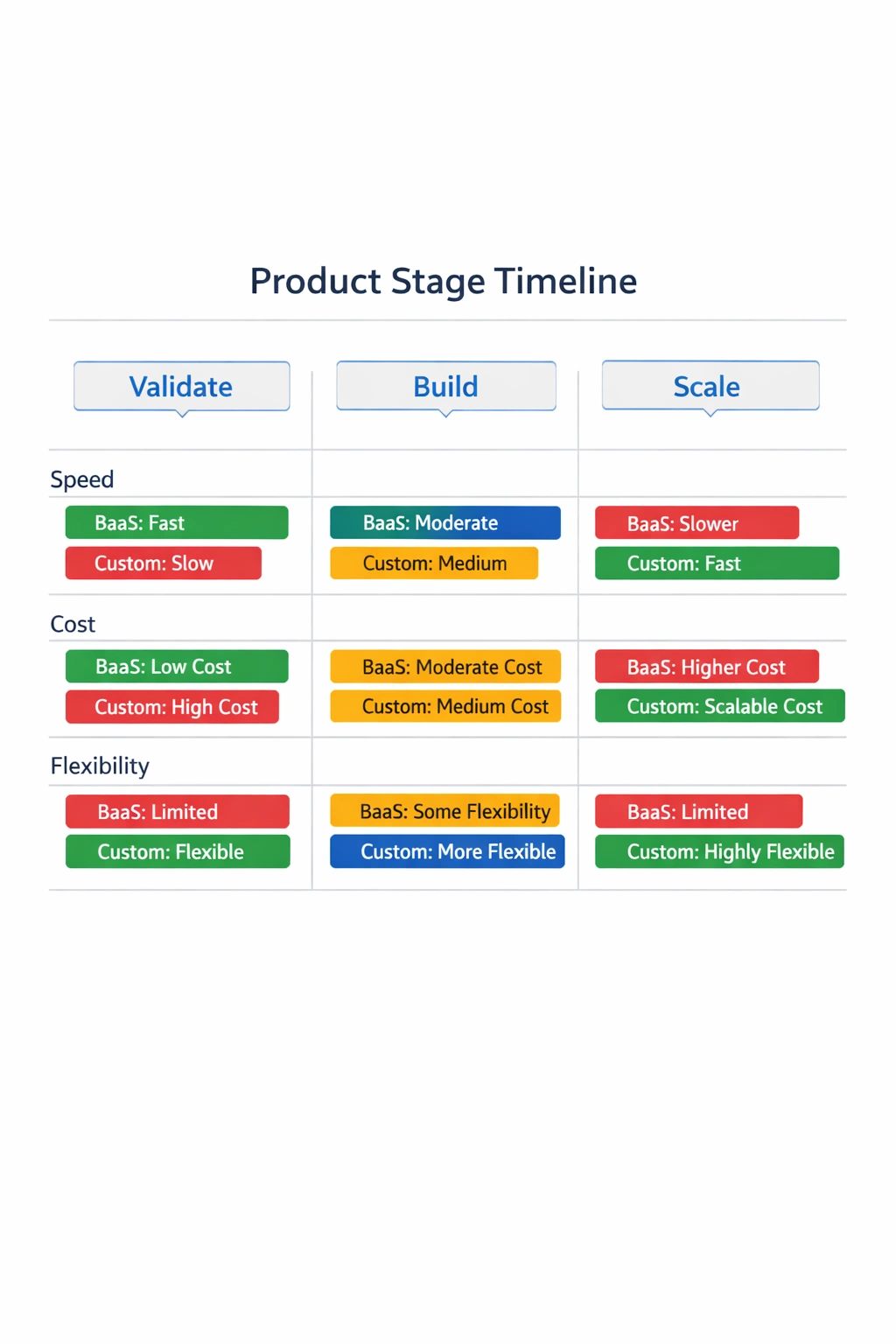
If you are building a product to validate a hypothesis — not to scale, not to impress enterprise buyers, but to find out whether people want what you are building — backend as a service lets you move at a speed that custom development cannot match. You can test, iterate, and pivot without carrying the overhead of a full backend engineering function.
At this stage, the cost of building custom is not just financial. It is the opportunity cost of the weeks you spend on infrastructure that may be irrelevant if the product direction changes.
Small teams without backend expertise
A two-person founding team where both founders have frontend or product backgrounds can ship a functional, production-ready application on a BaaS platform without hiring a backend engineer. Firebase or Supabase can handle authentication, data storage, and basic API functionality well enough to get to first revenue.
This is not a permanent solution for most products. But it is a legitimate path to traction that does not require solving a hiring problem before you have validated the business.
Standard feature sets with no differentiation in the backend
If your product’s competitive advantage lives in the user experience, the content, the distribution strategy, or the business model — and not in the backend architecture — then a BaaS platform delivers everything you need at a fraction of the cost and time of building custom.
A content platform, a simple marketplace, a community tool, or an internal business application rarely needs a custom backend to succeed. Using BaaS for these products is not a shortcut. It is an appropriate allocation of engineering resources toward the layers that actually differentiate your product.
Where custom backend development wins
BaaS platforms have real ceilings. The founders who run into them are usually the ones who chose BaaS for the right reasons early and then held on too long.
Complex or proprietary business logic
When your product’s core behavior — the rules, calculations, workflows, and decision trees that make it valuable — requires logic that a pre-built platform cannot express cleanly, you need custom. BaaS platforms are optimized for standard patterns. The moment your requirements deviate significantly from those patterns, you are working against the platform rather than with it.
Specific performance or scalability requirements
BaaS platforms abstract infrastructure management away from you, which is convenient until you need to optimize for performance at scale. If your product handles high-concurrency workloads, requires sub-100ms response times, or processes large volumes of data in real time, a managed platform may not give you the control needed to hit those benchmarks.
Custom backends can be tuned, profiled, and optimized at every layer. BaaS platforms give you configuration options within a defined envelope — and outside that envelope, your options are limited.
Data sovereignty and compliance requirements
Enterprise buyers, regulated industries, and products handling sensitive personal data often require specific guarantees about where data is stored, how it is accessed, and who can see it. HIPAA compliance, GDPR data residency requirements, and SOC 2 certification are significantly harder — sometimes impossible — to achieve cleanly on a shared managed platform.
If your go-to-market strategy involves selling to healthcare, finance, legal, or government buyers, a custom backend with full infrastructure control is often a prerequisite, not an option.
Long-term cost at scale
BaaS pricing models are designed to be accessible at low usage and profitable at high usage. Firebase’s read and write costs, for example, can become significant at scale in ways that are difficult to predict early. A custom backend running on AWS or Google Cloud, designed efficiently, frequently becomes more cost-effective than BaaS once monthly active users reach a meaningful threshold.
Understanding the full cost trajectory of each model — including the infrastructure costs that accumulate over time — is covered in detail in the backend development cost breakdown for 2026.
The hybrid approach: what it looks like in practice
The choice between backend as a service and custom development is not always binary. Many production SaaS products in 2026 run on hybrid architectures — using a BaaS platform for commodity functionality while building custom logic where it matters backend as a service.
A common pattern looks like this: Supabase handles authentication and basic database operations. A custom API layer, built in Node.js or Python, sits on top and handles the proprietary business logic, third-party integrations, and any performance-sensitive operations. The BaaS layer reduces development time for standard features. The custom layer protects the product’s technical differentiation.
This approach requires more architectural discipline than a pure BaaS implementation, and more technical judgment than a fully custom build. But for startups moving from validation to growth, it often represents the most pragmatic path — capturing the speed advantages of managed infrastructure without surrendering control of the layers that matter most.
How to decide which model fits your product right now
Four questions frame the decision clearly.
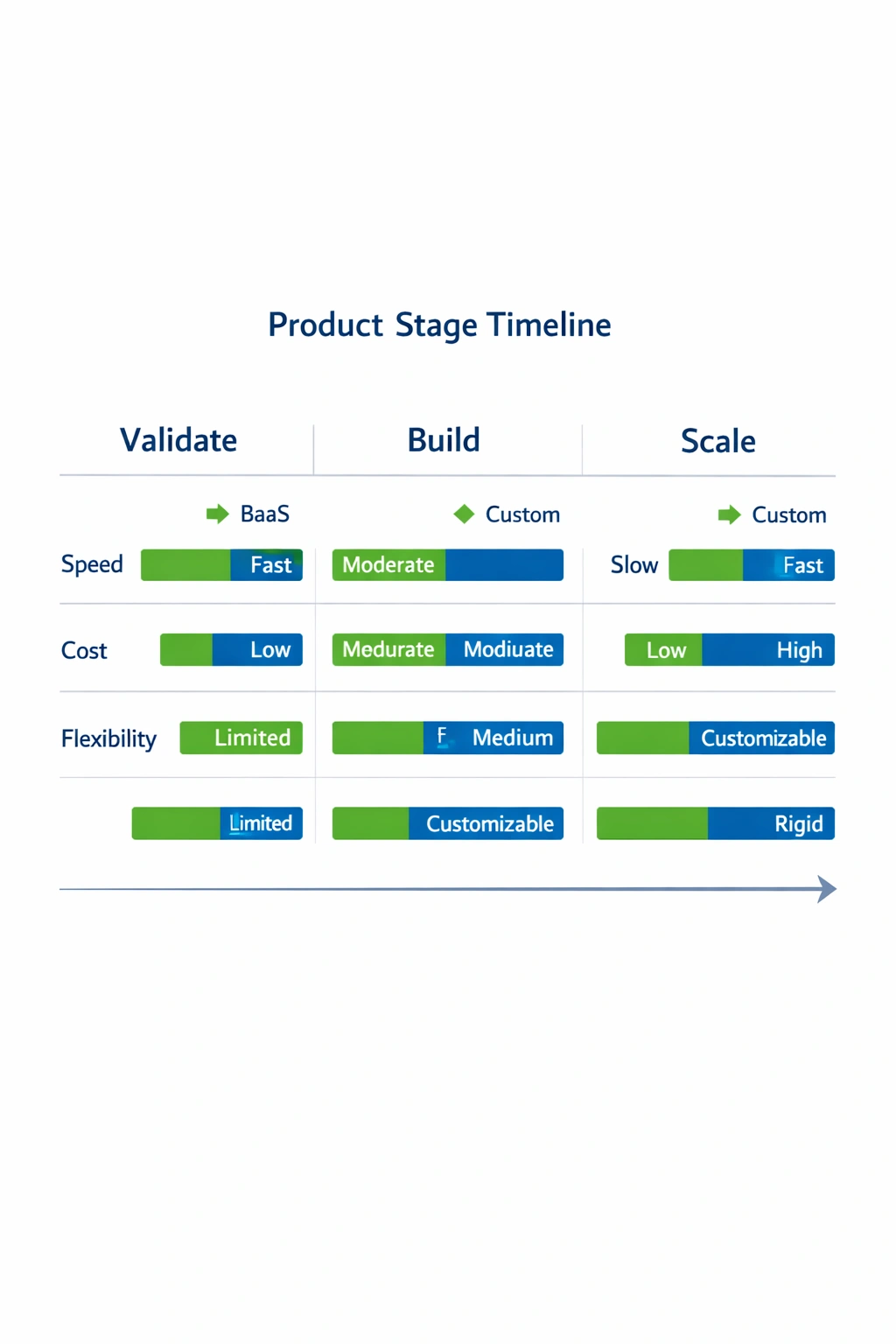
What is your current stage? If you are pre-revenue or pre-product-market fit, the speed advantages of BaaS almost always outweigh its limitations. If you are post-traction and preparing to scale, the calculus shifts.
Where does your product’s technical differentiation live? If the answer is “in the backend logic,” build custom from the start or plan a migration early. If the answer is anywhere else, BaaS buys you time and resources to invest where differentiation actually happens.
What are your compliance and data requirements? This question often resolves the decision immediately for regulated industries. Know your requirements before you choose a platform.
What does your technical team look like? A team with strong backend engineering capability can execute a custom build efficiently. A team without that capability will spend more time fighting a custom backend than building product. Match the model to the team, not the ideal team you plan to hire.
If you are evaluating vendors or agencies to execute either approach, the guide to choosing a backend development agency without regrets gives you a structured framework for assessing whether a team is equipped to recommend and deliver the right architecture for your specific situation.
And if you are considering whether to outsource the backend build entirely — whether BaaS, custom, or hybrid — the comparison of outsourcing vs. in-house backend development walks through the structural trade-offs before you commit to either path.
Conclusion
Backend as a service and custom backend development are not competing philosophies. They are tools suited to different problems at different stages. The founders who get this decision right are the ones who evaluate it against their actual product requirements, their actual team capabilities, and their actual growth trajectory — not against a general opinion about which approach is more legitimate.
Start with what moves you fastest toward validation. Build custom where your product’s value depends on it. And revisit the decision as your product and your requirements evolve.