

There is a specific kind of exhaustion that comes from running a business without a system. You are working long hours, your team is busy, projects are moving — and yet deadlines still slip, clients still feel surprised by delays, and you still end the quarter wondering where the time and budget went Project management for small businesses.
The problem is rarely effort. Most entrepreneurs and their teams work hard. The problem is structure — or more precisely, the absence of it. When work is managed through instinct, habit, and memory rather than a repeatable system, the same failures recur on every project regardless of how experienced the team becomes.
Project management for small businesses is the discipline that replaces instinct with structure. It does not require a dedicated project manager on staff, a suite of expensive software, or a certification from a professional body. It requires a clear understanding of how projects work, a set of practical tools and frameworks, and the discipline to apply them consistently.
This guide covers everything a small business owner needs to build that system — from foundational concepts to methodology selection, tool choice, planning frameworks, and the templates that make the whole operation repeatable. Each section addresses a specific layer of the problem, and together they form a complete operational blueprint for delivering projects reliably, at any scale.
What project management really means for small business owners
Most definitions of project management come from enterprise contexts — large organizations with dedicated program offices, formal governance structures, and teams whose entire job is managing the management of work. That framing makes the discipline feel inaccessible to a ten-person business, which is why most small business owners never fully adopt it.
The reality is simpler. Project management for small businesses means applying enough structure to your work that projects get delivered predictably — on time, within budget, and at the quality level your clients and stakeholders expect. The tools and frameworks you use to achieve that are secondary to the habit of actually applying them.
At its core, every project your business runs shares the same fundamental structure. There is a goal. There is a set of tasks required to reach that goal. There are people responsible for those tasks. There are resources — time, money, people — available to complete them. And there is a deadline. Project management is the practice of aligning those elements deliberately rather than letting them collide through improvisation Project management for small businesses.
The five phases that every project moves through
Regardless of industry, project size, or team structure, every project follows a predictable lifecycle. Understanding these phases helps you know what decisions to make at each stage and where most projects go wrong.
Initiation is where the project is defined at a high level. The goal is established, the key stakeholders are identified, and the project is evaluated for feasibility before any resources are committed. This is where scope — the boundaries of what the project includes and excludes — is set for the first time.
Planning is where the project is converted from a goal into an actionable blueprint. Tasks are broken down, ownership is assigned, timelines are built, risks are identified, and a communication structure is established. Planning is the phase most small businesses rush through, and it is where most project failures originate.
Execution is where the team carries out the work. The project manager’s role in this phase is to keep work moving, resolve blockers — obstacles that prevent a task from progressing — and maintain communication between all parties involved.
Monitoring and controlling runs parallel to execution. It involves tracking actual progress against the plan, identifying variances early, and making adjustments before small deviations compound into major delays.
Closure is the phase most small businesses skip entirely. It involves formally completing the project, documenting lessons learned, and delivering the final output to the client or stakeholder. Skipping closure means the same mistakes repeat on the next project because nobody captured what went wrong or what worked well.
Why the absence of project management costs more than you think
The cost of unmanaged projects is rarely visible as a single line item. It shows up as overtime hours spent recovering from a missed deadline. It shows up as a client relationship that soured because of a communication gap. It shows up as a team member who burns out after carrying a project that was scoped unrealistically from the start.
According to PMI’s research, a significant percentage of project investment is wasted due to poor project performance globally each year — and that figure is disproportionately higher in organizations that underinvest in project management practices. For small businesses operating on tighter margins, the impact of a single failed project can be substantial.
The triple constraint — the relationship between scope, time, and cost — is the framework that makes this visible. Every project lives inside these three boundaries. Changing one affects the other two. A client who wants to expand the scope of a project mid-engagement is not just requesting more work — they are requesting either more time, more budget, or a reduction in quality somewhere else. Understanding the triple constraint gives you the language to have that conversation professionally and set expectations clearly.
For a deeper breakdown of these foundational concepts, including the core vocabulary every project manager needs and how these principles apply to everyday business operations, what is project management? a no-fluff breakdown for first-time managers covers each element in practical terms built specifically for entrepreneurs.
Choosing the right project management software for your team
The tool you use to manage projects shapes how your team thinks about projects. A platform that makes work visible, ownership clear, and progress trackable changes the daily behavior of everyone on the team — not because it forces them to work differently, but because it makes the right way to work the path of least resistance.
Choosing the wrong tool produces the opposite effect. A platform that is too complex creates friction that teams quietly work around. A platform that is too simple gets abandoned the moment project complexity grows beyond what it can handle. A platform that nobody logs into consistently is worse than no platform at all, because it creates the illusion of a system while work continues to be managed through email threads and memory.
For small business owners, the software decision deserves more deliberation than it typically gets — and less anxiety than most comparison articles generate Project management for small businesses.
What the right tool actually needs to do
Before evaluating specific platforms, it helps to define the functional requirements that any project management tool needs to meet for a small business context. There are four of them.
Task visibility means every team member can see all active tasks, their current status, their owner, and their deadline without sending a message to ask. Visibility eliminates the category of problems caused by people not knowing what is happening on a project they are part of.
Ownership clarity means every task has exactly one person responsible for its completion. Not a team. Not two people. One person. Tools that allow tasks to exist without an assigned owner are tools that will accumulate unowned tasks until a deadline forces a conversation that should have happened at assignment.
Communication context means discussions about a task happen inside that task, attached to the relevant work rather than scattered across a separate messaging platform. When the conversation about a deliverable lives next to the deliverable, new team members can get up to speed without a briefing, and decisions are documented automatically.
Progress reporting means the project manager can generate a clear picture of what is on track, what is at risk, and where bottlenecks are forming without manually collecting status updates from each team member. A tool that requires the project manager to chase status is a tool that adds workload rather than reducing it.
The platforms worth considering in 2026
The project management software market is crowded, but the options that consistently perform well for small teams cluster around five platforms, each with a distinct strength and a distinct trade-off.
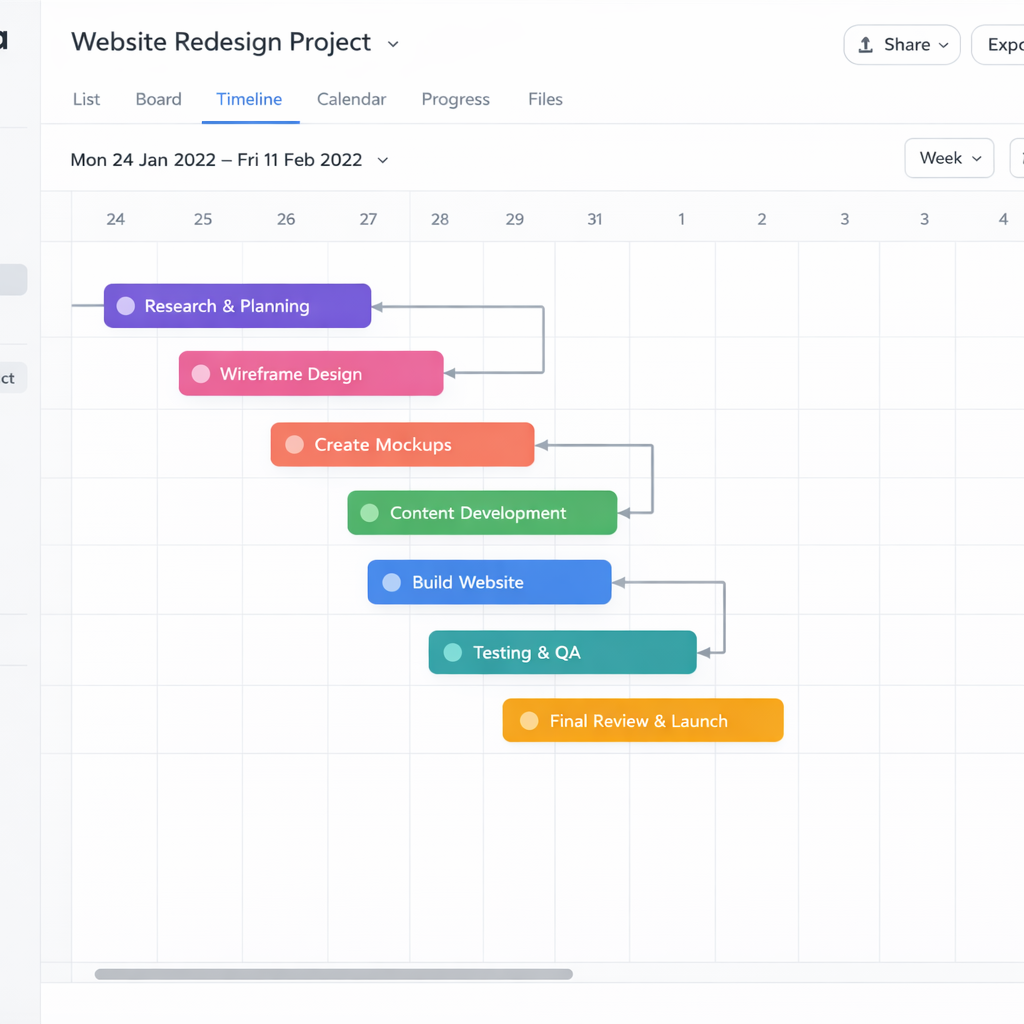
Asana remains one of the most mature and flexible options available. Its ability to display the same project as a list, a board, a timeline, or a calendar — without losing any underlying data — makes it adaptable to teams with different working styles. The free plan supports up to fifteen users and covers the core functionality most small businesses need. Paid tiers unlock automation, portfolio views, and advanced reporting.
Monday.com positions itself as a work operating system rather than a pure project management tool. Its visual interface is among the most intuitive in the category, and its automation builder is genuinely accessible for non-technical users. It works particularly well for teams that want to manage projects, track client relationships, and run internal processes from a single platform. Pricing is per seat with a minimum of three users.
ClickUp is the most feature-dense option and offers the most generous free plan in the category. For entrepreneurs who want a single tool to replace their task manager, document editor, goal tracker, and time tracker, ClickUp makes a credible case. The trade-off is a steeper learning curve — new users benefit from starting with a minimal configuration and adding complexity only when a specific problem demands it.
Notion sits at the intersection of project management and knowledge management. It is not the strongest pure project management platform on this list, but for small teams that need structured documentation alongside basic project tracking, it fills a unique gap. Its recent updates have meaningfully improved its project tracking capabilities, though teams with complex dependencies and timeline requirements will likely find Asana or ClickUp more capable.
Trello is the simplest entry point in the category and the right choice for solo entrepreneurs or very small teams running straightforward, linear workflows. Its kanban board — columns of cards moving from left to right as work progresses — is immediately understandable without training. It does not scale well into complex multi-project environments, but as a starting point for teams piloting a project management system for the first time, it delivers high adoption with minimal friction.
How to make the decision without overthinking it
The decision framework is simpler than most comparison articles suggest. Four questions narrow the field quickly.
How many people need access? Under five people, nearly every platform on this list works at a reasonable cost. Above ten, per-seat pricing starts to differentiate options meaningfully — ClickUp’s free plan and Asana’s competitive pricing become more relevant at that scale Project management for small businesses.
How complex are your projects? Projects with multiple phases, parallel workstreams, and task dependencies require timeline and dependency features. Asana and ClickUp handle these well. Projects that are relatively linear and sequential can be managed effectively in Trello or Notion.
How technical is your team? Teams with limited comfort around new software will adopt Monday.com or Trello more readily. Teams comfortable with configuration will find ClickUp’s depth an asset rather than a burden.
What is your budget? Every platform on this list has a free tier worth testing before any purchasing decision is made. Run a real project on the free plan for two to three weeks before committing to a subscription. The hands-on experience will tell you more than any feature comparison matrix.
The methodology your team uses also influences which tool fits best — a point developed in detail in agile project management: why most small teams get it wrong, where specific frameworks are matched to the platforms that support them most naturally.
For a complete side-by-side evaluation of each platform including pricing breakdowns and use-case recommendations, best project management software for small teams in 2026 covers every option your business is likely to consider.
Project management methodologies — choosing the right approach for your business
Having the right tool is only part of the equation. The methodology — the structured approach that determines how your team organizes, executes, and delivers work — is what gives the tool its operational logic. A great platform with no methodology produces a well-organized mess. A clear methodology with no supporting tool produces a system that exists on paper and nowhere else.
For small business owners, methodology selection is one of the most consequential decisions in building a project management practice — and one of the least discussed. Most entrepreneurs default to whatever approach feels natural, which is usually a loose version of whatever they experienced at a previous job, adapted imperfectly to a context it was never designed for.
The goal of this section is not to make you a methodology expert. It is to give you enough clarity to choose an approach that matches how your business actually operates and how your clients actually need to receive work.
The three methodology families every entrepreneur should understand
Project management methodologies fall into three broad families. Each one represents a different philosophy about how work should be organized and delivered, and each one performs well in specific contexts and poorly in others.
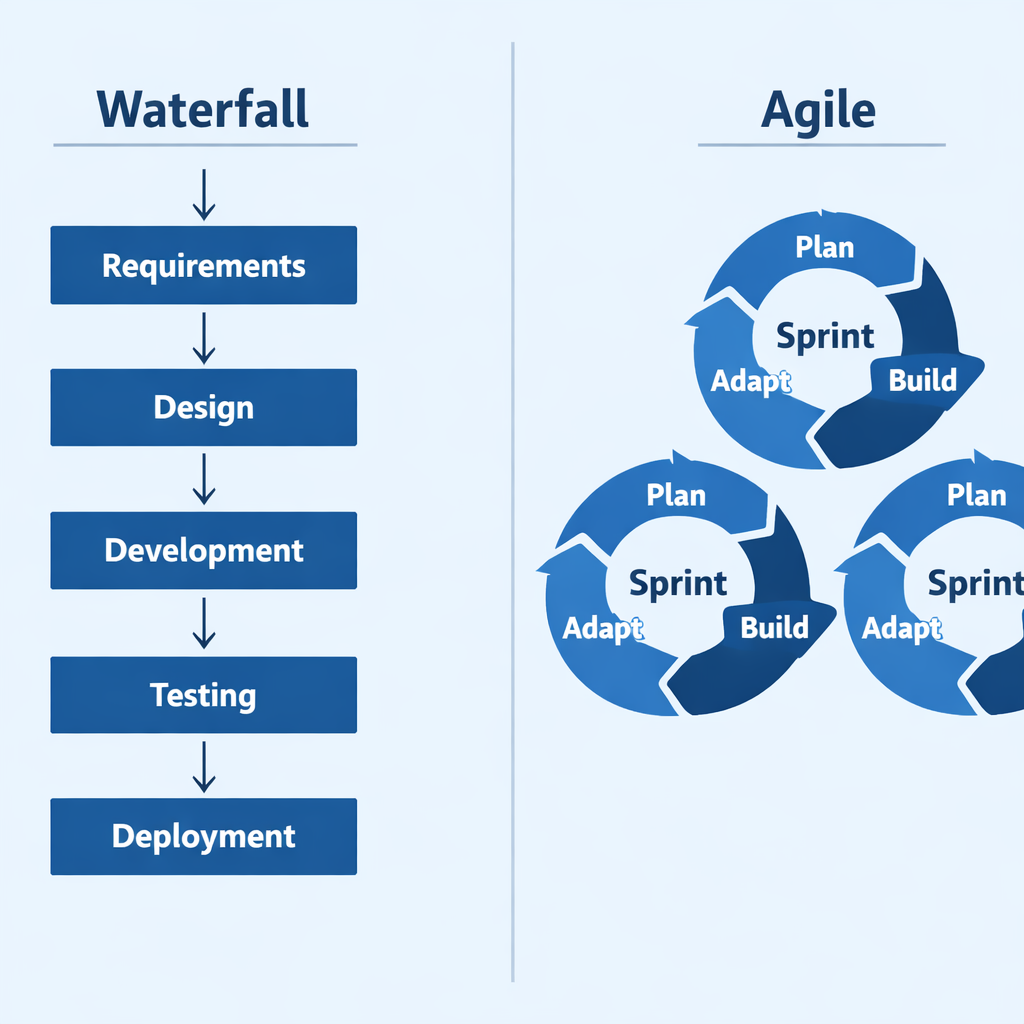
Predictive methodologies — commonly called waterfall — organize work as a linear sequence of phases. The project is fully planned upfront, each phase must be completed before the next begins, and changes to scope or direction are formally managed through a controlled process. Waterfall works well when the project outcome is clearly defined from the start, when regulatory or contractual requirements demand documentation at each phase, and when the cost of changing direction mid-project is high.
Adaptive methodologies — the agile family — organize work into short iterative cycles that produce incremental outputs and incorporate feedback continuously. Rather than planning everything upfront, adaptive methodologies plan at the level of detail appropriate for the immediate work ahead and adjust the broader plan as new information emerges. Agile works well when requirements are likely to evolve, when client feedback needs to be incorporated frequently, and when the team is building something where the right answer is not fully known at the start.
Hybrid methodologies combine elements of both. A common pattern for small businesses is using waterfall-style planning and milestone structures in client-facing communications — because clients often need the certainty of a fixed delivery date — while running the internal execution using agile cycles that allow the team to adapt and improve continuously.
Waterfall: when linear planning is the right choice
Waterfall project management follows five sequential phases — initiation, planning, execution, testing, and closure — with formal sign-off required at the end of each phase before the next begins. The strength of this approach is its predictability. Everyone knows exactly what will be delivered, when, and at what cost, because those parameters were established in detail before work began.
For small businesses, waterfall is the right choice for projects with a fixed, well-understood scope — a website build with an agreed sitemap and design brief, an event with a confirmed date and venue, a regulatory submission with defined requirements. In these contexts, the upfront investment in detailed planning pays dividends because the plan does not change significantly once work begins.
The weakness of waterfall is its rigidity in the face of change. When a client changes their mind about a key requirement mid-project, or when an external dependency shifts the timeline unexpectedly, waterfall plans require formal change management processes that can slow momentum and create friction in client relationships.
Agile: building in the flexibility your projects actually need
Agile project management organizes work into short cycles called sprints — typically one to two weeks long — each of which produces a tangible, reviewable output. At the end of each sprint, the team reviews what was built, incorporates feedback, and plans the next sprint based on updated priorities.
The core advantage of agile for small businesses is its built-in correction mechanism. Because work is reviewed frequently and direction is adjusted regularly, problems surface early when they are still small and recoverable. In a waterfall project, a fundamental misalignment between client expectations and project output might not surface until delivery — at which point correcting it requires significant rework.
Agile also distributes decision-making more evenly across the project lifecycle. Rather than front-loading all decisions into a planning phase before work begins, agile teams make decisions at the point when they have the most relevant information — which is usually during or after execution of the preceding sprint.
The most common agile frameworks for small businesses are Scrum, Kanban, and Scrumban. Scrum uses fixed sprint cycles with defined roles and ceremonies. Kanban uses a continuous flow model with visual boards and work-in-progress limits — caps on how many tasks can be active simultaneously. Scrumban combines sprint structure with kanban’s visual management principles and works well for teams transitioning from one framework to the other.
Hybrid: the pragmatic choice for most small businesses
Pure waterfall and pure agile are theoretical ideals. Most small businesses operate in a context that requires elements of both — client contracts that demand fixed deliverables and timelines, combined with internal workflows that benefit from iterative execution and continuous improvement.
A hybrid approach acknowledges this reality and builds a methodology that serves both needs. The client-facing layer is predictive — you commit to a scope, a timeline, and a budget at the start of the engagement and manage changes through a formal process. The internal execution layer is adaptive — your team runs in sprints, holds retrospectives, and adjusts its approach based on what it learns during execution.
This combination gives clients the certainty they need to approve projects and allocate budget, while giving your team the flexibility to deliver quality work without being locked into a plan that may have been built on incomplete information.
How to choose the right methodology for your projects
The methodology decision comes down to three questions about the nature of your work.
How well-defined is the outcome at the start? If the client can describe exactly what they want and that description is unlikely to change, waterfall planning is appropriate. If the outcome will be shaped by ongoing feedback and discovery, agile is the better fit.
How tolerant is the client of iteration and incomplete outputs? Some clients are comfortable reviewing work-in-progress and providing feedback that shapes the final product. Others need to see a complete, polished deliverable at each milestone. The client’s tolerance for iteration is as important as the project’s inherent complexity in determining the right approach.
How experienced is your team with structured project management? Teams new to formal project management often find waterfall easier to adopt initially because its linear structure mirrors how most people intuitively think about work. Agile requires more behavioral change — particularly the discipline of sprint boundaries and retrospectives — and is better introduced after a team has baseline project management habits in place.
For a detailed exploration of how agile specifically applies to small business contexts — including the most common implementation mistakes and how to avoid them — agile project management: why most small teams get it wrong covers the full framework with practical guidance built for entrepreneurs rather than enterprise teams.
How to build a project management plan that actually gets used
Every methodology discussed in the previous section depends on one thing to function: a plan. Not a plan in the abstract sense of having a general idea of how the project will unfold — a documented, structured, shared plan that defines what will be done, who will do it, by when, and with what resources.
The project management plan is the operational core of every project your business runs. It is the document your team refers to when they need to understand their responsibilities, the document your client references when they want to understand project status, and the document you return to when something goes wrong and you need to diagnose where the breakdown occurred.
Most small business owners have attempted some version of a project plan — a spreadsheet with tasks and dates, a shared document with a bullet list of deliverables, a project board in a tool they set up and abandoned. The gap between those attempts and a plan that actually gets used consistently is not complexity. It is completeness. A plan that covers only tasks and dates leaves out the components that prevent the most common project failures.
The seven components that make a project plan functional
A project management plan that works in practice — not just on paper — covers seven distinct areas. Each one addresses a specific category of project risk. Leaving any of them out does not simplify the plan. It creates a gap that will surface as a problem during execution.
Scope and objectives define what the project is trying to achieve and what it includes and excludes. The objective should be specific enough to be measurable — not “improve client onboarding” but “reduce the time from signed contract to first deliverable from ten days to five days by a specific date.” The scope exclusions are as important as the inclusions. Documenting what the project does not cover is the primary defense against scope creep.
Work breakdown structure is the process of decomposing the project objective into progressively smaller units of work until each unit is small enough to assign to one person with a realistic timeline. The rule of thumb is that no individual task should take more than two days to complete. Tasks larger than that are phases or milestones in disguise — they need to be broken down further before they can be tracked meaningfully.
Timeline and milestones convert the work breakdown structure into a schedule. Each task gets a start date, an end date, and a position in the sequence relative to the tasks that precede it and the tasks that depend on it. Milestones — significant checkpoints that mark the completion of a phase or the delivery of a major output — are identified separately from individual tasks and serve as the primary communication tool with clients and stakeholders.
Resource allocation confirms that the people assigned to the project have the capacity to deliver it within the proposed timeline. This is where many small business project plans fail silently — the right people are assigned on paper, but nobody verified that those people are not already committed to other projects running simultaneously. Resource allocation also covers budget, with estimated costs attached to each project phase and tracked against actuals throughout execution.
Risk register is a structured log of events that could affect the project negatively, along with an assessment of likelihood and impact and a mitigation strategy for each. For small business projects, five to ten honestly assessed risks paired with concrete responses is more valuable than an exhaustive list nobody reads. The most common risks to document are client delays in approvals, third-party dependencies, key person risk, and scope expansion from stakeholders who were not fully aligned at initiation.
Communication plan defines how information flows throughout the project — who receives updates, how frequently, in what format, and through which channel. A clear communication plan eliminates the category of problems caused by stakeholders feeling uninformed and the category of problems caused by decisions being made without the right people in the room.
Change management process creates a structured way to evaluate and incorporate change requests without destabilizing the project. A minimal change management process includes a written change request, an impact assessment covering scope, timeline, and budget effects, and a formal approval or rejection before any work on the change begins.
Building the timeline without setting yourself up to fail
The timeline is the component that most entrepreneurs get wrong — not because they cannot build a schedule, but because they build it optimistically rather than realistically. A timeline built on best-case assumptions has no capacity to absorb the delays that every real project encounters.
The critical path is the sequence of dependent tasks that determines the earliest possible project completion date. Identifying it requires mapping which tasks depend on the completion of other tasks before they can begin — these dependencies are what create the chain. Any delay on a critical path task delays the project end date by exactly the same amount. Tasks that are not on the critical path have float — time available before their delay affects the project end date.
Once the critical path is identified, build in a buffer of ten to fifteen percent of the total project duration before committing to a delivery date. A twelve-week project should have one to two weeks of buffer built into the timeline. That buffer is not padding — it is an honest acknowledgment that real projects encounter surprises that a plan cannot fully anticipate.
The milestone structure gives clients and stakeholders visibility into progress without requiring access to the full task-level plan. A milestone like design concepts approved or development phase complete communicates meaningful progress in language that does not require project management literacy to interpret. Building milestone reviews into the timeline also creates natural checkpoints for scope conversations — if a client wants to add work, the milestone review is the right moment to have that discussion.
Writing a plan your team will actually consult
The most technically complete project management plan is worthless if the team does not use it. Adoption is a design problem, not a discipline problem. Plans that get ignored are almost always plans that were designed for the person who wrote them rather than for the people who need to execute from them.
Three design principles drive consistent plan adoption in small business contexts.
The plan must live inside the tool the team already uses every day. A project plan in a separate document that requires a deliberate decision to open will be consulted less frequently than a plan embedded in the project management platform the team logs into as part of their daily workflow. The format of the plan matters less than its location.
The plan must be written at the right level of detail — specific enough to assign ownership and track progress, not so granular that maintaining it becomes more work than doing the actual project. A plan that requires fifteen minutes of daily updating will be abandoned under deadline pressure. A plan that requires two minutes of daily updating will be maintained even on the busiest days.
The plan must be introduced to the team in a kickoff meeting before work begins. Reading a plan independently is not the same as hearing the project manager walk through the rationale behind key decisions, flag the highest-risk areas, and clarify ownership of tasks that could be interpreted as belonging to more than one person. The kickoff meeting is where the plan becomes shared understanding rather than a document one person wrote and everyone else filed away without reading.
When to update the plan and when to hold the line
A project management plan is a living document, not a contract. It should be updated when reality diverges meaningfully from the original assumptions — when a task takes significantly longer than estimated, when a risk materializes and changes the timeline, when a client approves a change request that affects scope or budget.
It should not be updated every time something feels uncertain. Plans that are revised too frequently lose their function as a baseline — the original approved version against which progress is measured. When the baseline shifts constantly, there is no stable reference point for evaluating whether the project is on track.
The practical discipline is to update the plan when an approved change occurs and to document the reason for the update. Every version of the plan should be traceable — you should be able to look back at the original baseline and understand exactly what changed, when, and why. That traceability is what makes post-project retrospectives genuinely useful rather than a reconstruction of events from memory.
For the specific templates that support each component of the project management plan — including ready-to-use structures for the work breakdown, risk register, status report, and retrospective — project management templates that cut planning time in half provides everything you need to build a complete planning library without starting from scratch.
For a dedicated walkthrough of the full plan-building process with step-by-step guidance on each component, how to build a project management plan from scratch covers the complete methodology in practical terms built for small business owners.
Project management templates — building a reusable system for every project
Every project your business runs shares more structural DNA with your previous projects than it differs from them. The scope conversation happens every time. The task breakdown happens every time. The risk identification, the stakeholder alignment, the status reporting — these are not unique events that require a fresh approach on each engagement. They are recurring patterns that most small business owners rebuild from scratch on every project because the idea of creating reusable systems feels like a task they will get to eventually.
Eventually rarely comes. And every time a project kicks off without a template, someone on the team spends hours recreating a structure that already exists somewhere in a previous project folder, slightly different each time, inconsistent enough that it cannot be handed off without explanation.
Project management templates solve this problem permanently. They capture your operational logic once, in a format that can be reused, adapted, and improved across every project that follows. The compounding effect of a well-built template library is significant — not just in time saved, but in the consistency of delivery that clients notice and respond to.
Why most template systems fail within a month
The failure pattern for project management templates is predictable. An entrepreneur downloads a comprehensive template pack, spends a weekend customizing it, shares it with the team, and finds three weeks later that nobody is using it. The templates are sitting in a folder somewhere, and the team has reverted to building project documents from scratch because the templates felt like more work than they saved.
The failure is almost never about the quality of the templates. It is about three implementation mistakes that are easy to avoid once you know to look for them.
The first mistake is building templates that are too comprehensive. A project initiation document with twenty-three fields that takes an hour to complete will be skipped under deadline pressure every single time. The most effective templates are the ones that capture only what is genuinely necessary — the minimum structure required to prevent the specific failures that occur without it.
The second mistake is storing templates in the wrong place. If your team has to navigate to a separate folder, open a different application, or send a message asking where the template lives, the friction alone will stop consistent adoption. Templates need to live inside the tool your team opens every morning as part of their standard workflow.
The third mistake is never updating templates after initial creation. A template built for a project type your business ran eighteen months ago may not reflect how your team works today. Templates that fall out of sync with current practice get quietly abandoned and replaced with informal workarounds that nobody documents.
Choosing the right platform to house your template library is a decision that connects directly to the tool evaluation covered in best project management software for small teams in 2026, where each platform’s template and automation capabilities are evaluated in context.
The five templates that cover the full project lifecycle
A complete template library for a small business does not require dozens of documents. Five core templates cover the full lifecycle of any project from initiation through closure, and each one addresses a specific category of project failure.
The project brief template is the initiation document that creates alignment before any work begins. It defines the project objective in one to two sentences, the scope including explicit exclusions, the key deliverables, the timeline with major milestones, the budget or resource allocation, and the primary stakeholders with their roles and decision-making authority. The scope exclusion section is the most important and most frequently skipped component — documenting what the project does not include is the primary defense against scope creep in client-facing engagements.
The project plan template translates the brief into an actionable task structure. It includes the full task list organized by project phase, an assigned owner for each task, start and due dates, a status indicator, a dependencies field identifying which tasks must be completed before a given task can begin, and a notes field for context or blockers. The dependencies column is what separates a functional project plan from a task list — it is the component that catches timeline risks before they materialize as missed deadlines.
The meeting agenda and notes template brings structure to every project meeting without adding bureaucracy. It includes the meeting objective in one sentence, the agenda items with time allocations, a decisions section where every decision made is recorded verbatim, and an action items section with a named owner and a specific due date for each item. The action items section is what converts a productive conversation into accountable execution. An action item without a named owner is a task that will not get done.
The project status report template keeps stakeholders informed without requiring a meeting. It includes a one-line project health indicator — on track, at risk, or off track — a summary of what was completed in the past period, a summary of what is planned for the coming period, any risks or blockers requiring stakeholder awareness, and any decisions requiring stakeholder input before work can proceed. The health indicator at the top is the most important element — it forces an honest assessment of project status in a format that cannot be softened by careful paragraph construction.
The project retrospective template is the most underused document in small business project management and the one that compounds the most value over time. It captures four things: what went well and should be repeated, what did not go well and should be changed, what was unclear and needs better definition upfront next time, and what specific process changes the team commits to implementing on the next project. The specificity of the final section is what makes a retrospective actionable. Without concrete commitments, a retrospective is a conversation that produces no change.
How to build a template library that scales with your business
A template library that serves a two-person operation looks different from one that serves a fifteen-person team, but the principles for building one that scales are consistent regardless of current size.
Start with one template, not five. The project brief is the highest-leverage starting point because it affects every project from the moment it begins. Build a brief template that reflects how your business scopes and initiates work, use it on the next three projects without modification, and then revise it based on what you learned. A template refined through real use is more valuable than a template that looks comprehensive on paper but has never been tested against actual projects.
Once the brief template is working consistently, add the project plan template. Use both together for two project cycles before adding the status report. Build the library incrementally, adding each template only when the previous one is genuinely embedded in your team’s workflow. A library of two templates your team uses every time is more valuable than a library of ten templates nobody opens.
Assign a template owner — one person responsible for maintaining the library, updating templates when processes change, and ensuring new team members know where to find them and how to use them. Without an owner, templates go stale within a quarter as the team’s actual practices evolve while the documented templates remain frozen at an earlier version of how the business operated.
Finally, build template use into your project kickoff checklist. The first action item when starting any new project should be opening the project brief template and completing it before any other work begins. If that step is documented as part of the kickoff process, it happens automatically rather than depending on someone remembering to do it under the pressure of a new engagement starting.
Connecting templates to methodology
The templates your business uses should reflect the methodology your team has adopted. A waterfall project requires more upfront documentation — a comprehensive brief, a detailed project plan, a formal change management log — because the predictive approach front-loads decision-making before execution begins. An agile project requires lighter upfront documentation but more recurring structure — sprint planning notes, daily standup logs, sprint review summaries, and retrospective records that accumulate over the project lifecycle.
The retrospective template is particularly central to agile practice. In a Scrum framework, the sprint retrospective is a formal ceremony that occurs at the end of every sprint — not just at project closure. Building a retrospective template that can be completed in fifteen minutes and captures the three core questions — what went well, what did not, and what will change next sprint — makes the ceremony sustainable rather than something the team skips when they are busy.
For teams running agile workflows, the retrospective connects directly to the sprint review process and the broader framework decisions covered in agile project management: why most small teams get it wrong, where the relationship between ceremony, cadence, and team performance is explored in practical terms.
The return on investment of a well-built template library
The time investment in building a template library is front-loaded and the returns are ongoing. A project brief template that takes three hours to build and refine will save thirty minutes on every project that uses it. If your business runs twenty projects a year, that is ten hours saved annually from a single template — and the brief is the simplest one in the library.
The less visible return is consistency. When every project starts with the same brief, runs from the same plan structure, and communicates through the same status report format, clients experience a level of professionalism that is difficult to achieve through effort alone. Consistency is what makes your delivery process feel like a system rather than an improvisation, and systems are what allow businesses to grow without proportionally increasing the workload on the people running them.
For a complete walkthrough of each template with component-level guidance and implementation advice, project management templates that cut planning time in half provides the full breakdown your team needs to build and deploy a template library that works from the first project it touches.
Project management certifications — are they worth it for entrepreneurs?
There is a question that comes up consistently among entrepreneurs who are building out their project management practice: at what point does formal training or certification add real value, and at what point is it a credential that looks impressive on a LinkedIn profile without changing how you actually run projects?
The honest answer is that it depends on what you are trying to achieve. For entrepreneurs who manage internal projects and client engagements without needing to demonstrate credentials to a procurement committee, the practical knowledge gained from applying the frameworks in this guide will deliver more immediate value than any certification. For entrepreneurs who sell services to enterprise clients, government agencies, or organizations that require demonstrated project management competency as a condition of engagement, certification is not optional — it is a commercial requirement.
Understanding the landscape of available certifications, what each one signals, and what the preparation process actually teaches is the starting point for making that decision intelligently.
The certifications that carry real weight in 2026
The project management certification market has expanded significantly over the past decade, and not all credentials carry equal weight. The ones worth understanding fall into three categories: globally recognized generalist certifications, methodology-specific certifications, and entry-level credentials for practitioners who are earlier in their project management journey.
The Project Management Professional, known as the PMP, is the most recognized project management certification globally and the benchmark against which most other credentials are measured. Issued by the Project Management Institute, the PMP requires a combination of formal education, documented project management experience — typically three to five years depending on education level — and a passing score on a rigorous examination that covers predictive, agile, and hybrid project management approaches.
For entrepreneurs, the PMP signals a level of project management competency that opens doors with enterprise and government clients who require it as a baseline qualification. The preparation process is also genuinely educational — the study required to pass the PMP examination forces a systematic review of project management concepts that most practitioners have absorbed piecemeal through experience rather than through structured learning.
The examination was updated in 2021 to reflect the increasing prevalence of agile and hybrid approaches in professional practice. Approximately half of the current examination content covers predictive methodologies and half covers agile and hybrid frameworks, which makes the PMP a more relevant credential for modern project environments than its earlier iterations.
The CAPM, or Certified Associate in Project Management, is the entry-level credential from PMI and the appropriate starting point for entrepreneurs who are earlier in their project management practice or who do not yet meet the experience requirements for the PMP. It requires no prior project management experience — only twenty-three hours of project management education — and covers the same body of knowledge as the PMP at a foundational level.
For entrepreneurs who want the credibility of a PMI credential without the three-to-five-year experience requirement, the CAPM is a legitimate and recognized starting point. It also functions as a structured introduction to the PMI body of knowledge, which provides a useful framework for organizing the project management concepts your business will apply daily.
The PMI-ACP, or Agile Certified Practitioner, is PMI’s agile-specific certification and the most relevant credential for entrepreneurs whose businesses operate primarily in agile or hybrid environments. It requires documented agile project experience and covers the full range of agile frameworks — Scrum, Kanban, Lean, XP, and others — at a level of depth that the PMP’s agile content does not reach.
For entrepreneurs running product development businesses, technology services firms, or creative agencies where agile methodologies are the operational standard, the PMI-ACP signals a depth of agile competency that the PMP alone does not communicate.
Scrum-specific certifications worth knowing
Beyond the PMI credential family, the Scrum framework has generated its own certification ecosystem that is worth understanding separately — particularly for entrepreneurs whose teams operate primarily in agile environments.
The Certified ScrumMaster, or CSM, issued by the Scrum Alliance, is the most widely recognized Scrum-specific credential. It requires attendance at a two-day certified Scrum training course delivered by an authorized trainer, followed by a relatively straightforward online examination. The CSM is less rigorous than the PMP as a credential but more focused — it certifies competency specifically in the Scrum framework rather than project management broadly.
For entrepreneurs who have adopted Scrum as their primary delivery methodology and want to deepen their team’s implementation or signal Scrum competency to clients, the CSM is a practical and relatively accessible credential to pursue.
The Professional Scrum Master, or PSM, issued by Scrum.org, is the alternative Scrum certification that many practitioners consider more rigorous than the CSM because it does not require a mandatory training course — only a passing score on an examination that tests genuine Scrum knowledge rather than course attendance. The PSM Level I examination has a pass mark of eighty-five percent, which is meaningfully higher than most comparable credentials in the space.
For entrepreneurs who prefer self-directed learning and want a credential that reflects demonstrated knowledge rather than course completion, the PSM is worth considering over the CSM.
How to evaluate whether certification is worth your time and investment
The certification decision for an entrepreneur is fundamentally a return-on-investment calculation. The relevant variables are the cost of the certification including examination fees and preparation materials, the time required to prepare adequately, the commercial value of holding the credential in your specific market, and the practical knowledge gained through the preparation process regardless of the credential itself.
PMP examination fees are approximately four hundred dollars for PMI members and five hundred and fifty-five dollars for non-members as of current pricing — though these figures change periodically and should be verified directly with PMI before planning. Preparation typically requires one hundred to one hundred and fifty hours of study for candidates with solid project management experience, and significantly more for those coming to the material with less background.
The commercial value calculation is straightforward: if your business is actively pursuing or currently working with clients who require PMP certification as a qualification criterion, the credential pays for itself on the first engagement where it is the deciding factor. If your business operates in markets where certification is never mentioned in client conversations, the practical knowledge gained through preparation may be valuable but the credential itself adds limited commercial return.
A useful middle path for entrepreneurs who want structured project management education without the full commitment of PMP preparation is PMI’s online learning ecosystem, which offers courses and micro-credentials that build specific competencies without requiring the full examination process.
What certification preparation actually teaches you
Regardless of the commercial value of the credential itself, the preparation process for a rigorous project management certification teaches something that experience alone rarely provides: a systematic, structured view of project management as a complete discipline rather than a collection of practices absorbed piecemeal over time.
Most entrepreneurs who have managed projects for years without formal training have strong instincts in the areas where their experience is deepest and significant gaps in areas they have not encountered or have navigated intuitively without understanding the underlying framework. Certification preparation surfaces those gaps in a controlled environment — before they surface as project failures in front of a client.
The PMP body of knowledge, for example, covers risk management, procurement management, stakeholder engagement, and quality management at a depth that most small business practitioners have never formally addressed. Working through those domains in preparation for the examination produces a more complete project management practitioner even if the examination itself is never taken.
For entrepreneurs who decide that formal certification is not the right investment at this stage of their business, the frameworks and methodologies covered throughout this guide — combined with the practical application of the planning and template systems covered in project management templates that cut planning time in half and how to build a project management plan from scratch — provide a foundation that delivers measurable results without the time and financial investment of formal certification.
Making the decision for your business
The clearest framework for the certification decision is a simple three-question test.
Do your current or target clients require or prefer certified project managers? If yes, the PMP or the relevant methodology-specific credential is a commercial investment with a calculable return. If no, proceed to the next question.
Do you have significant gaps in your project management knowledge that structured preparation would address? If yes, certification preparation — even without sitting the examination — is a high-value learning investment. The PMI body of knowledge is freely available as a study resource regardless of whether you pursue the credential.
Do you have the time and budget to pursue certification without compromising current project delivery? If yes, the PMP or PMI-ACP is worth pursuing. If no, the practical application of the frameworks in this guide will deliver more immediate business impact than a credential pursued under resource pressure.
Project management certifications are tools, not destinations. The goal is not to hold a credential — it is to deliver projects reliably, build client trust, and grow a business that operates on systems rather than improvisation. Certification can accelerate that journey for the right entrepreneur in the right market context. For others, the same journey begins with the frameworks, tools, and planning practices covered throughout this guide.
Project management methodologies compared — finding the right fit for your workflow
Every section of this guide has referenced methodology in context — how agile shapes sprint planning, how waterfall supports fixed-scope client contracts, how hybrid approaches balance client-facing predictability with internal adaptability. This section brings those references together into a direct comparison that gives you a clear decision framework for matching methodology to project type across your entire business operation.
The methodology question is not a one-time decision. As your business grows, takes on different types of clients, and builds more complex internal operations, the right approach for one project may be entirely wrong for another running simultaneously. The goal is not to choose a single methodology and apply it universally — it is to develop enough fluency across the major frameworks that you can select the right approach for each project based on its specific characteristics.
Why methodology selection matters more than most entrepreneurs realize
The methodology your team uses determines more than how work is organized. It shapes how your team communicates, how decisions get made, how changes are handled, and how clients experience the delivery process. Two teams using the same tool and the same level of effort but different methodologies will produce consistently different outcomes — not because one methodology is inherently superior, but because each one is optimized for a specific type of work and a specific type of client relationship.
Applying a rigid waterfall methodology to a creative project where client preferences are inherently subjective and likely to evolve produces a high rate of rework at delivery. The client approves a plan that describes the final output in terms they understood at the time, receives the output weeks or months later, and discovers that their preferences have shifted in ways neither party could have predicted at initiation.
Applying a pure agile methodology to a construction project where each phase must be physically complete before the next can begin produces chaos. Agile’s iterative feedback loops assume that outputs can be reviewed and revised. Concrete foundations cannot be revised mid-pour.
The fit between methodology and project type is what determines whether your team’s effort translates into outcomes your clients value — or into friction, rework, and relationship damage that erodes the commercial value of the work regardless of its technical quality.
A direct comparison of the four major methodologies
The four methodologies worth understanding for small business contexts are waterfall, agile, Lean, and Kanban. Each has a distinct philosophy, a distinct strength, and a distinct set of conditions under which it performs well.
Waterfall is the sequential methodology where each phase — initiation, planning, execution, testing, closure — must be completed before the next begins. Its defining characteristic is comprehensive upfront planning: scope, timeline, budget, and deliverables are defined in detail before execution starts, and changes are managed through a formal process that evaluates impact before approval.
Waterfall performs best when the project outcome is clearly defined and unlikely to change, when regulatory or contractual requirements demand phase-gate approvals and formal documentation, and when the cost of mid-project change is high enough to justify the investment in upfront planning. Construction projects, regulatory submissions, hardware manufacturing, and fixed-scope client contracts are natural waterfall contexts.
Its weakness is inflexibility in the face of legitimate change. When a client’s needs evolve mid-project — as they often do in knowledge work and creative services — waterfall’s change management process creates friction that can damage the client relationship and slow momentum on the work itself.
Agile is the iterative methodology where work is organized into short cycles that produce incremental outputs and incorporate feedback continuously. Its defining characteristic is adaptive planning: rather than defining everything upfront, the team plans at the level of detail appropriate for the immediate work ahead and adjusts the broader plan as new information emerges.
Agile performs best when requirements are likely to evolve, when client feedback needs to be incorporated frequently, when the team is building something where the right answer is not yet fully known, and when speed of delivery and responsiveness to change are more valuable than comprehensive upfront documentation. Software development, marketing campaigns, product design, and content strategy are natural agile contexts.
Its weakness is the difficulty of committing to fixed scope, timeline, and budget at the start of an engagement — which is exactly what most clients want before they approve a project. Pure agile requires a level of client trust and collaborative engagement that not every client relationship supports.
Lean is a methodology borrowed from manufacturing — specifically from the Toyota Production System — that focuses on maximizing value delivery while minimizing waste. Waste in a Lean context means any activity that consumes resources without contributing to the output the client values: unnecessary meetings, redundant approvals, waiting time between dependent tasks, overproduction of documentation that nobody reads.
Lean performs best in operational contexts where recurring processes can be systematically analyzed and improved over time. It is less a project delivery methodology and more an operational philosophy — the goal is to continuously reduce the friction, delay, and unnecessary effort embedded in how your business runs its standard workflows.
For small businesses, Lean principles are most valuable in service delivery operations — client onboarding processes, recurring reporting workflows, support operations — where the same process runs repeatedly and every improvement compounds across future iterations.
Kanban is a flow-based methodology that visualizes work as cards moving across columns on a board — typically representing stages like to do, in progress, review, and done. Its defining characteristic is the work-in-progress limit: a cap on how many tasks can be active in any stage simultaneously, which prevents the team from starting too many things and finishing too few.
Kanban performs best for teams with ongoing, unpredictable workloads where work arrives continuously rather than in discrete project-shaped batches. Support operations, content production, maintenance work, and internal IT operations are natural Kanban contexts. It is also an excellent transitional methodology for teams moving from no formal system to a structured one, because its visual simplicity makes adoption straightforward without requiring behavioral changes as significant as those Scrum demands.
The hybrid approach most small businesses actually need
Pure methodology implementations are theoretical ideals. Most small businesses operate in a context that requires a pragmatic combination of approaches — and recognizing that is not a compromise, it is an accurate reading of how real project work functions.
The most effective hybrid pattern for small business client work combines waterfall-style client communication with agile internal execution. The client-facing layer is predictive: you commit to a scope, a timeline, and a budget at the start of the engagement and manage changes through a formal process that documents impact before approval. The internal execution layer is adaptive: your team runs in sprints, holds retrospectives, and adjusts its approach based on what it learns during execution without surfacing every internal adjustment as a formal change request.
This combination serves both parties. The client gets the certainty they need to approve the project and allocate budget. The team gets the flexibility to deliver quality work without being locked into a plan that was built before any of the work had been done and therefore could not fully anticipate the complexity that execution reveals.
A second hybrid pattern worth knowing is Scrumban — the combination of Scrum’s sprint structure with Kanban’s visual board and flow principles. Scrumban works particularly well for small teams that run a mix of project work and ongoing operational tasks. The sprint provides rhythm and focus for project deliverables. The Kanban board manages the continuous flow of operational requests that arrive between sprints without disrupting project execution.
Matching methodology to project type: a practical decision framework
The methodology selection decision comes down to four questions about the specific project being evaluated — not about your business in general, but about this project, with this client, under these conditions.
How well-defined is the outcome at the start? A project where the client can describe the final deliverable in precise, measurable terms is a waterfall candidate. A project where the final form of the output will be shaped by ongoing discovery and feedback is an agile candidate.
How tolerant is the client of iteration? A client who is comfortable reviewing incomplete work, providing directional feedback, and watching the output evolve across multiple cycles is an agile-compatible client. A client who needs to see a polished, complete deliverable at each milestone and becomes anxious when shown work-in-progress is a waterfall-compatible client — regardless of what the project’s inherent complexity might suggest.
How stable is the team’s capacity over the project duration? Agile sprints require consistent team availability across the sprint cycle. A team with highly variable capacity — key members frequently pulled into other commitments mid-sprint — will struggle to maintain sprint integrity and may perform better with a flow-based approach like Kanban that accommodates variable throughput without breaking a fixed cycle.
How mature is the team’s project management practice? Teams new to formal project management often find waterfall easier to adopt initially because its linear structure mirrors how most people intuitively think about sequential work. Agile requires more behavioral discipline — sprint boundaries, retrospective honesty, backlog management — and performs best when the team already has baseline project management habits in place. Introducing agile to a team with no prior project management structure is like teaching someone to drive in a manual transmission on a highway — technically possible, but unnecessarily difficult.
For the complete exploration of how agile specifically applies to small business contexts — including the implementation mistakes that derail most small team agile adoptions and the step-by-step process for introducing sprints and retrospectives without overwhelming a team that is simultaneously delivering client work — agile project management: why most small teams get it wrong covers the full framework in practical terms built for entrepreneurs.
Building methodology fluency as a business asset
The most operationally mature small businesses are not the ones that have chosen the right methodology — they are the ones whose leadership understands multiple methodologies well enough to apply the right one to each project without internal debate or external consultation.
That fluency is built through deliberate practice rather than theoretical study. Pick one methodology, apply it consistently across three to five complete project cycles, run retrospectives at the end of each cycle, and document what the methodology revealed about your team’s working patterns and your clients’ preferences. Then evaluate whether the methodology is serving the work or whether the work is being constrained to fit the methodology.
The distinction matters. A methodology that is serving the work produces better outcomes with less friction over time. A methodology that is constraining the work produces consistent overhead — workarounds, informal exceptions, and team members quietly ignoring parts of the framework because those parts do not fit how the actual work unfolds.
When you find the latter pattern, it is usually a signal not that the team is undisciplined but that the methodology is mismatched to the project type. Switching frameworks in that context is not an admission of failure — it is the correct operational response to evidence that the current approach is not fit for purpose.
Understanding how methodology connects to the broader practice of project management for small businesses — including how it shapes tool selection, planning approach, and client communication — is the thread that runs through every section of this guide and comes together most clearly in the full operational picture available at the pillar level.
Conclusion
Running a small business without a project management system is not a sign of agility — it is a structural vulnerability that compounds with every new client, every new hire, and every new project your business takes on. The frameworks, tools, and practices covered in this guide exist to close that vulnerability before it becomes the ceiling on your growth.
The path from improvisation to operational clarity does not require a complete overhaul of how your business runs. It requires a series of deliberate decisions — about how projects are initiated, how plans are built, how teams are organized, how work is tracked, and how lessons are captured and applied to the next engagement.
Each section of this guide represents one of those decisions. Understanding what project management is and why it matters gives you the conceptual foundation. Choosing the right software gives your team the infrastructure to work visibly and accountably. Selecting the right methodology gives your execution the structural logic it needs to deliver consistently. Building a complete project management plan gives each project a blueprint that survives first contact with reality. Developing a template library makes that blueprint reusable and scalable. Understanding the certification landscape tells you where formal credentials add commercial value and where practical application matters more. And developing fluency across methodologies gives you the judgment to match your approach to the work rather than forcing the work to fit your approach.
These are not sequential steps where step one must be complete before step two begins. They are parallel investments that reinforce each other. A team using the right tool but no methodology will see limited improvement. A team with a strong methodology but no templates will rebuild their operational structure from scratch on every project. A team with excellent templates but no planning discipline will produce consistent documents that describe projects nobody is actually managing.
The compounding value of project management for small businesses comes from the integration of all these elements into a coherent system — one that your team uses consistently, your clients experience as professionalism, and your business leverages as a growth asset rather than an administrative burden.
Start where the friction is highest. If projects are failing at initiation because scope is never clearly defined, begin with the project brief. If projects are failing at execution because nobody knows who owns what, begin with the project plan. If projects are failing at closure because the same mistakes repeat on every engagement, begin with the retrospective. Pick the highest-leverage entry point, apply it consistently across three project cycles, and build from there.
The businesses that deliver reliably, retain clients, and scale without chaos are not the ones with the most talented people or the largest budgets. They are the ones that have built systems capable of converting effort into predictable outcomes — and project management, applied consistently and intelligently, is the most direct path to becoming one of them.