

Choosing the right ERP platform is one of the highest-leverage decisions an entrepreneur can make. The wrong choice costs you time, money, and team morale. The right one becomes the operational backbone your entire business runs on. The best AI ERP software options today are built specifically for lean teams — not enterprise giants with six-figure contracts. This comparison breaks down exactly which platforms deliver real value at small business scale. If you’re still getting familiar with what these systems actually do, the complete guide to AI ERP software for small businesses is the right starting point before evaluating specific tools.
How to evaluate an ERP platform without getting lost in feature lists
Every ERP vendor will tell you their platform does everything. The demo will be clean, the sales rep will be responsive, and the feature checklist will look impressive. None of that tells you whether the platform actually fits the way your business operates best AI ERP software .
The entrepreneurs who make the best ERP decisions start with constraints, not features. They know their budget ceiling, their team’s technical comfort level, their most painful operational bottleneck, and the integrations they can’t live without. That filter eliminates most of the noise before a single demo is booked.
Before comparing platforms, get clear on four things:
Your transaction volume. Some platforms are optimized for high-volume, low-margin operations. Others are built for complex, low-volume workflows. The fit matters more than the brand name.
Your integration dependencies. If your business runs on Shopify, QuickBooks, or a specific 3PL, your ERP needs to connect to those systems cleanly. A platform with a weak integration layer will create more problems than it solves.
Your team’s capacity for change. A powerful platform with a steep learning curve will stall if your team doesn’t adopt it. Implementation support and onboarding quality are as important as the feature set.
Your growth trajectory. The platform you need today at 8 employees looks different from the one you’ll need at 40. Choose something you can grow into, not just grow out of best AI ERP software .
With those filters in place, here are the platforms that consistently deliver for entrepreneurial teams in 2025.
The platforms worth your attention in 2025
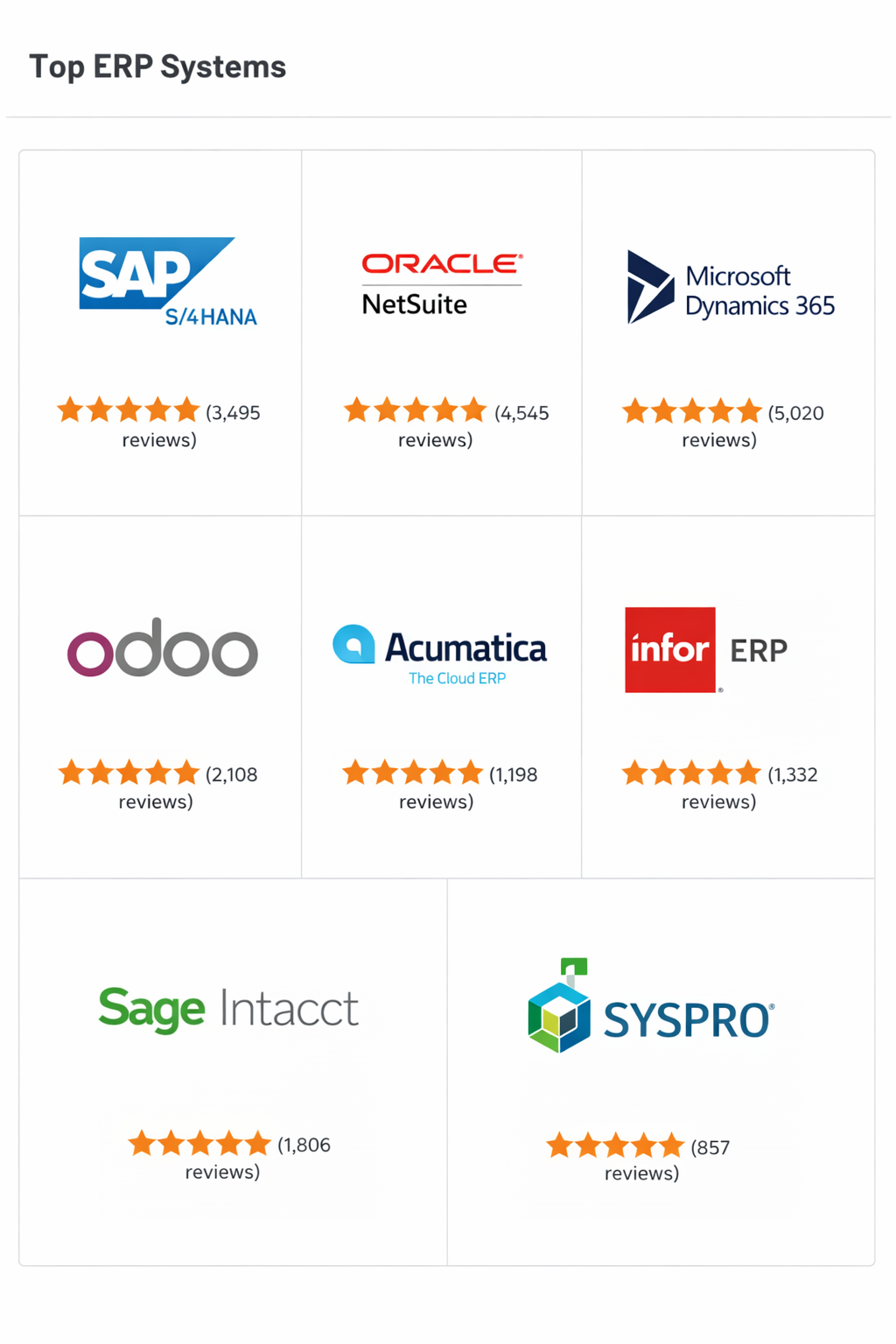
The ERP market is crowded, but the number of platforms genuinely worth considering for entrepreneurial businesses is smaller than the vendor landscape suggests. The ones below have earned their place through consistent performance, realistic pricing for growing teams, and meaningful AI feature development over the past two years.
NetSuite — built for businesses ready to scale hard
Oracle NetSuite is the benchmark for cloud ERP at the growth-stage level. It covers financials, inventory, order management, CRM, and HR in a single unified platform, and its reporting engine is one of the strongest in the market.
The AI layer in NetSuite handles demand planning, cash flow forecasting, and automated financial close processes with meaningful accuracy. For entrepreneurs who are past the early scrappy stage and building toward a serious operational infrastructure, NetSuite is the platform most often recommended by CFOs and operators who have seen both sides of the ERP market.
The honest downside is cost. NetSuite’s licensing starts around $999 per month plus per-user fees, which puts it out of reach for very early-stage businesses. Implementation also requires investment — either a certified partner or a dedicated internal resource. If you’re generating consistent revenue and have operational complexity that justifies the spend, the ROI is well-documented. If you’re still pre-revenue or running a very lean operation, start elsewhere.
Best for: Product businesses, multi-entity operations, teams preparing for a funding round or acquisition.
Odoo — the modular option for entrepreneurs who want control
Odoo is the platform that surprises most entrepreneurs who discover it after years of paying for disconnected SaaS tools. It covers the full ERP surface area — accounting, inventory, manufacturing, HR, CRM, project management, and e-commerce — and lets you activate only the modules you actually need best AI ERP software .
The open-source foundation means an active developer community, a wide range of third-party integrations, and the flexibility to customize workflows without being locked into vendor roadmaps. The cloud-hosted version starts at a price point accessible to small teams, and the modular structure means you’re not paying for capabilities you haven’t deployed yet.
The AI features in Odoo are more utilitarian than flashy — automated invoice processing, smart inventory reordering, and predictive lead scoring in the CRM module — but they work reliably and don’t require a data science team to configure.
The learning curve is real. Odoo rewards teams that invest time in setup and configuration. Teams that rush the implementation often underuse the platform and blame the tool for problems that were actually onboarding failures best AI ERP software .
Best for: Entrepreneurs who want full operational coverage without enterprise pricing, and who have at least one technically capable person on the team.
SAP Business One — when you need enterprise depth at SMB scale
SAP Business One occupies an interesting position in the market. It’s built by the same company behind some of the world’s largest enterprise ERP deployments, but it’s specifically designed for businesses with 10 to 250 employees best AI ERP software.
The platform’s strength is depth. Financial management, inventory control, production planning, and reporting are all built to a standard that most SMB-focused platforms don’t match. The AI and machine learning features — bundled under SAP’s Business Technology Platform — include predictive analytics, automated document processing, and intelligent workflow routing best AI ERP software.
The implementation model is partner-dependent, meaning you’ll almost always work with a certified SAP partner to deploy and configure the system. That adds cost and timeline, but it also means you get professional guidance through the process rather than figuring it out from documentation alone.
For entrepreneurs in manufacturing, wholesale distribution, or any industry where inventory complexity and production tracking matter, SAP Business One has a legitimate edge over lighter platforms.
Best for: Product-heavy businesses, manufacturers, distributors, and operators who need enterprise-grade inventory and production management without a full SAP enterprise contract.
Microsoft Dynamics 365 Business Central — best for Microsoft-native teams
best AI ERP software If your business runs on Microsoft 365 — Teams, Outlook, Excel, SharePoint — then Dynamics 365 Business Central deserves serious consideration. The native integration between Business Central and the Microsoft stack is genuinely seamless in a way that third-party integrations rarely are.
The platform covers core ERP functionality with strong financial management, supply chain, and project management modules. The Copilot features embedded in Business Central — Microsoft’s branded AI layer — handle tasks like automated bank reconciliation, predictive inventory replenishment, and natural language report generation.
Pricing is per-user and modular, which makes it accessible for smaller teams, though costs scale quickly as you add users and premium modules. The implementation experience varies significantly depending on the partner you work with, so partner selection matters as much as platform selection here.
Best for: Teams already embedded in the Microsoft ecosystem, professional services businesses, and operators who want AI-assisted reporting without learning a new interface paradigm.
Zoho ERP — the lean operator’s entry point
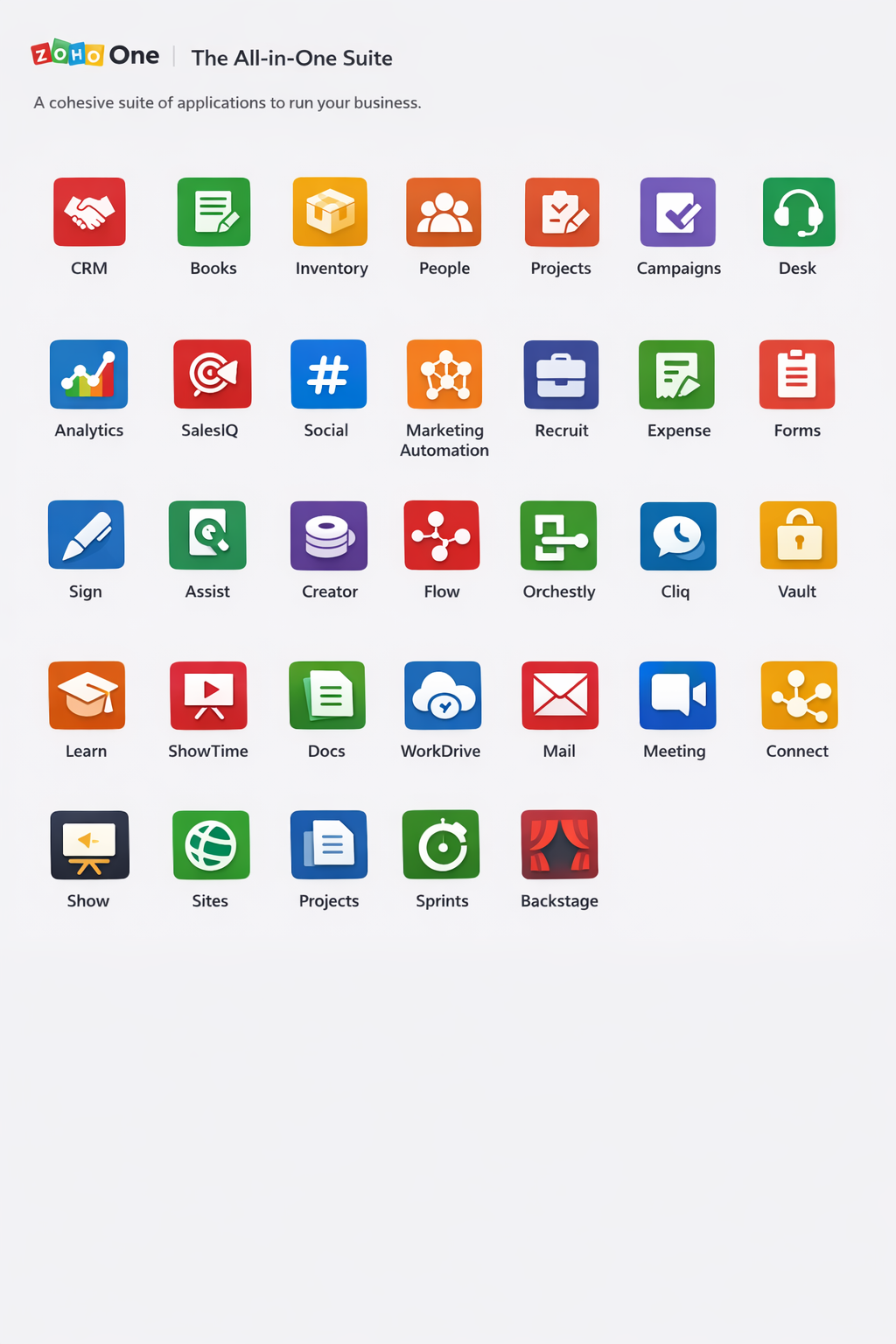
Zoho doesn’t market a product called “Zoho ERP” directly, but the combination of Zoho Books, Zoho Inventory, Zoho CRM, Zoho People, and Zoho Analytics — all within the Zoho One bundle — functions as a genuinely capable ERP environment for early-stage and lean businesses best AI ERP software.
The pricing model is the most accessible on this list. Zoho One covers the entire suite for a flat per-user monthly fee that makes it viable for solo operators and very small teams. The AI features, branded as Zia across Zoho’s products, handle anomaly detection, sales forecasting, and automated workflow suggestions with solid reliability.
The trade-off is ceiling. As your business grows in complexity — multiple entities, sophisticated inventory operations, advanced manufacturing — Zoho will eventually show its limits. But for entrepreneurs in the early-to-mid growth phase who need operational coverage without a five-figure annual software contract, Zoho One is the most underrated option in the market.
For a deeper look at how to get one of these platforms running without disrupting your operations, the AI ERP implementation guide walks through the process from data migration to team onboarding.
Best for: Solo operators, early-stage startups, service businesses, and entrepreneurs who need full operational coverage at the lowest viable cost.
How to match a platform to your actual business model
The comparison above gives you the landscape, but the right choice comes down to your specific situation. Here’s a simple matching framework:
You sell physical products and manage inventory across multiple locations. NetSuite or SAP Business One. The inventory and supply chain modules in both platforms are purpose-built for this complexity.
You run a service business or agency with project-based billing. Microsoft Dynamics 365 Business Central or Odoo. Both handle project management and time-based billing better than inventory-heavy platforms.
You’re in manufacturing or have production workflows. SAP Business One or Odoo. Manufacturing module depth is where both platforms separate themselves from the rest of this list.
You’re early-stage and need operational coverage without major spend. Zoho One. Start there, build your processes, and migrate to a more powerful platform when the complexity demands it.
You’re preparing for rapid scale or investor scrutiny. NetSuite. The reporting, audit trail, and multi-entity capabilities are what finance teams and due diligence processes expect at that level.
The questions to ask before you sign anything
Every platform on this list has a sales team that will tell you what you want to hear. The questions below are designed to get past the demo and into the reality of what you’re actually buying.
What does the implementation timeline look like for a business our size? Any vendor who can’t give you a realistic range based on your company profile is either inexperienced or not paying attention.
What does the total first-year cost look like, including implementation, training, and any required add-ons? Licensing fees are rarely the full picture. Get the all-in number before you compare.
Who handles support after go-live, and what are the response time commitments? Post-launch support quality is where most ERP horror stories actually originate.
Can we speak with two or three customers in our industry who are a similar size? Reference calls with real customers are the single most reliable signal you have about what the day-to-day experience actually looks like.
What does the data migration process look like, and who owns it? If the answer is vague, that’s a risk. Data migration is the hardest part of any ERP implementation, and it deserves a clear owner and a clear plan.
To understand how the platforms above compare against older legacy systems — and whether upgrading from what you already have makes sense — the AI ERP vs traditional ERP breakdown gives you a direct comparison without the vendor spin best AI ERP software.
Conclusion
Choosing an ERP platform is not a decision to rush, but it’s also not one to overthink indefinitely. The cost of staying on disconnected, manual systems compounds quietly every month. At some point the friction becomes expensive enough that action is unavoidable.
The entrepreneurs who make the best decisions here are the ones who start with their constraints, talk to real customers of the platforms they’re considering, and choose a vendor whose implementation support matches their team’s actual capacity for change.
Pick the platform that fits where you are today and can grow with where you’re going. Then commit to the implementation with the same focus you’d give any other high-leverage operational decision .