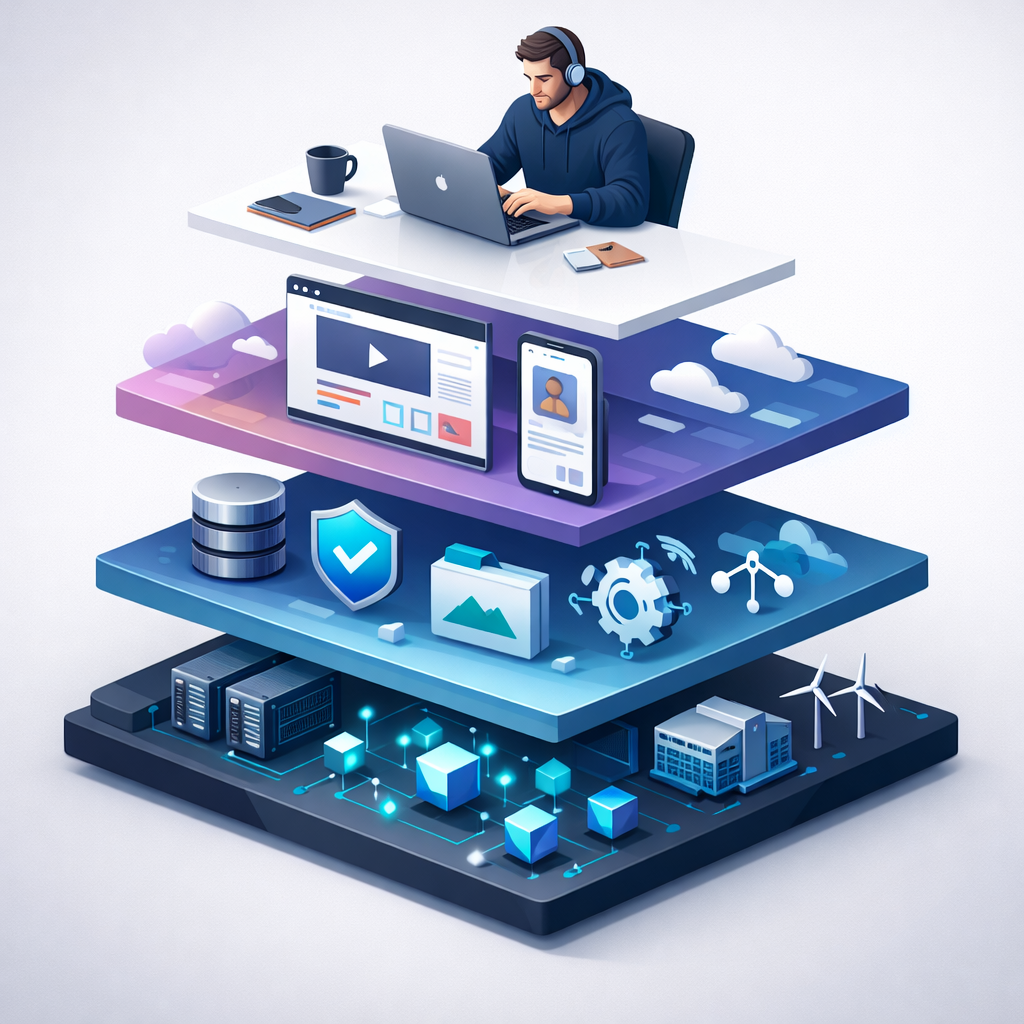

The ERP market has split into two distinct generations, and the gap between them is widening fast. This ERP system comparison cuts through the vendor noise to show exactly where traditional and AI-driven platforms differ — in cost, capability, and day-to-day operational impact. Traditional systems were built for stability and control. They work, but they demand significant time, budget, and technical overhead to maintain. AI-driven platforms are built for speed, automation, and decision support that lean entrepreneurial teams can actually leverage. If you’ve already explored the complete guide to AI ERP software and are now ready to choose, this is the honest breakdown — without vendor bias.
Why this comparison matters more than ever in 2025
The ERP decision has never been more consequential for entrepreneurial businesses, and it has never been more confusing. The market is flooded with platforms that call themselves AI-driven while delivering little more than a slightly smarter dashboard. At the same time, legacy vendors are bolting AI features onto decade-old architectures and marketing the result as transformation.
Cutting through that noise requires a clear framework for what actually separates these two generations of software — not in terms of marketing language, but in terms of how they behave inside a real business, under real operational pressure, with a real team trying to use them every day.
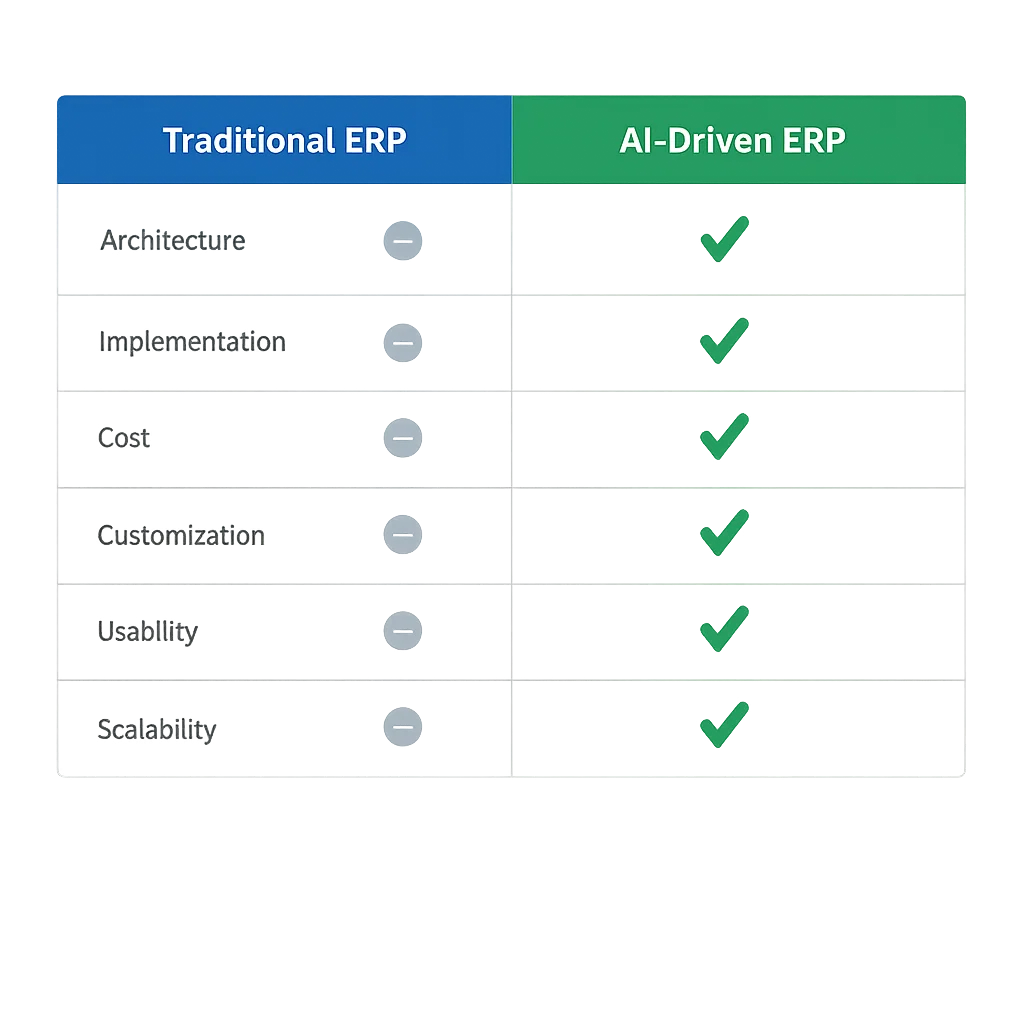
This comparison is built on that framework. It covers architecture, cost, implementation, usability, automation depth, and scalability — the six dimensions that actually determine whether an ERP platform fits your business or fights it.
How traditional ERP systems were built and what they were built for
Traditional ERP systems emerged in the 1990s and early 2000s as a response to a specific problem: large enterprises had operational data scattered across incompatible systems, and the cost of that fragmentation was enormous. SAP, Oracle, and Microsoft built platforms that centralized that data and enforced standardized processes across the organization.
The architecture they chose was on-premise, meaning the software ran on servers owned and maintained by the business. Updates were infrequent, often annual, and required dedicated IT teams to deploy. Customization was extensive but expensive — modifying a traditional ERP to fit a specific business workflow could take months of development work and cost hundreds of thousands of dollars.
The model worked for the organizations it was designed for. A multinational manufacturer with a dedicated IT department, a multi-year implementation budget, and stable processes that didn’t need to change frequently could extract enormous value from these platforms.
The problem is that this model was never designed for entrepreneurial businesses. The cost structure, the implementation timeline, the IT dependency, and the rigidity of the architecture are fundamentally misaligned with how fast-moving, lean organizations actually operate.
Traditional ERP systems that survived into the cloud era adapted by moving their architectures online, but many carried the underlying design assumptions of their on-premise origins with them. The interface improved. The core logic often didn’t.
What AI-driven ERP systems actually do differently
The distinction between an AI-driven ERP and a traditional one is not primarily about interface design or cloud hosting. It is about the relationship between the system and the data it manages.
Traditional ERP systems are record-keeping platforms. They store what happened, generate reports when asked, and wait for a human to interpret the output and decide what to do next. The intelligence lives entirely with the user.
AI-driven ERP systems are decision-support platforms. They analyze patterns in the data continuously, surface insights proactively, automate routine decisions based on rules the business sets, and flag anomalies before they become problems. The intelligence is distributed between the user and the system.
In practical terms, this difference shows up in five specific ways.
Proactive alerts versus reactive reports. A traditional ERP generates a cash flow report when you ask for one. An AI-driven platform alerts you three weeks in advance that your cash position is trending toward a gap based on current receivables and projected expenses.
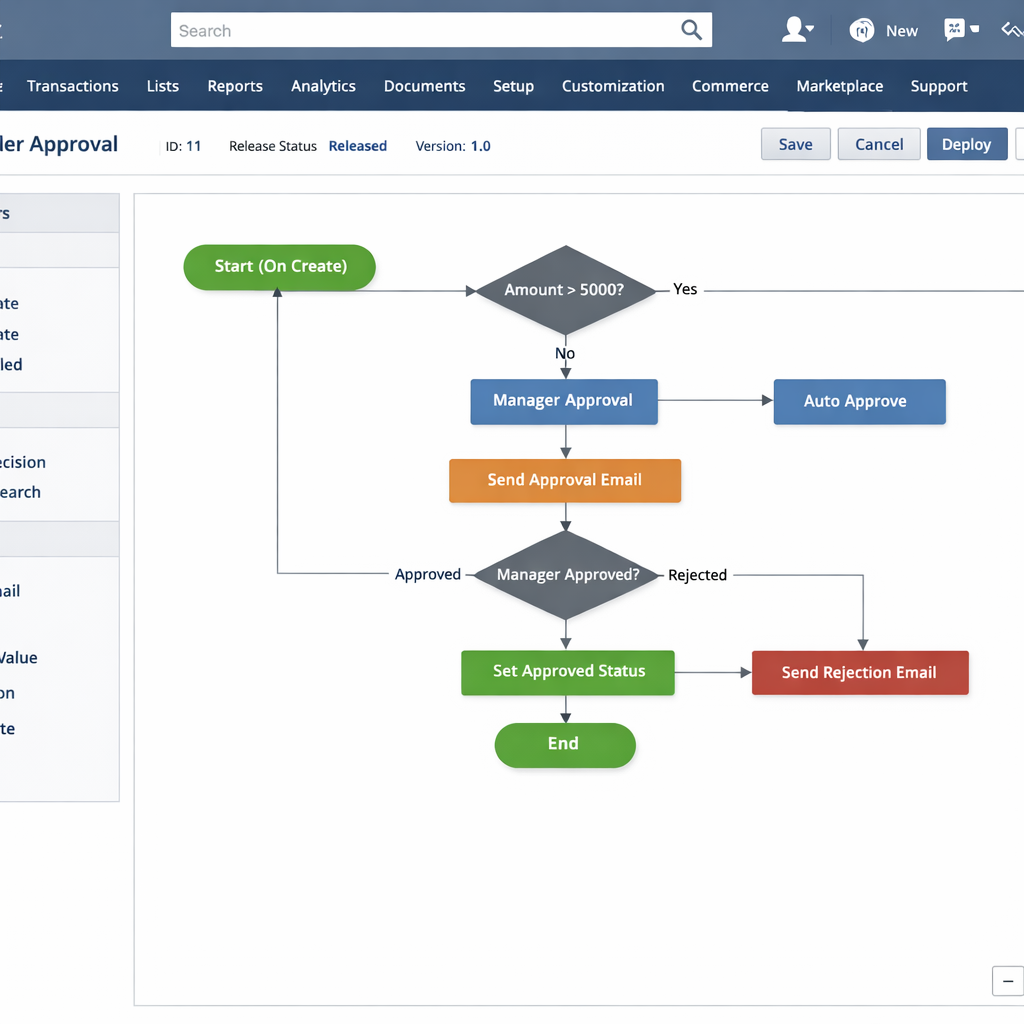
Automated workflow execution versus manual process management. A traditional ERP records that an inventory item has hit its reorder point. An AI-driven platform automatically generates the purchase order, routes it for approval, and sends it to the supplier — based on automation rules you configured once.
Natural language interaction versus structured queries. Leading AI-driven platforms now allow users to ask questions in plain language — what were my three highest-margin products last quarter— and receive immediate answers without building a custom report.
Continuous learning versus static configuration. AI-driven systems improve their predictions over time as they accumulate more of your business’s data. A demand forecast generated after 12 months of operational data is meaningfully more accurate than one generated after 30 days.
Anomaly detection versus scheduled audits. Traditional systems surface errors when someone looks for them. AI-driven platforms flag unusual patterns — a duplicate payment, an inventory count that doesn’t match purchase history, an expense that falls outside normal parameters — automatically and in real time.
Head-to-head comparison across six critical dimensions
Architecture and deployment
Traditional ERP platforms, even cloud-hosted versions, are often built on monolithic architectures — large, tightly coupled codebases where changing one component affects others. Updates are managed by the vendor on a fixed release schedule.
AI-driven ERP platforms are typically built on modern microservices architectures, where individual components can be updated, scaled, or replaced independently. This means faster feature releases, more reliable uptime, and easier integration with third-party tools.
Advantage: AI-driven ERP. The architectural flexibility of modern platforms translates directly into lower maintenance overhead and faster adaptation to business needs.
Implementation timeline and complexity
Traditional ERP implementations for mid-sized businesses typically run six to eighteen months. They require dedicated implementation partners, extensive customization work, and significant internal resource investment.
AI-driven ERP implementations for comparable businesses typically run two to six months. Modern platforms are designed with faster onboarding in mind — pre-built industry templates, guided setup workflows, and modular deployment mean you can go live with core functionality quickly and expand over time.
Advantage: AI-driven ERP. For entrepreneurial businesses that can’t pause operations for a year-long implementation project, the faster deployment timeline is a material operational advantage.
Total cost of ownership
Traditional ERP licensing often involves large upfront costs, annual maintenance fees, and significant ongoing IT and customization expenses. The total first-year cost for a mid-sized business can easily reach six figures when implementation partner fees are included.
AI-driven ERP platforms typically operate on subscription models with per-user monthly pricing. Implementation costs are lower, ongoing maintenance is handled by the vendor, and the modular structure means you’re only paying for the capabilities you’re actually using.
Advantage: AI-driven ERP for most entrepreneurial businesses. The exception is very large deployments where the cumulative subscription cost over a decade may approach or exceed a traditional licensing investment.
Customization depth
Traditional ERP platforms offer deep customization — almost any workflow can be modified with sufficient development investment. This is genuinely valuable for businesses with highly specialized processes that no standard platform configuration can accommodate.
AI-driven ERP platforms offer configuration flexibility but more limited customization depth. Most entrepreneurial businesses will never hit that ceiling, but businesses with genuinely unique operational requirements may find the constraints limiting.
Advantage: Traditional ERP for businesses with highly specialized workflows. AI-driven ERP for the majority of entrepreneurial operations that can adapt to standard platform configurations.
Usability and adoption
Traditional ERP interfaces were built by engineers for power users. They are functional but rarely intuitive, and the learning curve is steep enough that many businesses hire dedicated ERP administrators to manage the system.
AI-driven ERP platforms are designed with the end user in mind. Modern interfaces, role-based dashboards, and guided workflows mean faster team adoption and lower training overhead.
Advantage: AI-driven ERP. Faster adoption translates directly into faster time-to-value from the implementation investment.
Scalability
Traditional ERP platforms were built to handle enterprise-scale complexity and can accommodate enormous transaction volumes, multiple legal entities, and complex global operations.
AI-driven ERP platforms have closed the scalability gap significantly over the past five years. Leading platforms like NetSuite and Microsoft Dynamics 365 handle multi-entity, multi-currency, and high-volume operations reliably. Some newer platforms still have scalability ceilings that more established tools don’t.
Advantage: Traditional ERP at true enterprise scale. AI-driven ERP for the vast majority of entrepreneurial businesses that will never approach those limits.
The hidden costs most entrepreneurs miss on both sides
The sticker price of an ERP platform is rarely the number that matters most. The costs that surprise entrepreneurs most often on both sides of this comparison fall into three categories.
Internal time investment. Both platform types require significant internal time during implementation — process mapping, data migration, configuration decisions, team training. This time has a real cost even when it doesn’t appear on an invoice. Traditional ERP implementations typically demand more of this internal time, but AI-driven implementations are not trivial either. Budget for it explicitly.
Integration development. Every tool your ERP needs to connect to — your e-commerce platform, your payment processor, your 3PL, your payroll provider — requires either a native integration or custom development work. Traditional ERP platforms often require expensive custom integration work. AI-driven platforms typically offer broader native integration libraries, but gaps still exist. Audit your integration requirements before signing any contract.
Change management and retraining. When a team moves from a familiar set of tools to a new platform, productivity dips before it improves. That dip has a cost. Teams that invest in structured change management — clear communication, role-specific training, designated champions — recover faster. Teams that treat adoption as automatic pay the cost in errors, workarounds, and delayed value realization.
When traditional ERP still makes sense
This comparison has leaned toward AI-driven ERP for most entrepreneurial use cases, and that lean is justified by the evidence. But there are specific situations where traditional ERP platforms remain the stronger choice.
Highly regulated industries with complex compliance requirements. Some industries — aerospace, defense, pharmaceuticals, certain financial services categories — have compliance and audit trail requirements that legacy ERP platforms were specifically built to satisfy. The depth of compliance tooling in platforms like SAP S/4HANA is genuinely difficult to match with newer alternatives.
Businesses with deeply customized legacy implementations. If your business has spent years and significant capital customizing a traditional ERP to fit highly specific workflows, the migration cost to a new platform may outweigh the operational benefits of the switch. A thorough cost-benefit analysis is warranted before committing to a migration.
Enterprise-scale operations with global complexity. Multi-country operations with complex transfer pricing, multiple legal entities, and high transaction volumes may still find that enterprise-grade traditional platforms offer capabilities that newer alternatives haven’t fully replicated.
For everything outside those specific scenarios, the operational advantages of AI-driven ERP — faster implementation, lower total cost, better usability, and genuine automation depth — make a compelling case for the modern approach.
To see how specific AI-driven platforms stack up against each other within that category, the best AI ERP software comparison gives you a detailed breakdown by business type and use case.
Making the decision with confidence
The framework for making this decision is simpler than the vendor landscape makes it appear.
If your business is under 250 employees, growing faster than your current tools can support, and doesn’t have a specialized compliance or customization requirement that only a legacy platform can satisfy — an AI-driven ERP is almost certainly the right direction.
The remaining question is which platform within that category fits your specific situation. That answer depends on your industry, your transaction volume, your existing tech stack, and your team’s capacity for change. None of those variables can be resolved by a feature comparison alone.
The entrepreneurs who make this decision well are the ones who start with an honest assessment of their operational constraints, talk to real customers of the platforms they’re considering, and choose based on fit rather than brand recognition or sales pressure.
Once you’ve made the platform decision, the next critical variable is execution. The AI ERP implementation guide gives you a stage-by-stage framework for getting the platform live without disrupting the operations you’re trying to improve.
Conclusion
The gap between AI-driven and traditional ERP is not just a technology gap. It is a philosophy gap. Traditional platforms were built around the assumption that humans interpret data and make all decisions. AI-driven platforms are built around the assumption that the system should handle the routine so that humans can focus on the consequential.
This ERP system comparison points in one clear direction for entrepreneurial businesses that need to move fast, operate lean, and make good decisions with imperfect information. The technology has matured enough that the risk of adopting a modern platform is no longer a serious objection. The risk of not adopting one — while competitors build smarter infrastructure — is increasingly the more expensive choice.
If cost is still the variable holding back your decision, the full breakdown of what small businesses actually pay for ERP software gives you the real numbers before you commit to anything.