

The biggest barrier to AI implementation in manufacturing is rarely budget it is the absence of a clear starting point that non-technical founders can actually execute. Most roadmaps assume you have an in-house data team, which immediately makes them useless for the majority of entrepreneurs running lean operations. A grounded understanding of AI in industrial automation: what actually works in 2026 makes it significantly easier to sequence your investments without wasting the first six months on the wrong infrastructure. This page gives you the practical framework for AI implementation in manufacturing that skips the theory and starts with what moves the needle AI implementation manufacturing.
The gap between wanting to implement automation and actually doing it successfully is not a technology gap. The platforms are capable. The use cases are proven. The vendors are ready to sell. The gap is almost always a sequencing and preparation problem — moving to deploy before the operational foundation is ready, or choosing the wrong starting point because the evaluation process was driven by vendor enthusiasm rather than operational clarity.
AI implementation in manufacturing fails expensively when it is treated as a technology project. It succeeds when it is treated as an operational change with a technology component. That distinction sounds simple. In practice, it changes almost every decision in the process.
This roadmap is built for entrepreneurs who want to move forward without the six-figure mistakes that come from skipping the steps that actually matter.
Why most first attempts at AI implementation in manufacturing stall
Before mapping the path forward, it is worth understanding the failure patterns clearly. They are consistent enough across industries and operation sizes that recognizing them in your own planning process is genuinely protective AI implementation manufacturing.
Starting with the platform instead of the problem: The most common version of this mistake is attending a vendor demo, getting impressed by the dashboard, and working backward to find a use case that justifies the purchase. The platform becomes the answer before the question is defined. Deployments that start this way almost always produce systems that are technically operational but operationally irrelevant — dashboards that nobody acts on, alerts that nobody trusts, and a renewal conversation that is hard to justify.
Underestimating data readiness: Every AI implementation in manufacturing depends on data. Not just the existence of data, but data that is accurate, consistent, and accessible in a format the platform can use. Operations that skip the data readiness assessment and go straight to platform deployment spend the first several months of their implementation cleaning data retroactively — which is slower, more expensive, and more disruptive than doing it before deployment.
Trying to automate too much at once: The instinct to capture the full value of automation immediately is understandable but consistently counterproductive. Broad deployments across multiple use cases simultaneously multiply the complexity, the integration requirements, the change management burden, and the number of things that can go wrong at once. The operations that build durable automation capabilities almost always start narrow and expand methodically.
Neglecting the human side of the transition: AI implementation in manufacturing changes how people work. Floor supervisors who have managed by instinct for fifteen years are now expected to act on system recommendations. Maintenance technicians whose value came from knowing machines intimately are now working alongside predictive systems. If the change management piece — communication, training, building trust in the system — is treated as an afterthought, adoption fails regardless of how good the technology is.
operational diagnosis before any technology decision
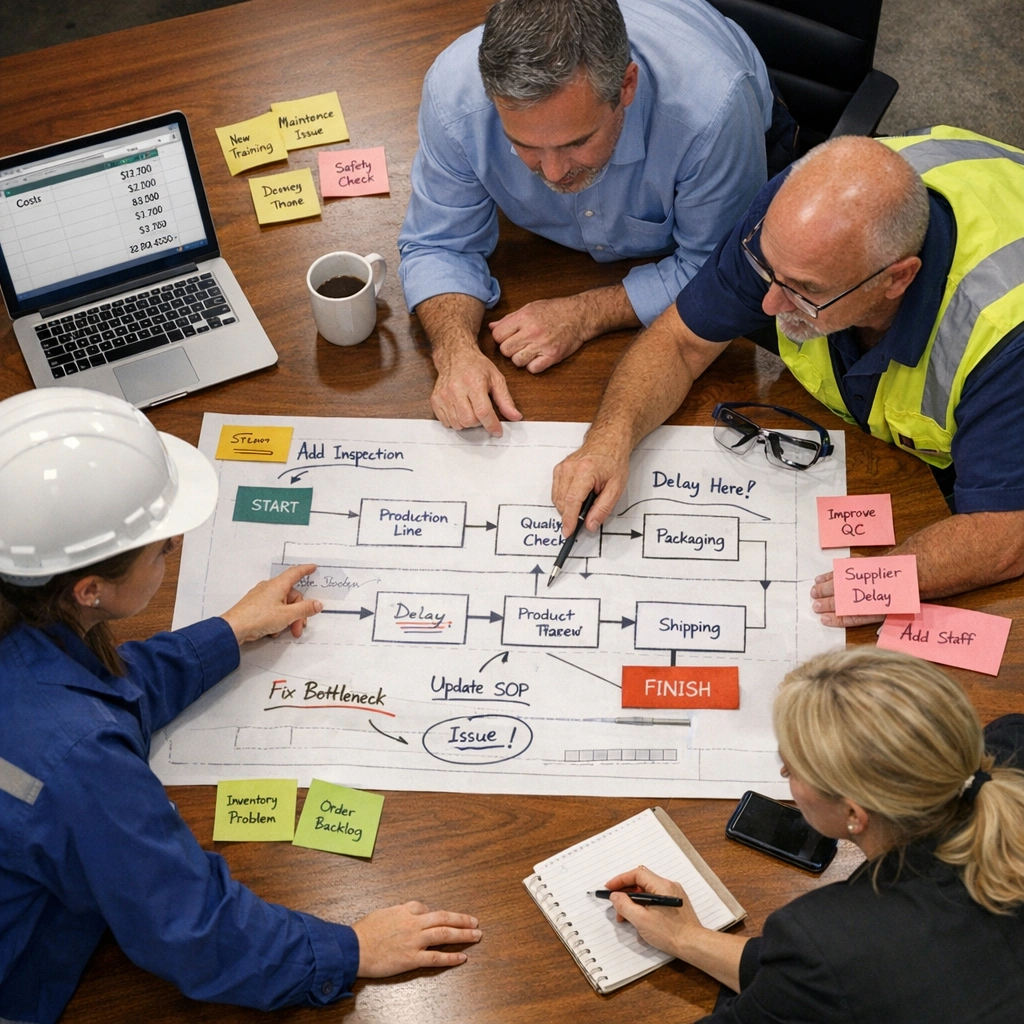
The first phase of successful AI implementation in manufacturing has nothing to do with technology. It is a structured assessment of your operation designed to answer one question: where is the highest-value problem that automation can solve, given where your operation actually is today?
This assessment covers four areas.
Cost and loss mapping: Where is your operation losing money in ways that are measurable and recurring? Unplanned downtime, quality defects reaching customers, excess inventory, energy waste, labor inefficiency in specific process steps. Quantify each one in annual cost terms. This becomes your opportunity map — the ranked list of problems that automation could address, sized by their financial impact.
Data availability audit: For each problem on your opportunity map, what data currently exists that is relevant to solving it? Machine sensor data, production records, quality logs, maintenance history, energy consumption records. Assess both existence and quality. Data that exists but is siloed in paper logs or inconsistent spreadsheets requires remediation before it can support an automation deployment.
Process stability assessment: Automation amplifies what already exists in your processes. A stable, well-documented process becomes more efficient when automated. An unstable, poorly understood process becomes a faster version of its existing problems. Before automating any process, assess whether it is stable enough to automate — or whether process improvement needs to come first.
Organizational readiness evaluation: Does your team have the capacity to support an implementation alongside their existing responsibilities? Is there a clear internal owner for the deployment — someone with both the authority to make decisions and the operational credibility to drive adoption on the floor? Implementations without a strong internal owner consistently underperform regardless of platform quality.
use case selection and prioritization
With a clear opportunity map and an honest data readiness assessment, the use case selection process becomes straightforward. You are looking for the intersection of three criteria: high financial impact, adequate data availability, and reasonable implementation complexity for your current organizational capacity AI implementation manufacturing.
The use cases that consistently score well on all three criteria for first deployments are predictive maintenance on high-criticality rotating equipment, quality inspection automation at a single high-volume inspection point, and demand forecasting for a defined product category with at least 24 months of clean sales history.
Predictive maintenance typically wins on financial impact — unplanned downtime is one of the most expensive recurring costs in asset-heavy operations — and on data availability, since most modern equipment already generates the sensor data that predictive systems need. The full deployment approach for this use case is covered inpredictive maintenance AI: stop paying for breakdowns, which is worth reading before you begin vendor conversations.
Quality inspection automation wins when your current defect escape rate has a measurable customer impact — returns, complaints, warranty claims — and when your inspection point is physically accessible for camera mounting and has consistent, controllable lighting. The platform comparison and implementation detail for this use case is in machine vision manufacturing: why manual inspection is failing you.
Demand forecasting wins when inventory carrying cost or stockout frequency is a significant margin driver and when your sales data history is clean and complete. The full breakdown of forecasting platforms and deployment expectations is inAI supply chain optimization: end the guesswork for good.
The use case that scores highest on your specific opportunity map, given your specific data readiness, is the right starting point. Not the one with the most impressive vendor demo.
vendor selection without the theater
Vendor selection for AI implementation in manufacturing deserves more discipline than most entrepreneurs apply to it. The standard process — attend demos, collect proposals, compare feature lists, negotiate on price — produces decisions that look thorough but frequently miss the factors that determine whether a deployment actually succeeds.
The evaluation criteria that matter most are not the ones vendors lead with.
Reference customers at your scale and complexity: Ask every vendor for reference customers who are comparable to your operation in size, industry, and technical complexity. Not their flagship enterprise deployment — operations that resemble yours. Talk to those customers directly and ask specifically about implementation timeline, data preparation requirements, and what they would do differently.
Implementation support model: Who actually does the implementation work? Some vendors have strong in-house implementation teams. Others rely heavily on third-party systems integrators whose quality varies significantly. Understand exactly who will be working on your deployment and what their track record looks like.
Data integration specifics: Ask the vendor to walk you through, specifically, how their platform will connect to your existing equipment, your ERP, and your quality management system. Generic answers about “open APIs” and flexible integration are not specific answers. If they cannot describe the integration path for your specific systems, they have not done the pre-sales work to earn the evaluation.
Total cost over 36 months: Request a 36-month total cost projection that includes license fees, implementation services, training, ongoing support, and any hardware requirements. Compare platforms on this number, not on annual license cost alone.
implementation execution and the 90-day milestone
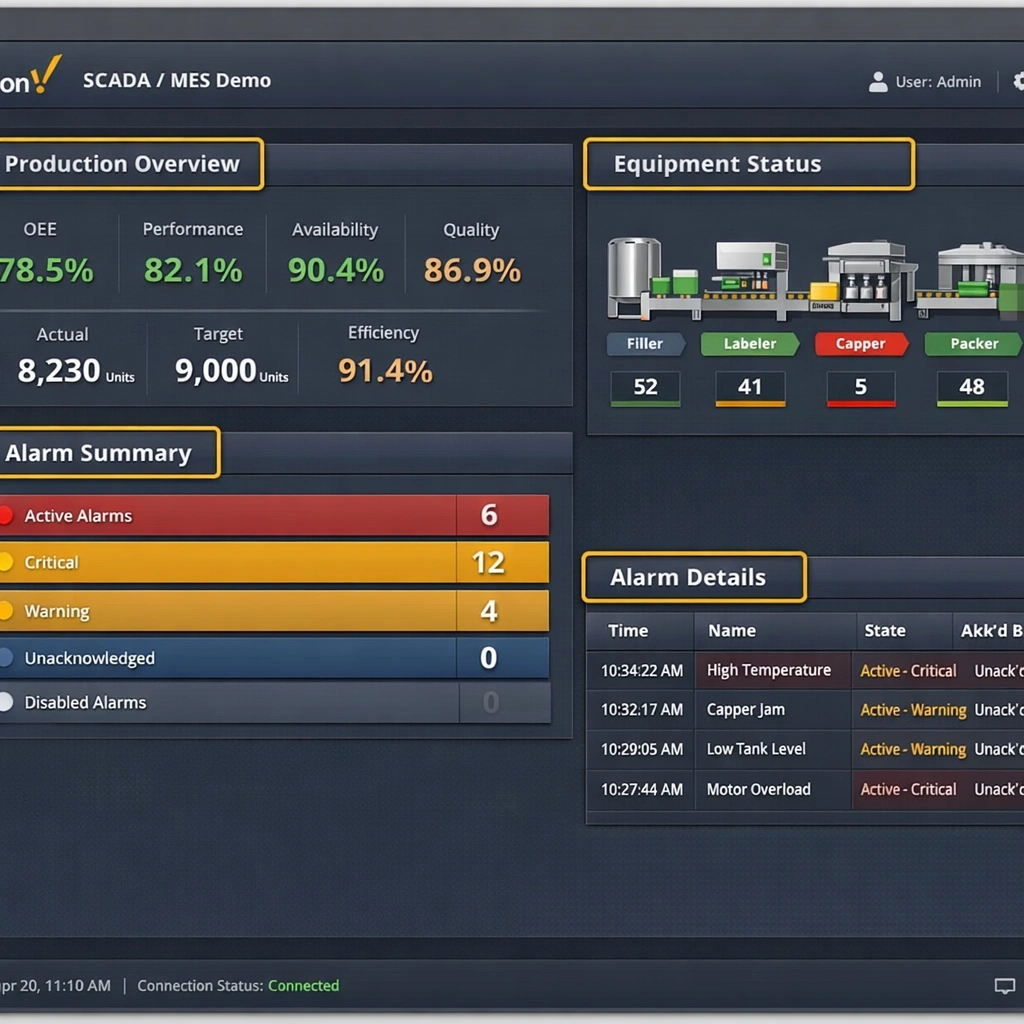
A well-structured AI implementation in manufacturing deployment follows a phased execution model that builds confidence and demonstrates value before expanding scope.
Days 1 to 30 — infrastructure and baseline: Install sensors or connect to existing data sources. Establish data flows to the platform. Configure the initial monitoring or analytics environment. Define your measurement baselines — the pre-deployment performance metrics against which you will evaluate the system’s impact. This phase should end with data flowing reliably and a clear picture of what “normal” looks like for the monitored assets or processes.
Days 31 to 60 — calibration and validation: Run the system in parallel with your existing processes. Do not act on system recommendations yet — use this period to validate that the system’s outputs align with what your experienced operators know to be true. Where the system’s assessments diverge from operator knowledge, investigate the discrepancy rather than defaulting to either the system or the human. Both can be right. Both can be wrong. The calibration period is how you find out.
Days 61 to 90 — first operational decisions: Begin acting on system recommendations for a defined subset of decisions — maintenance scheduling for monitored assets, quality alerts at the automated inspection point, or replenishment recommendations for the forecasted product category. Track every decision and its outcome. By day 90, you should have enough data to make an honest assessment of whether the system is delivering value against your pre-deployment baselines.
The 90-day milestone is a genuine decision point, not a formality. If the system is delivering measurable improvement, the case for expanding scope is clear. If it is not, the 90-day review gives you the data to understand why — whether the issue is model calibration, data quality, integration gaps, or adoption problems — before those issues compound across a broader deployment.
scaling from first win to operational capability
The operations that build durable competitive advantage from AI implementation in manufacturing are the ones that treat the first deployment as infrastructure rather than as a finished project. The first use case proves the model, builds organizational confidence, and creates the data foundation that makes subsequent deployments faster and cheaper.
The scaling sequence that works best follows the value chain of your operation. If predictive maintenance was your first deployment, the natural next step is connecting that equipment health data to your production scheduling system — so that maintenance windows are automatically reflected in your production plan rather than handled through manual coordination. If demand forecasting was your first deployment, the natural next step is extending that forecast accuracy into your production scheduling and supplier ordering processes.
Each expansion leverages the data infrastructure and organizational capability built in the previous phase. The compounding effect of sequential deployments — each one building on the last — is what separates operations that extract sustained value from automation from those that perpetually restart with new platforms and new promises.
For entrepreneurs who want to understand how all of these layers connect into a coherent operational strategy,industrial automation software: the honest comparison for 2026covers the platform landscape that sits beneath these use cases and how to evaluate it without getting lost in vendor claims.
The internal capability you are actually building
AI implementation in manufacturing is not just a series of technology deployments. Done well, it builds an organizational capability — the ability to identify high-value automation opportunities, assess data readiness, select and deploy platforms effectively, and measure results honestly — that compounds in value over time.
Operations with this capability move faster on each subsequent deployment because the organizational muscle memory is already there. They make better vendor selections because they know the right questions. They achieve faster time-to-value because their data infrastructure is already in place. And they retain the talent that wants to work in environments where operational decisions are grounded in data rather than driven by the loudest voice in the room.
That capability does not develop automatically. It develops through deliberate practice — starting with a well-chosen first deployment, measuring it honestly, learning from what worked and what did not, and applying those lessons to the next one.
Conclusion
AI implementation in manufacturing is not a leap. It is a sequence of well-prepared steps, each one building the foundation for the next. The entrepreneurs who execute it successfully are not the ones with the largest budgets or the most technical teams. They are the ones who define their problems precisely, assess their readiness honestly, select platforms against their specific operational requirements, and measure their results with enough discipline to know when something is working and when it needs adjustment.
The roadmap exists. The platforms are ready. The only thing left is the decision to start — and the discipline to start in the right place.