

Reacting to supply chain disruptions after they happen is a strategy that costs margin every single time. AI supply chain optimization shifts that dynamic by forecasting demand patterns, identifying supplier risk early, and automating reorder decisions before stockouts occur. Entrepreneurs who treat this as a standalone fix often miss the compounding effect it creates when integrated into a broader AI in industrial automation: what actually works in 2026 strategy. This page gives you a grounded look at what AI supply chain optimization can and cannot do for your operation today.
Most supply chain problems look like logistics problems on the surface. A stockout here, a delayed shipment there, an overstock situation that ties up cash for three months. But trace any of them back far enough and you almost always find the same root cause: a decision made on incomplete or outdated information.
AI supply chain optimization does not fix your logistics network by making it faster. It fixes the information layer that your decisions run on. And when that layer improves, everything downstream — inventory positioning, supplier relationships, production scheduling, customer fulfillment — improves with it.
For entrepreneurs running operations where margin is tight and demand is variable, this is not a theoretical benefit. It is a direct line to better cash flow, fewer emergency purchases, and a supply chain that bends without breaking when conditions change.
What AI supply chain optimization actually changes
Traditional supply chain planning relies on two inputs that are both structurally limited: historical averages and human judgment. Historical averages assume the future will resemble the past. Human judgment fills in the gaps, but it does so inconsistently and at a speed that rarely matches the pace of market change.
AI supply chain optimization replaces those inputs with something more dynamic. It ingests a broader set of signals sales history, seasonal patterns, promotional calendars, supplier lead time variability, weather data, economic indicators, even social trend signals for consumer-facing businesses — and builds forecasts that update continuously as new data arrives.
The practical result is a planning system that tells you not just what you sold last month, but what you are likely to need next month, which suppliers are most likely to be late, and where your inventory positioning is creating risk right now.
The three areas where this change produces the most immediate financial impact are demand forecasting accuracy, inventory optimization, and supplier risk management.
Demand forecasting: from educated guessing to data-driven precision
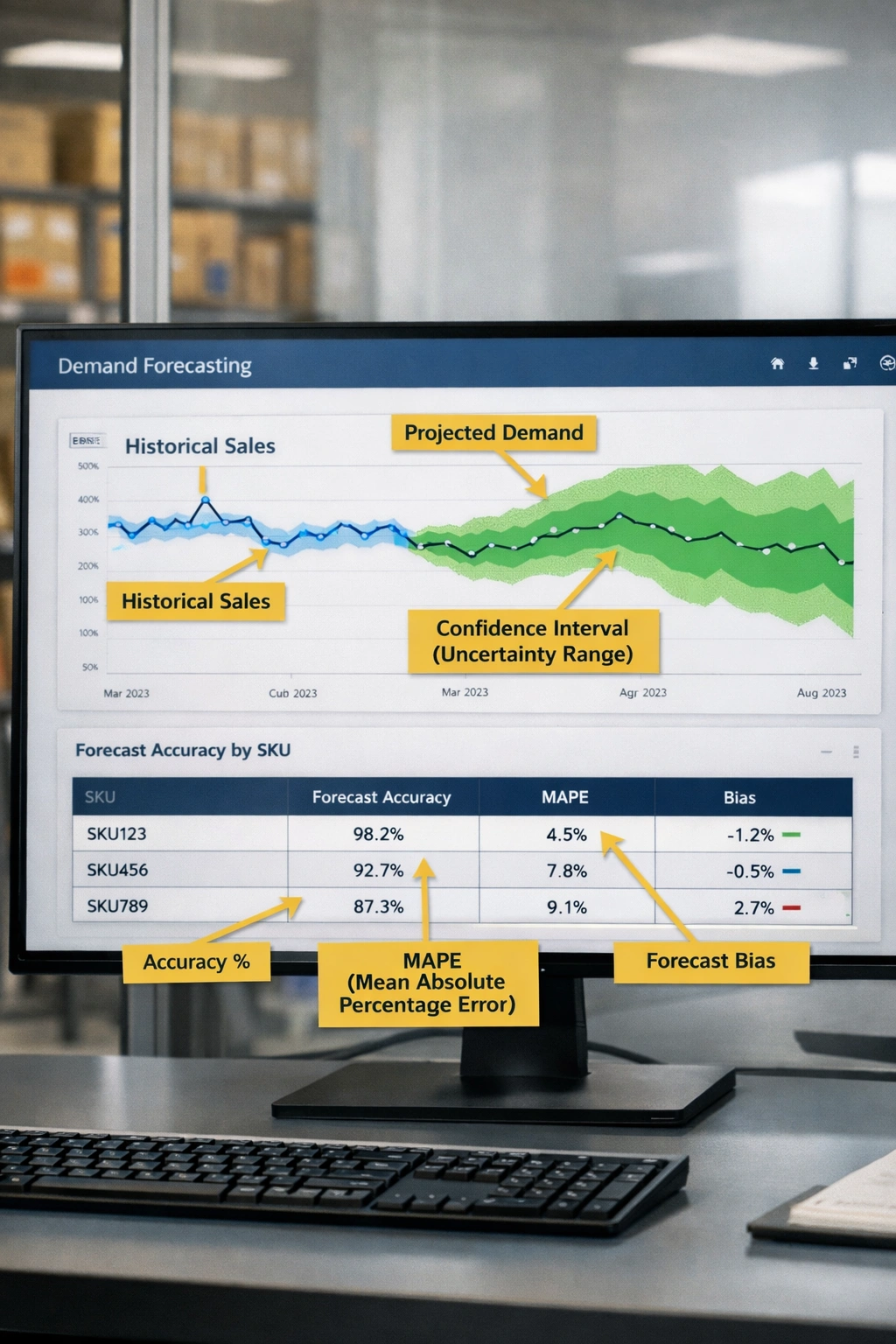
Demand forecasting is where most AI supply chain optimization deployments start, and for good reason. Forecast accuracy is the upstream variable that determines the quality of almost every other supply chain decision. If your forecast is wrong, your inventory levels are wrong, your production schedule is wrong, and your supplier purchase orders are wrong. Everything cascades from that first error.
Traditional forecasting methods — moving averages, exponential smoothing, simple regression models — work reasonably well in stable, predictable environments. They fail in proportion to how much variability your business faces: new product introductions, promotional spikes, channel shifts, seasonal compression, supply disruptions. The more dynamic your environment, the more those methods underperform.
AI-driven forecasting handles variability better because it is not constrained to a single statistical model. Modern platforms run multiple model types simultaneously — time series models, machine learning models, causal models that incorporate external variables — and weight their outputs based on which is performing best for each product category under current conditions. This ensemble approach, combining outputs from multiple models rather than relying on one, consistently outperforms any single method across varied product portfolios.
The documented improvement in forecast accuracy from well-implemented AI supply chain optimization typically falls in the range of 20 to 40 percent reduction in forecast error, measured against the previous planning method. For operations carrying meaningful inventory, that accuracy improvement translates directly into reduced safety stock requirements and fewer emergency replenishment orders.
Entrepreneurs who have already assessed their quality control infrastructure through machine vision manufacturing: why manual inspection is failing youwill recognize the same pattern here: the biggest gains come from replacing a process that has a structural ceiling, not just optimizing one that is already working well.
Inventory optimization: stop paying to hold the wrong stock
Inventory is cash in a frozen state. Too much of it ties up working capital and creates write-off risk. Too little creates stockouts, lost sales, and the kind of customer experience that does not recover easily. Most operations that have not deployed AI supply chain optimization are running both problems simultaneously: overstocked on slow movers, understocked on fast ones.
The reason this happens under traditional planning is that reorder points and safety stock calculations are typically set once and reviewed infrequently. They do not automatically adjust when a product’s demand pattern changes, when a supplier’s lead time increases, or when a new competitor enters a category and shifts purchase behavior.
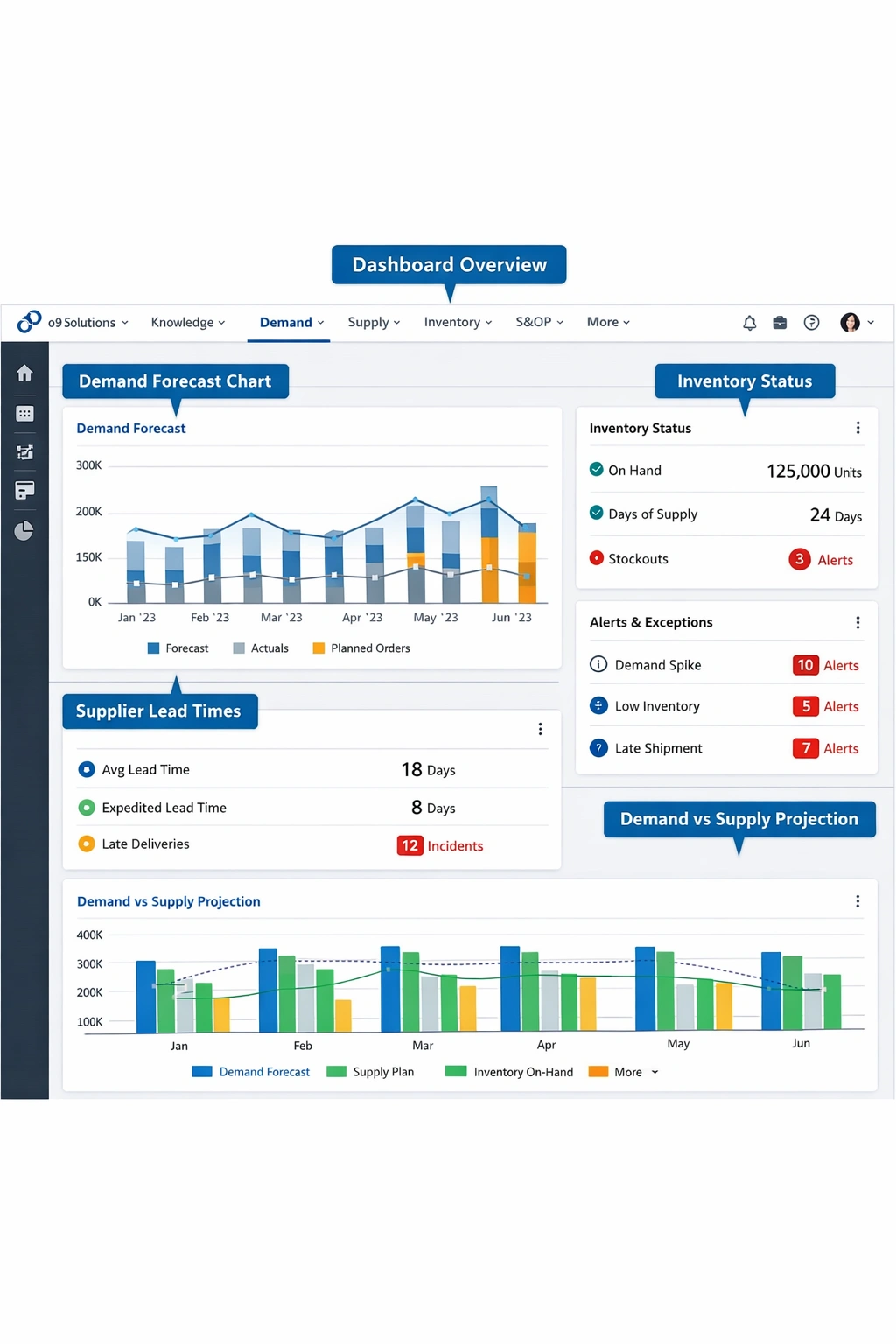
AI supply chain optimization recalculates these parameters continuously. Every SKU’s reorder point, safety stock level, and order quantity recommendation updates as the underlying data changes. The system flags items where current stock positions are creating risk — either excess or shortage — and surfaces those alerts before the situation becomes a problem rather than after.
For multi-location operations, the optimization layer also addresses inventory positioning across sites. Which warehouse should hold which stock to minimize fulfillment cost and maximize service level? As demand patterns shift geographically, the system updates those recommendations dynamically rather than waiting for a quarterly planning review.
Supplier risk management: know before the disruption hits
The supply chain disruptions of the early 2020s made supplier risk visible in a way that most operations had never experienced directly. The lesson for entrepreneurs was not that disruptions are unpredictable — it is that most operations had no early warning system when supplier conditions started to deteriorate.
AI supply chain optimization addresses this through continuous supplier monitoring. Modern platforms ingest financial health signals, news and regulatory data, shipping and customs delay patterns, and geographic risk indicators for supplier locations. When a supplier’s risk profile changes — a credit downgrade, a production facility in a region experiencing political instability, a pattern of increasing lead time variability — the system surfaces that information before it becomes a delivery failure.
This does not eliminate supplier risk. It converts it from a surprise into a manageable variable. Operations with this visibility can accelerate orders from at-risk suppliers before a disruption locks in, qualify alternative suppliers proactively rather than scrambling during a shortage, and adjust customer commitments with enough lead time to manage expectations rather than explain failures.
The connection between supplier risk visibility and broader operational resilience is developed further inAI in industrial automation: what actually works in 2026, which covers how supply chain intelligence fits alongside equipment reliability and quality control as part of a coherent automation strategy.
Platforms delivering results in 2026
The AI supply chain optimization platform market has matured into a clear tiered structure. Enterprise platforms built for global complexity, mid-market solutions designed for growing operations, and specialized tools focused on specific supply chain functions each serve a different buyer profile.
Blue Yonder (formerly JDA) is one of the most widely deployed enterprise supply chain platforms globally. Its demand forecasting and inventory optimization modules are built for high-SKU, multi-channel operations and carry a strong track record in retail, consumer goods, and manufacturing. The implementation complexity and cost reflect its enterprise positioning.
o9 Solutions has gained significant traction with mid-to-large manufacturers and distributors looking for an integrated planning platform that connects demand sensing, supply planning, and financial impact modeling in a single environment. Its scenario planning capabilities are particularly strong for operations facing significant demand uncertainty.
Kinaxis RapidResponse is the dominant platform for supply chain scenario planning in complex manufacturing environments. Its strength is speed running supply chain scenarios in real time rather than overnight batch processes which makes it particularly valuable for operations where conditions change faster than traditional planning cycles can accommodate.
Relex Solutions has built a strong position in retail and consumer goods supply chains, with demand forecasting and replenishment optimization capabilities that handle the promotional complexity and seasonal patterns that simpler platforms struggle with.
Llamasoft now part of Coupa focuses on supply chain network design — the strategic question of where to locate inventory and how to structure your supplier and distribution network — which complements operational planning tools rather than replacing them.
What to expect from a first deployment
The entrepreneurs who get AI supply chain optimization working fastest are the ones who resist the temptation to automate everything at once. The platforms are capable of broad deployment, but the learning curve — both for the system and for the planning team is steepest in the early months.
A focused first deployment targets one product category or one business unit rather than the full portfolio. This contains the data preparation work, makes the results easier to measure cleanly, and gives your planning team time to build confidence in the system’s recommendations before they are acting on them across the entire business.
The data preparation requirement is the most commonly underestimated part of the process. AI supply chain optimization runs on clean, structured historical data. Sales history, purchase orders, goods receipts, lead time records, and promotional calendars all need to be available, accurate, and formatted consistently before the platform can produce reliable forecasts. Operations that skip this step and go straight to platform configuration consistently report longer time-to-value and lower initial forecast accuracy.
A realistic timeline for a focused first deployment from data preparation through initial forecast generation to the first production planning cycle running on system recommendations — is 60 to 120 days depending on data readiness and integration complexity.
The metrics that confirm it is working
Setting measurement baselines before deployment is essential. The key metrics for AI supply chain optimization are:
Forecast accuracy by SKU category: Measure mean absolute percentage error (MAPE), the average percentage difference between forecasted and actual demand, before and after deployment. A meaningful improvement is a reduction of 20 percent or more against your pre-deployment baseline.
Inventory turnover rate: How many times per year does your average inventory sell through? Improving forecast accuracy should produce a measurable increase in turnover as excess safety stock is reduced.
Stockout frequency: Track the number of stockout events per month across monitored SKUs. This should decline as inventory positioning improves.
Emergency purchase rate: What percentage of your purchase orders are placed on an expedited basis at premium cost? This metric is a direct indicator of planning quality and should decline steadily after deployment.
Supplier on-time delivery rate: If your platform includes supplier monitoring, track whether proactive risk management is improving the percentage of orders delivered on time against commitment.
Conclusion
The supply chains that perform best under pressure are not the ones with the most inventory buffer or the most supplier redundancy. They are the ones with the best information. AI supply chain optimization is fundamentally an information quality upgrade — one that makes every planning decision downstream more accurate, more timely, and more responsive to conditions as they actually are rather than as they were six months ago.
The tools are mature. The deployment path is documented. The ROI case is measurable from the first planning cycle. For entrepreneurs running operations where demand variability or supplier complexity is a recurring source of margin erosion, this is one of the highest-return investments available in 2026.