

Most small business owners manage projects every single day without realizing it — they just do it without a system, which is where things fall apart. Understanding what is project management means recognizing that every client deliverable, product launch, or team task follows a lifecycle that can be planned, tracked, and improved.What is project management? Once you map that lifecycle, as outlined in the complete guide to project management for small businesses, you stop reacting to chaos and start running a predictable operation. This guide breaks down the core concepts so you can apply them immediately, even if you’re a team of one .
What is project management? Stop winging your workload
Running a business means juggling deadlines, people, budgets, and expectations — often all at once. Most entrepreneurs handle this through instinct and habit, which works until it doesn’t. When a client project slips, a product launch gets delayed, or a team member drops the ball because nobody was clear on who owned what, the root cause is almost always the same: there was no system. That system has a name — project management — and understanding it is the first step toward building a business that runs on intention rather than improvise.
What is project management, really?
What is project management?Project management is the practice of organizing work — defining what needs to get done, who is responsible, by when, and with what resources — so that a specific goal is reached predictably and efficiently. It applies to any effort that has a beginning, a middle, and an end. That includes a client website build, a product launch, a marketing campaign, an office relocation, or even onboarding a new hire.
The formal definition from the Project Management Institute describes it as the application of knowledge, skills, tools, and techniques to project activities to meet project requirements. In plain terms: it is the discipline of making sure work gets finished on time, within budget, and at the quality level your client or business expects.
What is project management is one of the most searched questions among entrepreneurs who feel the friction of growth — and the answer matters because the moment you treat your work as a series of managed projects rather than an ongoing blur of tasks, everything becomes easier to measure, improve, and delegate.
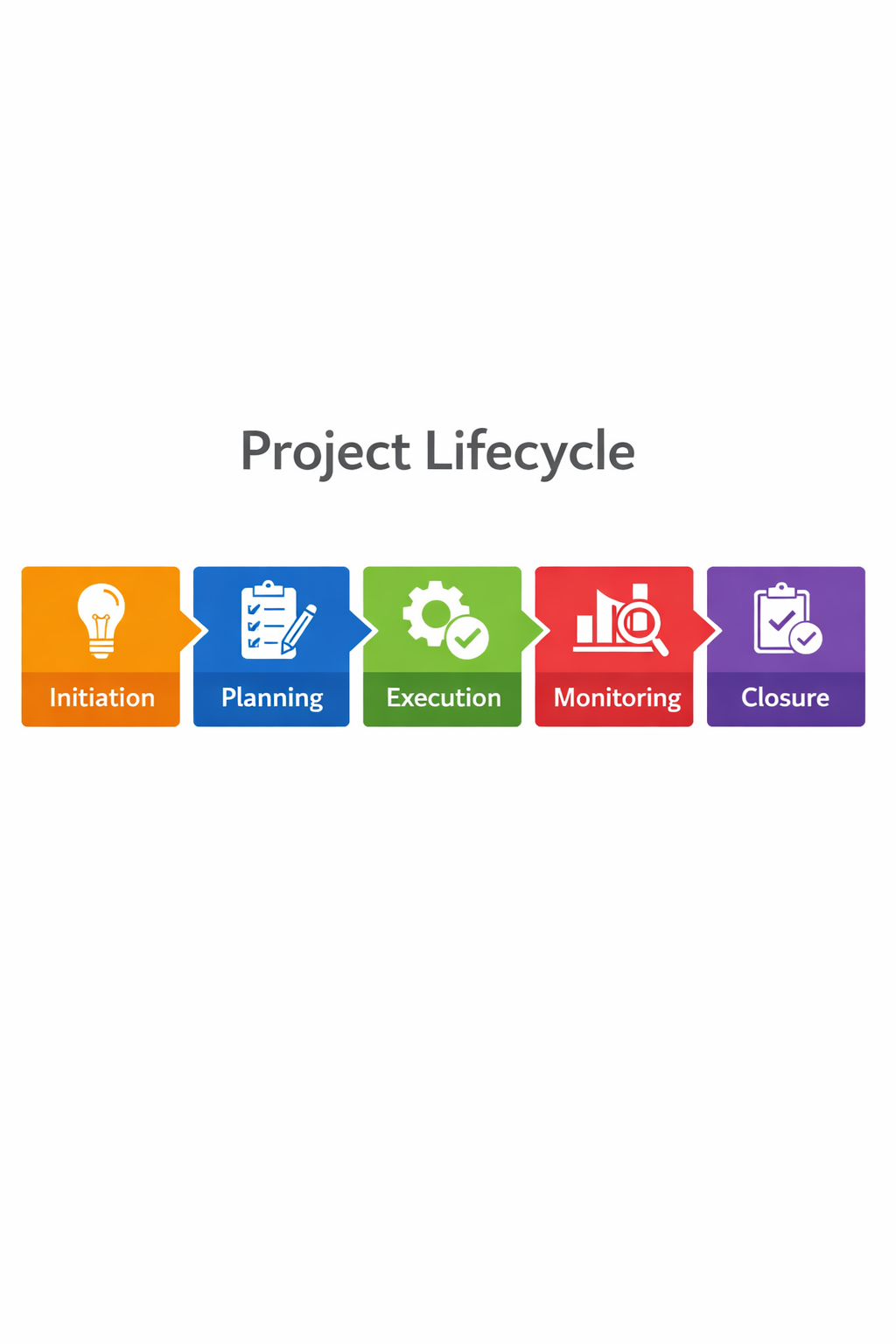
The five phases every project moves through
Whether you are building a mobile app or launching a new service offering, every project follows a predictable lifecycle. Understanding these phases helps you know where you are at any given moment and what decisions need to be made.
Initiation is where the project is defined at a high level. You identify the goal, the stakeholders — the people who have a stake in the outcome — and whether the project is worth doing at all. This is where scope, that is the boundaries of what the project includes and excludes, gets established for the first time.
Planning is where the real work of project management happens. You break the goal into tasks, assign ownership, set deadlines, allocate resources, and identify risks before they become problems. A strong plan, like the one detailed in how to build a project management plan from scratch, is the difference between a project that runs itself and one that needs constant firefighting.
Execution is where the team carries out the work defined in the planning phase. The project manager’s job here is to keep things moving, remove blockers, and ensure communication stays clear between everyone involved.
Monitoring and controlling runs parallel to execution. It means tracking progress against the plan — are tasks getting done on time? Is the budget holding? Are quality standards being met? This phase is where early warning signs get caught before they become crises.
Closure is the phase most small business owners skip entirely. It involves formally completing the project, documenting what worked and what didn’t, releasing team members from their project responsibilities, and delivering the final outcome to the client or stakeholder.
Why most small business owners struggle without it
The absence of project management does not look like chaos on day one. It looks like hustle. You are responsive, flexible, and getting things done through sheer effort. The problem is that hustle does not scale.
As your business grows, the cost of unclear ownership multiplies. Two people think they are responsible for the same task, so it gets done twice — or not at all because each assumed the other handled it. Deadlines get missed because nobody tracked dependencies, meaning the tasks that had to happen before other tasks could begin. Budgets erode because scope was never formally defined and clients keep adding requests without pushback.
These are not people problems. They are system problems. And what is project management if not the system that prevents them?
According to PMI’s Pulse of the Profession report, organizations that undervalue project management report significantly higher rates of failed projects, wasted budget, and scope creep — the gradual expansion of a project beyond its original boundaries — compared to those that invest in structured practices.
For entrepreneurs, this is not about adding bureaucracy. It is about building the kind of operational clarity that lets you take on more work, hire with confidence, and deliver consistently without burning yourself out in the process.
The three constraints that every project lives inside
Every project you manage operates within three competing forces, often called the triple constraint or the project management triangle.
Scope defines what the project includes. Time defines how long it takes. Cost defines how much it requires in budget and resources. These three are connected in a way that matters: if a client asks you to expand the scope of a project, either the timeline needs to extend, the budget needs to increase, or both. You cannot change one without affecting the others.
Understanding the triple constraint gives you a framework for every client conversation about changes. Instead of absorbing requests without pushback, you can explain the trade-off clearly: adding this feature means we either push the deadline by two weeks or we increase the budget by a specific amount. That is not a difficult conversation — it is a professional one.
There is also a fourth element many practitioners add to the model: quality. If you compress time and cost without reducing scope, quality takes the hit. Knowing where quality standards sit on your priority list helps you make faster decisions when trade-offs are necessary.
Core project management terms you need to know
The vocabulary of project management can feel intimidating at first, but most of the foundational terms are straightforward once you strip out the corporate language.
A milestone is a significant checkpoint in the project — not a task, but a marker that signals a phase has been completed or a major deliverable has been reached. A deliverable is any tangible output the project produces: a report, a prototype, a launched website, a signed contract.
A stakeholder is anyone who has an interest in the project outcome, including the client, your team, your vendors, or even the end users of whatever you are building. Risk refers to any uncertain event that could affect the project positively or negatively — most project managers focus on negative risks and build mitigation plans, meaning plans to reduce either the likelihood or impact of a risk if it occurs.
A baseline is the original approved version of the project plan — scope, schedule, and budget — against which progress is measured. When people talk about a project being over budget or behind schedule, they are comparing current status to the baseline.
If you want to go deeper on how these terms map to specific workflows and tools, the complete guide to project management for small businesses covers each one in context across the full project lifecycle.
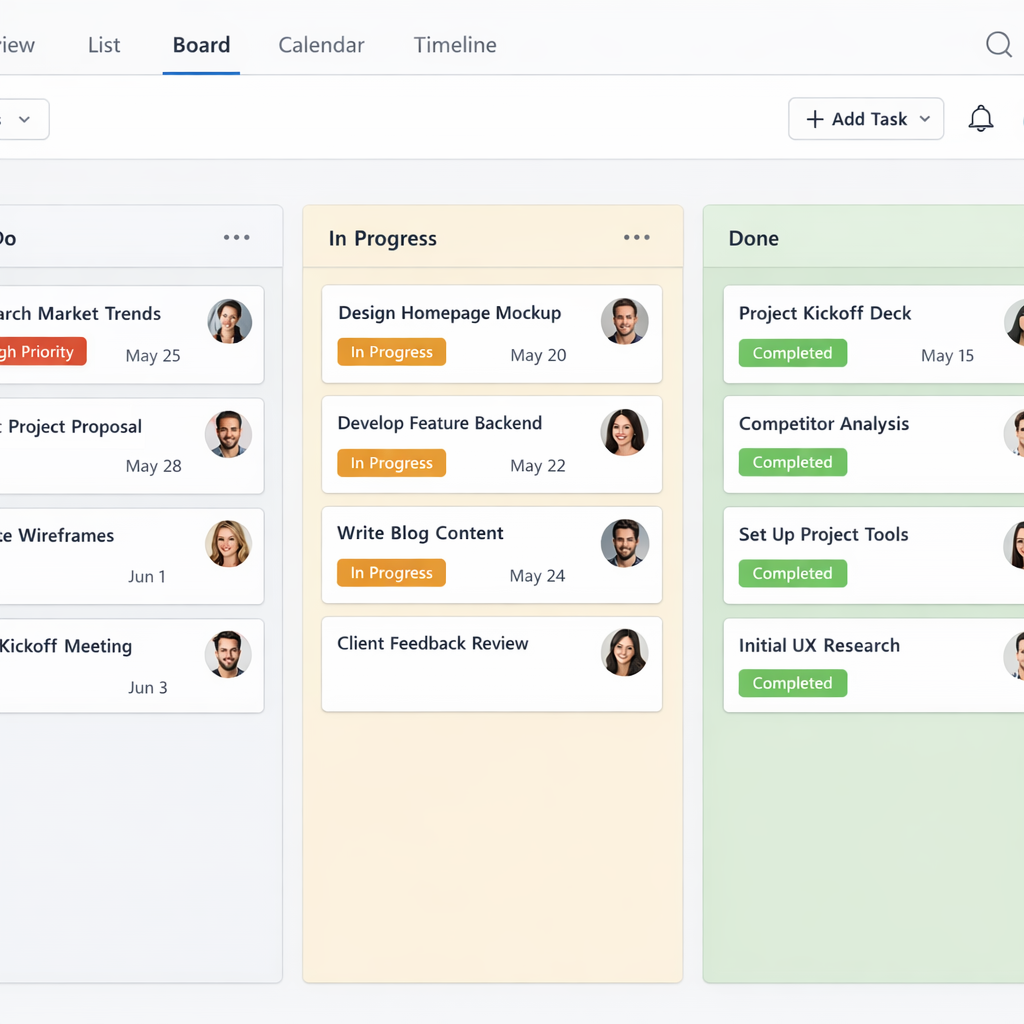
How project management connects to business growth
There is a direct line between how well you manage projects and how fast your business can grow. Every time a project gets delivered late, over budget, or below expectations, it costs you more than the immediate loss — it costs you referrals, repeat business, and the kind of reputation that compounds over time.
On the other side, businesses that consistently deliver on scope, on time, and within budget build a compounding advantage. Clients trust them with bigger projects. Teams work with less friction because roles and expectations are clear. Hiring becomes easier because onboarding a new person into a structured system is far less chaotic than bringing them into a workflow built on improvisation.
What is project management?Project management is also what makes delegation possible. If your process lives in your head, you cannot hand it off. Once it is documented, structured, and repeatable — which is exactly what a solid project management practice produces — you can remove yourself from execution and focus on growth.
For entrepreneurs who are ready to move beyond improvisation, the next practical step is choosing a system and a set of tools that match the way your team works. The best project management software for small teams breaks down the top options available in 2026 so you can make a confident choice without wasting time on tools that do not fit your workflow.
Conclusion
Project management is not a corporate concept reserved for large teams with dedicated program managers. It is the discipline that turns intention into execution — and for small business owners, it is the single clearest lever for delivering better work, building stronger client relationships, and creating a business that does not depend entirely on your constant presence to function. Start with the fundamentals covered here, apply them to your next project, and notice how quickly clarity replaces chaos.