
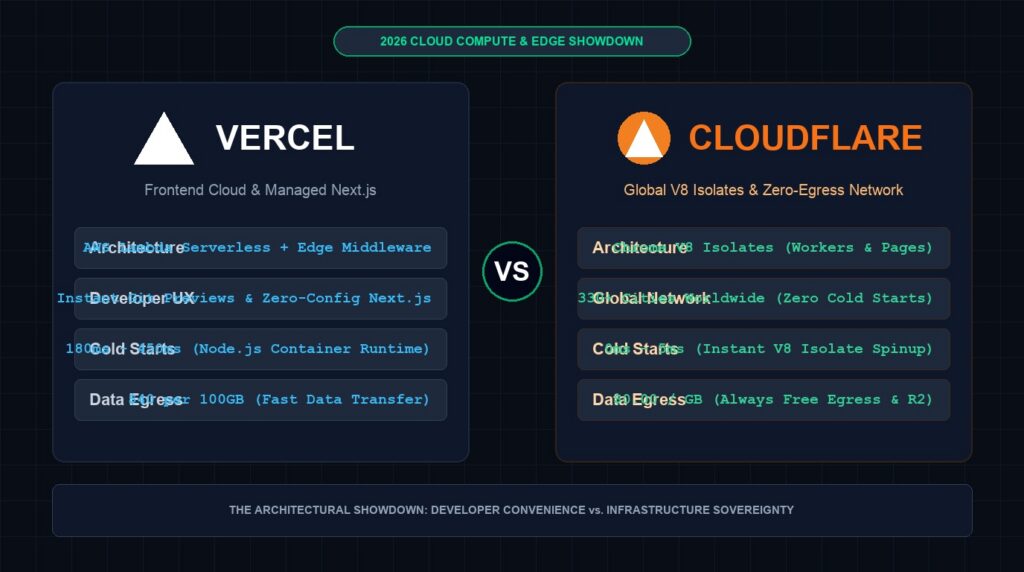
Few technical decisions in modern web engineering spark as much financial anxiety and architectural debate as choosing where to deploy your frontend and edge workloads: Vercel or Cloudflare? On one side sits Vercel, the gold standard of frontend developer experience (DX) and the corporate steward of Next.js, celebrated for zero-configuration preview environments but infamous for jaw-dropping bandwidth surcharges when traffic spikes. On the other stands Cloudflare, the planetary network powerhouse whose Workers, Pages, and zero-egress R2 storage challenge traditional serverless economics with Chrome V8 isolates and unmetered global bandwidth. Having architected multi-tenant SaaS platforms and handled petabyte-scale traffic surges on both infrastructures, here is the unfiltered reality of Vercel vs. Cloudflare in 2026.
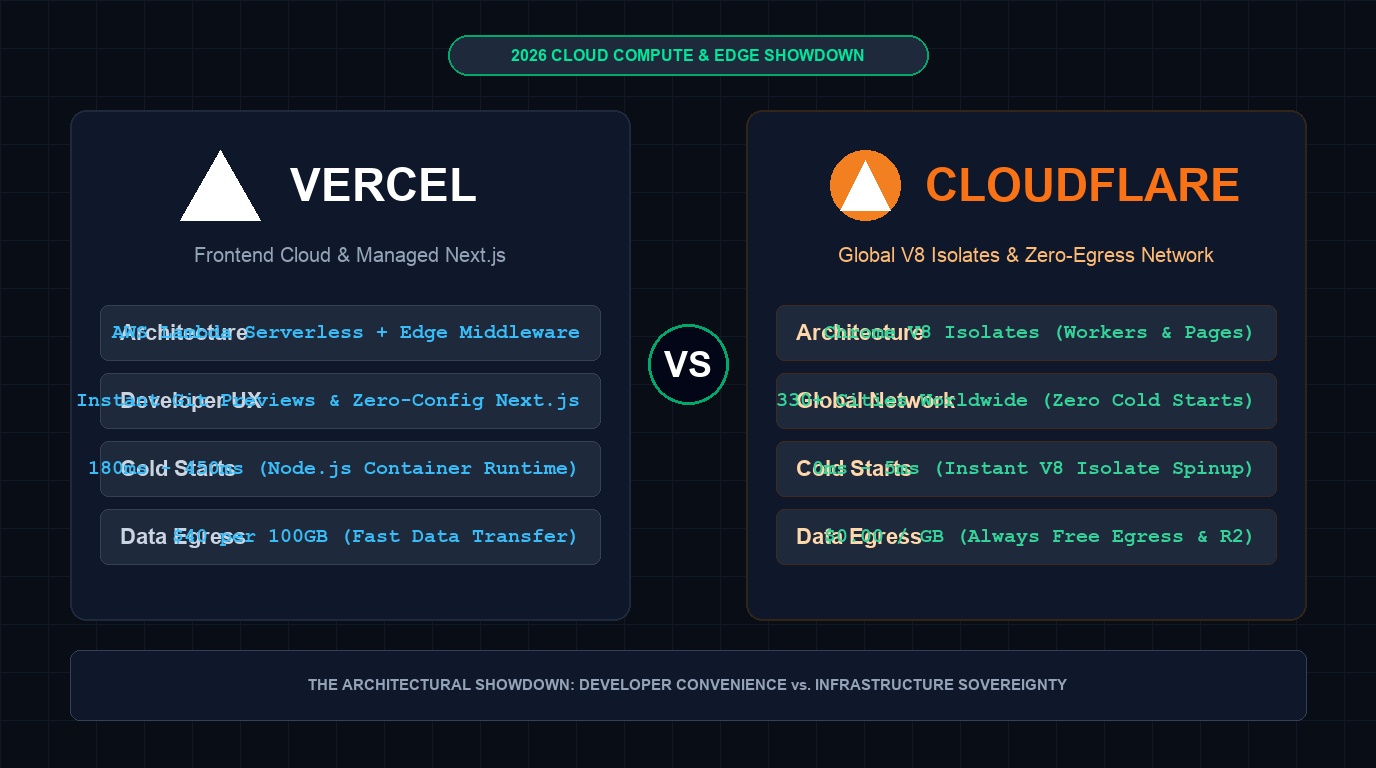
For startup founders, engineering leads, and full-stack teams, the dilemma is no longer just about milliseconds of latency. It is an existential trade-off between developer velocity and unit economic survival. A surprise viral hit on social media can turn a modest \$20/month Vercel Pro subscription into a four-figure bandwidth invoice overnight, whereas Cloudflare’s flat billing and zero egress fees protect your bottom line at the expense of framework-native conveniences.
The Core Architectural Divergence: AWS Lambda Wrappers vs. Bare-Metal V8 Isolates
To grasp why Vercel and Cloudflare behave so differently under load, you must examine the underlying compute engines executing your code.
1. Vercel: The Managed Hybrid Layer on AWS
While Vercel markets itself as a unified edge platform, the overwhelming majority of full-stack Next.js compute (Server-Side Rendering, Server Actions, Route Handlers, and Incremental Static Regeneration) actually runs on AWS Lambda in centralized regional datacenters (primarily us-east-1 in Northern Virginia):
- Runtime Mechanics: Standard Vercel Serverless Functions spin up containerized Node.js micro-VMs (Firecracker). When cold, these functions suffer from startup latencies ranging from 150ms to upwards of 500ms depending on bundle size and dependencies.
- Edge Middleware: Vercel does provide lightweight Edge Functions running on V8 isolates at CDN points of presence (PoPs), but they are heavily constrained in execution time, memory, and Node.js core module support, acting primarily as routing and rewrite filters rather than heavy application engines.
- The Next.js Synergy: Vercel’s software layer is deeply coupled with Next.js internals. Advanced primitives like Server Components (RSC), automatic image optimization, stale-while-revalidate caching, and partial prerendering (PPR) work effortlessly with zero glue code.
2. Cloudflare: True Global V8 Isolates (Workers & Pages)
Cloudflare discarded the virtual container paradigm entirely. When you deploy a Cloudflare Worker or Cloudflare Pages project, your code executes inside lightweight Google Chrome V8 isolates running directly on bare-metal servers across more than 330 cities worldwide:
- Zero Cold Starts: Because V8 isolates instantiate within milliseconds without booting an operating system or Node runtime, cold starts are practically nonexistent (typically <5ms).
- Planetary Execution: Unlike Vercel’s default single-region compute, Cloudflare executes your code at the exact PoP nearest to the client request. A visitor in Tokyo runs code in Tokyo; a visitor in Frankfurt runs code in Frankfurt.
- Open-Standard Runtimes: Cloudflare runs on workerd, a Web-standards-compliant runtime. While support for standard Web APIs (
fetch,Request,Response,Crypto) is flawless, legacy Node.js C++ bindings or native binaries cannot execute inside isolates without polyfills.
The Bandwidth & Pricing Reality Check
Pricing structure is where Vercel and Cloudflare diverge most dramatically. In 2026, data egress and usage thresholds remain the primary driver of migrations from Vercel to Cloudflare.
| Pricing Metric | Vercel (Pro Tier) | Cloudflare (Workers Paid / Pages) |
|---|---|---|
| Base Monthly Fee | \$20 per team member / month | \$5 / month flat (unlimited seats on Pages) |
| Included Bandwidth | 1 TB / month fast data transfer | Unlimited / Unmetered (No egress bandwidth charge) |
| Bandwidth Overage Cost | \$40 per 100 GB (\$0.40 / GB) | \$0.00 / GB (Always free egress) |
| Serverless Invocations | 1,000,000 invocations included | 10,000,000 requests included (\$0.30 per 1M additional) |
| Object Storage (Images/Media) | Vercel Blob (\$0.15/GB storage + \$0.10/GB egress) | Cloudflare R2 (\$0.015/GB storage, \$0 egress) |
Consider a high-growth SaaS application serving rich media, dynamic dashboards, and PDF exports that consumes 5 TB of bandwidth in a given billing cycle:
- On Vercel Pro: 1 TB is included. The remaining 4 TB (4,000 GB) incurs a staggering overage fee of
40 * $40 = $1,600. Add your team seat fees, and your monthly invoice exceeds \$1,650. - On Cloudflare Workers Paid: Bandwidth is completely unmetered. Even with 50 million edge requests, your total monthly cost stands at roughly \$17.00.
This 100x pricing disparity on data transfer has prompted countless engineering teams to re-evaluate their default hosting stacks, particularly when paired with edge-native backends like Turso (libSQL) or self-hosted databases like PocketBase.
Next.js Compatibility: The OpenNext Revolution
Historically, the strongest justification for enduring Vercel’s premium pricing was Next.js itself. Running Next.js App Router, Server Actions, and dynamic ISR outside of Vercel was notoriously brittle. That technological moat has dissolved thanks to OpenNext.
Deploying Next.js to Cloudflare in 2026
Through Cloudflare’s first-class integration with OpenNext (@opennextjs/cloudflare), deploying full-stack Next.js applications directly into Cloudflare Workers and Pages is now a production-grade reality:
# Modern Cloudflare Next.js build command:
npm install --save-dev @opennextjs/cloudflare
npx @opennextjs/cloudflare build
npx wrangler pages deploy .worker-next/assets
OpenNext automatically dissects your Next.js build output, routing static assets directly to Cloudflare’s planetary CDN cache, while transforming SSR functions and Server Actions into optimized workerd edge isolates. Image optimization is seamlessly delegated to Cloudflare Images, cutting rendering costs by over 80%.
Storage & Peripheral Ecosystem Comparison
A web framework cannot operate in isolation. You need databases, object storage, key-value caches, and pub/sub message queues. How do the respective ecosystems stack up?
Edge Data & Storage Architecture:
- Cloudflare’s Unified Data Primitives: Cloudflare provides native, distributed storage primitives directly inside Workers: Cloudflare D1 (serverless SQLite at the edge), Hyperdrive (intelligent pooling and caching for existing Postgres databases), Cloudflare KV (low-latency global key-value store), and Workers AI (serverless GPU inference for running Llama 3 and Whisper without cloud infrastructure).
- Vercel’s Partner Marketplaces: Vercel does not build proprietary distributed database engines. Instead, Vercel Storage repackages third-party managed infrastructure—partnering with Neon for Vercel Postgres, Upstash for Vercel KV/Redis, and AWS S3 for Vercel Blob. While integration is slick via their dashboard, pricing includes a marked-up convenience fee.
Developer Experience (DX) & CI/CD Workflows
Where Vercel still maintains a clear advantage is in day-to-day developer ergonomics and frontend team workflows.
The Vercel Experience
Connecting a GitHub repository to Vercel remains one of the smoothest onboarding experiences in software engineering. Every pull request automatically spins up an isolated Preview Deployment with a unique URL, instant SSL, and collaborative visual commenting tools that allow designers, PMs, and QA engineers to annotate live DOM elements directly in the browser.
The Cloudflare Experience
Cloudflare Pages has closed the gap significantly with automatic Git deployments, preview branches, and instant rollbacks via the wrangler CLI. However, Cloudflare’s dashboard remains a utility-focused, enterprise-grade cloud console. It lacks the polish, collaborative visual previews, and tailored frontend performance insights (like Vercel Speed Insights and Web Vitals analytics) that make Vercel beloved by product teams.
Feature-by-Feature Showdown
| Capability | Vercel | Cloudflare |
|---|---|---|
| Primary Execution Engine | AWS Lambda Node.js Containers + Edge V8 Middleware | Chrome V8 Isolates (workerd) across 330+ PoPs |
| Cold Start Latency | 150ms – 500ms (Container boot) | 0ms – 5ms (Instant isolate spinup) |
| Bandwidth Egress Costs | \$40 per 100 GB over 1TB limit | \$0.00 / GB (Always Free) |
| Next.js Support | Native, Day-0 first-party support | Excellent via OpenNext adapter |
| DDoS & Enterprise WAF | Basic protection; Enterprise plans required for advanced WAF | Industry-leading global DDoS mitigation & WAF included |
| Team Collaboration & Previews | World-class in-browser DOM comments & previews | Branch previews available, but lacks visual feedback tools |
| AI Inference at Edge | Vercel AI SDK (calls external OpenAI/Anthropic APIs) | Workers AI (native serverless GPU inference on global edge) |
The Strategic Decision Matrix: Which Platform Fits Your Team?
Deploy to Vercel If:
- Developer velocity is your #1 corporate priority: You have a well-funded seed or Series A/B startup where saving 20 engineering hours a month on DevOps tooling far outweighs a \$100-\$300 cloud invoice.
- Your application is read-light and API-centric: If your web app primarily serves SaaS administrative dashboards, authenticated internal tools, or B2B portals with predictable traffic that will never breach the 1TB bandwidth tier, Vercel’s DX is unmatched.
- Your engineering team relies heavily on Node.js native dependencies: If your backend routes require complex C++ libraries (e.g., legacy PDF generators, canvas image manipulation, or older ORM connection pools) that workerd cannot easily execute.
Deploy to Cloudflare If:
- Your product distributes heavy media, video, or high-throughput APIs: If you are building consumer applications, public programmatic SEO directories, content media sites, or streaming tools, Cloudflare’s unmetered bandwidth and zero-egress R2 storage will save you thousands of dollars every month.
- You demand instant global latency without cold starts: Real-time games, live financial tickers, authentication redirects, and latency-sensitive API gateways benefit enormously from V8 isolates running directly at 330+ edge locations with 0ms spinup time.
- You want infrastructure sovereignty: You prefer building on open web standards (W3C APIs) that avoid proprietary framework lock-in. For teams combining edge compute with modern developer tools, see our reviews of Cursor vs. Windsurf and our breakdown of PostHog vs. Mixpanel.
The Recommended Hybrid Architecture
The most sophisticated cloud architectures in 2026 do not treat Vercel and Cloudflare as an either/or choice. Instead, they leverage both platforms where their respective strengths shine brightest:
- Cloudflare as the Global Edge & Security Perimeter: Use Cloudflare DNS, WAF, bot management, and DDoS protection as your root gateway. Route static media, user uploads, and large binary downloads through Cloudflare R2 and CDN caching rules to ensure zero egress bandwidth fees.
- Vercel for Frontend App Delivery: Host your Next.js presentation layer and authenticated customer portal on Vercel to preserve rapid preview workflows, collaborative QA comments, and seamless server components.
- Cloudflare Workers for High-Frequency Micro-APIs: Offload high-throughput webhooks, telemetry ingest, and edge routing to Cloudflare Workers, keeping expensive Lambda compute cycles on Vercel strictly reserved for core UI rendering.
Frequently Asked Questions
Is Cloudflare Pages really 100% free for bandwidth?
Yes. Cloudflare’s core value proposition is unmetered bandwidth across both their Free and Paid tiers. Unless you violate their terms of service by attempting to use basic CDN pages as a raw pirate video hosting distribution system, standard web traffic, APIs, and media distributions incur zero egress bandwidth fees.
Can I use Prisma or Drizzle ORM on Cloudflare Workers?
Yes. Modern ORMs like Drizzle ORM and Prisma have full edge-driver support. When connecting to traditional centralized PostgreSQL databases, Cloudflare Hyperdrive can automatically pool connections and cache read queries at the edge, eliminating connection exhaustion issues common in serverless environments.
Why is Vercel’s bandwidth so much more expensive than AWS directly?
Vercel’s fast data transfer is priced at \$40 per 100GB (\$0.40/GB), which is significantly higher than AWS CloudFront’s standard egress rates (\$0.085/GB or lower). This markup subsidizes Vercel’s generous free tier, automated preview infrastructure, and high-touch developer tooling.
Does Next.js on Cloudflare support Server-Side Rendering (SSR)?
Yes. By utilizing the @opennextjs/cloudflare adapter, Next.js App Router applications compile to workerd isolates, executing dynamic SSR, Server Actions, and dynamic route handlers natively at Cloudflare’s edge PoPs.