
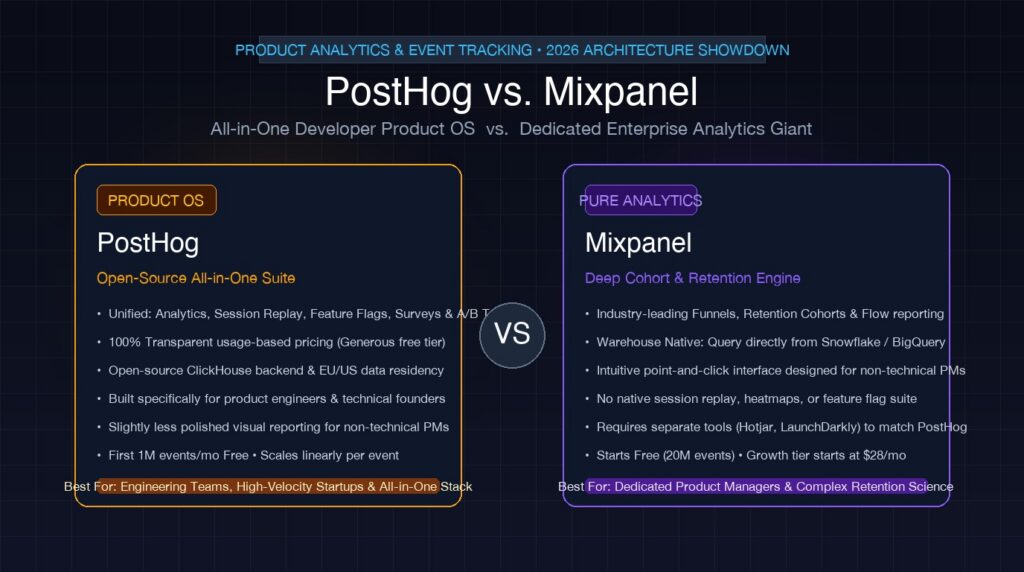
When scaling modern software in 2026, understanding user behavior is the difference between product-market fit and a slow churn death. For product managers, growth hackers, and software engineers, that understanding begins with a pivotal architectural decision: PostHog or Mixpanel. Both platforms represent the gold standard of product analytics, yet they approach the discipline from opposing engineering worldviews. Mixpanel is the battle-tested, dedicated analytics giant engineered to turn complex retention funnels and cohort behaviors into intuitive visual dashboards for non-technical teams. PostHog, by contrast, is an open-source “Product OS” that consolidates event tracking, session replay, feature flags, A/B testing, and user surveys into a single developer-first platform.
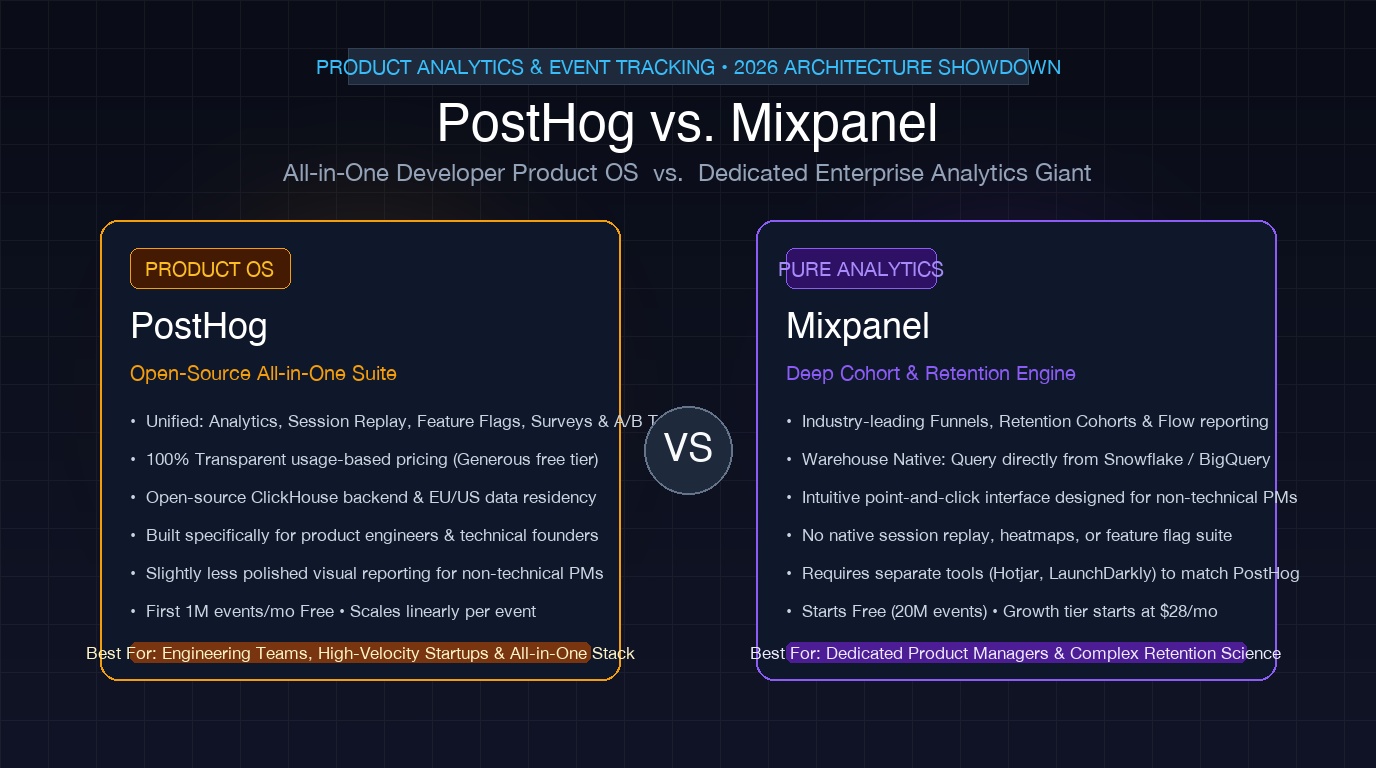
As Senior Software Analyst Robert Sullivan, I have audited product analytics, customer data platforms (CDPs), and telemetry pipelines across dozens of venture-backed startups and mid-market SaaS companies. Having previously dissected Stripe vs. Paddle vs. Lemon Squeezy and Datadog vs. Grafana Cloud, I have seen too many founders get blindsided by massive event-volume bills or trapped managing five disconnected SaaS subscriptions because their analytics tool lacked native session recording or feature gating. In this unvarnished 2026 teardown, we compare PostHog and Mixpanel across query sophistication, developer experience, tool consolidation, and real-world billing math.
Core Architectural Philosophies: The “Product OS” vs. Dedicated Analytics
The philosophical divide between PostHog and Mixpanel fundamentally shapes your engineering workflow and monthly software spend:
PostHog: The All-in-One Developer Product OS
PostHog operates on a single premise: engineering and product teams should not have to stitch together six different tools to understand user behavior. Powered by an open-source ClickHouse database, PostHog combines five essential product utilities under one roof:
- Product Analytics: Event-based tracking, funnels, retention tables, user paths, and lifecycle cohorts.
- Session Replay: High-fidelity video-like reproductions of real user sessions with DOM events, console log capture, network timing, and privacy masking.
- Feature Flags & A/B Testing: Multi-variant flags, percentage rollouts, user targeting, and automated statistical significance calculators.
- Surveys & User Feedback: In-app popups, Net Promoter Score (NPS) widgets, and qualitative feedback linked directly to the user’s recorded session.
- HogQL (Direct SQL Access): A native SQL dialect that lets developers write arbitrary ClickHouse queries directly against their raw event lake with zero export lag.
Mixpanel: The Pure-Play Product Analytics Engine
Mixpanel has spent over a decade perfecting a single craft: making event analytics blindingly fast, accessible, and intuitive for business stakeholders:
- Exploratory Query Speed: Mixpanel’s proprietary in-memory database (Arb) provides unmatched interactive speed when slicing massive datasets across multiple nested breakdown dimensions.
- Superior Cohort & Retention UX: Setting up complex behavioral cohorts (e.g., “Users who completed onboarding step 3 within 24 hours but did not invite a teammate”) is remarkably intuitive and requires zero technical training.
- Warehouse Native: Mixpanel allows enterprises to query event data directly from their central cloud warehouse (Snowflake, BigQuery, Databricks) without duplicating storage or maintaining custom reverse-ETL pipelines.
- Focused Scope: Mixpanel does not offer native session replay, feature flags, or in-app surveys. To get those features, teams must integrate and pay for third-party tools like LaunchDarkly, Hotjar, or FullStory.
Deep Functional Showdown: Head-to-Head Technical Analysis
1. Funnels, Retention, and Query Ergonomics
When analyzing standard conversion funnels, both platforms perform admirably. However, differences emerge when answering nuanced product questions:
| Analytics Capability | PostHog | Mixpanel | User Experience Winner |
|---|---|---|---|
| Conversion Funnels | Step-by-step conversion, time-to-convert, historical comparison | Multi-path funnels, dynamic exclusions, frequency per step | Mixpanel (Slightly smoother UX) |
| Retention Cohorts | Daily/Weekly/Monthly brackets, customizable return events | Industry benchmark: unbounded retention, rolling windows, custom curves | Mixpanel (Gold standard) |
| User Pathing / Flows | Sankey diagrams showing preceding/following events | Interactive flow trees with drop-off nodes and branch collapsing | Tie |
| Raw Query Flexibility | Native HogQL (Write raw SQL queries against ClickHouse) | Point-and-click formula editor and JQL (legacy) | PostHog (Decisive for engineers) |
For dedicated Product Managers and Growth Marketers who want to slice funnels without touching code, Mixpanel’s visual interface remains the gold standard. For Product Engineers who want to join custom metadata, write complex SQL aggregations, and query raw telemetry, PostHog’s HogQL is vastly more powerful.
2. The “Consolidation Multiplier”: Session Replay & Feature Flags
The decisive differentiator for modern engineering teams is PostHog’s tight contextual integration across features:
In PostHog, when you inspect a drop-off step in a conversion funnel (e.g., users abandoning the checkout payment form), you can click directly on the dropped-off cohort and watch the exact session replay of those users hitting an error, seeing their cursor rage-click, and reading their console errors in real time. If you suspect an issue, you can immediately toggle a feature flag or launch an A/B test directly inside the same platform.
With Mixpanel, you see the drop-off percentage, but you have no native visual context. To understand why users abandoned, you must export user IDs to a tool like FullStory or LogRocket, hope the user session was recorded, and pay two separate enterprise invoices.
3. Data Privacy, Open Source & Compliance
Data residency and privacy governance represent critical compliance hurdles:
- PostHog (Open Core & EU Hosting): PostHog offers an open-source core deployable on your own infrastructure (hobbyist self-hosting), alongside dedicated EU Cloud (Frankfurt) and US Cloud hosting options that comply with GDPR, HIPAA, and SOC2 Type II.
- Mixpanel (Proprietary Enterprise Cloud): Mixpanel is strictly proprietary SaaS, offering robust SOC2 Type II, HIPAA, and ISO 27001 certifications. Mixpanel’s Warehouse Native product allows enterprise data to remain completely inside your private Snowflake or BigQuery cluster, satisfying strict data localization mandates.
Pricing Breakdown: What Do 1M, 10M, and 50M Events Actually Cost?
Both platforms have evolved their pricing to be highly competitive, but their billing mechanics differ significantly:
| Monthly Event Volume | PostHog (Product Analytics Only) | Mixpanel (Growth Tier) | TCO Winner |
|---|---|---|---|
| 1 Million Events/mo | $0 / month (First 1M events free every month) | $0 / month (Free tier covers up to 20M events with limitations) | Tie |
| 5 Million Events/mo | $1,350 / month (or $0 on free tier) | ~$120 / month (Linear Growth tier) | Mixpanel (Pure analytics volume) |
| 20 Million Events/mo | ~$3,800 / month (Volume-discounted rates) | ~$500 to $800 / month (Contract-dependent) | Mixpanel (For pure events) |
| The Full Stack Math: Analytics + Replays + Flags | Included in tiered volume pricing | Requires $2,000+/mo in secondary tools (Hotjar + LaunchDarkly) | PostHog (Decisive full-stack TCO) |
If your sole requirement is ingesting massive firehoses of raw events (tens of millions of monthly events) without needing session replays or feature flags, Mixpanel’s event-only pricing is often cheaper per pure data point. However, once you factor in the $1,500–$3,500/month cost of standalone session recording and feature-flagging subscriptions, PostHog’s consolidated stack delivers massive total cost savings.
Comprehensive Feature Comparison Table (2026)
| Evaluation Metric | PostHog | Mixpanel |
|---|---|---|
| Primary Orientation | All-in-one developer Product OS | Dedicated visual product analytics |
| Core Database Engine | ClickHouse (Open-source columnar OLAP) | Arb (Proprietary in-memory OLAP) / Warehouse Native |
| Native Session Replay | Yes (Industry-leading DOM recording & masking) | No (Requires third-party integration) |
| Feature Flags & A/B Testing | Yes (Native statistical significance engine) | No (Requires LaunchDarkly, Statsig, or Optimizely) |
| Direct SQL Access | Yes (Native HogQL query console) | No (Point-and-click UI or warehouse SQL) |
| Dashboard & Report Polish | Clean, modern developer-centric UI | Exceptional, executive-ready presentation polish |
| Self-Hosting Capability | Open-source community edition available | Strictly proprietary SaaS |
| Best For | Product Engineers, Technical Founders, Full-Stack Teams | Dedicated Product Managers, BI Teams, Data Analysts |
The Final Architectural Verdict: How to Choose
Choosing between PostHog and Mixpanel comes down to whether you prioritize an all-in-one developer toolkit or a dedicated product management workbench.
Choose PostHog if:
- You want to eliminate software bloat and replace separate subscriptions for Analytics, FullStory/Hotjar, LaunchDarkly, and in-app surveys with a single SDK.
- Your team consists of product engineers and technical founders who love writing raw SQL (HogQL) to answer edge-case data questions.
- You value the ability to jump immediately from a dropped-off funnel step into the corresponding session replay video.
- You appreciate open-core software, transparent usage-based pricing, and European data residency.
Choose Mixpanel if:
- Your primary analytics users are non-technical product managers, growth marketers, and business executives who demand intuitive, point-and-click exploratory dashboards.
- You already have established, best-of-breed enterprise tools for feature flagging and session recording and only want a dedicated event analytics layer.
- You want Warehouse Native analytics that query directly from your existing Snowflake or BigQuery single source of truth.
- Your product tracks enormous raw event volumes (50M+ events/month) and you require the lowest possible per-event ingestion cost.
Frequently Asked Questions
Can PostHog completely replace Hotjar and LaunchDarkly?
Yes. For over 90% of software companies, PostHog’s native Session Replay and Feature Flags fully replace standalone subscriptions to Hotjar and LaunchDarkly, providing superior value because user session videos and flag assignments are tied directly to analytics event streams.
Does PostHog slow down web or mobile applications?
No. PostHog’s client SDKs (Web, React, iOS, Android, Flutter) are heavily optimized. Event tracking batches calls asynchronously in the background. While Session Replay records DOM mutations, it uses web workers to avoid blocking the main JavaScript thread, resulting in sub-millisecond perceived performance impact.
Can I export my historical event data from Mixpanel to PostHog?
Yes. Mixpanel allows raw data exports via their REST API or warehouse sync, and PostHog provides pre-built migration scripts and data import pipelines to ingest historical Mixpanel JSON events into your PostHog ClickHouse cluster without losing user identity histories.