

SAP S/4HANA cloud is not just a software update — it is a full architectural shift from on-premise legacy systems to a real-time, cloud-native ERP environment built on SAP’s in-memory database. For businesses already running older SAP versions, the question is not whether to upgrade eventually, but whether the timing and business case are right today. If you are still getting familiar with the platform’s foundation, the SAP ERP system guide that covers the full operational scope is the right starting point. This page focuses on what SAP S/4HANA cloud actually changes, what the migration demands, and whether your business is positioned to absorb that transition profitably.
The deadline that is forcing every SAP customer’s hand
SAP has set a hard deadline. Mainstream maintenance for SAP ECC — the previous generation on-premise ERP platform that the majority of existing SAP customers currently run — ends in 2027. Extended maintenance runs through 2030 for customers who pay a premium surcharge. After that, SAP ECC is unsupported.
That deadline is not a sales tactic. It is a published product lifecycle commitment that SAP has maintained consistently since announcing it in 2020. Every business running SAP ECC today is on a migration clock whether they acknowledge it or not.
The question is not whether to move to SAP S/4HANA cloud. For most existing SAP customers, it is a matter of when, how, and at what cost. The businesses that plan that transition deliberately — with a clear business case, a realistic timeline, and a structured migration methodology — will absorb the change productively. The ones that wait until 2029 and scramble will pay a significant premium for the urgency.
For businesses new to SAP entirely, S/4HANA cloud is simply the current platform. There is no legacy version to migrate from, and the decision is straightforward. This article addresses both audiences — existing SAP customers evaluating migration and new buyers evaluating S/4HANA as a first deployment.
What SAP S/4HANA cloud actually is — and what it is not
The name SAP S/4HANA combines several distinct concepts that are worth separating clearly before evaluating the platform.
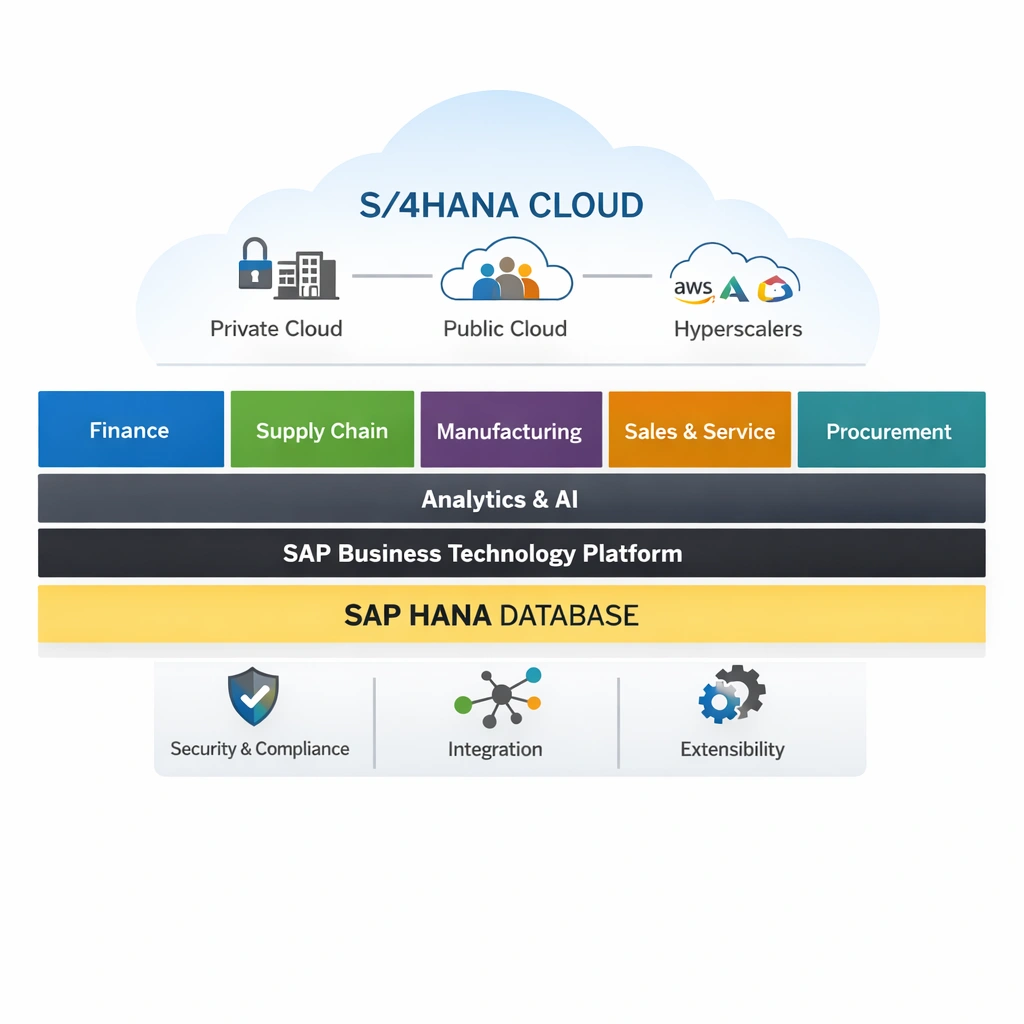
S/4 refers to the fourth generation of SAP’s business suite — a complete redesign of the application layer that simplifies the data model, removes redundant tables, and rebuilds core processes for real-time execution.
HANA refers to SAP’s proprietary in-memory database — High-performance ANalytic Appliance — which stores and processes data in RAM rather than on disk, enabling transaction processing and analytics to run simultaneously on the same data set without separate reporting infrastructure.
Cloud refers to the deployment model — the platform runs on managed cloud infrastructure rather than on servers your organization owns and operates.
These three elements work together to produce a platform that is materially different from SAP ECC in several important ways.
The data model in S/4HANA is significantly simplified. SAP ECC contained tens of thousands of database tables, many of which were redundant aggregates maintained for reporting performance. S/4HANA consolidates these into a leaner structure that HANA’s in-memory processing handles directly. The result is faster processing, simpler data architecture, and a reduction in the volume of custom code required to run standard processes.
The user interface defaults to SAP Fiori — the modern, role-based, tile-driven interface that replaces the classic SAP GUI. Fiori runs in any browser on any device, which eliminates the desktop client dependency that complicated SAP ECC deployments for years.
What S/4HANA is not is a simple upgrade. Moving from SAP ECC to S/4HANA requires a structured migration project — a technical conversion of your existing system, a functional redesign of processes that have changed in the new architecture, and a data migration that must handle the structural differences between the old and new data models.
The three deployment models for SAP S/4HANA cloud
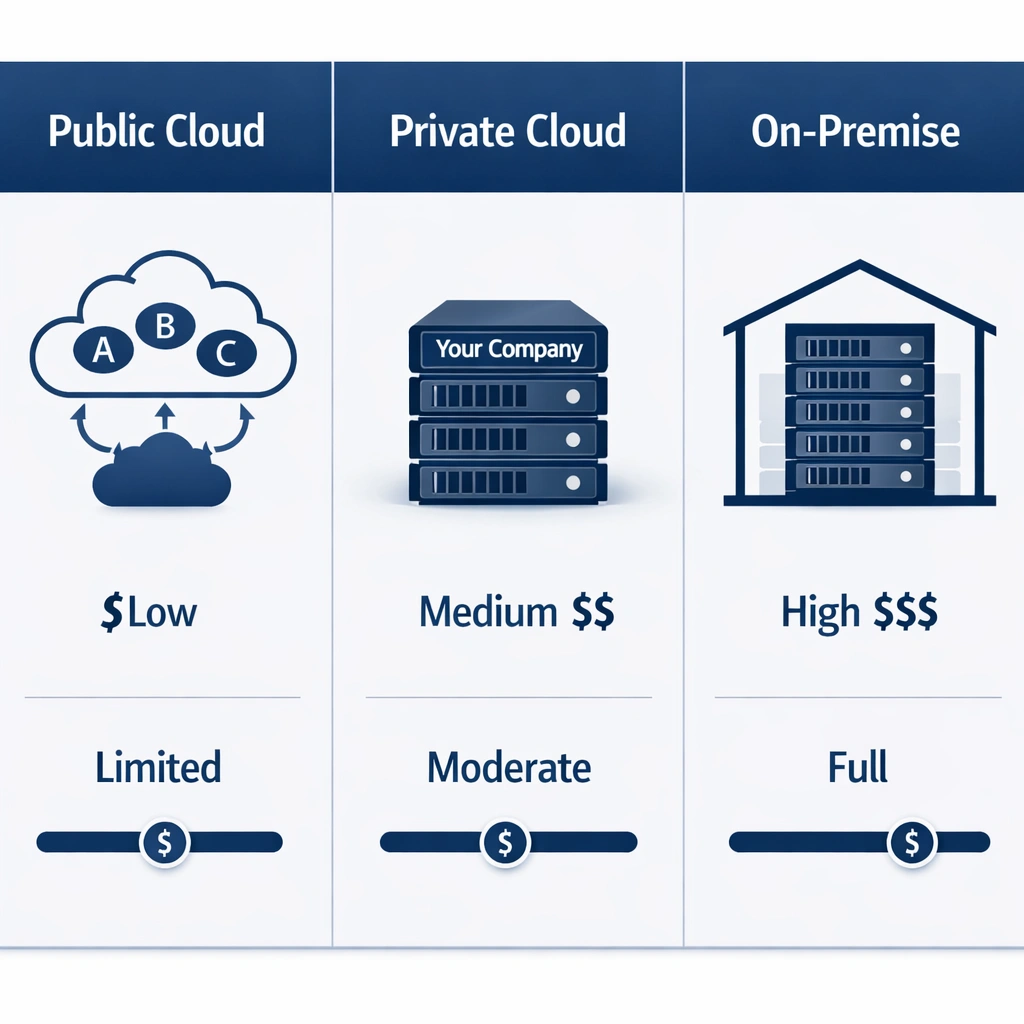
SAP offers SAP S/4HANA cloud in three deployment configurations, each with distinct implications for cost, control, and implementation complexity.
Public cloud — SAP S/4HANA Cloud, essentials edition
The public cloud model is a multi-tenant SaaS deployment. SAP manages the infrastructure, the upgrades, and the system administration. Your organization configures the system within the boundaries SAP defines — which are deliberately constrained to protect the multi-tenant environment and ensure upgrade compatibility.
This model offers the fastest time to value, the lowest infrastructure cost, and the most predictable upgrade path. The trade-off is limited customization flexibility. If your business processes require significant deviation from SAP’s standard best practices, the public cloud model will create friction.
For businesses deploying SAP for the first time with a relatively standard operational model, the public cloud edition is the most practical entry point. Implementations typically run three to six months for a core suite deployment.
Private cloud — SAP S/4HANA Cloud, extended edition
The private cloud model runs on dedicated infrastructure — either SAP’s own HANA Enterprise Cloud or a hyperscaler such as AWS, Microsoft Azure, or Google Cloud Platform — managed by SAP or a certified cloud partner. Your organization retains significantly more configuration and customization flexibility than the public cloud model allows.
This model is appropriate for businesses with complex, industry-specific processes that cannot be accommodated within the standard best practice boundaries of the public cloud edition. Manufacturing companies with non-standard production planning models, businesses with heavily customized financial processes, and organizations with complex integration landscapes typically require private cloud or on-premise deployment.
Infrastructure costs for private cloud run $3,000 to $20,000 per month depending on system size, the number of environments in your landscape, and performance specifications.
On-premise
On-premise S/4HANA deployment means your organization owns and operates the server infrastructure running the HANA database and application layer. This model provides maximum control and customization flexibility but carries the highest infrastructure cost and the greatest internal IT capability requirement.
On-premise is increasingly rare for new S/4HANA deployments. Most businesses choosing on-premise are either operating in regulated industries with strict data residency requirements or are large enterprises with existing data center investments they are not yet ready to exit.
For a detailed breakdown of how these deployment models affect the total cost of ownership calculation, the SAP ERP cost analysis that covers infrastructure costs across all three deployment options provides the numbers by model.
What the migration from SAP ECC to S/4HANA actually involves
For businesses currently running SAP ECC, the migration to S/4HANA is the most consequential SAP project they will undertake since the original implementation. Understanding what it involves is essential for accurate planning.
SAP defines three primary migration approaches.
Greenfield implementation
A greenfield migration treats the S/4HANA deployment as a new implementation. The existing ECC system is not converted — instead, the business redesigns its processes from scratch in S/4HANA, migrates only the data it needs to carry forward, and goes live on a clean system.
The advantage of greenfield is the opportunity to eliminate accumulated technical debt — years of custom code, workarounds, and process compromises that have built up in the ECC system. The business starts fresh on a modern architecture with clean processes aligned to S/4HANA best practices.
The disadvantage is cost and timeline. A greenfield migration is essentially a full reimplementation, which means the investment is comparable to the original ECC deployment. For businesses with complex ECC environments, that can mean $500,000 to $2,000,000 or more in implementation services.
Brownfield conversion
A brownfield migration — also called a system conversion — technically converts the existing ECC system to S/4HANA in place. The existing configuration, custom code, and historical data move to the new architecture through SAP’s Software Update Manager tooling.
Brownfield is faster and less expensive than greenfield for businesses with stable, well-configured ECC systems. The trade-off is that the technical debt and process compromises in the ECC system carry forward into S/4HANA. The business gets a modern architecture running legacy processes — which limits the operational benefit of the upgrade.
Selective data transition
Selective data transition is a hybrid approach where specific business units, geographies, or process areas are migrated greenfield while others are converted brownfield. This model allows businesses to modernize their highest-value processes while managing migration risk and cost through phased execution.
For most mid-market businesses, selective data transition represents the most pragmatic path — it delivers the process improvement benefits of greenfield where they matter most without requiring a full reimplementation across the entire business.
The migration approach decision has direct implications for the implementation methodology and partner selection process. The SAP ERP implementation roadmap that covers methodology selection and partner evaluation provides the framework for making those decisions in the context of an S/4HANA migration.
The real ROI case for SAP S/4HANA cloud
The business case for migrating to SAP S/4HANA cloud is built on five categories of measurable return. Vague claims about “digital transformation” and “future-readiness” are not a business case. These are.
Reduction in financial close cycle time
S/4HANA’s in-memory processing and simplified data model enable real-time financial reporting that eliminates the batch processing delays built into SAP ECC. Businesses that previously ran a five to seven day month-end close consistently report reductions to two to three days after S/4HANA migration. At a CFO’s fully loaded cost, three fewer days of month-end close effort per month represents meaningful annual savings at scale.
Inventory optimization
Real-time inventory visibility across the full supply chain — enabled by S/4HANA’s embedded analytics — allows procurement and planning teams to reduce safety stock levels without increasing stockout risk. A 10% reduction in inventory carrying costs for a business managing $5,000,000 in average inventory represents $500,000 in released working capital.
Infrastructure cost reduction
Migrating from on-premise ECC — with its associated hardware refresh cycles, data center costs, and infrastructure management overhead — to a managed cloud deployment typically reduces infrastructure-related IT spend by 20% to 40% over a three-year period.
Custom code elimination
SAP ECC environments accumulate custom code over years of operation. Each custom object carries a maintenance cost — developer time spent keeping it compatible with system updates. S/4HANA migrations that include a custom code remediation effort consistently reduce the custom code footprint by 30% to 60%, which translates directly into lower ongoing maintenance costs.
Embedded analytics replacing separate BI infrastructure
Many SAP ECC environments run a separate Business Warehouse system to handle reporting workloads that the transactional system could not support. S/4HANA’s embedded analytics eliminate the need for a separate BW layer in most mid-market scenarios, removing both the licensing cost and the data synchronization complexity of maintaining two systems.

The warning signs that your business is not ready for S/4HANA cloud
Not every business is positioned to absorb an S/4HANA migration productively. These are the conditions that indicate the timing may not be right regardless of the 2027 deadline pressure.
Unresolved data quality problems. If your current SAP ECC system contains years of unclean master data — duplicate vendors, inconsistent material records, unreconciled open items — migrating to S/4HANA amplifies those problems rather than resolving them. Data remediation must precede migration, not accompany it.
Unstable business processes. If your organization is in the middle of a significant operational change — a merger, an acquisition, a market pivot, a major product line change — adding an ERP migration to that environment creates compounding risk. Stabilize the business first.
Insufficient internal project capacity. S/4HANA migrations require sustained internal resource commitment from finance, IT, operations, and HR simultaneously. Organizations that cannot dedicate experienced internal resources to the project alongside the implementation partner consistently experience delays and cost overruns.
No clear business case. If the ROI analysis does not produce a credible payback period within four years, the migration economics do not support the investment at this stage. Extended maintenance through 2030 may be the more rational choice while the business builds the operational foundation to absorb the migration productively.
For businesses evaluating whether SAP S/4HANA is the right platform for their specific industry and operational profile — particularly in comparison to Oracle Fusion Cloud or Microsoft Dynamics 365 — the SAP ERP vs competitors comparison that breaks down platform selection across six critical dimensions provides the analytical framework.
Conclusion
SAP S/4HANA cloud is the right destination for businesses running SAP ECC — the 2027 maintenance deadline makes that direction inevitable. The question is whether the timing, business case, and organizational readiness align to make the migration productive rather than reactive.
The businesses that approach this transition with a clear ROI model, a realistic assessment of their data quality and process maturity, and a migration methodology matched to their actual complexity will extract genuine operational value from the upgrade. The ones that migrate under deadline pressure without that preparation will spend significantly more and return significantly less.
The deadline is fixed. The preparation is a choice.