
Choosing between SAP and Oracle is one of the highest-stakes infrastructure decisions a growing business can make, and most comparison articles give you a feature table and call it a day. SAP ERP vs Oracle is a more nuanced conversation — one that depends on your industry, team size, integration needs, and long-term growth roadmap. Before stacking both platforms side by side, grounding yourself in how the SAP ERP system is built and what it was designed to solve gives you the right lens for comparison. This page breaks down SAP ERP vs Oracle across the dimensions that actually matter when you are writing a check this size SAP ERP vs Oracle.
Why this comparison matters more than most vendor battles
ERP vendor selection is not a reversible decision. The platform you choose becomes the operational backbone of your business for the next seven to ten years minimum. Migrating from one enterprise ERP to another is a project that rivals the original implementation in cost and complexity. Getting the decision right the first time is not just preferable it is financially necessary.
SAP and Oracle are the two dominant players in the enterprise ERP market. Together they account for the majority of large and mid-market ERP deployments globally. Both platforms are mature, capable, and supported by extensive partner ecosystems. Both can handle the operational complexity of a scaling business across multiple industries.
The question is not which platform is better in the abstract. The question is which platform is better for your specific business, at your current stage, in your industry, with your team’s capabilities and your growth trajectory.
That question requires a more structured analysis than most comparison articles provide SAP ERP vs Oracle .
Company background: what each vendor was built to do
Understanding the origins of SAP and Oracle clarifies why their products differ in the ways that matter most to buyers.
SAP: built for operations first
SAP was founded in 1972 by five former IBM engineers in Mannheim, Germany. The founding vision was a single, integrated system that could run all of a company’s business processes in real time — a radical idea at the time when most enterprise software was departmental and disconnected.
SAP built its reputation in manufacturing and process industries. The platform’s depth in supply chain management, production planning, materials management, and financial controlling reflects decades of development driven by the operational complexity of industrial businesses. That operational DNA remains visible in SAP S/4HANA today.
Oracle: built for data and finance first
Oracle was founded in 1977 by Larry Ellison in Santa Clara, California, initially as a database company. Oracle’s ERP capabilities — now unified under Oracle Fusion Cloud ERP — grew through a combination of internal development and aggressive acquisition, including PeopleSoft, JD Edwards, and Siebel Systems.
Oracle’s strength has historically been in financial management, human capital management, and database performance. Its roots as a database company mean the platform’s analytical and reporting capabilities are deeply native rather than bolted on. Financial services, technology companies, and professional services firms have traditionally gravitated toward Oracle for these reasons.
Head-to-head comparison: the six dimensions that determine the right choice
functional depth by business area
SAP advantage areas: supply chain management, manufacturing and production planning, procurement, plant maintenance, and multi-tier distribution. If your business involves physical goods moving through a complex supply chain, SAP’s operational depth in these areas is difficult to match.
Oracle advantage areas: financial management, human capital management, project portfolio management, and subscription billing. Oracle Fusion’s financial consolidation capabilities are particularly strong for businesses with complex multi-entity structures or international operations requiring sophisticated currency and intercompany accounting.
The verdict: if operations are your primary complexity driver, SAP holds the functional advantage. If finance and HR complexity are your primary drivers, Oracle is competitive or superior.
industry fit
SAP has deeper industry-specific solution sets — called Industry Cloud solutions — across manufacturing, retail, utilities, oil and gas, chemicals, and life sciences. These pre-configured industry templates reduce the customization burden significantly for businesses in these sectors.
Oracle has strong industry positioning in financial services, higher education, government, and professional services. Its project management and billing capabilities make it a natural fit for professional services firms managing complex client engagements.
For entrepreneurs in manufacturing, distribution, or retail, SAP’s industry pedigree is a genuine differentiator. For businesses in financial services or project-based professional services, Oracle’s industry depth is more relevant SAP ERP vs Oracle.
total cost of ownership
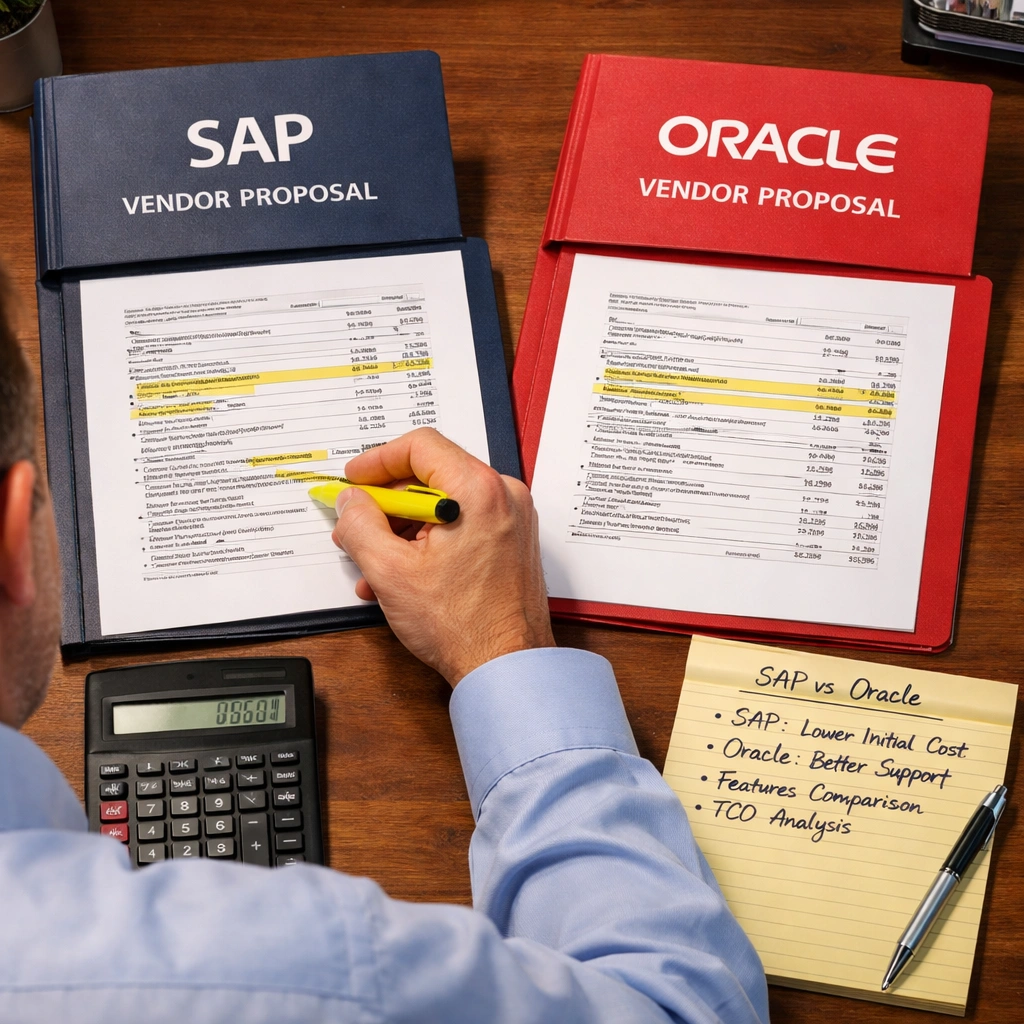
Neither SAP nor Oracle publishes transparent pricing, and both use negotiated licensing models that make direct comparison difficult without specific proposals in hand.
As a general pattern observed across mid-market deployments in 2025, SAP S/4HANA Cloud and Oracle Fusion Cloud ERP land in comparable total cost of ownership ranges for equivalent user counts and functional scope. The differences tend to emerge in implementation costs rather than licensing.
SAP implementations at the mid-market level tend to run longer and cost more due to the platform’s configuration depth. Oracle Fusion Cloud implementations, particularly for finance-focused deployments, can move faster because the platform’s financial management layer requires less custom configuration for standard processes.
For businesses where implementation speed is a priority — a post-merger integration, for example, or a business under regulatory pressure to modernize quickly — Oracle’s faster time-to-value in finance deployments is a real consideration.
The full picture of what SAP ERP cost includes across all five cost categories is covered in the SAP ERP cost breakdown that exposes the numbers vendors rarely quote upfront.
technology architecture and innovation roadmap
Both SAP and Oracle have made significant investments in modernizing their platforms for cloud-native deployment, embedded analytics, and process automation.
SAP S/4HANA runs on SAP’s proprietary in-memory HANA database, which enables real-time processing of large transaction volumes without separate reporting infrastructure. The SAP Business Technology Platform, a unified development and integration environment, sits alongside S/4HANA and provides tools for building extensions, integrations, and automation without modifying the core system.
Oracle Fusion Cloud ERP runs on Oracle’s own cloud infrastructure — Oracle Cloud Infrastructure, or OCI — and benefits from Oracle’s database heritage with deep native analytics and machine learning capabilities embedded directly into business processes. Oracle’s autonomous database technology automates routine database administration tasks, reducing infrastructure management overhead.
For businesses with a strong internal IT team that values customization flexibility, SAP’s extension model offers more latitude. For businesses prioritizing embedded intelligence and lower infrastructure management overhead, Oracle’s autonomous cloud infrastructure is an advantage.
implementation ecosystem and partner availability
Both SAP and Oracle are supported by large global partner ecosystems. The practical difference for mid-market buyers is partner density at the regional level.
SAP has a larger certified partner network globally, which translates to more implementation options — and more price competition — particularly in markets outside the United States and Western Europe. For businesses in emerging markets or regions with limited enterprise software consulting capacity, SAP’s partner density is a practical advantage.
Oracle’s implementation partner ecosystem is strong in North America and Western Europe but thinner in some emerging markets. For businesses operating primarily in established markets, this difference is minimal. For businesses with significant operations in regions where Oracle consulting capacity is limited, it becomes a real constraint.
The quality of your implementation partner ultimately determines more about your project outcome than the platform itself. The SAP ERP implementation guide that covers how to evaluate and select implementation partners applies equally to Oracle implementations and is worth reviewing regardless of which platform you choose.
user experience and adoption
User experience has become a meaningful differentiator in enterprise ERP over the past five years, driven by the consumerization of software expectations. Employees who use intuitive consumer apps daily have increasingly low tolerance for complex, dated enterprise interfaces.
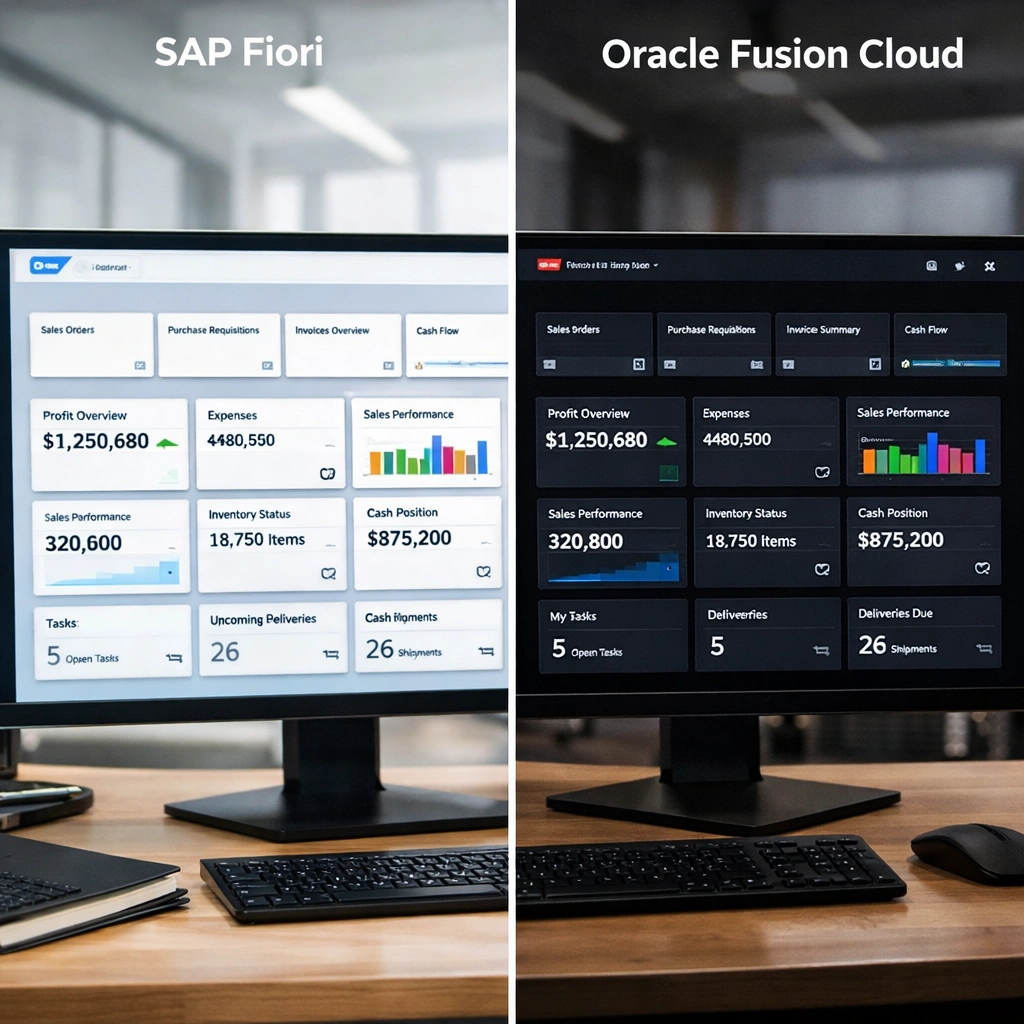
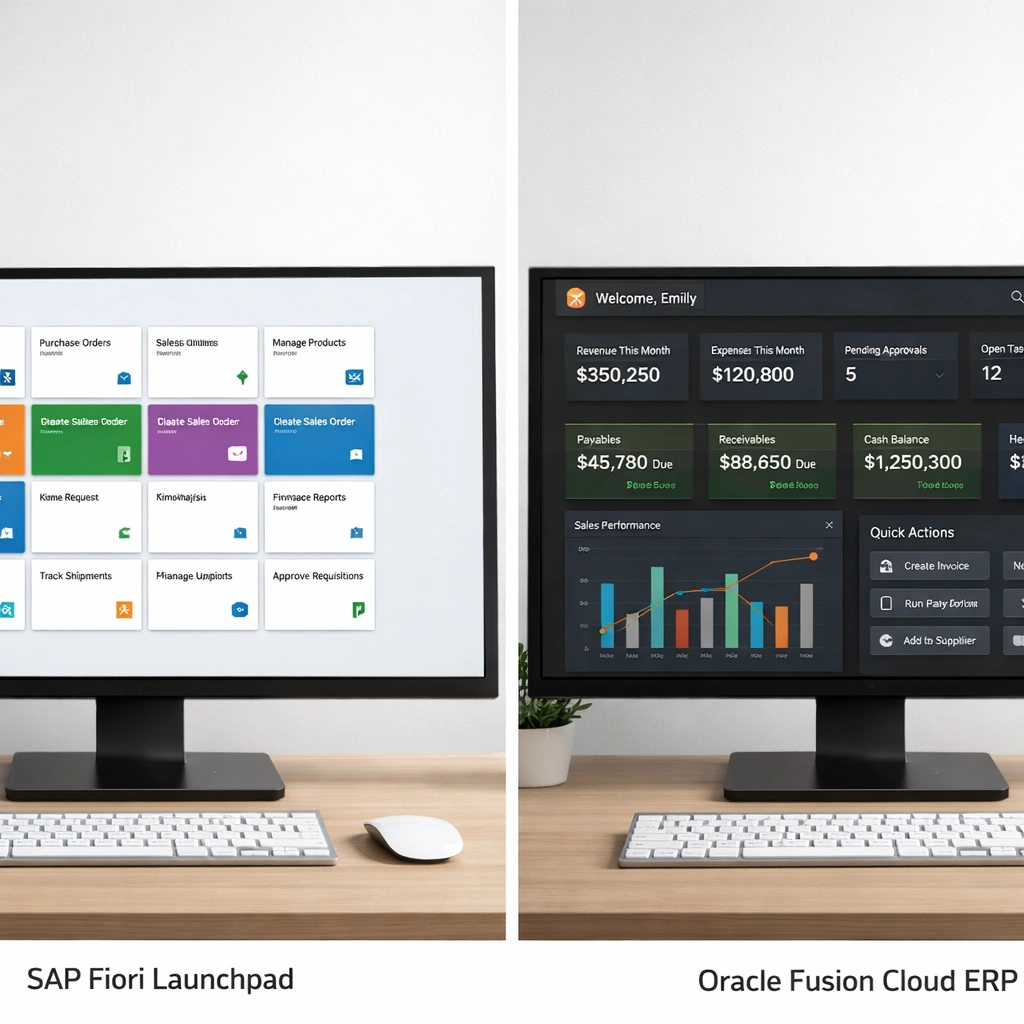
SAP Fiori — SAP’s modern user interface layer — represents a significant improvement over classic SAP GUI. It is tile-based, role-specific, and responsive across devices. However, Fiori adoption varies significantly across SAP implementations. Companies that invest in a proper Fiori deployment see strong user adoption. Companies that deploy S/4HANA but leave users on the classic interface miss most of the user experience improvement.
Oracle Fusion Cloud’s interface is modern by default — it is a cloud-native application built with contemporary UI standards from the ground up rather than retrofitted. Users generally find Oracle Fusion’s interface more immediately intuitive, which can accelerate adoption in the early post-go-live period.
For businesses where rapid user adoption is a critical success factor — high turnover environments, for example, or organizations with limited tolerance for extended training programs — Oracle’s interface advantage is worth weighing.
The third option most comparison articles ignore: Microsoft Dynamics 365
Any honest SAP vs Oracle comparison for mid-market entrepreneurs must acknowledge Microsoft Dynamics 365 as a serious alternative that frequently outperforms both on total cost of ownership for businesses in the 50 to 500 employee range SAP ERP vs Oracle.
Dynamics 365 offers a modular cloud ERP suite with deep integration into Microsoft 365, Teams, and Azure. For businesses already operating in the Microsoft ecosystem, the integration advantage is immediate and the user adoption curve is significantly lower than either SAP or Oracle.
Dynamics 365 is not the right choice for businesses with high manufacturing complexity, sophisticated supply chain requirements, or global multi-entity structures demanding the deepest available functionality. But for service businesses, professional services firms, and distribution companies with straightforward operational models, Dynamics 365 delivers strong functional coverage at a meaningfully lower total cost of ownership than either SAP or Oracle.
The decision framework is not SAP vs Oracle in isolation. It is SAP vs Oracle vs Dynamics 365, evaluated against your specific operational requirements, industry, growth trajectory, and budget.
How to make the final decision: a practical framework
After evaluating SAP ERP vs Oracle across these six dimensions, the decision process comes down to four questions that only your business can answer.
Where is your primary operational complexity? If it is in supply chain, manufacturing, or procurement, SAP’s functional depth is the strongest available. If it is in financial consolidation, project management, or HR, Oracle is competitive or superior.
What is your industry? SAP’s industry cloud solutions give it a structural advantage in manufacturing, chemicals, retail, and utilities. Oracle leads in financial services and professional services.
What does your three-year total cost of ownership look like for each platform? Get fully loaded proposals — licensing, implementation, infrastructure, training, and support — before making any comparison. Headline license numbers are not sufficient.
What is your implementation timeline requirement? If speed to value is critical, Oracle Fusion’s faster finance deployments or Dynamics 365’s lower implementation complexity may outweigh SAP’s functional depth for your current needs.
For businesses that have confirmed SAP as the right platform and are now evaluating the migration path to the cloud-native version, the SAP S/4HANA cloud upgrade analysis that breaks down migration requirements and ROI is the logical next step.
Conclusion
SAP ERP vs Oracle is not a question with a universal answer. Both platforms are enterprise-grade, both are well-supported, and both can handle the operational complexity of a scaling business. The right choice depends entirely on where your complexity lives, what your industry demands, and what your business can realistically absorb in implementation cost and organizational change.
The worst outcome is choosing a platform based on brand recognition or a vendor’s persuasive sales process rather than a structured evaluation of your actual requirements. The framework in this article gives you the structure to make that evaluation on your own terms SAP ERP vs Oracle.