
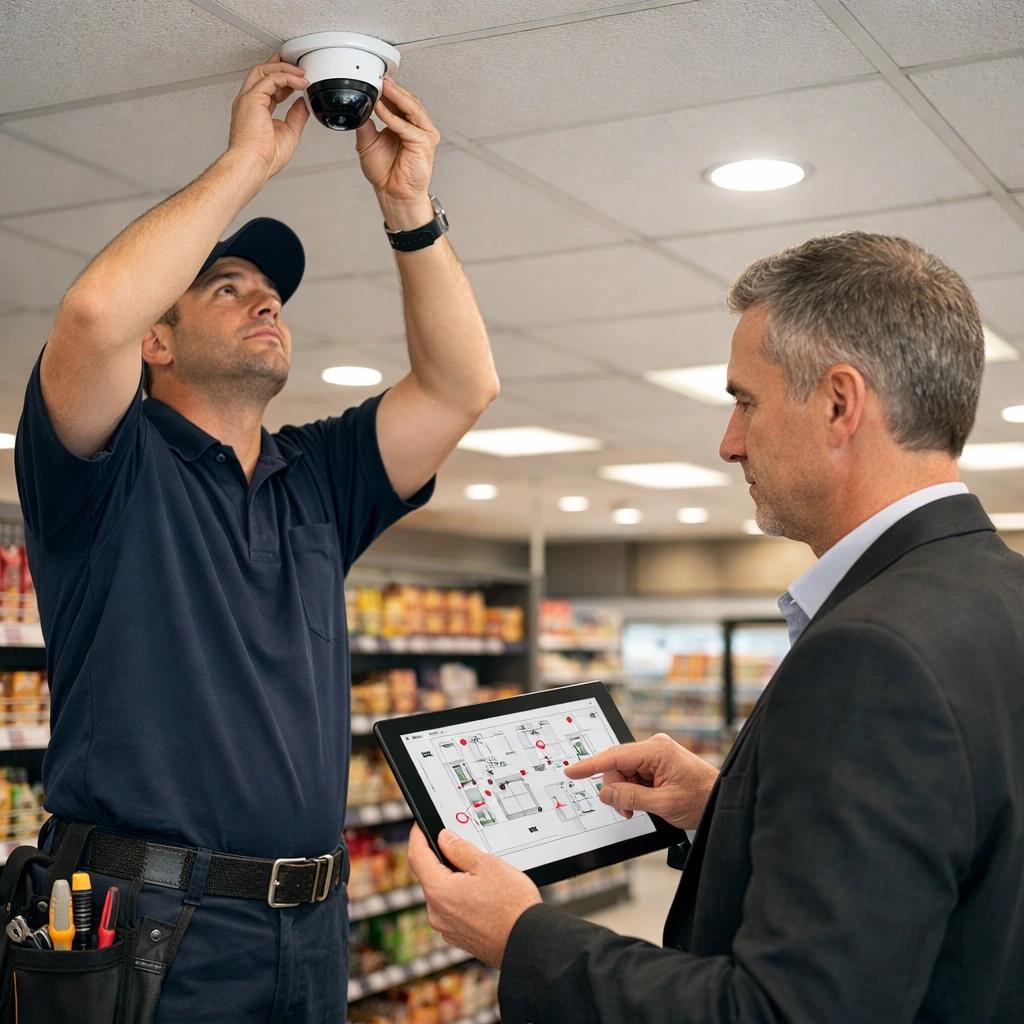
Most implementation failures happen not because the technology is flawed, but because store owners skip the scoping and vendor vetting steps and go straight to hardware installation. Knowing how to implement AI vision retail correctly means starting with your biggest operational pain point, not the flashiest feature on a vendor’s demo reel. The use cases worth prioritizing — shelf monitoring, loss prevention, and customer analytics — are the same ones driving adoption across the retail AI vision automation landscape that entrepreneurs are navigating in 2026. A structured rollout, even for a single-location store, will determine whether your investment pays off within months or gets shelved after the first quarter how to implement AI vision retail.
Why most retail AI vision deployments underperform in the first quarter
The implementation failures that retail entrepreneurs experience with AI vision technology are rarely caused by the technology itself. They are caused by the decisions made in the six weeks before the first camera goes up — or more accurately, by the decisions that were skipped entirely during that period.
A store owner who purchases a platform based on a compelling vendor demo, installs cameras in the locations the vendor recommends without independently validating those positions against their actual traffic patterns, and launches without a defined staff alert response protocol will consistently underperform against the ROI projections in the sales deck. Not because the system does not work, but because the conditions required for it to work were never established.
Implementing AI vision retail correctly is a process problem before it is a technology problem. The sections below walk through that process in the sequence that produces the fastest and most durable return.
Define your primary use case before you contact a single vendor
The single most important decision in any retail AI vision implementation happens before any vendor conversation begins. You need to identify the one operational problem that is costing you the most measurable revenue right now and that needs to be the anchor for every subsequent decision.
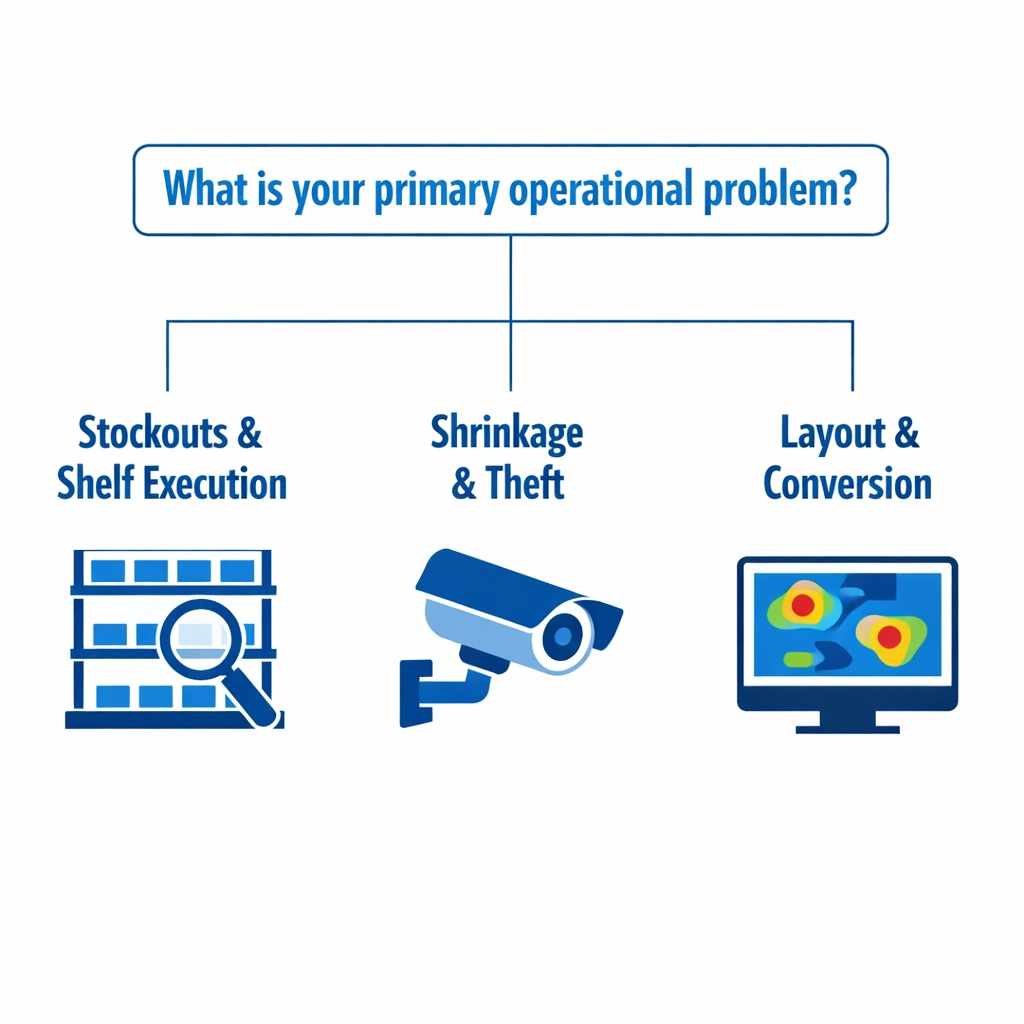
how to implement AI vision retail The three primary use cases in retail AI vision are shelf monitoring, loss prevention, and customer behavior analytics. Each one solves a different problem, requires different camera configurations, and performs best on different platform architectures. A system optimized for shelf intelligence at the aisle level is not the same system optimized for behavioral anomaly detection at the checkout station.
Trying to solve all three problems simultaneously in a first deployment is the fastest route to a system that does none of them well. Pick one. Build the business case around that one use case. Expand after you have demonstrated measurable ROI on the initial deployment.
If stockouts are your most visible revenue leak, AI shelf monitoring retail is your starting point. If shrinkage is your primary concern, retail computer vision loss prevention should anchor your first deployment. If layout optimization and promotional effectiveness are the decisions you most need better data for, AI customer behavior analytics retail is where your implementation budget produces the most immediate strategic value.
Audit your existing infrastructure before evaluating platforms
Before you request a single vendor demo, conduct an honest audit of three infrastructure elements that will determine which platforms are compatible with your store and which ones will create integration problems that slow your deployment timeline.
Network infrastructure
AI vision systems — particularly those that process data at the edge and sync analytics to a cloud dashboard — require stable, high-bandwidth network connectivity. A store running on a standard consumer-grade router with shared bandwidth across POS terminals, staff devices, and customer WiFi is not adequately prepared for a multi-camera vision deployment.
Assess your current network capacity and identify whether an infrastructure upgrade is required before installation. Factoring this into your total cost of ownership calculation upfront prevents the scenario where a $15,000 platform deployment is held up for six weeks by a $400 network problem that nobody budgeted for.
Existing camera infrastructure
If your store already has cameras installed, determine whether they are compatible with the AI vision platform you are evaluating before assuming you can leverage existing hardware. Most AI vision platforms have specific requirements around camera resolution, frame rate, and field of view that standard security cameras do not meet. In many cases, existing cameras will need to be replaced or supplemented — and that cost needs to be in your budget from the beginning.
Integration compatibility with your current stack
Identify the specific tools your store currently uses for point-of-sale, inventory management, and staff communication. Request explicit confirmation from every vendor you evaluate that their platform integrates natively with each of those tools — not through a generic API that requires custom development work on your end. Integration gaps discovered after purchase are among the most common sources of implementation delays and unexpected costs.
Structure your vendor evaluation process around production evidence
The vendor evaluation stage is where most retail entrepreneurs make the decision that determines whether their implementation succeeds or fails. The evaluation criteria that matter are not the ones that show up most prominently in vendor marketing materials.
Request a reference customer in your store category
Every vendor worth evaluating has production deployments in stores similar to yours. Ask for a direct introduction to a reference customer operating in your store format — similar size, similar SKU count, similar customer volume — and speak to that customer directly before making any purchase decision.
The questions worth asking that reference customer are specific: what was the calibration period before alerts became reliable, how did staff respond to the system in the first thirty days, what integration problems emerged after installation, and what would they do differently if they were starting the deployment over.

Evaluate total cost of ownership over 24 months, not sticker price
The hardware cost and the first-year subscription fee are the numbers vendors lead with. The numbers that determine actual ROI are the ones that come after — annual subscription renewals, per-camera or per-location scaling fees, integration maintenance costs, and the staff time required to manage the system and respond to alerts.
Build a 24-month total cost of ownership model for every platform you evaluate and compare those models against your projected return from the primary use case you identified in step one. A platform that costs 30 percent more upfront but delivers twice the integration depth and requires half the ongoing maintenance overhead may be the more cost-effective choice over a two-year horizon.
Pilot before you commit to a full deployment
Most enterprise-grade retail AI vision platforms will negotiate a limited pilot deployment — typically covering one zone or one store location — before a full contract is signed. A pilot period of four to six weeks gives you production performance data from your actual store environment, which is the only data that reliably predicts full deployment outcomes.
If a vendor refuses to discuss a pilot arrangement, treat that refusal as a significant red flag. Vendors with confidence in their production performance welcome pilots. Vendors whose systems perform differently in production than in demos avoid them.
Design your camera placement strategy independently
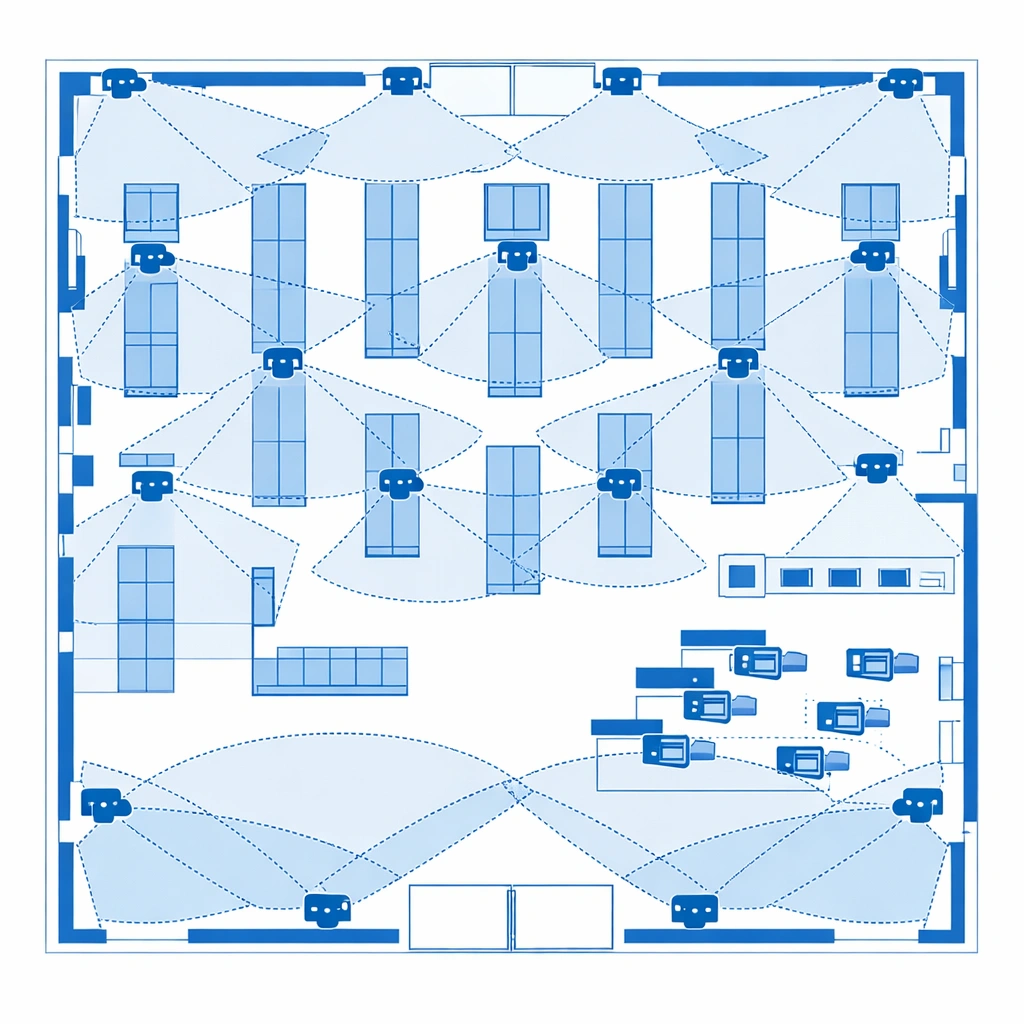
Camera placement is one of the most consequential technical decisions in a retail AI vision implementation, and it is one that vendors have a conflict of interest in making for you. A vendor recommending camera placement is optimizing for system performance under conditions that make their platform look good. You need to optimize for coverage of the specific operational problems you identified in step one.
For shelf monitoring deployments, camera placement needs to prioritize the zones with the highest stockout frequency and the highest revenue impact per stockout event — not uniform coverage of every aisle.
For loss prevention deployments, camera placement needs to prioritize the zones with the highest shrinkage concentration, the checkout stations with the highest fraud risk, and the entry and exit points that represent the highest walk-out theft exposure.
For customer behavior analytics deployments, camera placement needs to cover the traffic flow paths and conversion zones that your current merchandising decisions are most dependent on — not just the areas with the most physical space for camera installation.
Engage an independent retail technology consultant to validate your placement strategy before installation if your deployment involves more than five cameras. The cost of that consultation is significantly lower than the cost of reinstalling hardware after a deployment that produced incomplete coverage data.
Build your staff alert response protocol before go-live
The most common operational failure point in retail AI vision deployments is not technical — it is behavioral. A system that generates accurate, timely alerts produces zero operational value if the staff response to those alerts is slow, inconsistent, or nonexistent.
Before your system goes live, define and document the following for every alert type your platform generates.
Who receives the alert by role, not by name, so the protocol survives staff turnover. What the expected response action is specific, unambiguous, and achievable within the response time window that preserves the value of the alert. What the escalation path is when the primary recipient does not acknowledge the alert within the defined window. And how alert response compliance will be measured and reviewed on a weekly basis during the first ninety days.
Train your entire floor team on the alert response protocol before the system goes live. The calibration period — typically two to four weeks is the right time to run this training, using the system’s initial data output as a training tool rather than an operational input.
Staff who understand why the system exists, what it is designed to do, and what their specific role in the response workflow is will engage with it constructively. Staff who encounter it for the first time as an unexpected source of work instructions will resist it — and that resistance will undermine your ROI regardless of how well the technology performs.
Establish your measurement framework before you go live
Defining your success metrics after deployment is one of the most reliable ways to end up with an inconclusive ROI assessment that makes it impossible to justify expansion or renewal. Your measurement framework needs to be in place before the system goes live, with baseline data captured during the two weeks prior to activation.
The metrics worth tracking depend on your primary use case. For shelf monitoring, the foundational metrics are on-shelf availability rate, average time to restock after alert, and category sales lift in monitored sections. For loss prevention, the key metrics are shrinkage rate by zone, alert-to-response time, and incident frequency before and after deployment. For customer behavior analytics, the metrics that matter are zone conversion rate, average dwell time in target merchandising zones, and revenue per square foot in areas where layout changes were informed by behavioral data.
Review these metrics weekly for the first ninety days. The weekly cadence is important — it gives you enough data to distinguish signal from noise while maintaining the operational tempo needed to course-correct quickly if the deployment is not performing as expected.
The complete picture of how shelf monitoring, loss prevention, and customer analytics work together as an integrated operations layer — and how the data from each use case informs the others — is covered in how retail AI vision automation is transforming store operations in 2026.
Conclusion
Implementing AI vision retail successfully is less about finding the right technology and more about executing the right process before, during, and after installation. The stores that get a strong return on this investment share one characteristic above all others: they treated the deployment as an operations project, not a technology purchase.
Define your use case. Audit your infrastructure. Evaluate vendors on production evidence. Design your camera placement strategy around your specific operational problems. Build your staff response protocol before go-live. And measure against a baseline from day one.
Follow that sequence and the technology will deliver. Skip any step in it and you will be troubleshooting an underperforming deployment six months from now instead of planning your next location rollout.