
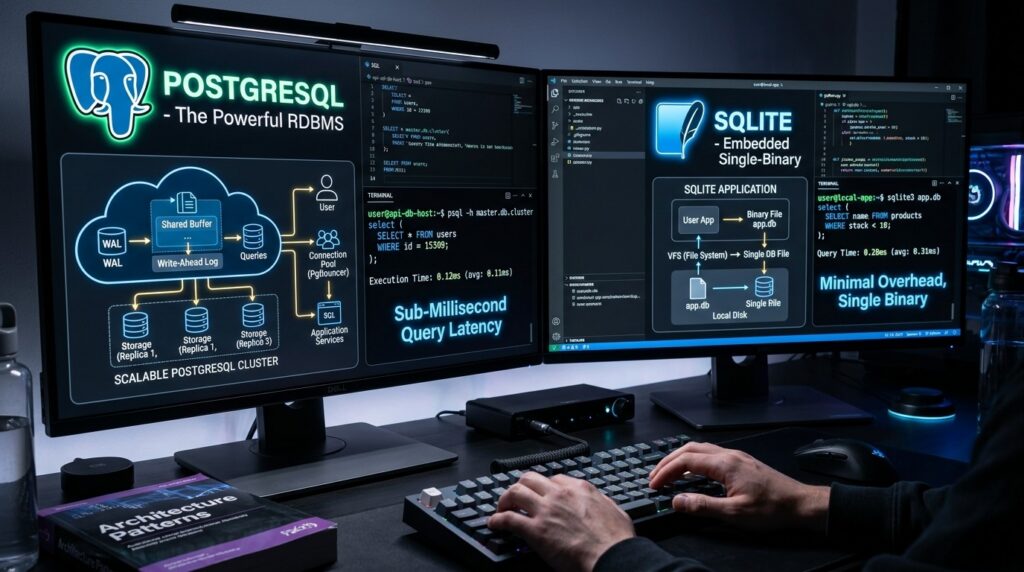
The developer pushback against cloud vendor lock-in and unpredictable serverless billing has reached a tipping point in 2026. For engineers building modern full-stack web and mobile applications, the two most popular open-source Firebase alternatives are PocketBase and Supabase. Yet, despite sharing the goal of providing instant authentication, realtime databases, and file storage, their underlying architectures could not be further apart.
One is a hyper-lean, single-binary Go executable powered by embedded SQLite. The other is a comprehensive, production-grade microservices suite built around the world’s most advanced relational database: PostgreSQL. In this hands-on infrastructure guide, we examine their resource overhead, query flexibility, concurrency ceilings, and operational maintenance.
Architectural Showdown: Single Binary vs. Container Fleet
Understanding what actually runs on your server is essential before committing production data:
- PocketBase: Written entirely in Go, PocketBase compiles into a single, self-contained executable with zero external dependencies. It embeds SQLite in Write-Ahead Logging (WAL) mode directly into the application process. Running PocketBase requires zero container orchestration:
./pocketbase servestarts your HTTP REST API, realtime event bus, Admin UI dashboard, and S3-compatible file storage handler instantly. - Supabase: Supabase is not a single application; it is an ecosystem of specialized open-source tools coordinated via Docker Compose or Kubernetes. A self-hosted Supabase cluster orchestrates PostgreSQL 16+, PostgREST (instant RESTful API from schema), GoTrue (authentication engine), Kong (API gateway), Realtime (Elixir Phoenix WebSocket engine), and Storage API (S3 storage bridge).
Server Footprint & Memory Overhead
To quantify resource consumption, we deployed baseline self-hosted installations of both systems on standard Hetzner cloud instances:
| Infrastructure Metric | PocketBase (v0.22+) | Supabase (Self-Hosted Docker) | Difference |
|---|---|---|---|
| Idle Memory (RAM) | ~24 MB | ~1.8 GB – 2.2 GB | PocketBase (⚡ 90x lighter) |
| Minimum Recommended VPS | 512MB RAM ($3.50/mo) | 4GB RAM / 2 vCPUs ($14/mo) | PocketBase wins for solo devs |
| Deployment Complexity | Single binary + systemd service | 12+ Docker containers via compose | PocketBase trivial maintenance |
| Cold Boot Time | < 50 milliseconds | 35 – 50 seconds (container mesh) | PocketBase instant restart |
Database Capabilities & Query Power
Here is where the architectural trade-offs become critical. While PocketBase’s SQLite engine handles read-heavy workloads with astonishing speed, Supabase unlocks the unmatched power of the PostgreSQL ecosystem:
- Complex Relational Queries: Supabase exposes direct PostgreSQL connections. You can execute arbitrary window functions, recursive CTEs, full-text search with customized dictionaries, and native vector embeddings using
pgvectorfor local RAG pipelines. PocketBase exposes an expressive client-side filtering syntax and view collections, but lacks native arbitrary multi-table joins without writing custom Go extension hooks. - Row Level Security (RLS): Supabase enforces security directly inside Postgres via native Row Level Security policies. Regardless of whether a query arrives via PostgREST, GraphQL, or direct SQL connection, your security rules remain mathematically airtight. PocketBase utilizes collection-level API rules evaluated in memory via a fast Go expression parser.
- Concurrency & Write Contention: With SQLite WAL mode, PocketBase easily sustains thousands of concurrent reads, but writes are serialized to a single writer. For high-throughput transactional applications (e.g., live auction bidding, IoT telemetry ingestion), Postgres’s multi-version concurrency control (MVCC) in Supabase is necessary.
Realtime Engine: SSE vs. WebSockets
Both platforms deliver instantaneous reactive data feeds to frontend clients (React, Vue, Flutter, iOS, Android), but through different transport protocols:
PocketBase utilizes Server-Sent Events (SSE). SSE operates over standard HTTP/2, automatically traversing corporate firewalls, proxies, and load balancers without requiring WebSocket upgrade handshakes. It is exceptionally lightweight and reconnects natively with zero custom client logic.
Supabase relies on its battle-tested Realtime engine written in Elixir. Utilizing the Phoenix framework’s actor model, Supabase listens to PostgreSQL’s Write-Ahead Log via logical decoding and broadcasts row-level changes over bidirectional WebSockets. It also supports client-to-client broadcast channels and presence tracking (ideal for multiplayer apps like Figma or live chat).
Extensibility: Go Framework vs. Edge Functions
When default CRUD endpoints aren’t enough, how do you add custom backend business logic?
- PocketBase as a Go Framework: PocketBase can be imported as a standard Go package. You can write custom HTTP routes, background cron jobs, and database hooks with native Go performance:
app := pocketbase.New() app.OnRecordBeforeCreateRequest("orders").Add(func(e *core.RecordCreateEvent) error { // Custom validation & payment gateway call return nil }) app.Start() - Supabase Edge Functions: Supabase uses Deno-based TypeScript Edge Functions. They deploy independently, run close to users, and execute with low cold-start latency, making it ideal for teams with dedicated frontend and TypeScript engineers.
Comprehensive Feature Matrix
| Feature | PocketBase | Supabase |
|---|---|---|
| Core Database | Embedded SQLite (WAL mode) | PostgreSQL 16+ |
| Underlying Language | Go | Elixir, Go, TypeScript, Rust |
| Authentication | Email/Password, OAuth2 (30+ providers) | Email, OAuth2, SAML, Magic Link, Phone |
| File Storage | Local Disk or S3-Compatible | S3-Compatible (MinIO / AWS S3) |
| AI / Vector Search | External (or sqlite-vss extension) | Native pgvector extension |
| Backup & Migration | Copy single data.db file |
pg_dump or WAL-G replication |
| Admin Dashboard | Built-in, ultra-clean web UI | Full-featured Supabase Studio |
The Final Verdict: Which One Should You Self-Host?
Deploy PocketBase if: You are a solo developer, bootstrapped founder, or small team building MVPs, mobile applications, SaaS dashboards, or internal tools. If you want a database that starts in 20 milliseconds, uses 25MB of RAM on a $4/month VPS, and can be backed up simply by copying a single file, PocketBase offers unmatched developer joy and zero maintenance anxiety.
Deploy Supabase if: You are building high-concurrency enterprise applications, need advanced SQL capabilities (stored procedures, views, full-text search), require vector search for AI agents, or plan to scale across distributed replicas. Supabase is a true enterprise backend operating system that scales effortlessly from seed to IPO.