
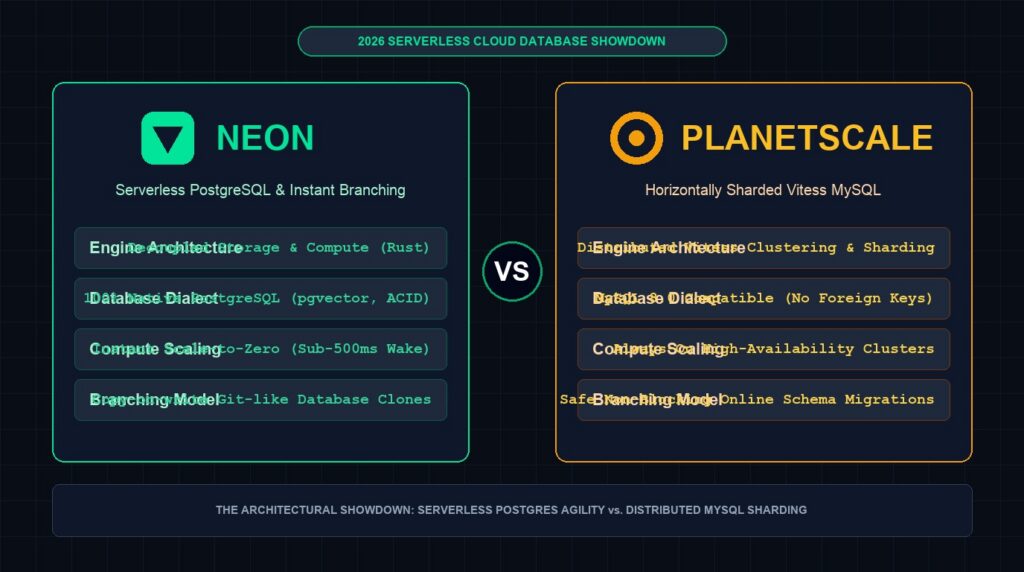
The evolution of cloud databases has reached a transformative milestone: developers no longer accept provisioning fixed-capacity virtual machines, wrestling with complex replica failovers, or dreading destructive schema migrations. In this modern cloud-native era, two platforms stand as the definitive vanguards of serverless database architecture: Neon, the open-source serverless PostgreSQL engine that completely decoupled storage from compute; and PlanetScale, the enterprise-hardened MySQL powerhouse built on Google-born Vitess that introduced non-blocking schema branching to the masses. Having designed and scaled mission-critical transactional architectures on both platforms, here is the unfiltered technical, operational, and financial reality of Neon vs. PlanetScale in 2026.
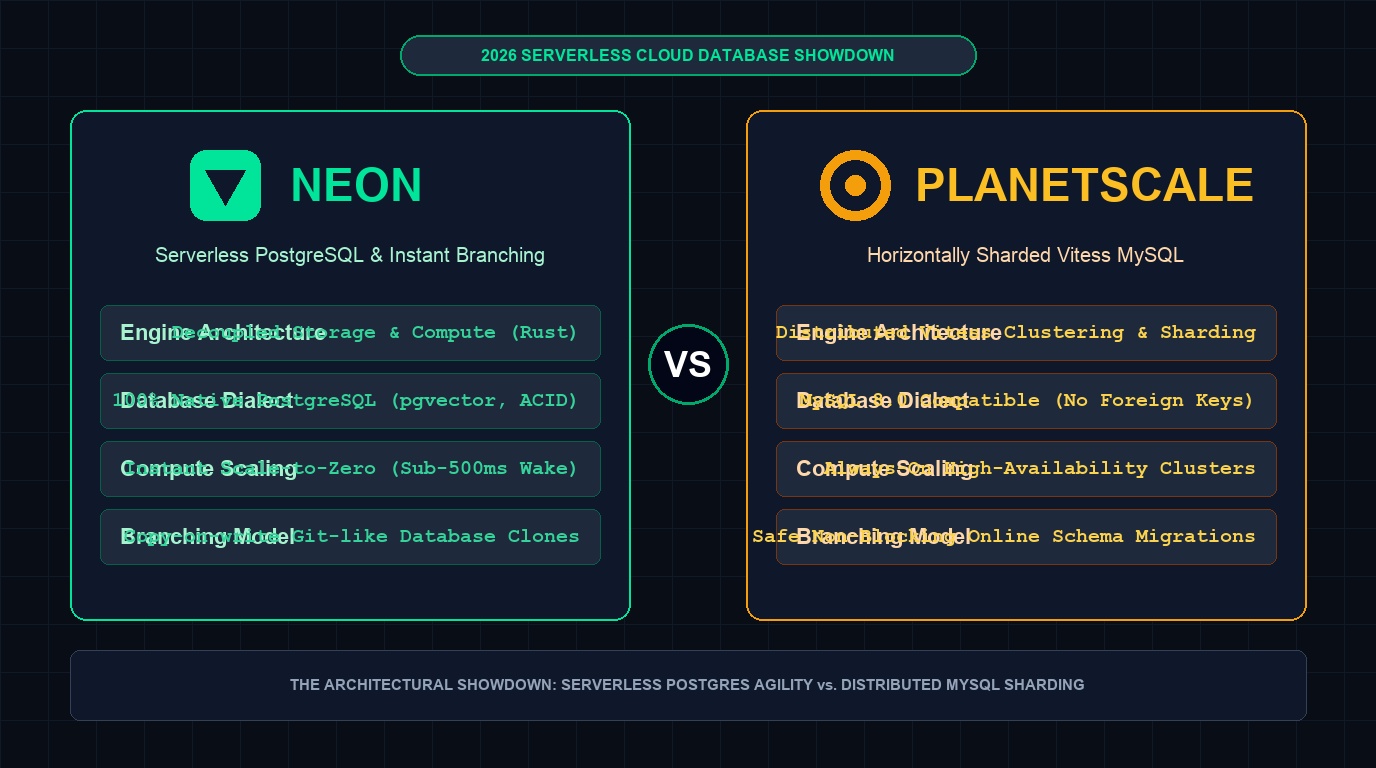
For Principal Architects, Engineering Directors, and full-stack founders, choosing between Neon and PlanetScale is not merely a preference for PostgreSQL syntax over MySQL. It determines whether your database can scale down to zero during idle development hours, how easily you can support AI vector embeddings with pgvector, whether your application can safely enforce foreign key relational integrity, and how much you will pay each month when your startup scales from thousands to millions of daily queries.
The Core Architectural Divergence: Decoupled Rust Storage vs. Distributed Vitess Sharding
The operational divide between Neon and PlanetScale begins at the foundational infrastructure layer.
1. Neon: Decoupled PostgreSQL Storage & Compute
Neon took standard, unmodified open-source PostgreSQL and fundamentally re-architected its storage engine in Rust:
- Separation of Concerns: In Neon, the compute layer is a stateless PostgreSQL process running inside a lightweight container (Firecracker micro-VM), while storage is offloaded to a specialized distributed tier consisting of Safekeepers (managing write-ahead logs via Paxos consensus) and Pageservers (storing immutable historical block deltas in S3/cloud storage).
- True Scale-to-Zero: Because compute is decoupled from data storage, Neon can suspend an idle database in seconds. When an incoming SQL query or HTTP connection arrives via its WebSocket proxy, Neon rehydrates the PostgreSQL compute instance in under 500ms, saving up to 90% on non-production environment bills.
- 100% Native Postgres Compatibility: Because the query engine is pure PostgreSQL, all native extensions work out of the box: pgvector for vector embeddings and RAG pipelines,
PostGISfor geospatial queries, andpg_cronfor automated database scheduling.
2. PlanetScale: Horizontally Sharded Vitess MySQL
PlanetScale is built on Vitess, the open-source distributed database clustering engine originally developed at YouTube to scale MySQL to billions of global users:
- Planetary Horizontal Sharding: While traditional relational databases struggle once tables exceed hundreds of gigabytes, Vitess allows PlanetScale to partition massive MySQL tables across hundreds of distributed shards transparently. Your application code continues querying a single logical connection string via
vtgate. - Always-On Multi-Tenant Architecture: PlanetScale does not do scale-to-zero. Compute clusters remain warm and ready to absorb sudden massive traffic spikes without cold start penalties.
- The Vitess Trade-Off (Foreign Keys): To achieve massive distributed sharding across nodes, Vitess historically discouraged or prohibited database-level foreign key constraints. While PlanetScale has introduced managed foreign key support in single-shard and specific cluster setups, many enterprise schemas still rely on application-level integrity enforcement to prevent cross-shard transaction deadlocks.
Database Branching & Developer Workflows: Copy-on-Write vs. Schema Diffs
Both platforms famously popularized “Git-like database branching,” but they implement the concept with different developer intentions.
| Branching Metric | Neon | PlanetScale |
|---|---|---|
| Branching Paradigm | Data + Schema Branching (Copy-on-write at storage page level) | Schema-Only Branching (Isolated schema copies; data requires explicit seeding) |
| Branch Creation Speed | Instantaneous (<1 second) regardless of database size (100MB or 500GB) | Instantaneous (<2 seconds) for schema generation |
| Production Schema Migrations | Standard Postgres DDL migrations (or tools like Prisma/Drizzle/Flyway) | Non-Blocking Online DDL (zero table locking or downtime on live tables) |
| Preview Environment CI/CD | Flawless integration with Vercel/GitHub Actions (each PR gets real sanitized data) | Requires mock data seeding scripts for PR preview branches |
Neon’s branching is an engineering marvel: because Pageservers store data as a tree of immutable page deltas, creating a branch creates an instant point-in-time snapshot. A developer debugging a catastrophic production bug can spawn a branch containing 200 GB of real production data in under 2 seconds, execute destructive experimental SQL updates, and delete the branch without copying a single gigabyte or impacting live customers.
PlanetScale focuses its branching on safe schema deployment. When you propose a database change, PlanetScale generates a visual schema diff. Merging a branch into production triggers vitess online DDL: changes apply asynchronously in the background using ghost tables without holding exclusive table locks or blocking user queries. For high-volume e-commerce or gaming backends where an ALTER TABLE on a 50-million-row table would normally lock customer checkouts, PlanetScale’s migration engine is peerless.
AI & Vector Search: pgvector vs. MySQL Limitations
In 2026, virtually every modern SaaS application incorporates AI agents, semantic retrieval, or embedding lookups. How each database supports these modern workloads is a major deciding factor.
Vector & AI Infrastructure:
- Neon’s Native pgvector Supremacy: Because Neon is 100% standard PostgreSQL, you simply execute
CREATE EXTENSION vector;. You can store OpenAI, Cohere, or local open-weights embeddings directly alongside your relational tables, index them using HNSW or IVFFlat, and perform hybrid keyword/vector search in a single SQL query. Neon also features pg_embedding and specialized vector indexing optimizations. - PlanetScale’s Vector Story: While PlanetScale has introduced experimental vector indexing extensions for MySQL, the MySQL ecosystem historically lags far behind PostgreSQL in native vector indexing maturity. Teams running heavy AI workloads on PlanetScale frequently must provision dedicated vector databases like Pinecone or Qdrant alongside their MySQL cluster.
Pricing & Total Cost of Ownership (TCO): The Free Tier Fallout
Pricing strategy is where the developer community witnessed the sharpest philosophical divergence between these two companies.
PlanetScale’s Post-Hobby Strategy
In early 2024, PlanetScale made the controversial decision to eliminate its beloved free hobby tier, restructuring its pricing entirely around paying businesses and enterprise workloads:
- Scaler Pro Plan: Starts at \$39 per month minimum base fee. Includes 10 GB storage, 10 million row reads, and 1 million row writes, with overages billed at \$2.50 per 10 GB storage, \$1.50 per 10M reads, and \$1.50 per 1M writes.
- Enterprise & Sharded Tiers: Custom negotiated enterprise contracts running anywhere from \$2,000 to \$50,000+ per month for dedicated Vitess clusters.
Neon’s Developer-First Freemium Model
Neon capitalized on developer frustration by maintaining and expanding a generous, permanent free tier:
- Free Tier: 0.5 GB storage, 1 project, up to 10 branches, and 100 compute hours per month (with automatic scale-to-zero). Perfect for indie hackers, prototyping, and MVPs.
- Launch Plan (\$19/month): 10 GB storage included, 300 compute hours, unlimited branches, and configurable autoscaling compute sizes up to 8 vCPUs and 32 GB RAM.
- Scale Tier (\$69/month): 50 GB storage, 750 compute hours, IP allowlists, and larger dedicated autoscaling compute pools.
For early-stage startups, bootstrapped founders, and developers maintaining hundreds of preview environments, Neon’s \$0 to \$19 pricing combined with scale-to-zero is dramatically more economical than PlanetScale’s \$39 minimum baseline. For teams evaluating serverless Postgres options, review our deep breakdown of Supabase vs. Neon and our edge database analysis of Turso vs. Supabase.
Feature-by-Feature Showdown
| Evaluation Criteria | Neon | PlanetScale |
|---|---|---|
| Underlying Engine | Decoupled Serverless PostgreSQL 16/17 | Distributed Vitess MySQL 8.0 |
| Scale-to-Zero Capability | Yes (Automated suspend; sub-500ms wake) | No (Always-on warm compute instances) |
| Relational Foreign Keys | 100% Native, complete cascading delete/update | Supported with caveats; historically discouraged in sharded clusters |
| Horizontal Sharding | Vertical compute autoscaling (up to 8 vCPU per node) | True Vitess horizontal sharding across hundreds of nodes |
| AI & Vector Embeddings | Native pgvector with HNSW indexing | Limited / requires external vector storage |
| Free Hobby Tier | Generous permanent free tier (0.5GB + 100 compute hrs) | None (Minimum \$39/month entry) |
When to Choose Neon vs. PlanetScale
Choose Neon If:
- Your stack is built on PostgreSQL: You love Postgres features like JSONB querying, arrays, custom enumerations, complex triggers, and native foreign keys with cascade operations.
- You are developing generative AI applications: You want to store vector embeddings directly inside your database using
pgvectorwithout paying for a separate Pinecone or Weaviate subscription. - You want copy-on-write database branches with real data: You want every pull request in your GitHub repository to automatically launch a full-fidelity preview database seeded with real development data in under two seconds.
- Cost efficiency and scale-to-zero matter: You want idle staging, development, and testing databases to cost zero dollars when nobody is using them.
Choose PlanetScale If:
- Your application experiences massive, hyper-scale write throughput: You are building high-volume gaming leaderboards, global ad-tech telemetry, or multi-tenant platforms processing millions of transactions per second that exceed the capacity of a single PostgreSQL node.
- Zero-downtime schema migrations are your biggest pain point: You run mission-critical 24/7 web services where a locked table during a database migration would cost tens of thousands of dollars in downtime.
- Your engineering organization is deeply proficient in MySQL: You have years of institutional expertise optimizing MySQL queries, connection pooling, and InnoDB storage parameters.
Frequently Asked Questions
Is Neon completely open-source?
Yes. The entire Neon core architecture—including the Rust Pageserver, Safekeeper consensus layer, and storage broker—is 100% open-source under the Apache 2.0 license on GitHub. You can inspect the code or self-host the stack on your own Kubernetes infrastructure.
Can Neon handle high-concurrency connection spikes?
Yes. Because serverless functions on platforms like Vercel or AWS Lambda can easily overwhelm PostgreSQL’s native process-per-connection model, Neon provides a built-in PgBouncer connection pooler over WebSockets, allowing a single Neon database to handle tens of thousands of concurrent client connections without dropping requests.
Does PlanetScale support standard MySQL GUI clients like TablePlus and DBeaver?
Yes. PlanetScale exposes standard MySQL wire protocol connections. You can connect standard tools like TablePlus, DBeaver, or MySQL Workbench using secure TLS connections or the PlanetScale CLI proxy (pscale connect).
How does Neon compare to Supabase?
While Supabase is an all-in-one Backend-as-a-Service that bundles PostgreSQL with authentication, storage, edge functions, and real-time WebSockets, Neon is a pure, specialized serverless database focused strictly on scalable compute and instant branching. In fact, many developers use Neon as the serverless database layer behind custom backend frameworks. For a full comparison, read our review of Supabase vs. Neon.