
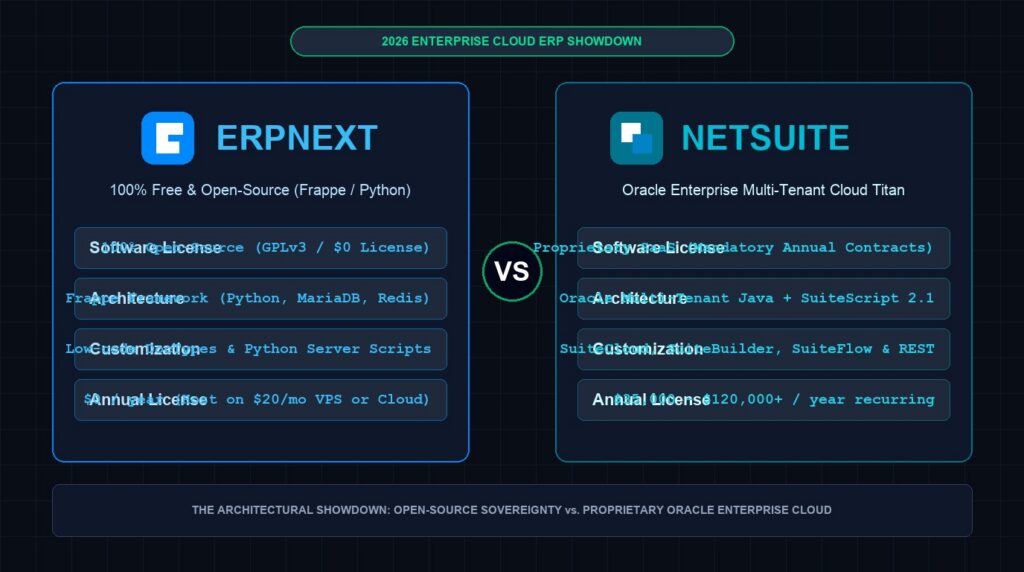
In the high-stakes realm of enterprise resource planning, scaling mid-market enterprises frequently find themselves caught between two polar extremes of corporate computing: committing their business operations and financial ledger to Oracle NetSuite, the industry’s undisputed \$50,000-to-\$150,000/year cloud titan; or embracing ERPNext, the radically transparent, 100% open-source ERP built on the Python-based Frappe Framework that delivers enterprise accounting, manufacturing, and inventory with zero software licensing fees. While NetSuite is celebrated by Wall Street auditors and venture capitalists as the gold standard for pre-IPO governance, a relentless wave of contract price escalations, mandatory annual lock-ins, and complex customization fees has prompted pragmatic CFOs and engineering-driven manufacturers to ask a once-unthinkable question: can an open-source system truly match Oracle’s flagship cloud ERP? Having supervised multi-entity implementations across both platforms, here is the unfiltered architectural and financial reality of ERPNext vs. NetSuite in 2026.
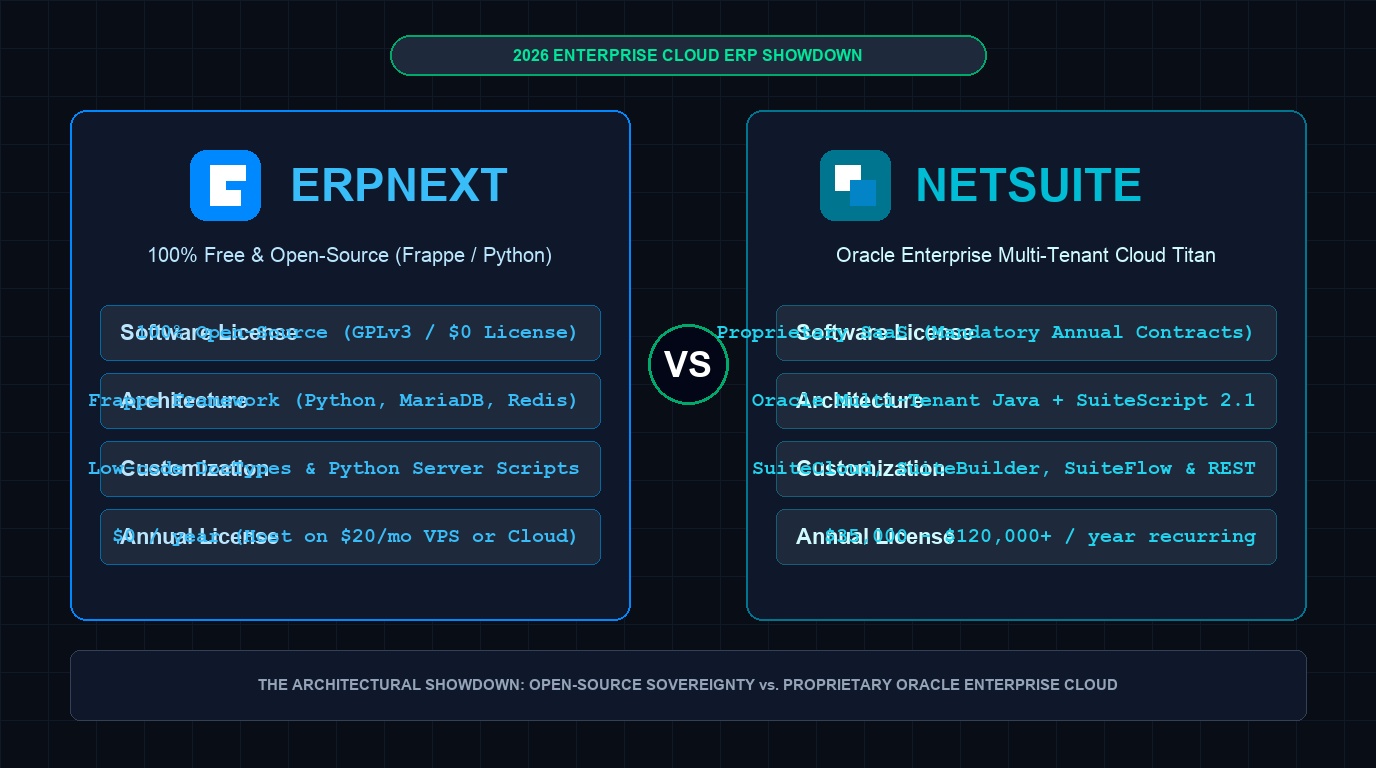
For Chief Financial Officers, Chief Technology Officers, and manufacturing executives, the comparison between ERPNext and NetSuite is not merely a budgetary debate between “free” software and expensive SaaS. It defines your core software sovereignty, your dependency on proprietary consulting ecosystems, whether you can inspect and modify your underlying application source code, and how quickly your operational teams can adapt workflows without paying \$250/hour to certified SuiteCloud developers.
The Fundamental Architectural Divide: Modern Python Monolith vs. Multi-Tenant Java Legacy
To grasp why ERPNext and NetSuite feel so fundamentally different to operate, configure, and extend, you must look beneath the user interface at their foundational software architectures.
1. ERPNext: The Python, MariaDB & Frappe Framework
Developed by Rushabh Mehta and the Frappe team, ERPNext is built on the Frappe Framework, a batteries-included full-stack web application framework written in Python, JavaScript, and MariaDB (with PostgreSQL support):
- 100% Open-Source Purity (GPLv3): Unlike “open-core” vendors who strip essential features from their community editions, ERPNext includes all core business modules—General Ledger, Multi-Currency, Manufacturing (MRP), Serial/Batch Inventory, HRMS & Payroll, CRM, Asset Management, and Helpdesk—completely free and unrestricted.
- The DocType Metadata Architecture: Everything in Frappe is a “DocType” (Document Type). Defining a new business entity automatically generates database tables, REST API endpoints, form views, list filters, and role-based permission rules with zero manual boilerplate code.
- Infrastructure Sovereignty: You can host ERPNext on a \$20/month Hetzner or AWS EC2 Linux virtual machine using Docker, or deploy on Frappe Cloud for managed continuous backups and automated upgrades. Your database resides entirely under your control. For teams comparing open-source solutions, see our breakdown of ERPNext vs. Odoo.
2. Oracle NetSuite: The Pioneer of Multi-Tenant Enterprise Cloud
Founded in 1998 and acquired by Oracle in 2016 for \$9.3 billion, NetSuite was the world’s very first cloud software company. Its architecture is built around a centralized, multi-tenant Oracle database cluster:
- Proprietary Closed SaaS: You cannot download, self-host, or directly access the raw database tables of NetSuite. Your application runs in Oracle Cloud Infrastructure (OCI) datacenters, with scheduled semi-annual version upgrades (Release .1 and .2) applied across customer pods.
- SuiteCloud Developer Network: Customizations in NetSuite are executed through SuiteScript 2.1 (a proprietary JavaScript API running on the Rhino/GraalVM engine), SuiteFlow (visual workflow automation), and SuiteTalk (SOAP/REST Web Services).
- The OneWorld Multi-Entity Standard: Where NetSuite reigns supreme is global corporate consolidation. NetSuite OneWorld allows multinational corporations with dozens of legal entities across 190+ currencies and 100+ countries to maintain localized charts of accounts with automated intercompany transaction eliminations in real time.
Financial Governance, Audit Controls & General Ledger Rigor
For mid-market CFOs preparing for public offerings, debt covenants, or rigorous Big Four accounting audits, the integrity of the general ledger is the paramount selection criterion.
| Financial & Governance Metric | ERPNext (v15/v16) | Oracle NetSuite OneWorld |
|---|---|---|
| Accounting Paradigm | Strict Double-Entry General Ledger with immutable submitted vouchers | Multi-Book Accounting (parallel GAAP, IFRS, and local tax ledgers) |
| Intercompany Eliminations | Manual inter-company journal entries or customized automated scripts | Automated real-time intercompany transactions & elimination journals |
| Revenue Recognition (ASC 606 / IFRS 15) | Deferred revenue accounting schedules (basic milestone/straight-line) | Advanced Revenue Management (ARM) with multi-element contract allocation |
| Audit Trails & Segregation of Duties (SoD) | Version history on DocTypes; role-level permission matrices | System Notes on every field change; out-of-the-box SOX compliance tooling |
NetSuite is engineered from the ground up for corporate compliance. Its Advanced Revenue Management (ARM) module handles complex contract modifications, software subscription ratable amortization, and professional service milestone billing under strict ASC 606 regulations. If an enterprise plans to go public via an IPO, investment bankers and external auditing firms recognize NetSuite immediately, significantly lowering compliance risk.
However, ERPNext’s financial core is far more disciplined than many proprietary detractors assume. ERPNext enforces strict double-entry immutability: once an invoice, payment entry, or journal voucher is Submitted, it cannot be modified or deleted. It can only be canceled and amended, generating a clear audit lineage. For companies with domestic operations or straightforward international trade, ERPNext satisfies GAAP and IFRS statutory reporting requirements without difficulty. For deeper enterprise cloud comparisons, review our analysis of NetSuite vs. Odoo and NetSuite vs. SAP Business One.
Manufacturing, MRP & Inventory Operations
Both systems provide comprehensive discrete manufacturing capabilities, but their day-to-day usability for warehouse and plant managers diverges sharply.
Operational & Shop Floor Reality:
- ERPNext’s Modern Shop Floor Agility: ERPNext features multi-level Bills of Materials (BOM), operations routing, work order tracking, workstation capacity scheduling, subcontracting, and native barcode scanning. The web interface is clean, modern, and mobile-responsive, allowing warehouse workers with tablets or handheld scanners to perform stock transfers, stock reconciliation, and cycle counts without expensive third-party scanning add-ons.
- NetSuite Advanced Manufacturing & WMS: NetSuite’s base inventory system is functional, but advanced manufacturing capabilities—such as rough-cut capacity planning, finite work-order scheduling, and visual drag-and-drop Gantt dispatch consoles—require purchasing the Advanced Manufacturing module. Similarly, barcode mobile scanning requires the NetSuite WMS (Warehouse Management System) add-on, each of which adds \$10,000–\$25,000 to your annual recurring contract.
Total Cost of Ownership (TCO): The \$5,000 vs. \$250,000 5-Year Reality
The financial chasm between ERPNext and NetSuite represents one of the starkest pricing contrasts in all of enterprise software.
NetSuite: The Proprietary Enterprise Escalator
NetSuite pricing is famously opaque, negotiated on annual or multi-year contracts through direct sales representatives or NetSuite Solution Providers:
- Base Platform Fee: Standard Edition begins at roughly \$999/month (\$11,988/yr), while Premium/Enterprise tiers range from \$2,500 to \$5,000+/month.
- User Licenses: Full Access users cost approximately \$99 per user / month (\$1,188/user/year).
- Mandatory Add-on Modules: Essential capabilities—such as OneWorld multi-entity (\$1,999/mo), Advanced Revenue Management (\$999/mo), Advanced Inventory (\$999/mo), and NetSuite WMS (\$1,200/mo)—are billed separately.
- Implementation Fees: A professional NetSuite implementation rarely costs less than \$75,000, with complex multi-entity or manufacturing deployments easily climbing between \$120,000 and \$250,000+.
- The Renewal Price Hike: At contract expiration (typically year 3 or 5), Oracle frequently eliminates initial sales discounts, resulting in 15% to 30% price increases on recurring subscriptions.
ERPNext: The Zero-License Open Model
With ERPNext, the software license is permanently free under the GNU General Public License (GPLv3):
- Software License Cost: \$0.00. Unlimited users, unlimited entities, unlimited transactions.
- Hosting Infrastructure: Run on self-hosted cloud servers (Hetzner, AWS, DigitalOcean) for \$40–\$150/month, or subscribe to managed Frappe Cloud starting at \$50–\$250/month with automated backups, staging environments, and high-availability caching.
- Implementation & Customization: Professional implementation through a certified Frappe Partner or experienced open-source consultancy typically ranges from \$15,000 to \$45,000 total.
5-Year TCO Comparison (40 Users, Manufacturing & Multi-Currency):
ERPNext (Frappe Cloud / Enterprise Support): \$0 software + \$150/mo hosting + \$35,000 implementation + \$10,000/yr support = ~\$94,000 Total (5 Years).
Oracle NetSuite (Base + 40 Users + OneWorld + Implementation): \$72,000/yr licenses × 5 years (\$360,000) + \$120,000 implementation + add-ons = ~\$520,000 Total (5 Years).
Customization & Developer Ergonomics: Frappe Python vs. SuiteScript
How easily your internal engineers can adapt your ERP to unique operational workflows determines your long-term business agility.
Customizing ERPNext
Because ERPNext is built on clean modern Python, finding capable Python/JavaScript developers is straightforward and affordable. Custom fields, server scripts, automated email alerts, and webhook dispatches can be created directly from the web interface using Server Scripts without restarting the application. Complex business logic is packaged into custom Frappe apps that live cleanly in version-controlled Git repositories.
Customizing NetSuite
NetSuite customization requires specialized SuiteCloud developers. While SuiteScript 2.1 is robust, the developer feedback loop is notoriously slow: deploying scripts, debugging governance execution units (NetSuite limits scripts to 1,000 to 10,000 API governance units to prevent CPU hogging on shared pods), and managing deployment bundles between sandbox and production accounts requires specialized tooling. SuiteScript consultants frequently bill at premium rates of \$180–\$280/hour.
Feature-by-Feature Showdown
| Evaluation Criteria | ERPNext | Oracle NetSuite |
|---|---|---|
| Software Licensing Model | 100% Free & Open-Source (GPLv3) | Proprietary SaaS (Mandatory Annual Contracts) |
| Deployment Flexibility | Self-hosted VPS, on-premise, or Frappe Cloud | Oracle Cloud Infrastructure (SaaS only) |
| Global Multi-Entity Consolidation | Multi-Company Chart of Accounts; manual eliminations | Unrivaled (OneWorld automated tax & elimination engine) |
| Built-in Modules Included | All modules included (Accounting, MRP, HRMS, CRM, Barcode) | Modular à la carte (each module incurs monthly fees) |
| Developer Talent Availability | Standard Python / JavaScript / MariaDB engineers | Specialized SuiteScript developers ($180–$250/hr) |
| Pre-IPO & Auditor Acceptance | Acceptable; requires demonstrating custom audit controls | Industry standard benchmark for Big Four auditors |
When to Choose ERPNext vs. NetSuite
Choose ERPNext If:
- You refuse to sign multi-year proprietary SaaS hostage contracts: You want complete ownership of your database, zero user license costs, and the freedom to host on your own infrastructure.
- You have an in-house or accessible Python/engineering culture: You want the agility to build custom DocTypes, automate internal APIs, and adapt your ERP continuously without paying exorbitant partner consulting retainers.
- You are a bootstrapped, mid-market manufacturer or distributor: You have 20 to 150 employees and want full MRP, serial number tracking, quality inspection, and HRMS out of the box without paying for individual module add-ons.
- Predictable unit economics are essential: You want your software costs to scale based on raw server compute, not by penalizing you for adding warehouse or shop floor users.
Choose Oracle NetSuite If:
- You are an active pre-IPO scale-up with institutional investors: Your board of directors, private equity sponsors, or prospective underwriters require an audit-hardened platform that external auditors can review with zero friction.
- You manage a sprawling multi-national conglomerate with 10+ foreign subsidiaries: You require NetSuite OneWorld’s automated multi-entity intercompany eliminations, statutory tax localization across 100+ jurisdictions, and multi-book currency revaluations.
- You require complex ASC 606 revenue recognition: You sell multi-element software contracts, subscriptions, and professional services that require automated revenue amortizations. If you are comparing accounting-first platforms, see our breakdown of Sage Intacct vs. NetSuite.
- You want an enterprise SaaS platform with an enormous global partner ecosystem: You have the budget (\$100k+/year) and prefer delegating implementation and ongoing maintenance to established certified consulting agencies.
Frequently Asked Questions
Can ERPNext really replace NetSuite?
For growing mid-market companies (between \$5M and \$50M in annual revenue) operating primarily within one to three countries, yes. Many manufacturers, eCommerce brands, and distributors successfully run their entire business on ERPNext, saving hundreds of thousands of dollars in licensing fees. However, multinational enterprises with complex ASC 606 revenue recognition and dozens of international subsidiaries typically still require NetSuite OneWorld.
Is ERPNext truly 100% free?
Yes. The entire ERPNext codebase is open-source under the GPLv3 license. There is no artificial user limit or feature gating. You only pay for your own hosting infrastructure (e.g., \$20–\$150/month) and any implementation or technical support services you contract from Frappe or independent partners.
Does NetSuite allow self-hosting on private servers?
No. NetSuite is strictly a multi-tenant cloud SaaS offering hosted exclusively on Oracle Cloud Infrastructure (OCI). There is no on-premise, air-gapped, or self-hosted deployment option.
How difficult is it to migrate from QuickBooks to ERPNext or NetSuite?
Migrating from QuickBooks to either platform requires mapping your chart of accounts, importing customer/vendor masters, and establishing opening trial balances. ERPNext provides intuitive CSV/Excel import tools via the Data Import DocType. NetSuite uses its SuiteCloud CSV Import assistant. Both migrations typically take 8 to 16 weeks depending on historical data cleanup.