
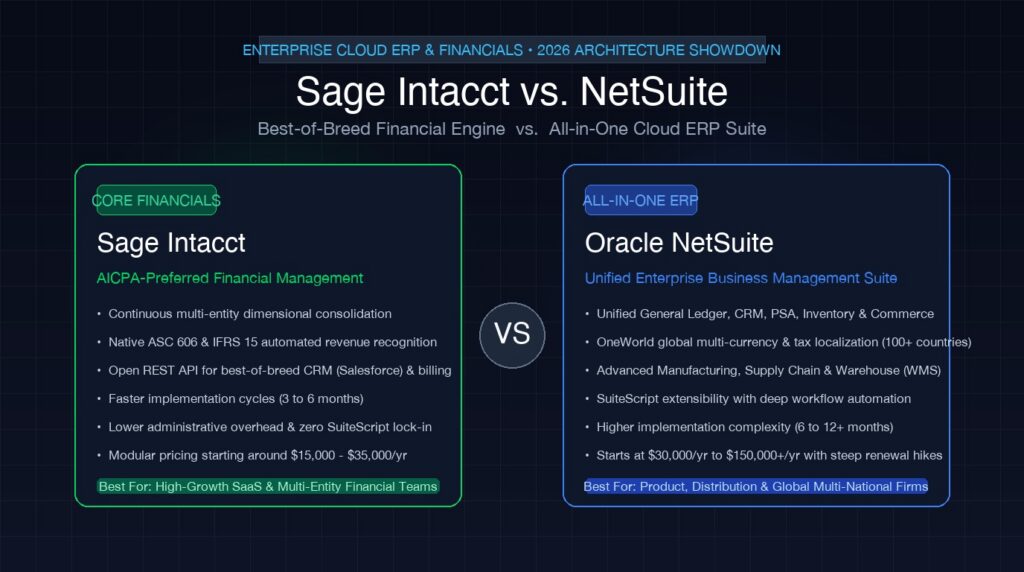
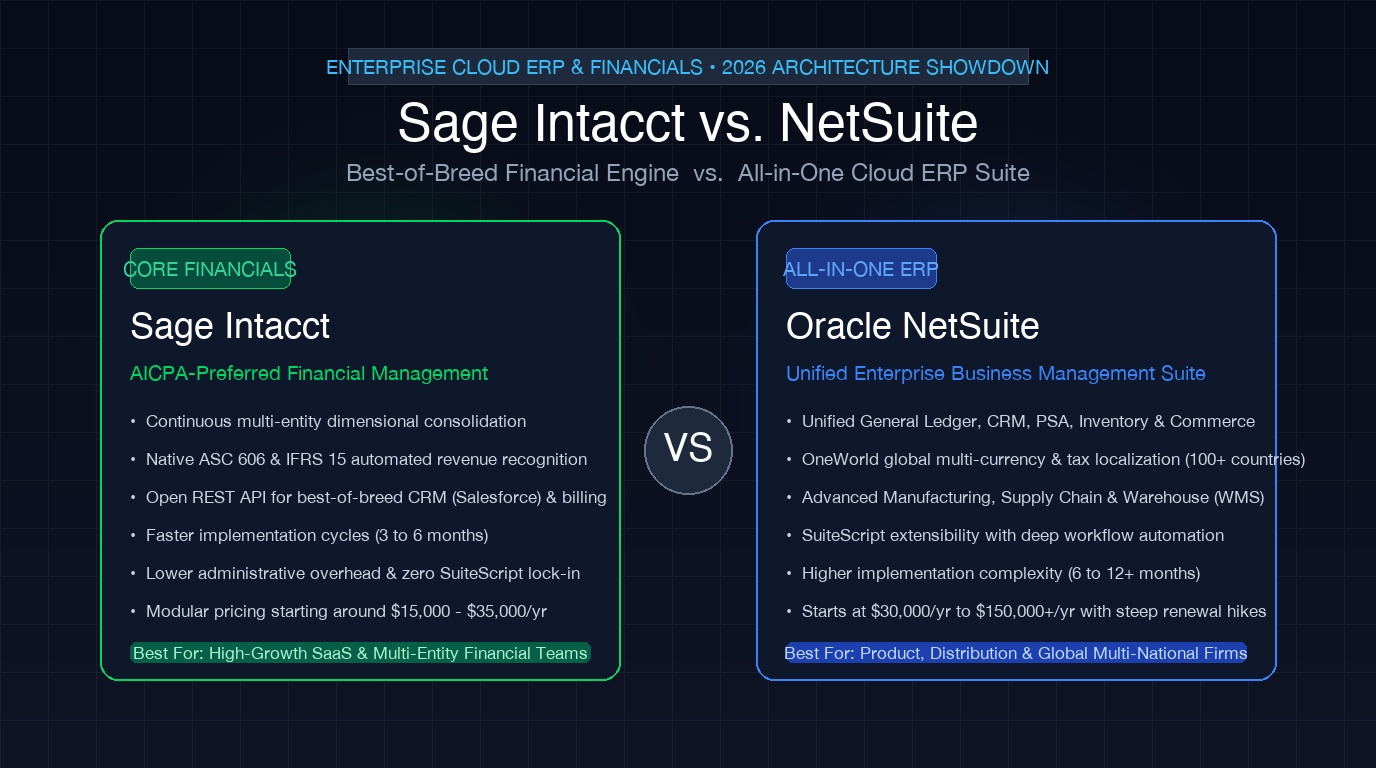
When a high-growth company outgrows QuickBooks or Xero, the executive committee inevitably faces a defining enterprise crossroads: Sage Intacct or Oracle NetSuite. Both platforms dominate mid-market financial management, yet they embody opposing corporate philosophies. Sage Intacct positions itself as the AICPA’s preferred, best-of-breed financial powerhouse—designed to integrate seamlessly with modern CRM and billing stacks like Salesforce and Stripe. NetSuite, by contrast, sells the dream of an all-in-one unified ERP suite—bundling financials, CRM, inventory, PSA, and eCommerce into a single shared database.
As Principal Enterprise ERP Architect Nathan Peterson, I have guided more than forty mid-market and enterprise ERP migrations. Having previously dissected Microsoft Dynamics 365 vs. NetSuite and Acumatica vs. NetSuite, I know firsthand that buying the wrong financial platform can paralyze accounting closes, inflate consulting bills, and trap finance teams in multi-year custom coding sinkholes. In this exhaustive 2026 technical breakdown, we strip away vendor marketing to compare Sage Intacct and NetSuite across general ledger architecture, multi-entity consolidation, revenue recognition (ASC 606), implementation realities, and total cost of ownership (TCO).
Core Architecture: Best-of-Breed vs. Unified Monolithic ERP
The philosophical divide between these two systems dictates your entire corporate software strategy:
Sage Intacct: The Composable Financial Core
Sage Intacct is laser-focused on financial management. It deliberately avoids building mediocre native CRMs or warehouse systems. Instead, Intacct operates as a financial hub with an open, bidirectional REST API designed to plug into specialized applications:
- Salesforce Native Integration: Intacct boasts an Advanced CRM connector pre-built and maintained directly by Sage engineering, enabling continuous bidirectional synchronization of accounts, contracts, renewals, and billing schedules.
- Dimensional Chart of Accounts: Rather than forcing accountants to build a bloated chart of accounts with thousands of segmented sub-accounts, Intacct uses independent data dimensions (Department, Location, Customer, Vendor, Item, Class, Project, Employee) tagged to transactions.
- AICPA Endorsement: Sage Intacct remains the only cloud accounting software endorsed by the American Institute of Certified Public Accountants (AICPA), reflecting its uncompromising auditability and GAAP compliance.
NetSuite: The Unified Single-Database Suite
Acquired by Oracle in 2016, NetSuite is an all-in-one business management engine. It operates on a single consolidated relational database powering all operational modules:
- End-to-End Operational Breadth: NetSuite ships native modules for General Ledger, Fixed Assets, Accounts Payable/Receivable, CRM, Professional Services Automation (OpenAir), Advanced Inventory, Order Management, and Warehouse Management (WMS).
- OneWorld Global Architecture: NetSuite’s flagship OneWorld engine handles complex multinational structures with built-in multi-currency, multi-taxation rules, and multi-GAAP compliance across over 100 countries.
- SuiteCloud & SuiteScript: Customizations, server-side scripts, and UI extensions are written in SuiteScript (JavaScript-based framework), allowing developers to alter nearly any native business workflow.
Deep Functional Showdown: Head-to-Head Technical Comparison
1. Multi-Entity Financial Consolidation
For high-growth businesses acquiring subsidiaries, operating international divisions, or managing holding entities, consolidation speed is a primary operational bottleneck.
Sage Intacct: Provides continuous, real-time consolidation. Intercompany eliminations, currency translations, and shared vendor/customer lists happen instantly across dimensional slices. A CFO can view a consolidated P&L across five legal entities with one click, drill down directly into the journal entry of a specific subsidiary, and generate eliminations without running a batched batch-close job.
NetSuite OneWorld: OneWorld is an enterprise powerhouse for global operations, but its hierarchical structure is rigid. Subsidiaries must be configured within a strict parent-child tree. Once configured, altering parent-subsidiary relationships requires significant professional services intervention. Furthermore, consolidated financial reporting often requires scheduled batch processes rather than continuous live rollups.
2. ASC 606 & IFRS 15 Revenue Recognition
Subscription SaaS, hybrid hardware/software, and professional services firms face stringent compliance rules under ASC 606. Recognizing revenue across dynamic contracts, mid-term upgrades, downgrades, and billing schedules separates enterprise accounting platforms from basic ledger tools.
| Capability | Sage Intacct Contract & Rev Rec | NetSuite Advanced Revenue Management (ARM) | Architectural Edge |
|---|---|---|---|
| Dual Book Accounting | Native (Simultaneous ASC 605 and ASC 606 books) | Supported via Multi-Book accounting module | Tie |
| Contract Modification Handling | Automated prospective/cumulative catch-up schedules | Automated re-allocation via Revenue Arrangements | Sage Intacct (More intuitive UI) |
| CRM Sync for Contracts | Real-time CPQ / Opportunity sync via Salesforce connector | Native if using NetSuite CRM; complex if using Salesforce | Sage Intacct (Best-of-breed CRM) |
| Audit Trail Transparency | Waterfalls directly linked to contract lines | Revenue Elements linked to source transactions | Sage Intacct (Superior visual audit log) |
While NetSuite’s Advanced Revenue Management (ARM) module is capable, it is notoriously complex to configure and audit. Sage Intacct’s Contract Accounting module was engineered specifically for modern subscription models, enabling finance leaders to generate revenue recognition waterfalls without wrestling with esoteric SuiteScript workflows.
3. Customization, Extensibility & Developer Lock-In
Extensibility determines whether your IT department can maintain your ERP independently or whether you are held hostage by expensive implementation partners:
- NetSuite (SuiteScript & SuiteFlow): NetSuite offers virtually limitless customization via SuiteScript. However, heavily customized NetSuite environments frequently suffer from script governance limits (concurrency locks), degraded UI load times, and broken workflows during semi-annual version upgrades (Release 1 and Release 2). Similar to the complexities we analyzed in NetSuite vs. Odoo, maintaining an enterprise NetSuite deployment often requires a full-time in-house NetSuite Administrator ($130,000–$160,000/yr salary).
- Sage Intacct (Platform Services & Open APIs): Intacct separates core financials from external extensions. Custom fields, objects, and smart rules are configured through point-and-click Platform Services. Integration with external software relies on clean REST APIs, ensuring that annual software updates never overwrite or break custom business logic.
Implementation Reality: Time to Value & Failure Rates
ERP implementations are notorious for budget overruns. Understanding the typical rollout timeline is essential for realistic operational planning:
| Implementation Metric | Sage Intacct | Oracle NetSuite |
|---|---|---|
| Average Go-Live Timeline | 3 to 6 months | 6 to 12+ months |
| Implementation Cost Multiple | 1.0x to 1.5x of annual software licensing | 1.5x to 3.0x of annual software licensing |
| Dedicated In-House Admin Required? | No (Senior Accountant / Controller can administer) | Yes (Dedicated certified NetSuite Administrator) |
| User Adoption Curve | Fast (Intuitive, modern accountant-friendly UI) | Steep (Legacy dense forms, complex role permissions) |
The 3-Year Total Cost of Ownership (TCO) Breakdown
NetSuite sales reps are infamous for offering 40% to 65% introductory discounts on Year 1 contracts to win competitive deals. However, CFOs who fail to negotiate strict renewal caps are blindsided by 15% to 30% compounding annual price increases upon contract expiration. Here is an honest 3-year TCO comparison for a $50M mid-market business with 25 finance users and 5 legal entities:
| Expense Category | Sage Intacct (Financial Core) | Oracle NetSuite (Unified ERP) |
|---|---|---|
| Year 1 Software Licensing | $28,000 | $38,000 (after 50% initial discount) |
| Implementation & Data Migration | $35,000 | $85,000 |
| Year 2 Software Licensing | $30,500 (locked 5% cap) | $52,000 (discount rollback) |
| Year 3 Software Licensing | $33,000 | $68,000 (standard renewal hike) |
| Administration & Consulting Support (3 Yrs) | $25,000 (Managed partner hours) | $180,000 (Full-time internal admin) |
| Total 3-Year Investment | $151,500 | $423,000 |
While NetSuite provides native CRM and light inventory within that cost, companies that already run Salesforce or HubSpot gain virtually zero ROI from NetSuite’s built-in CRM, effectively paying an enterprise premium for redundant modules.
Comprehensive Feature Comparison Table (2026)
| Evaluation Criteria | Sage Intacct | Oracle NetSuite |
|---|---|---|
| Primary Orientation | Best-of-breed core financial management | Monolithic all-in-one enterprise ERP |
| General Ledger Structure | Dimensional tagging (Lean Chart of Accounts) | Segmented accounts, classes, and departments |
| Multi-Entity Consolidation | Continuous real-time rollup with instant drill-down | Hierarchical OneWorld rollups via scheduled batches |
| Revenue Recognition | Built-in ASC 606 / IFRS 15 subscription engine | Advanced Revenue Management (ARM) add-on module |
| CRM Capability | Partner-led (Deep native integration with Salesforce) | Native built-in CRM (Basic) or complex third-party sync |
| Inventory & Supply Chain | Light distribution / order entry (requires add-ons for heavy manufacturing) | Advanced WMS, demand planning, lot tracking, and shop-floor control |
| Upgrade Stability | Zero custom code breaks during quarterly updates | Occasional SuiteScript regression during semi-annual releases |
| Ideal Company Profile | B2B SaaS, Professional Services, Healthcare, Non-Profit | Wholesale Distribution, Retail, Manufacturing, Global eCommerce |
The Final Architectural Verdict
The choice between Sage Intacct and NetSuite boils down to a fundamental strategic question: Are you running a services/software business with specialized operational software, or are you running a complex physical supply chain?
Choose Sage Intacct if:
- You are a B2B SaaS, digital services, healthcare, or financial services company prioritizing dimensional reporting, auditability, and ASC 606 revenue automation.
- You have already standardized on Salesforce or HubSpot for your go-to-market operations and want a financial system that integrates seamlessly without forcing you into a proprietary CRM.
- You want an agile finance deployment completed in 3 to 5 months with lower ongoing administrative overhead.
- You want predictable, transparent software renewals without fear of predatory Oracle price hikes.
Choose Oracle NetSuite if:
- You are a wholesale distributor, manufacturing company, or multi-channel eCommerce brand requiring deep physical inventory tracking, assembly builds, and warehouse management (WMS) inside the same database as your financials.
- You manage a vast multinational corporate structure with complex overseas entities requiring multi-taxation and multi-language localized compliance in dozens of jurisdictions.
- You have the budget ($100,000+ implementation and full-time admin support) and organizational patience for a 9- to 12-month transformation rollout.
- You want a single unified vendor for ERP, CRM, and eCommerce, accepting functional trade-offs for the convenience of one throat to choke.
Frequently Asked Questions
Why does the AICPA endorse Sage Intacct instead of NetSuite?
The American Institute of CPAs (AICPA) selected Sage Intacct as its first and only preferred financial management software due to its pure GAAP compliance, dimensional general ledger design, strict audit controls, and real-time multi-entity consolidation capabilities.
Can Sage Intacct handle physical inventory like NetSuite?
Sage Intacct handles basic purchasing, order entry, and serialized inventory tracking. However, for complex multi-location warehouse management, lot tracking, Bill of Materials (BOM), and shop-floor manufacturing, Intacct relies on specialized partner integrations (e.g., MISys or Acctivate), whereas NetSuite provides advanced native manufacturing and WMS modules.
Is it easier to integrate Salesforce with Sage Intacct or NetSuite?
Sage Intacct offers a vastly superior Salesforce integration. The Sage Intacct Advanced CRM connector was co-developed with Salesforce, requires no custom middleware, and allows sales reps to generate sales orders and view accounting payment statuses directly within the Salesforce UI. NetSuite, owning a competing native CRM, requires third-party iPaaS middleware (like Celigo or Boomi) and ongoing SuiteScript maintenance to achieve comparable Salesforce synchronization.