
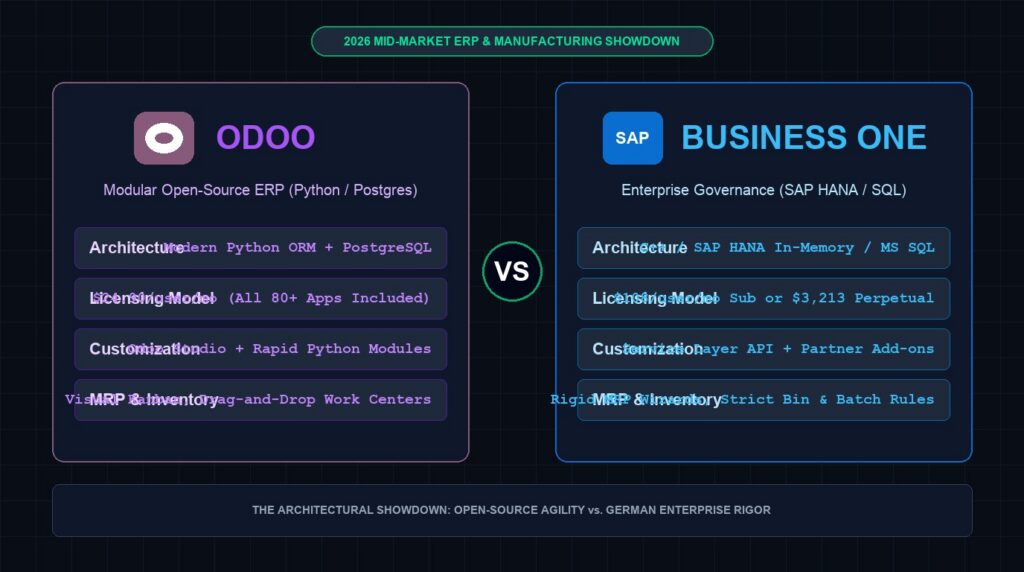
When a scaling manufacturing, wholesale distribution, or multi-entity business outgrows QuickBooks and fragmented spreadsheets, the ERP selection shortlist almost inevitably distills into a battle between two wildly opposing software philosophies: Odoo Enterprise and SAP Business One (SAP B1). In one corner stands Odoo, the Belgian open-source unicorn that disrupted enterprise software with modular Python apps, intuitive Kanban interfaces, and an aggressive \$24.90/user/month flat pricing model. In the other stands SAP Business One, the battle-hardened mid-market offering from Europe’s largest enterprise software titan, revered for unyielding GAAP/IFRS accounting controls, sophisticated Material Requirements Planning (MRP), and SAP HANA in-memory performance. Having led multi-million dollar implementations and recovery audits across both ecosystems, here is the unfiltered architectural and financial reality of Odoo vs. SAP Business One in 2026.
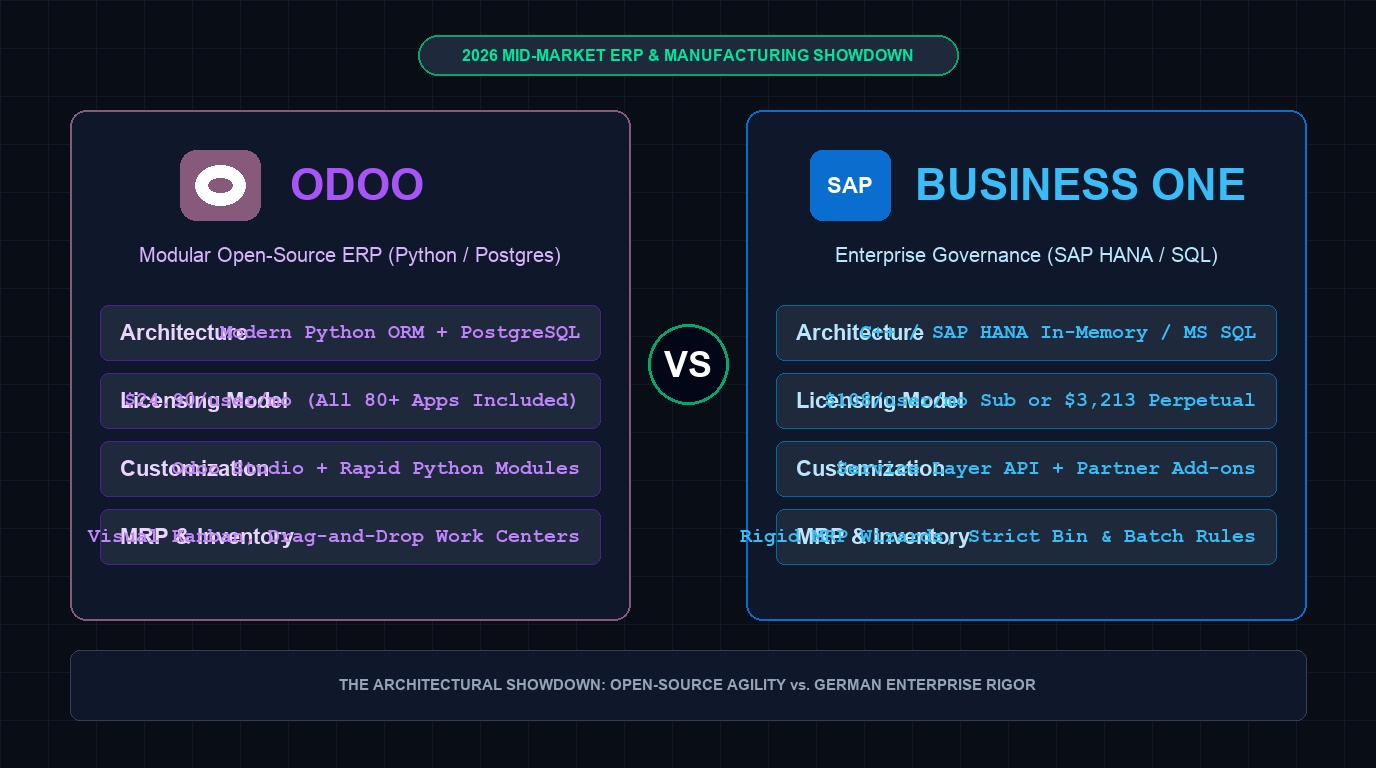
For Chief Operating Officers, CFOs, and IT directors, choosing between Odoo and SAP B1 is not merely a software procurement exercise. It determines whether your shop floor operators embrace visual tablet workflows or resist dense tabular forms, whether your auditors cruise through year-end closes without friction, and whether your 5-year software licensing expenditure lands under \$50,000 or escalates beyond \$250,000.
The Fundamental Architectural Divide: Modern Python ORM vs. Compiled Enterprise Monolith
The operational divide between Odoo and SAP Business One stems directly from their foundational software engineering and database architectures.
1. Odoo: The Modular Python & PostgreSQL Ecosystem
Originally created as OpenERP in Belgium, Odoo is designed as a unified web-native application framework built on Python and PostgreSQL:
- Fully Integrated Web Architecture: Odoo’s frontend is a responsive single-page web app built on Owl (Odoo Web Library). Every module—from CRM and eCommerce to Manufacturing (MRP), Barcode Scanning, and Double-Entry Accounting—shares the exact same data schema and relational model.
- Extensibility & Odoo Studio: Customizing Odoo does not require altering proprietary core code. Through Odoo Studio (no-code/low-code) or custom Python modules, developers inherit base classes (via Odoo’s custom Object-Relational Mapping system) and override specific methods without breaking database integrity.
- Deployment Flexibility: While most customers opt for Odoo.sh (Odoo’s fully managed cloud platform with automated staging branches), Odoo can be self-hosted on any private cloud or bare-metal Linux server running PostgreSQL. For teams evaluating open-source licenses, see our breakdown of Odoo Community vs. Enterprise and ERPNext vs. Odoo.
2. SAP Business One: The Structured Client/Server Powerhouse
Acquired by SAP in 2002 (originally TopManage from Israel), SAP Business One was built as a dedicated mid-market client/server desktop and browser solution engineered in C++ and C#:
- Underlying Database Engines: SAP B1 runs either on Microsoft SQL Server or SAP HANA (in-memory columnar database). On SAP HANA, complex aggregate financial queries, real-time inventory valuations, and multi-dimensional sales forecasting run directly in RAM with near-zero latency.
- The Web Client vs. Fat Client: While SAP has made massive strides with its browser-based Web Client (Fiori UI design), core configuration, complex MRP wizards, and deep administrative setups still frequently require the Windows desktop client.
- Rigid Relational Schema: SAP B1 enforces strict internal data validation rules. You cannot casually alter core ledger entries, delete posted invoices, or bypass inventory valuation layers. This rigidity guarantees pristine audit compliance at the expense of UI agility.
Manufacturing & MRP: Discrete Production, Routing & Shop Floor Reality
For discrete manufacturers, machine shops, and assembly plants, the MRP engine is the vital heartbeat of the ERP system.
| Manufacturing Capability | Odoo Enterprise (v18/v19) | SAP Business One (v10 / HANA) |
|---|---|---|
| Bill of Materials (BOM) | Multi-level BOMs, kits, subcontracting, and dynamic variant configurations | Production, Sales, Assembly, and Template BOMs with deep component versioning |
| Shop Floor Terminal & UX | Exceptional touch-screen tablet view with PDF instructions, step timers, and QC checks | Functional but dated tabular forms; usually requires 3rd-party MES add-on (e.g. Boyum B1 Usability / Beas) |
| MRP Calculation Wizard | Automated reordering rules, lead-time scheduling, and Just-In-Time (JIT) procurement | Advanced multi-scenario MRP Wizard considering min/max, forecasts, order lead times, and holidays |
| Work Centers & Capacities | Gantt chart scheduling, OEE tracking, work center hourly labor/cost absorption | Resource capacity management (machines/labor), daily run-time allocations |
| Traceability & Serials | Native upstream/downstream barcode traceability from receipt to delivery | Strict serial/batch lifecycle management with complete quarantine and release control |
Where Odoo utterly dominates is on the physical shop floor. Operators interact with a vibrant, touch-friendly tablet interface that displays step-by-step assembly drawings, barcode validation for raw components, and real-time scrap tracking. Workers do not need to understand complex ERP accounting logic to log production output.
SAP Business One, on the other hand, excels in deterministic calculation precision. Its MRP Wizard evaluates sales forecasts, minimum stock levels, confirmed purchase orders, production lead times, and multi-tier vendor pricing matrices across complex supply chains. However, to bring that power to shop floor terminals, most SAP B1 customers must purchase third-party manufacturing extensions like Beas Manufacturing (Boyum IT), adding \$15,000–\$40,000 to the total license cost. If you are comparing SAP against other enterprise cloud giants, see our in-depth analysis of NetSuite vs. SAP Business One.
Financial Governance, Audit Trails & Accounting Rigor
For CFOs and finance leaders, an ERP system is only as reliable as its general ledger and internal control framework.
Financial Architecture & Controls:
- SAP Business One’s Fortified Ledger: In SAP B1, once a journal entry is posted, it cannot be edited or deleted—only reversed with an offsetting audit transaction. It features multi-currency revaluation, strict segregation of duties (SoD), comprehensive tax localization packages for 50+ countries, and rigid period locks that make passing Big Four accounting audits seamless.
- Odoo’s Modernized Accounting: Odoo has dramatically improved its accounting engine in recent releases (v16 through v19), introducing automated bank feed synchronization (Plaid, Salt Edge), smart AI invoice digitization (OCR), and country-specific fiscal localizations. However, Odoo’s flexibility allows system administrators to adjust settings and cancel draft entries more freely, which requires disciplined user permission configuration to satisfy strict corporate auditors.
Total Cost of Ownership (TCO): The \$25/User vs. \$100/User Reality
Pricing structure is where the chasm between Odoo and SAP Business One becomes impossible to ignore.
Odoo Enterprise Pricing (Transparent & Predictable)
Odoo’s modern pricing model is radically simple: one single price unlocks all 80+ official Odoo applications:
- Standard Cloud / Odoo.sh: ~\$24.90 to \$37.40 per user / month (depending on promotional terms and multi-year commitments).
- No Module Add-on Penalties: You do not pay extra fees for adding Manufacturing, Barcode, Helpdesk, eCommerce, or CRM.
- Implementation Costs: Typical mid-market Odoo implementations range from \$15,000 to \$50,000 with a certified partner.
SAP Business One Pricing (The Traditional Enterprise Stack)
SAP B1 is sold exclusively through Value Added Resellers (VARs). Licensing is available either as a perpetual license or a monthly cloud subscription:
- Cloud Subscription: Professional Users run approximately \$108 to \$135 per user / month, while Limited Users (CRM or Logistics only) cost \$56 to \$75 per user / month.
- Perpetual License: Professional Users cost \$3,213 per seat upfront + mandatory 18%–20% annual software maintenance (~\$640/user/year).
- Implementation & Consulting Fees: Because configuring SAP B1 requires specialized certified consultants, implementation fees typically range from \$40,000 to \$150,000+. Furthermore, essential add-ons (like Boyum B1UP, integration service layers, or specialized shipping modules) add \$5,000–\$20,000 annually.
5-Year TCO Comparison (30 Professional Users):
Odoo Enterprise: 30 users × \$30/mo × 60 months = \$54,000 + \$35,000 implementation = ~\$89,000 Total.
SAP Business One (Cloud): 30 users × \$110/mo × 60 months = \$198,000 + \$75,000 implementation + \$20,000 add-ons = ~\$293,000 Total.
Ecosystem & Customization: Python vs. SAP Service Layer
How easily your internal developers or external agencies can extend the ERP dictates long-term agility.
Customizing Odoo
Odoo is a developer’s playground. Because Python is the lingua franca of modern backend engineering, finding talented Python developers is straightforward and affordable. Odoo’s App Store boasts over 40,000 community and commercial modules covering niche integrations with carriers, payment gateways, and third-party SaaS tools like Stripe or PostHog.
Customizing SAP Business One
SAP B1 integrates via the SAP Business One Service Layer (an OData REST-based API built on top of SAP HANA/SQL) and the legacy DI-API (Data Interface API). While powerful and rock-solid, building custom extensions requires specialized C#/.NET developers who command \$150–\$250/hour consulting rates. Upgrades between major SAP B1 versions also require extensive regression testing of third-party add-ons.
Head-to-Head Comparison Table
| Evaluation Criteria | Odoo Enterprise | SAP Business One |
|---|---|---|
| Primary Target Market | Growing SMBs to mid-market (10–300 users) | Established mid-market & enterprise subsidiaries (20–500 users) |
| User Interface & UX | Modern, intuitive, web-first, tablet-optimized | Traditional desktop client + evolving Fiori web UI |
| Accounting & Audit Governance | Flexible; requires strict configuration for tight audit trails | Uncompromising, audit-hardened financial controls |
| MRP & Forecasting Complexity | Excellent visual shop floor; standard reordering heuristics | Industrial-strength MRP calculations & supply chain modeling |
| Licensing Pricing Model | Transparent all-inclusive flat fee (~$25–$37/user/mo) | Tiered pricing ($108/user/mo) + add-ons + expensive VARs |
| Corporate Brand Pedigree | High-growth open-source champion | Globally recognized enterprise ERP brand |
When to Choose Odoo vs. SAP Business One
Choose Odoo Enterprise If:
- User adoption and modern digital ergonomics are critical: Your workforce includes younger tech-savvy teams, shop floor operators, or warehouse staff who need visual, mobile-responsive interfaces without steep learning curves.
- You want an all-in-one software ecosystem without vendor nickeling-and-diming: You need CRM, point of sale, eCommerce, helpdesk, project management, and inventory under one roof without purchasing separate third-party software subscriptions.
- You value custom rapid development: Your business has unique operational workflows that require custom Python logic or rapid Odoo Studio modifications. If you are comparing Odoo against NetSuite, review our analysis of NetSuite vs. Odoo.
- Budget and ROI predictability dominate your decision: You refuse to sign open-ended enterprise consulting retainers that exceed the original software purchase price.
Choose SAP Business One If:
- Strict financial compliance, GAAP/IFRS controls, and audit trails are non-negotiable: You are preparing for an IPO, operate in heavily regulated industries (medical devices, aerospace, defense), or have conservative institutional investors who insist on SAP-certified controls.
- You are an international subsidiary of an enterprise running SAP S/4HANA: SAP B1 integrates natively with parent company SAP S/4HANA instances, enabling seamless corporate reporting and intercompany rollups.
- You have highly complex discrete manufacturing with multi-tier MRP: Your production processes require mathematical supply chain forecasting, machine capacity constraints, and strict batch-level quarantine control.
- You prefer working through an established, local certified VAR: You want an accountable regional consulting firm that takes full ownership of hosting, maintenance, and 24/7 technical support.
Frequently Asked Questions
Can Odoo replace SAP Business One completely?
Yes. Many mid-market companies with 50 to 250 employees have successfully replaced SAP Business One with Odoo Enterprise to eliminate expensive annual maintenance fees and gain modern web/mobile interfaces. However, companies with rigid multi-tier manufacturing or parent-company SAP S/4HANA requirements often retain SAP B1 for its compliance rigor.
Is Odoo really open-source?
Odoo follows an “open core” model. Odoo Community is 100% free and open-source (LGPLv3), but lacks full accounting, barcode scanning, studio, and advanced manufacturing features. Odoo Enterprise is a proprietary licensed software suite that includes all 80+ apps, automatic database migration upgrades, and cloud hosting.
What database does SAP Business One run on?
SAP Business One runs either on Microsoft SQL Server or SAP HANA. In 2026, the overwhelming majority of new deployments run on SAP HANA due to its lightning-fast in-memory processing, real-time analytics, and interactive dashboard capabilities.
How long does an implementation take for each platform?
A standard Odoo Enterprise implementation typically takes 8 to 16 weeks for a mid-market distributor or manufacturer. SAP Business One implementations usually require 16 to 32 weeks due to deep blueprinting, data migration, and custom add-on configuration through a certified VAR.