

Most founders evaluate agencies the wrong way — they focus on portfolio aesthetics and hourly rates while ignoring the questions that actually predict outcomes. A backend development agency is not just a vendor; it becomes a co-author of your product architecture, and a poor fit creates technical debt that compounds every quarter backend development agency.
Before you shortlist anyone, understanding the full scope of backend development services for growing startups gives you a sharper lens to assess whether an agency is genuinely equipped to deliver what your product demands.
Why choosing the wrong backend development agency is so costly
A bad hire is expensive. A bad agency engagement is often worse. When you bring in the wrong backend development agency, the consequences compound in ways that are not immediately visible backend development agency.
Poor architectural decisions made in month one become structural constraints in month twelve. A database schema that was not designed for scale requires a costly migration when your user base grows. An API built without proper versioning breaks your mobile app every time the backend updates. Authentication logic written without security best practices creates vulnerabilities that surface at the worst possible moment backend development agency.
The cost of fixing these problems is not just financial. It is timeline compression when you can least afford it, lost trust with early customers, and technical debt that slows every future sprint.
Choosing a backend development agency correctly the first time is not perfectionism. It is risk management.
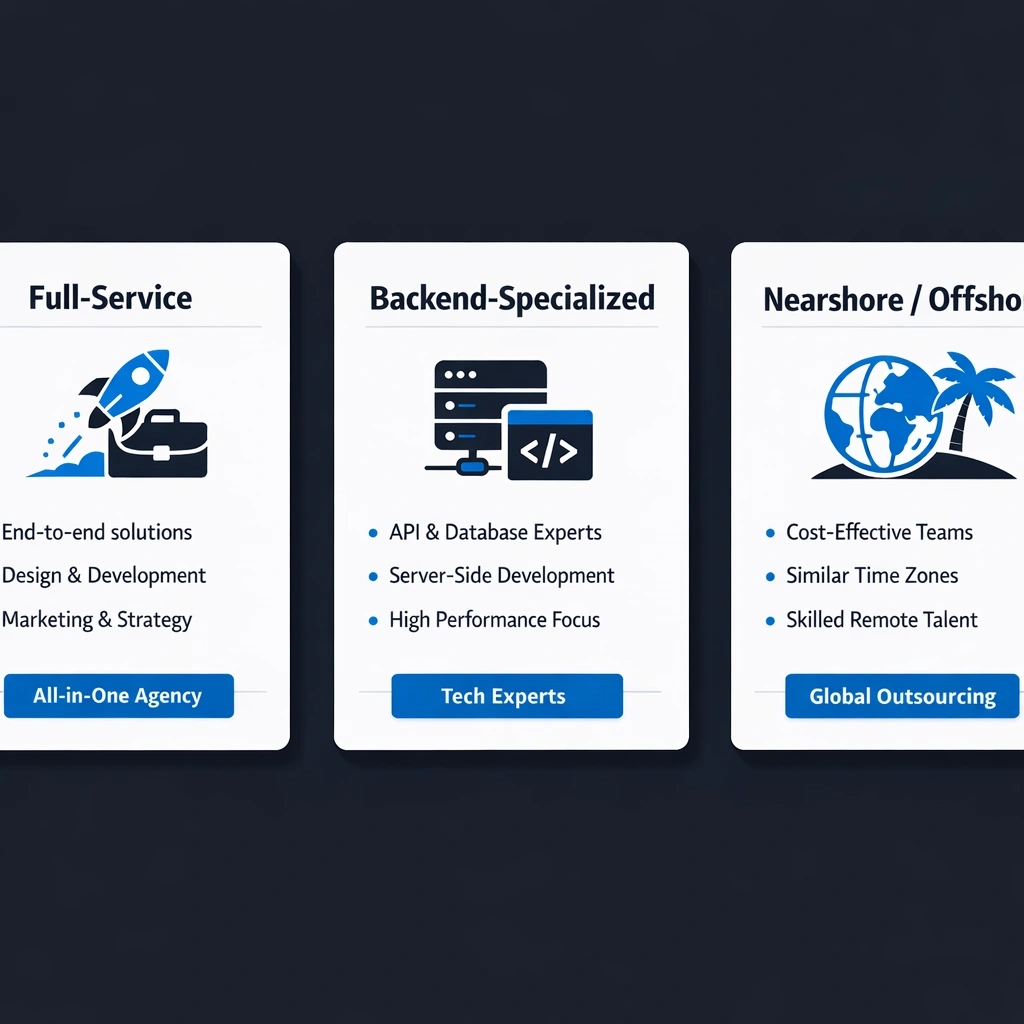
The 3 types of backend development agencies in the market
Not all agencies operate the same way, and understanding the model matters before you evaluate any specific vendor.
Full-service software development agencies
These agencies handle the full product stack — frontend, backend, mobile, design, and sometimes product strategy. They are convenient for founders who want a single vendor relationship and do not have strong technical preferences about team structure.
The trade-off is depth. A full-service agency may have backend developers on staff, but backend is not their core identity. For complex backend requirements, this generalist approach can produce adequate results but rarely exceptional ones.
Backend-specialized agencies
These agencies focus exclusively or primarily on server-side development — API architecture, database design, infrastructure, and system integration. Their teams tend to run deeper on the technical disciplines that matter most for backend work.
For founders building products where the backend is the product — data platforms, integration layers, high-performance APIs — a specialized agency is almost always the stronger choice despite the narrower scope.
Nearshore and offshore development firms
These firms offer dedicated development teams, often at significantly lower rates than US or Western European agencies, with talent based in Eastern Europe, Latin America, or Southeast Asia. The quality range is wide, and the model requires more active management from the founder’s side.
The best nearshore and offshore firms operate with mature project management processes, strong English communication, and documented development workflows. The weakest ones rely on the founder’s lack of technical oversight to mask quality problems until late in the engagement.
7 criteria for evaluating a backend development agency
When you move past the initial agency website and into active evaluation, these are the criteria that separate reliable partners from expensive disappointments.
1. Relevant technical depth
Does the agency have demonstrated experience with the technologies your product requires? Ask for specific examples — not just logos on a tech stack page, but projects where they made meaningful architectural decisions using those tools.
A backend development agency that has built three production SaaS products on PostgreSQL and Node.js is a different proposition from one that lists those technologies on a capabilities page but cannot discuss the trade-offs they navigated in practice backend development agency.
2. Discovery process before proposal
Strong agencies conduct a structured discovery phase before submitting a proposal. They ask about your data model, your expected traffic patterns, your third-party integration requirements, and your scaling timeline. They use the answers to inform an architecture recommendation before quoting.
An agency that sends a proposal within 24 hours of a one-paragraph brief is telling you that the proposal is not based on your actual requirements. That is a meaningful signal about how the rest of the engagement will go.
3. Code quality standards
Ask directly: what does their code review process look like? Do they use automated testing? What is their approach to documentation? What does a typical handoff package include?
Agencies with mature engineering practices welcome these questions. Agencies that deflect or answer vaguely are signaling that these practices either do not exist or are not enforced consistently.
4. Communication structure and cadence
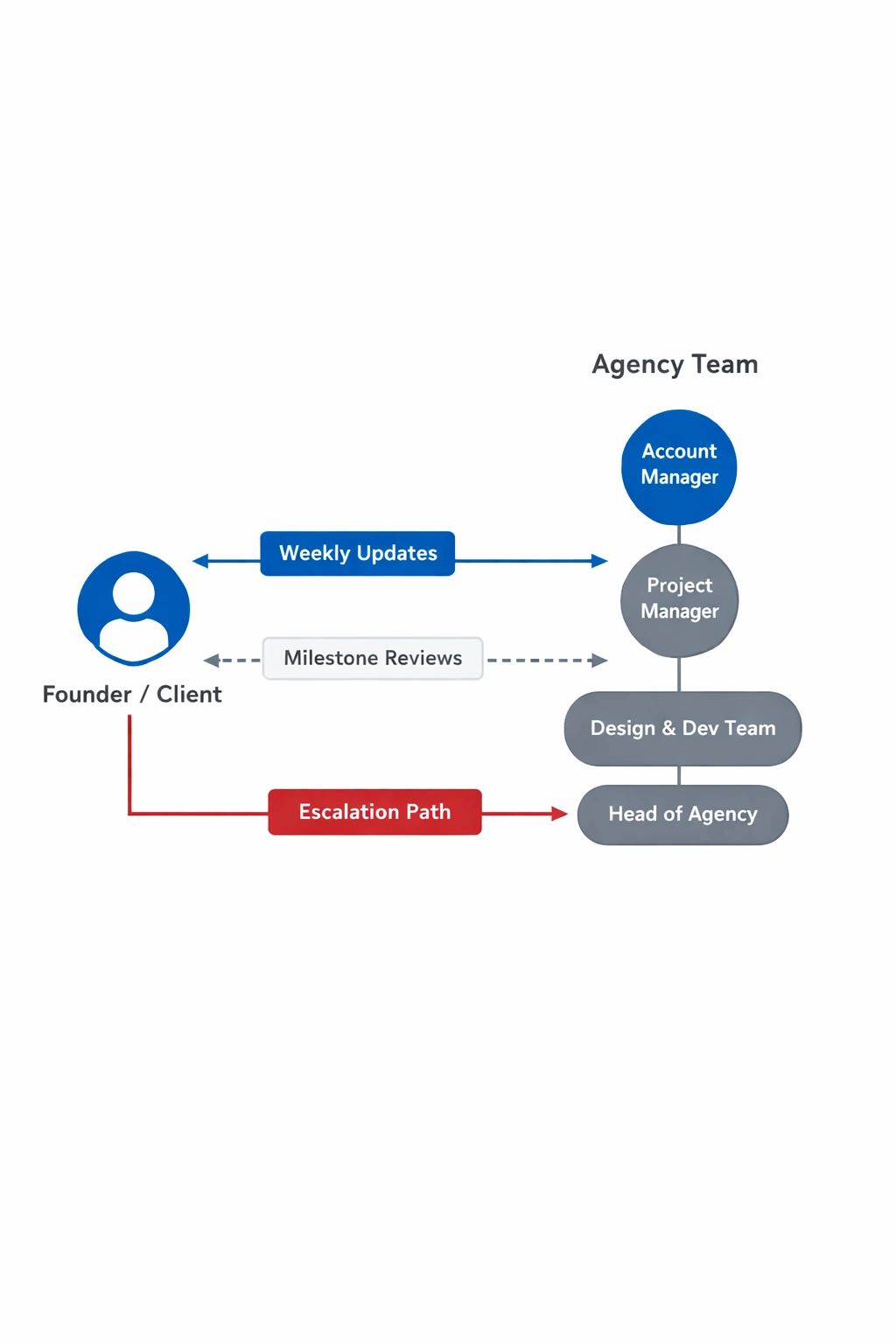
Backend development engagements run for weeks or months. The communication structure — how often you receive updates, who your primary contact is, how decisions get documented, how scope changes are handled — determines your day-to-day experience as a client.
Ask for a sample project update report. Ask who you will be speaking to weekly — the project manager, the technical lead, or both. Ask how they handle a situation where a developer on your project becomes unavailable mid-engagement.
5. Ownership and IP clarity
Before any work begins, the contract should clearly establish that all code, architecture documents, and credentials created during the engagement are owned by your company — not the agency. This sounds obvious, and yet IP disputes in software development engagements are common enough to warrant explicit attention.
Review the contract terms on intellectual property before signing. If the agency resists clear IP assignment language, treat that as a serious red flag.
6. Post-launch support terms
Ask what happens after the final deliverable is accepted. Is there a warranty period during which bugs are fixed at no charge? What are the terms for ongoing maintenance? What does the knowledge transfer process look like if you bring development in-house later?
The answers tell you how the agency thinks about long-term client relationships versus transactional project delivery.
7. Reference quality
A backend development agency with a strong track record will have clients willing to speak on the record about their experience. Ask for references specifically from projects similar to yours in scope and complexity. Ask the references not just whether they were satisfied, but what they would do differently and what surprised them about the engagement.
Generic positive references are easy to produce. Specific, candid ones reveal the agency’s actual operating style.
Red flags to watch for during the evaluation process
Some warning signs are subtle enough that founders miss them until they are already mid-engagement.
Overpromising on timeline — if an agency tells you a complex backend can be built in a timeline that experienced developers would consider unrealistic, they are either planning to cut corners or setting up a change order conversation after you are already committed.
Resistance to milestone-based contracts — agencies that insist on large upfront payments without corresponding milestone deliverables are structuring the engagement to their advantage, not yours. Milestone-based payment structures align incentives on both sides.
Vague technology recommendations — if an agency recommends a specific stack without being able to explain why it fits your use case better than alternatives, the recommendation is not based on your requirements. It is based on what they already know how to build.
No internal technical point of contact on your side — this is not a red flag from the agency, but a risk on your side. If no one internally can evaluate the technical quality of what is being delivered, you have no feedback mechanism. Before engaging any backend development agency, identify who will perform technical oversight — even if it means bringing in a fractional CTO for a few hours per week.
Understanding how the costs of these engagements break down — and how to structure payment to protect your budget — is covered in detail in the backend development cost breakdown for 2026.
How to structure the final decision between shortlisted agencies
Once you have evaluated three to five agencies against the criteria above, the final decision comes down to four factors weighted against each other.
Technical fit — does their demonstrated experience match your actual requirements, not just your general category?
Process maturity — do they have documented, repeatable development workflows, or do they operate on founder trust and developer autonomy?
Communication quality — in every interaction leading up to the contract, have they been clear, responsive, and specific? Pre-sales behavior reliably predicts engagement behavior.
Commercial terms — are the payment structure, IP assignment, warranty terms, and post-launch support clearly defined and founder-protective?
The agency that scores strongest across all four dimensions is rarely the cheapest option. It is almost always the most cost-effective one when measured against the full cost of the engagement — including the cost of fixing what a weaker agency leaves behind.
For founders who are still deciding whether to engage an agency at all or build the capability differently, the full comparison of outsourcing vs. in-house backend development walks through every trade-off worth considering before you commit to either path.
Conclusion
Selecting a backend development agency is one of the most consequential vendor decisions a non-technical founder makes. The right agency accelerates your product, protects your architecture, and leaves you with a codebase you can build on. The wrong one does the opposite — and the damage is rarely obvious until you are already paying to undo it.
Evaluate on process, not just portfolio. Ask the hard questions before you sign. And treat the pre-sales interaction as a preview of the engagement itself — because it almost always is.