

Every entrepreneur knows reviews matter. What most do not know is how to make them work as a system rather than a byproduct.
A business with 50 strategic, well-distributed reviews will consistently outperform a competitor with 500 reviews that sit untouched on a single platform. The difference is not volume.
It is architecture.
Amplified reviews are the structured process of collecting, curating, distributing, and deploying customer feedback across every touchpoint in your funnel — from the first search a buyer runs to the final moment before they commit to a purchase.
This guide breaks down that process into five actionable layers, each one building on the last.
What makes amplified reviews different from a standard review strategy is intentionality. Every piece of feedback is captured, placed, and activated with a specific commercial goal in mind — not left to accumulate passively on a platform you do not control.
Whether you are starting from zero or already have a review presence that is not converting, this framework shows you exactly how amplified reviews become one of the most powerful and cost-effective growth channels in your business.
What amplified reviews are and why they matter for your business
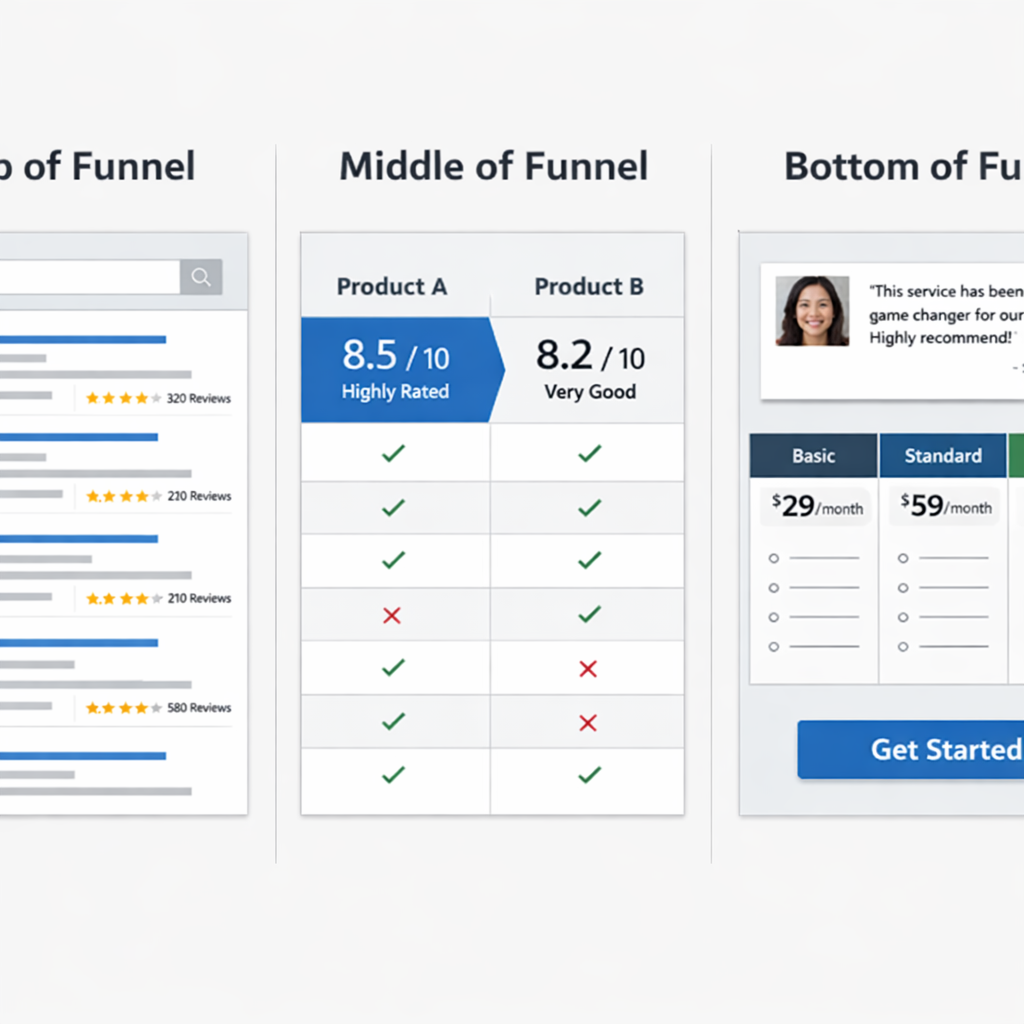
Most entrepreneurs treat reviews as a passive outcome. A customer buys, the transaction closes, and if the customer feels strongly enough they leave a public comment somewhere. The business owner checks it occasionally, feels good when it is positive, feels anxious when it is negative, and moves on.
That approach leaves the majority of the value in reviews completely untouched.
Amplified reviews operate on a different logic. Instead of waiting for reviews to accumulate and hoping buyers stumble across them, an amplified review strategy treats each piece of customer feedback as a distributable asset — something to be placed strategically at every stage of the buyer journey, on every channel where your potential customers are making decisions.
The distinction between a standard review and an amplified review is not about the content of the review itself. It is about what happens after the review is collected. A five-star Google review that sits on a Google profile page is useful to the buyer who is already searching for your business. That same review embedded on your homepage, quoted in a follow-up email, featured in a LinkedIn post, and referenced in a paid ad is useful to every buyer in your market — regardless of whether they were already looking for you amplified reviews.
Why online review management is the foundation of this strategy
Online review management, the practice of actively monitoring, responding to, and distributing customer feedback across platforms, is the operational backbone of an amplified review strategy. Without it, even the strongest reviews decay in value over time. Platforms deprioritize old content. Buyers discount reviews that are more than 90 days old. A review profile that was strong six months ago can become a liability today if it has gone stagnant.
Active online review management means three things in practice. First, you have visibility into every review across every platform where your business is listed — you are never caught off guard by feedback you did not know existed. Second, you have a response protocol that ensures every review, positive or negative, receives a timely and professional acknowledgment. Third, you have a distribution system that takes your strongest reviews and pushes them into your active marketing channels on a regular cadence.
This is not a marketing luxury for large businesses with dedicated teams. It is a foundational competitive advantage available to any entrepreneur willing to build the system.
The three-stage role of amplified reviews in your funnel
Amplified reviews do not serve a single function. They operate differently at each stage of your funnel, and understanding this three-stage role is what allows you to deploy social proof with precision rather than hoping it lands somewhere useful.
At the top of your funnel, amplified reviews drive discoverability. Search platforms factor review volume, recency, and rating into ranking algorithms. A business with a consistent stream of recent reviews ranks higher in local and category searches than a competitor with more reviews that stopped accumulating two years ago. More visibility means more traffic from buyers who are not yet aware of you.
In the middle of your funnel, reviews handle objection removal. A prospect who is comparing you to a competitor will use reviews as a tiebreaker. Specific, recent, and credibly detailed reviews shift that comparison in your favor without requiring any additional sales effort. The review does the persuasion work passively, at scale, every time a buyer runs that comparison amplified reviews.
At the bottom of your funnel, reviews close deals. A buyer who is already interested but has not committed is sitting on residual doubt. Placing a strong, relevant testimonial near your pricing page, your checkout flow, or your primary call-to-action button gives that buyer permission to commit. The review removes the last friction point between interest and purchase.
For a deeper breakdown of how this foundational layer works in practice, our complete breakdown of online review management and what amplified reviews actually mean walks through every component of the definition in detail.
How to collect more customer reviews without friction
The most common reason entrepreneurs have too few reviews is not that their customers are unhappy. It is that the collection process depends entirely on the customer’s spontaneous motivation — and spontaneous motivation is rare, even among your most satisfied buyers.
A customer who just had a great experience with your product is not thinking about leaving a review. They are thinking about the result they just got. The window between that positive feeling and the moment it fades is short. If you do not have a system that reaches them inside that window, the review never happens amplified reviews.
Knowing how to get more customer reviews consistently is therefore not a persuasion problem. It is a timing and systems problem. Solve for timing first. Build the system second. The volume follows.
The success moment: your most important collection variable
Every product or service has a success moment — the specific point in the customer journey where the core promise has been delivered and the customer feels the clearest, most immediate satisfaction. For a SaaS tool, it might be the completion of a first meaningful workflow. For a consulting engagement, it might be the delivery of a final report. For an e-commerce product, it might be the first use after delivery.
The success moment is your review collection trigger. Not the purchase date. Not the onboarding completion. Not a arbitrary number of days after signup. The moment your customer experiences the result they paid for.
Identifying your success moment requires you to think backwards from your customer’s perspective. Ask yourself: at what specific point in my customer journey does someone typically say — out loud or internally — “this was worth it”? That moment is your trigger. Build every collection sequence around it and your response rate will climb without any additional pressure or incentive.
How to get more customer reviews starts with this single discipline. Everything else — channel, message, platform — is secondary to getting the timing right.
The three highest-converting collection channels
Not every channel performs equally across every business type. But three channels consistently outperform all others when it comes to generating authentic, high-quality reviews at scale.
Email follow-up sequences remain the highest-converting channel for most businesses when configured correctly. A single email sent one to three days after the success moment, with one clear call to action and one direct link to your primary review platform, outperforms any in-app prompt or social media request. The key is restraint. One ask. One link. No paragraph explaining why reviews matter to your business. The customer does not need that context — they need frictionless access to the review form.
SMS requests work particularly well for local service businesses and operators where text message open rates significantly outperform email. The mechanics are simple: a message under 30 words, sent within 24 hours of the success moment, with a direct link. The proximity between reading the message and tapping the link is minimal, which translates directly into higher completion rates.
In-app or post-session prompts are the go-to for SaaS products and mobile applications. The critical distinction here is trigger specificity. A review prompt that fires after a user completes a high-value action — not after login, not on a random timer — produces response rates that passive prompts cannot match. The customer is already in a state of task completion, which is the closest in-app equivalent to the success moment.
Writing a review request that generates specific, useful responses
The language of your review request determines not just whether customers respond, but the quality of the reviews they leave. A generic request produces generic reviews. A specific, well-framed request produces the kind of detailed, result-oriented reviews that carry real marketing weight.
Three elements make a review request work at the language level.
Personalization signals that this is not a broadcast message. Use the customer’s name. Reference the specific product, service, or outcome they received. The difference between we would love your feedback and “we would love to hear how the onboarding process worked for you specifically” is the difference between a generic three-word review and a detailed account of a real customer experience amplified reviews.
Simplicity of the ask reduces decision fatigue. Do not ask the customer to share their experience across multiple platforms or to rate us wherever feels right. Give them one platform and one link. Every additional decision point between the request and the completed review is an opportunity for the customer to close the tab and move on.
Low-pressure framing counterintuitively increases follow-through. Phrases like “only if you have two minutes” or “no pressure at all” reduce the psychological weight of the request. Giving someone an easy out makes them more likely to complete the action, not less, because it removes the feeling of obligation that triggers avoidance.
Building a repeatable collection system
A one-time review push is not a strategy. A strategy is a system that runs without requiring your attention every week.
The architecture of a repeatable review collection system has four components. A trigger that fires automatically when the success moment occurs. A sequence of one to two messages delivered through your highest-converting channel for that customer segment. A single destination platform per customer segment, chosen based on where your buyers actually make decisions. And a monthly performance review that tracks request delivery rate, click-through rate, and completion rate so you can optimize the sequence over time.
Once this system is running, review collection becomes a background process rather than a manual task. That shift in operational load is what allows you to focus on the next layer of the strategy — choosing the right platforms to distribute those reviews where your buyers are actually making their purchase decisions.
The best platforms to distribute your reviews
Collecting strong reviews is only half the equation. The other half is making sure those reviews appear where your buyers are actually making decisions. A review that lives exclusively on a platform your target audience never visits is social proof working in a vacuum — credible in theory, invisible in practice.
Choosing the best review platforms for small business owners is not about being everywhere. It is about being dominant on the two or three platforms that carry the most weight with your specific buyer profile. Get that selection right and every review you collect does exponentially more work. Get it wrong and you are building a reputation in a room nobody enters.
Why platform selection is a strategic decision, not a default one
Most entrepreneurs default to Google because it is familiar and because every piece of marketing advice they have ever read tells them Google reviews matter. That instinct is correct but incomplete. Google is almost always part of the answer. It is rarely the complete answer, and for certain business types it is not even the most important platform in the stack.
The variable that should determine your platform priority is buyer behavior — specifically, where your ideal customer goes when they are researching a purchase in your category. A local service business and a B2B SaaS company have almost nothing in common when it comes to platform selection. Treating these two scenarios identically is one of the most common and costly mistakes in review strategy.
Before investing time building a review presence on any platform, answer two diagnostic questions. First, where did your last ten customers say they found you or validated their decision to buy? Second, where does your strongest competitor have the most visible and active review presence? The overlap between those two answers tells you exactly where to concentrate your collection and distribution efforts.
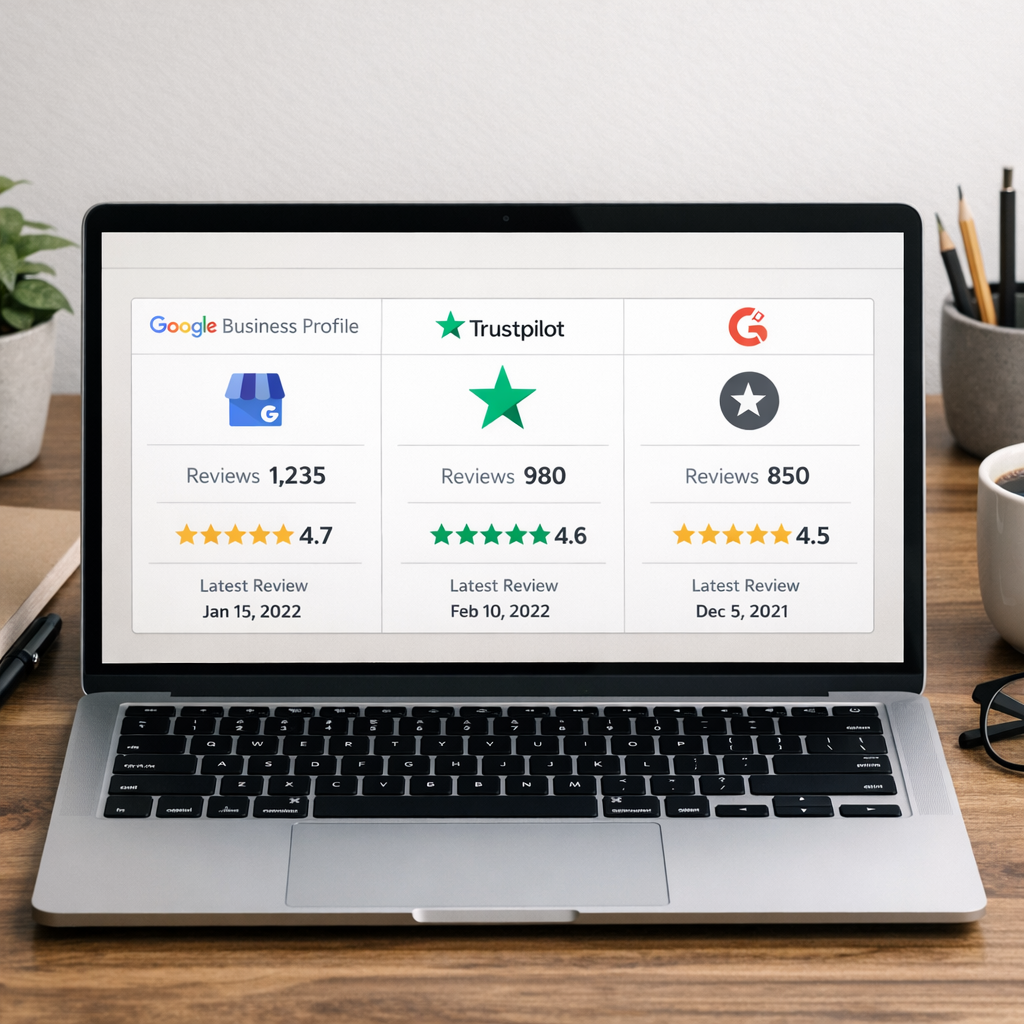
Google Business Profile — the non-negotiable foundation
For any business that serves customers in a specific geographic area or relies on search visibility for customer acquisition, Google Business Profile is not optional. It is the foundation on which every other platform decision is built.
Google reviews influence two outcomes simultaneously. They affect your local search ranking, which determines whether your business appears in the map pack results at the top of a search page — the most valuable real estate in local search. And they affect conversion directly, because your star rating and review count are visible to every buyer before they click anything.
The compounding dynamic here is significant and self-reinforcing. More reviews improve your ranking. Better ranking brings more organic traffic. More traffic generates more customers. More customers create more review opportunities. The loop builds on itself, but only if you are actively and consistently feeding it with new reviews.
The one strategic limitation of Google is specificity. A strong Google rating tells a buyer you are reliable and that other customers have had positive experiences. It does not tell them you are the best option for their specific use case, industry, or workflow. That is the gap that specialized platforms exist to fill amplified reviews.
Trustpilot — credibility for service businesses and e-commerce
Trustpilot occupies a distinct position in the review ecosystem. It is platform-agnostic — it works for any business type — but it carries particular weight for service businesses, subscription companies, and e-commerce brands that operate primarily online.
What makes Trustpilot strategically valuable is its reputation for independence among skeptical buyers. Consumers who have learned to distrust Google reviews — because they know businesses can actively solicit them — often turn to Trustpilot as a secondary validation source. The platform’s verification infrastructure and public response features make it feel more structured and accountable than a standard Google profile.
For entrepreneurs selling high-ticket services or running subscription businesses where buyer hesitation is highest, a strong Trustpilot profile adds a credibility layer that Google alone cannot provide. It signals that you are willing to be evaluated on a platform with stricter community standards and more visible public accountability.
The practical consideration is that Trustpilot demands active management. Negative reviews are prominent and public. Response time and response quality are visible to every future buyer who reads your profile. This is not a platform you can build and ignore. But managed correctly, it becomes one of the strongest independent trust signals in your marketing stack amplified reviews.
G2 and Capterra — where SaaS buyers make purchase decisions
If you run a software product, a SaaS tool, or any technology-based service, G2 and Capterra are the primary battlegrounds where buying decisions happen in your category. Understanding the best review platforms for small business owners in the SaaS space means understanding why these two platforms operate differently from every other option in the market.
Buyers on G2 and Capterra are not casually browsing. They are actively evaluating. They read detailed feature comparisons, use-case breakdowns, and reviews that describe specific workflows and integrations. They filter by company size, industry, and job function. They compare your product directly against competitors on a standardized scoring system. This is the most sophisticated review environment in the consumer market, and it rewards businesses that invest in building a detailed, well-managed profile.
A strong G2 profile does something Google and Trustpilot cannot do for a SaaS business. It places you inside category-level searches — queries like “best project management tool for remote teams or top CRM for solo founders — where the buyer has already decided to purchase and is choosing between options. That is the highest-value position in any sales funnel, and review volume on G2 is one of the primary factors that determines whether you appear there.
Capterra operates on a similar model with a buyer demographic that skews toward small business owners and non-technical decision makers. Running both platforms in parallel gives you broader category coverage without significant duplication of collection effort.
Industry-specific platforms and the first-mover advantage
Beyond the major generalist platforms, almost every industry has one or two review destinations that carry disproportionate weight with buyers in that specific category. For legal and medical professionals, platforms like Avvo and Healthgrades are often the first destination a potential client visits. For hospitality businesses, TripAdvisor remains dominant. For contractors and home service operators, Angi and Houzz drive significant purchase-intent traffic.
The strategic opportunity on industry-specific platforms is first-mover advantage. These platforms tend to have lower overall review volumes than Google or Trustpilot, which means a business that builds a strong profile early achieves category visibility that is significantly harder for competitors to displace later.
The rule for industry-specific platforms is straightforward. If your buyers use it and your competitors have active profiles there, you need to be on it. If your competitors have not yet saturated it, you need to be on it faster.
Building your platform stack
The goal is not omnipresence. The goal is strategic concentration on the platforms that deliver the highest return for your specific business type and buyer profile.
A practical platform stack for most entrepreneurs looks like this. One primary platform where you concentrate the majority of your review collection volume — Google for local and service businesses, G2 or Capterra for SaaS. One credibility platform that serves as a secondary validation source for skeptical buyers — Trustpilot for most business types. One industry-specific platform where first-mover advantage is still achievable in your category amplified reviews.
Once your platform stack is defined, build your collection sequences to route the right customer segments to the right destination. Enterprise buyers go to G2. Local service customers go to Google. First-time e-commerce buyers go to Trustpilot. The segmentation is not complicated — it just requires the intentionality that most businesses never apply to their review strategy.
The next layer of the strategy is making sure your collection and distribution processes run without manual intervention. Automating your review amplification system is where the operational efficiency gains become significant — and where consistent platform dominance becomes achievable without adding headcount.
How to automate your review amplification
Consistency is the variable that separates businesses with compounding review profiles from those that plateau. And consistency at scale is only achievable through automation. The moment review collection and distribution depend on a founder’s memory and available time, they become the first thing to fall off the priority list when the business gets busy — which is exactly when maintaining momentum matters most.
Learning how to automate customer reviews is not about removing the human element from your reputation strategy. It is about removing the friction that makes consistency impossible to sustain manually. The human element stays in the message tone, the response quality, and the strategic decisions about platform and timing. The automation handles the execution.
The architecture of an automated review system
Before evaluating any tool, understand the structural components that every effective automated review system needs to have. Choosing a tool before understanding the architecture is the most common reason entrepreneurs end up with an automation setup that runs but does not perform.
The first component is a trigger. This is the event in your customer journey that initiates the review request sequence. Effective triggers are tied to your success moment — the specific point where value has been delivered and customer satisfaction is at its peak. Common triggers include a completed purchase, a subscription renewal milestone, a support ticket closed as resolved, or a project marked complete in your project management system. The trigger should be precise, not approximate. “Seven days after signup” is an approximation. “First workflow completed” is a trigger.
The second component is a delay. Firing a review request the instant a transaction closes is almost always too early. The customer needs time to experience the value before they can speak credibly about it. Depending on your product type, the appropriate delay ranges from 24 hours for a straightforward e-commerce purchase to five to seven days for a service engagement with a longer delivery cycle. Build this delay into your sequence deliberately rather than defaulting to whatever the tool suggests.
The third component is the message sequence. One primary request, followed by a single reminder if no action is taken within five to seven days. Two messages maximum. The primary message should be short, specific, and route the customer to one platform with one link. The reminder should acknowledge that life gets busy and make the ask feel even lower pressure than the first message.
The fourth component is a performance feedback loop. A tracking mechanism that records which customers received a request, which ones clicked the review link, and which ones completed a published review. Without this data layer, you are running an automation system you cannot optimize — and an unoptimized system degrades in performance over time without you knowing why.
The right tools to automate customer reviews at every business stage
Several platforms in the market are purpose-built for review automation, and the right choice depends on your business type, existing technology stack, and the platforms you identified as your primary review destinations in the previous section.
Birdeye is one of the most comprehensive options available for multi-location businesses and service operators. It connects to over 200 review platforms, supports both SMS and email request sequences, and provides a centralized dashboard for monitoring and responding to reviews across all platforms simultaneously. For entrepreneurs managing reputation across multiple physical locations or business units, Birdeye eliminates the platform-switching that makes manual management unscalable.
Podium takes a similar approach with a stronger emphasis on SMS-based workflows. For local service businesses where text message open rates significantly outperform email, Podium’s architecture is built around that channel advantage. It integrates cleanly with most major point-of-sale and CRM systems, which simplifies the trigger configuration and reduces the technical setup time.
Reviewflowz is a lighter-weight option designed specifically for SaaS businesses. It monitors review activity across G2, Capterra, and other software-specific platforms, and can trigger internal Slack notifications or CRM updates when new reviews appear — making it easier to respond quickly, route positive reviews into your marketing workflow, and track competitor review activity in your category.
For entrepreneurs who already operate inside a CRM like HubSpot or a marketing automation platform like ActiveCampaign, building a native review request sequence within your existing tool is often the most efficient path. It requires more upfront configuration but eliminates the cost and integration complexity of a separate review-specific platform.
Setting up your first automated review workflow
Setting up your first workflow does not require technical expertise. It requires four decisions made clearly before you open any tool.
Decision one: what is your trigger event? Identify the single moment in your customer journey that most reliably corresponds to a satisfied customer. If you are not certain, look at the timing of your existing positive reviews — when in the customer lifecycle were those customers when they left them? Start with one trigger. Add complexity after the first 60 days of data.
Decision two: what is your primary review platform for this workflow? Pick one destination. Route all requests from this trigger to that single platform. Splitting a new workflow across multiple platforms dilutes your volume on each one and complicates your performance measurement.
Decision three: what are your message copy and delay settings? Write two messages — a primary request and a single follow-up. Set the primary request to fire 24 to 72 hours after the trigger, adjusted for your product type. Set the follow-up to fire five days after the primary if no click has been recorded. Keep both messages under 100 words.
Decision four: how will you measure success? Define your baseline response rate before the workflow launches. After 30 days, compare actual performance to that baseline. That single comparison tells you whether the trigger timing, message copy, or platform destination needs adjustment — before you invest time adding more complexity to the system.
The compliance rules that protect your automation from penalties
Automation creates scale, and scale amplifies mistakes. Practices that are merely inefficient when executed manually become actively damaging when run at volume across thousands of customer touchpoints.
Do not automate incentivized review requests. Offering discounts, credits, or any form of compensation in exchange for a review violates the terms of service of every major review platform. Automating this practice means violating those terms at scale, which significantly increases the risk of platform penalties, review removal, or account suspension.
Do not build review gating into your workflow. Review gating, the practice of routing unhappy customers to a private feedback form while directing only satisfied customers to public review platforms, is explicitly prohibited by Google, Trustpilot, and most other major platforms. It also produces a distorted public profile that sophisticated buyers recognize and distrust.
Do not send automated requests to customers who have already left a review on your target platform. Build an exclusion list into your workflow from day one. Sending a review request to someone who already reviewed you signals poor data hygiene and damages the post-purchase relationship.
Once your automation system is running cleanly and your review volume is building consistently, the next challenge shifts from collection to resilience. Knowing how to respond to negative reviews professionally is what protects the profile your automation system is building — because a single poorly handled negative review can undermine the credibility that dozens of positive ones have established.
Section 5: How to respond to negative reviews and protect your brand reputation
Every business receives a negative review eventually. The variable is not whether it will happen — it is whether your response will compound the damage or convert it into a visible trust signal for every future buyer who reads the exchange.
Most entrepreneurs react to negative reviews emotionally. They feel defensive, they delay responding, or they write something that escalates the situation publicly. This reaction is understandable but strategically costly, because the primary audience for your response is not the unhappy customer who left the review. It is every potential buyer who reads that exchange while evaluating whether to trust you with their money.
Understanding how to respond to negative reviews with consistency and professionalism is one of the highest-leverage reputation skills an entrepreneur can develop. A well-handled negative review often builds more credibility than a page full of five-star ratings, because it demonstrates how your business behaves under pressure — which is exactly what a risk-averse buyer needs to see before committing to a purchase amplified reviews .
Why your response is more important than the review itself
When a potential customer reads a negative review, they are running a silent evaluation. They want to understand how your business handles accountability. A response that is calm, specific, and solution-oriented tells them that your business is trustworthy even when things go wrong. A defensive or dismissive response tells them your business prioritizes self-protection over customer experience — and sends them to your competitor.
The psychological dynamic here is well-documented in buyer behavior research. Consumers are more likely to trust a business with a small number of negative reviews than one with a perfect rating, because a perfect rating feels implausible. What they are actually evaluating is not the negative review itself. It is the quality, speed, and specificity of your response to it.
This reframe is the foundation of a professional response strategy. Stop treating negative review responses as damage control for the reviewer. Start treating every response as a trust-building communication directed at the next hundred buyers who will read that exchange.
The four-part framework for how to respond to negative reviews
A strong review response has four components, and the sequence matters as much as the content.The first is acknowledgment. Open by recognizing the customer’s experience without immediately defending your business. This is not a generic pleasantry — it is a deliberate signal to every reader that you take feedback seriously and that your first instinct is to listen rather than deflect. Do not skip this step even when the review feels unfair or factually incorrect.
The second is empathy. Validate the frustration without admitting fault for circumstances outside your control. A simple statement like “I understand how frustrating this must have been” costs nothing operationally and immediately de-escalates the emotional temperature of the public exchange. Future buyers reading this response feel reassured that you are reasonable under pressure.
The third is a specific response to the issue described. This is where most business owners default to vague corporate language — we take all feedback seriously and are always striving to improve. That language is invisible to buyers because it says nothing specific. Address the actual issue the customer described. If they mentioned a slow delivery, address the delivery timeline directly. If they described a staff interaction, acknowledge that specific experience. Specificity signals that you read the review carefully and are not copy-pasting a template across every negative comment on your profile.
The fourth is a resolution path. Invite the customer to continue the conversation through a direct channel — an email address or a direct phone line. This moves the resolution offline, protects the public record from a back-and-forth argument that benefits nobody, and gives the dissatisfied customer a genuine opportunity to feel heard by someone with the authority to resolve the issue.
Platform-specific considerations for negative review responses
The mechanics and strategic context for responding differ between platforms, and treating every platform identically is a missed opportunity.
On Google Business Profile, your response appears publicly beneath the review and is indexed by search engines. This means your response is not just visible to people reading your profile — it can surface in search results for your business name and category keywords. Write every Google response as if it will be the first thing a new prospect reads about how your business handles problems. Keep responses under 150 words, maintain a professional tone throughout, and always end with a direct invitation to resolve the issue offline.
On Trustpilot, the audience tends to be in a later stage of the decision process. They are validating a near-final decision, not discovering options. A weak or absent response on Trustpilot carries more strategic cost than the same response on Google, because the reader is already close to a purchase commitment. Response quality on Trustpilot is therefore a bottom-funnel conversion variable, not just a reputation management task.
Building an automated alert system that notifies you the moment a new review appears is what makes platform-specific response speed achievable at scale. You cannot respond professionally within 24 hours to reviews you discover three weeks after they were posted.
Handling false and malicious reviews without damaging your own credibility
Not every negative review reflects a genuine customer experience. Competitors, disgruntled former employees, and bad-faith actors occasionally post reviews that are fabricated or deliberately misleading. The way you handle these situations — publicly and through platform reporting channels — has a direct impact on how future buyers perceive your brand’s integrity amplified reviews.
The first step is always verification. Before flagging a review as false, check your customer records thoroughly. A review that feels fabricated may describe a real interaction you are not personally aware of. Assuming malice before confirming the facts is a mistake that can turn a manageable complaint into a public escalation.
If verification confirms the review is false, use the platform’s official reporting mechanism to flag it for removal. Document your case clearly — include evidence that no transaction matching the reviewer’s description exists in your records. Resolution timelines vary by platform, but a well-documented report has a significantly higher removal rate than a generic flag.
While the report is under review, respond publicly to the flagged review with a calm, factual statement. Do not accuse the reviewer of dishonesty. State clearly that you have no record of this interaction, that you take all customer feedback seriously, and that you invite them to contact you directly to resolve any issue. That response is written for future buyers — it demonstrates methodical professionalism under unfair pressure, which is one of the most credible signals a brand can project.
Extracting operational intelligence from negative feedback
The most underused value in a negative review is the operational data it contains. An entrepreneur who treats negative reviews purely as reputation problems misses the fact that a dissatisfied customer just delivered a detailed, unsolicited product audit at no cost.
Build a simple monthly process for extracting this intelligence. Review all negative feedback received across your platforms in the previous 30 days. Categorize complaints by theme — delivery timelines, product quality, onboarding friction, pricing expectations, customer service interactions. Look for patterns across categories. One complaint about slow onboarding is an outlier. Four complaints about slow onboarding in a single month is a product problem that deserves the same priority as a critical bug report.
This monthly review should feed directly into your product and operations roadmap. The customers who leave negative reviews are the ones motivated enough to say something publicly — which means for every reviewer, there are likely multiple customers who experienced the same friction and said nothing. Treat the review as a signal with a much larger underlying population.
Collecting more reviews consistently increases the statistical significance of this operational feedback over time. A monthly negative review analysis based on 200 reviews tells you something actionable. The same analysis based on 15 reviews tells you very little amplified reviews.
Once your response system is running and your negative feedback is feeding your product roadmap, the final layer of the strategy is where the compounding returns become most visible. Turning every review — positive and critical — into active marketing and sales assets is what closes the loop between reputation management and revenue generation.
Conclusion: Building a review system that compounds over time
Most entrepreneurs approach reviews as a series of isolated tasks. Ask for a review here. Respond to a complaint there. Post a testimonial occasionally. The result is a reputation profile that exists but does not grow, and social proof that is present but does not convert.
The framework in this guide is built on a different premise. Amplified reviews are not a collection of separate tactics — they are an integrated system where each layer amplifies the effectiveness of every other layer. The collection process feeds the platform presence. The platform presence feeds the distribution strategy. The distribution strategy feeds the conversion rate. And the response protocol protects the entire structure from the inevitable friction that comes with operating at scale.
The five layers work in sequence, but they also work in parallel once the system is running. A business that has all five operating simultaneously — collecting consistently, distributing strategically, automating efficiently, responding professionally, and repurposing actively — builds a review profile that compounds in value every month without requiring proportional increases in time or budget.
Where to start when everything feels like a priority
The most common paralysis point for entrepreneurs reading a framework like this one is prioritization. Every layer feels important. Every gap feels urgent. The instinct is to try to fix everything at once, which usually means nothing gets built properly.
The sequencing is simpler than it appears. Start with collection. Nothing else in this system works without a consistent inflow of reviews. Identify your success moment, build one request sequence for one platform, and run it for 60 days. Do not move to the next layer until the collection system is producing reviews reliably.
Once collection is running, address your platform stack. Confirm that your primary platform matches where your buyers actually make decisions. If it does not, redirect your collection sequence before investing in distribution.
From there, automate what you have built manually. Take the collection sequence that is working and move it into an automation tool that removes the dependency on human memory and available time. That single operational shift is where consistency becomes sustainable rather than aspirational.
Then build your response protocol. Define the four-part framework for your team or for yourself. Set a response time standard. Build the alert infrastructure that ensures no review goes unanswered for more than 24 hours. This layer costs the least to build and protects everything else you have invested in the system.
Finally, activate your repurposing workflow. Take the reviews your system is now generating consistently and push them into your active marketing channels — your website, your email sequences, your social content calendar, your paid advertising creative. This is where the reputation asset your system has built starts generating measurable revenue impact.
The compounding effect of a complete amplified reviews system
The entrepreneurs who build this system completely — not partially, not eventually, but deliberately and in sequence — experience a compounding effect that most of their competitors never achieve.
In the first 90 days, the impact is primarily operational. Collection becomes consistent. Platform presence becomes current. Response time improves. The system is running but the results are not yet visible in revenue metrics.
Between 90 and 180 days, the visibility impact becomes measurable. Search rankings improve as review volume and recency increase. Conversion rates on pages with updated social proof begin to climb. The review profile starts looking like a live, actively managed asset rather than a static page.
Beyond six months, the compounding effect becomes the story. A business with a six-month-old automated review system, a well-managed platform presence, and an active repurposing workflow has built a reputation infrastructure that is genuinely difficult for a competitor to replicate quickly. Review volume, recency, and distribution breadth take time to build — and that time investment is what creates the competitive moat.
For entrepreneurs who want to see the immediate practical application of the repurposing layer — the part of the system that converts your review profile directly into revenue-generating marketing assets — our breakdown of how to use customer reviews for marketing gives you the specific formats, channel strategies, and calendar structure to activate that layer today.
The one metric that tells you the system is working
Every layer of this system has its own performance metrics — response rates, platform rankings, click-through rates, ad conversion improvements. But if you want a single number that tells you whether your amplified reviews system is healthy and growing, track your review velocity.
Review velocity is the number of new reviews you receive per month, averaged across your primary platforms. A growing velocity means your collection system is working and your customer experience is strong enough to generate consistent public endorsement. A flat or declining velocity means something in the collection sequence has broken down — a trigger that stopped firing, a message that stopped converting, a platform that stopped being prioritized in your requests.
Check your review velocity monthly. When it grows, protect the system that is producing it. When it drops, diagnose the specific layer where the breakdown occurred before assuming the problem is your product or customer experience.
The system is the asset. Build it once. Optimize it consistently. And let the compounding do the work that no single marketing campaign ever could.