

Managing reviews manually is one of those tasks that feels manageable when your business is small and becomes impossible the moment it starts growing. The entrepreneurs who scale their reputation fastest are not working harder on reviews — they are working on a system that runs without them. Learning how to automate customer reviews is not about removing the human element from your reputation strategy. It is about removing the friction that stops most businesses from being consistent in the first place. This layer of the strategy connects directly to our complete guide to amplified reviews, where automation sits as the engine that powers every other part of the system.
Why manual review management breaks down at scale
When you have ten customers a month, following up manually for reviews is annoying but manageable. When you have a hundred customers a month, it becomes a part-time job. When you have a thousand, it simply does not happen — and your review profile stagnates while your business grows automate customer reviews.
This is the core problem with manual review management. It is entirely dependent on human memory and available time, two resources that shrink as a business scales. The entrepreneur who personally follows up with every customer for a review is the same entrepreneur who stops doing it the moment a more urgent problem appears.
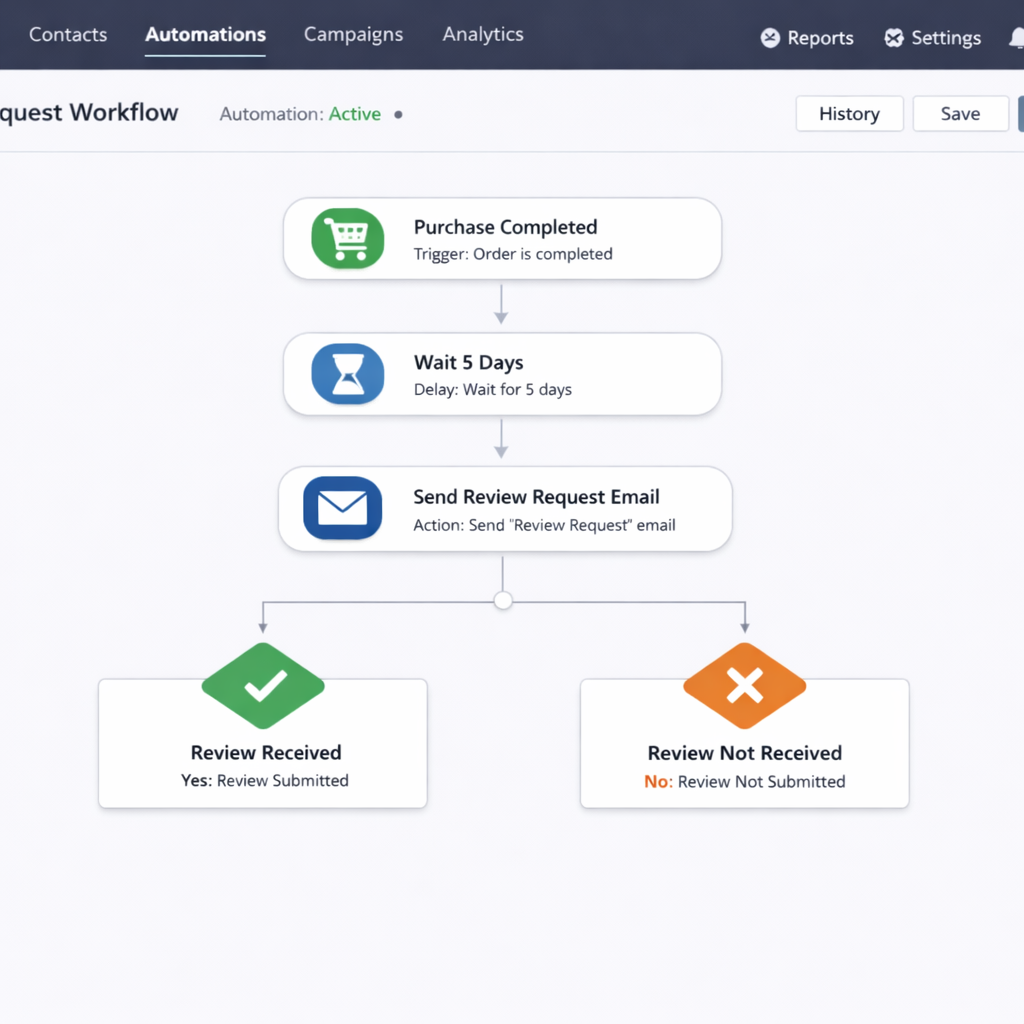
Automation removes that dependency. When a trigger fires — a purchase completes, a project closes, a support ticket resolves — the review request goes out automatically, on time, every time, regardless of what else is happening in the business that week.
The compounding effect of this consistency is significant. A business that sends 50 review requests a month automatically, with a 15 percent response rate, generates roughly 90 new reviews per quarter without a single manual action. A business relying on manual follow-up from a busy founder generates a fraction of that — inconsistently, and with degrading quality over time.
How to automate customer reviews starts with accepting that consistency is more valuable than personalization at scale, and that a well-timed automated request outperforms a perfectly written manual one that arrives three weeks late.
Understanding which platforms to route those automated requests toward is the prerequisite decision before you build any workflow, because the tool configuration changes depending on your platform stack automate customer reviews.
The core components of an automated review system
Before choosing a tool, understand the architecture. Every effective automated review system has four components, and the tool you choose needs to support all four.
The first is a trigger. This is the event that initiates the review request sequence. Common triggers include a completed purchase, a subscription renewal, a support ticket closed as resolved, or a project milestone marked complete in your project management tool. The trigger should correspond to your success moment — the point in the customer journey where value has been delivered and satisfaction is highest.
The second is a delay. Sending a review request the instant a transaction completes is too early. The customer needs time to experience the value. Depending on your product type, the appropriate delay ranges from 24 hours for a simple e-commerce purchase to five to seven days for a service engagement. Build this delay into your sequence intentionally.
The third is the message sequence. One primary request, followed by a single reminder if no action is taken within five to seven days. The messages should be short, specific, and route the customer directly to your primary review platform with a single link.
The fourth is a feedback loop. A mechanism that tracks which customers received a request, which ones clicked, and which ones completed a review. Without this data, you cannot optimize the sequence or identify segments with unusually low response rates.
Building a collection system with these fundamentals gives you the structural logic that automation simply executes at scale.
Best tools to automate customer reviews in 2024
Several tools in the market are built specifically for review automation, and the right choice depends on your business type, existing tech stack, and budget automate customer reviews.
Birdeye is one of the most comprehensive platforms for multi-location businesses and service operators. It connects to over 200 review platforms, supports SMS and email request sequences, and includes a centralized dashboard for monitoring and responding to reviews across all platforms simultaneously. It is particularly strong for businesses that need to manage reputation across multiple physical locations.
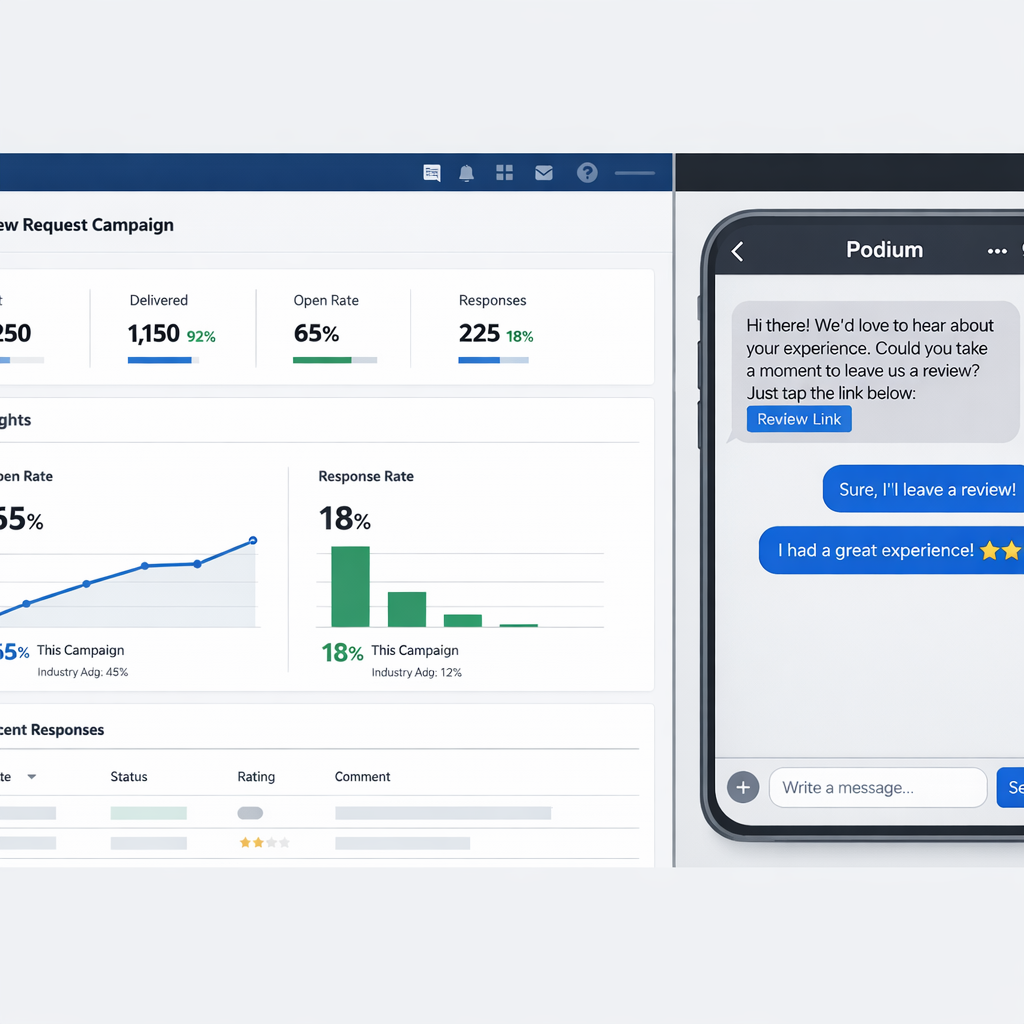
Podium takes a similar approach with a stronger emphasis on SMS-based review requests. For local service businesses where text message open rates significantly outperform email, Podium’s workflow is built around that channel. It integrates with most major point-of-sale and CRM systems, which simplifies the trigger setup.
Reviewflowz is a lighter-weight option designed specifically for SaaS businesses. It monitors review activity across G2, Capterra, and other software-specific platforms, and can trigger internal notifications or Slack alerts when new reviews appear — making it easier to respond quickly and route positive reviews into your marketing workflow.
For entrepreneurs who already use a CRM like HubSpot or a marketing automation platform like ActiveCampaign, building a native review request sequence inside your existing tool is often the most efficient path. It requires more configuration upfront but eliminates the cost and complexity of a separate review-specific platform.
 How to set up your first automated review workflow
automate customer reviews Setting up your first automated review workflow does not require technical expertise. It requires clarity on four decisions before you open any tool.
Decision one: what is your trigger event? Identify the single moment in your customer journey that most reliably corresponds to a satisfied customer. Start with one trigger. You can add more later.
Decision two: what is your primary review platform? Pick one destination for this first workflow. Route all requests from this trigger to that single platform. Splitting a new workflow across multiple platforms dilutes your volume and complicates your measurement.
Decision three: what are your message copy and timing? Write two messages — a primary request and a single follow-up. Set the primary request to fire 24 to 72 hours after the trigger, depending on your product type. Set the follow-up to fire five days later if no click has been recorded.
Decision four: how will you measure success? Define your baseline response rate before the workflow launches. After 30 days, compare actual results to that baseline. That comparison tells you whether the trigger timing, message copy, or platform destination needs adjustment.
Run this single workflow for 60 days before adding complexity. Most entrepreneurs over-engineer their first automation attempt and under-measure it. Simplicity first, optimization second.
Knowing how to automate customer reviews at this foundational level gives you the data you need to expand the system intelligently rather than randomly.
Avoiding the mistakes that get automation flagged or penalized
Automation creates scale, and scale amplifies mistakes. The practices that are merely inefficient when done manually become actively damaging when executed at volume.
Do not automate incentivized review requests. Offering discounts, credits, or any form of compensation in exchange for reviews violates the terms of service of every major review platform. Automating this practice means violating those terms at scale, which increases the risk of platform penalties or review removal.
Do not remove negative feedback from your automation funnel. Some tools offer a “review gating” feature — routing unhappy customers to a private feedback form while only directing satisfied customers to public review platforms. Most major platforms explicitly prohibit this practice, and it creates a distorted public profile that sophisticated buyers recognize and distrust.
Do not send automated requests to customers who have already left a review on your target platform. Build an exclusion list into your workflow from day one. Sending a review request to someone who already reviewed you signals poor data management and damages the relationship.
Do not automate responses to reviews. Use automation to notify you when a new review appears, but write responses manually. Automated review responses are detectable, feel impersonal, and undermine the credibility that your review profile is supposed to build.
Measuring the performance of your automated system
An automated system that nobody measures is just scheduled noise. Performance measurement is what separates a review automation strategy from a review automation experiment .
Four metrics matter most. Request delivery rate — the percentage of triggered requests that successfully reach the customer. Click-through rate — the percentage of delivered requests where the customer clicked the review link. Completion rate — the percentage of clicks that resulted in a published review. And platform distribution — the balance of new reviews across your target platforms over time.
Track these metrics monthly. A low delivery rate signals a technical issue with your integration or a data quality problem in your customer list. A low click-through rate signals a message copy or timing problem. A low completion rate signals a friction issue on the destination platform — too many steps between the link and the published review.
The combination of a well-configured automation system and consistent measurement is what turns how to automate customer reviews from a one-time setup task into a compounding growth asset. And once that asset is running, the next opportunity is turning those accumulated reviews into active marketing collateral that drives revenue at every stage of your funnel.
Conclusion
Automation does not replace the quality of your customer experience — it amplifies it. A business that delivers inconsistent results will generate inconsistent reviews no matter how sophisticated its automation setup is. But a business that consistently delivers value and pairs that with a well-timed automated request system will build a review profile that compounds faster than any competitor relying on manual follow-up automate customer reviews.