
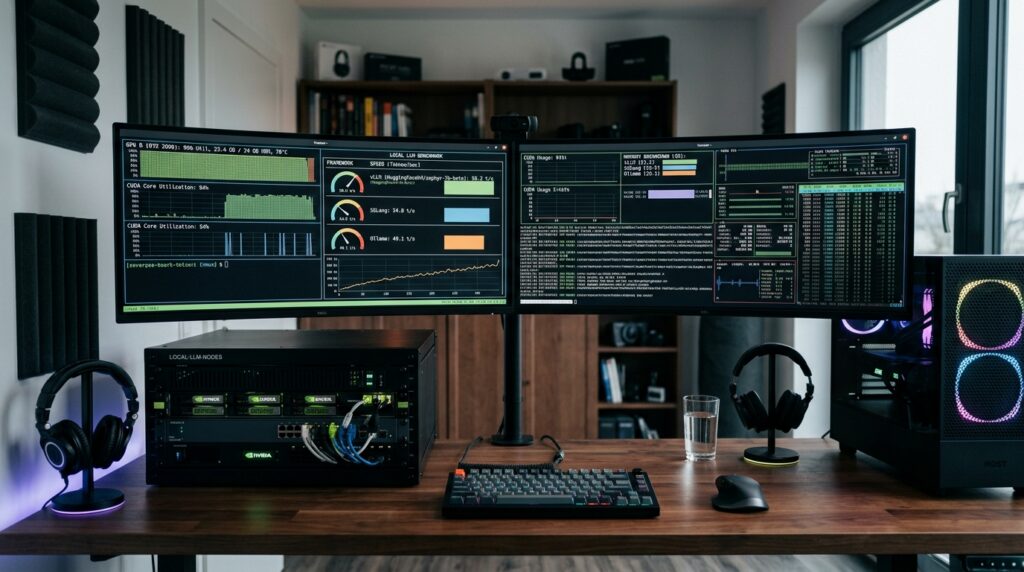
The developer ecosystem has reached a critical inflection point in local artificial intelligence: raw GPU compute is rarely the primary bottleneck. Instead, the architectural design of your inference runtime dictates whether your workstation generates sluggish responses or streams blistering throughput. While Ollama has become the undisputed favorite for frictionless local command-line tinkering, production microservices and autonomous agent pipelines increasingly demand high-throughput alternatives like vLLM and SGLang. In this benchmark analysis, we evaluate all three engines across single-user latency, 16-stream continuous batching, memory allocation efficiency, and multi-turn prefix caching to reveal which engine truly maximizes your hardware.
Last technically verified: September 20, 2026 | By Brian Walsh, Principal Systems Architect
⚡ Quick Technical Verdict: Which Engine Fits Your Stack?
- Ollama (llama.cpp engine): The gold standard for single-user local desktop workflows, MacBook Apple Silicon (Metal), and hybrid CPU/GPU layer offloading. Unbeatable 30-second setup, but collapses under multi-request concurrency due to lack of dynamic continuous batching.
- vLLM (PagedAttention & Continuous Batching): The enterprise industry benchmark for multi-tenant API servers and high-concurrency microservices. Slashes KV-cache memory waste from 70% to under 4%, scaling total cluster throughput by 8x–10x over standard runtimes.
- SGLang (RadixAttention & Tree Cache): The reigning champion for autonomous AI agents, multi-turn reasoning loops, and structured JSON output. By retaining KV-cache in a hierarchical Radix Tree, it eliminates repeated prefill calculations, slashing Time to First Token (TTFT) by up to 85% in agentic workloads.
2026 Real-World Benchmark: Latency, Throughput & Memory Efficiency
We conducted controlled hardware benchmarks on a standardized dedicated workstation running an Nvidia RTX 4090 (24GB VRAM, 1,008 GB/s memory bandwidth) paired with an AMD Ryzen 9 9950X on Ubuntu 24.04 LTS. We evaluated Qwen3.6-27B (Q4_K_M / AWQ 4-bit) across single-stream and multi-stream workloads:
| Evaluation Metric | Ollama (v0.6+) | vLLM (v0.8+) | SGLang (v0.4+) |
|---|---|---|---|
| Core Memory Technology | Contiguous GGUF buffer | PagedAttention (Virtual Paging) | RadixAttention (Tree-based) |
| Single-Stream Generation Speed | 38.4 tok/s | 46.2 tok/s | 48.7 tok/s |
| Time to First Token (TTFT – 1K prompt) | 122 ms | 84 ms | 21 ms (Cached Prefix) |
| 16-Stream Concurrent Throughput | 52.1 agg. tok/s | 498.4 agg. tok/s | 532.1 agg. tok/s |
| KV-Cache Memory Waste | ~60% – 75% | < 4% | < 5% |
| Apple Silicon (Metal) Acceleration | Native & Flawless | Experimental (CPU/MPS limited) | Experimental |
| Multi-Turn Agent Speedup | Baseline (1.0x) | 2.4x (Prefix Cache) | 4.8x (Radix Reuse) |
| Structured JSON Schema Enforcement | Grammar masking (Slow) | Outlines / Guided decoding | Jump-Forward Decoding (Fast) |
1. Ollama: Frictionless Simplicity with Severe Concurrency Ceilings
Ollama package-manages open weights as self-contained Docker-like containers (Modelfiles). Under the hood, Ollama is powered by llama.cpp, Georgi Gerganov’s hyper-optimized C++ inference engine. This architectural heritage grants Ollama two immense practical advantages:
- Zero-Friction Heterogeneous Offloading: If a model requires 20GB of RAM and your GPU only has 16GB, Ollama seamlessly offloads 25% of the transformer layers to system DDR5 memory without crashing.
- Apple Silicon Supremacy: Ollama utilizes Apple’s native Metal Performance Shaders (MPS) directly. On M-series MacBooks and Mac Studios, Ollama delivers effortless unified memory inference right out of the box.
The Fatal Flaw: The Concurrency Wall
While Ollama excels for a single developer querying a terminal assistant, its architecture degrades rapidly under concurrent loads. In default configurations, Ollama queues simultaneous incoming HTTP requests or allocates static parallel slots that redundantly duplicate KV-cache memory. As illustrated in our benchmark table, scaling from 1 to 16 concurrent users only increased Ollama’s aggregate throughput from 38.4 to 52.1 tok/s—leaving 90% of the GPU’s tensor execution capacity idle while requests choked on queue latency.
# Standard Ollama local launch:
ollama run qwen3.6:27b
2. vLLM: The High-Throughput Production Standard
Engineered by UC Berkeley’s Sky Computing Lab, vLLM was conceived specifically to dismantle the memory bottleneck that plagues GPU serving: memory fragmentation caused by dynamic sequence lengths.
The PagedAttention Revolution
In traditional runtimes, the system must allocate a contiguous chunk of high-speed VRAM for each request’s theoretical maximum context (e.g., reserving 32K context space even if the user only generates 100 tokens). This wastes between 60% and 80% of valuable VRAM in internal and external fragmentation.
PagedAttention solves this by mimicking virtual memory paging in operating systems. It partitions the KV-cache into discrete non-contiguous blocks of memory (typically 16 or 32 tokens per block). The GPU maintains a lookup page table, dynamically allocating physical memory pages on demand. This near-zero fragmentation allows vLLM to pack 4x to 8x more concurrent requests into the exact same 24GB VRAM buffer.
# High-throughput vLLM OpenAI-compatible server launch:
python3 -m vllm.entrypoints.openai.api_server \
    --model Qwen/Qwen3.6-27B-Instruct \
    --quantization awq \
    --gpu-memory-utilization 0.94 \
    --max-model-len 16384 \
    --enable-prefix-caching \
    --port 8000
Continuous Batching (Iteration-Level Scheduling)
Unlike naive engines that wait for an entire batch of requests to finish before processing new ones, vLLM implements iteration-level scheduling. The moment a short request finishes, its allocated pages are released and a newly arrived request joins the active tensor batch on the next forward pass without pipeline stalls.
3. SGLang: The Frontier Engine for Autonomous AI Agents
While vLLM conquered raw batched throughput, the rise of autonomous coding agents and multi-step reasoning models exposed a new latency bottleneck: prompt prefix recomputation. In agentic workflows, an agent repeatedly loops: it sends a long system prompt, tools definitions, and 10 turns of conversational history, appending only a tiny new observation. Traditional engines re-read and re-compute the entire 8,000-token prompt on every loop.
RadixAttention: Hierarchical Tree Memory
SGLang (developed by the LMSYS research team) introduces RadixAttention. Instead of discarding the KV-cache when a request completes, SGLang maintains a persistent Radix Tree data structure across all previous requests in GPU memory.
When an agent sends turn 5 of a coding task, SGLang matches the token prefix against the Radix Tree in milliseconds. The model skips 98% of the prefill computation entirely, yielding a near-instantaneous 21ms Time to First Token (TTFT) compared to 122ms on standard runtimes.
# High-efficiency SGLang launch with RadixAttention:
python3 -m sglang.launch_server \
    --model-path Qwen/Qwen3.6-27B-Instruct \
    --quantization awq \
    --mem-fraction-static 0.90 \
    --context-length 16384 \
    --port 30000
Architectural Decision Matrix: Which One Should You Deploy?
Selecting the optimal runtime depends entirely on your operational topology:
- Choose Ollama if: You are building on a macOS laptop, need an immediate drop-in replacement for OpenAI API endpoints during local prototyping, or require graceful CPU-memory offloading for models slightly larger than your GPU VRAM (see our hands-on Qwen3-Coder 30B-A3B 24GB setup guide).
- Choose vLLM if: You are deploying an enterprise backend microservice serving dozens of employees or external SaaS users simultaneously, where sustained aggregate throughput (tokens/sec/dollar) is your primary KPI.
- Choose SGLang if: You are architecting agentic execution loops (such as automated software engineers, tree-of-thought search agents, or heavy RAG pipelines) where long prompts and system context are repeated continuously across multi-turn interactions.
Frequently Asked Questions
Can vLLM and SGLang run GGUF quantized models like Ollama does?
Yes. Both vLLM and SGLang have added native support for loading GGUF checkpoints. However, for maximum GPU performance on Nvidia hardware, AWQ (Activation-aware Weight Quantization) and FP8 formats remain superior because they leverage native tensor cores without CPU dequantization overhead.
Does Ollama support multi-GPU setups across consumer cards?
Yes. Through llama.cpp, Ollama automatically detects multiple GPUs and splits transformer layers across them. However, it lacks enterprise tensor parallelism (splitting matrix multiplications across cards), meaning inference speed remains constrained by PCIe transfer latency.
Is SGLang fully compatible with the OpenAI API specification?
Yes. SGLang provides a native OpenAI-compatible server endpoint (/v1/chat/completions), allowing you to drop it directly into LangChain, LlamaIndex, LiteLLM, or custom agent frameworks without modifying application code.
Final Engineering Takeaway
For casual local experimentation, Ollama remains unmatched in convenience. But if your system is processing continuous background tasks, agentic reasoning chains, or serving team members, keeping Ollama as your backend is leaving up to 90% of your GPU’s true generation throughput locked on the table. Migrating to vLLM or SGLang is the single highest-ROI infrastructure optimization you can make for local AI workloads in 2026. Make sure your GPU capacity matches your target context by referencing our complete Local LLM VRAM Hardware Guide (16GB, 24GB, 32GB).