
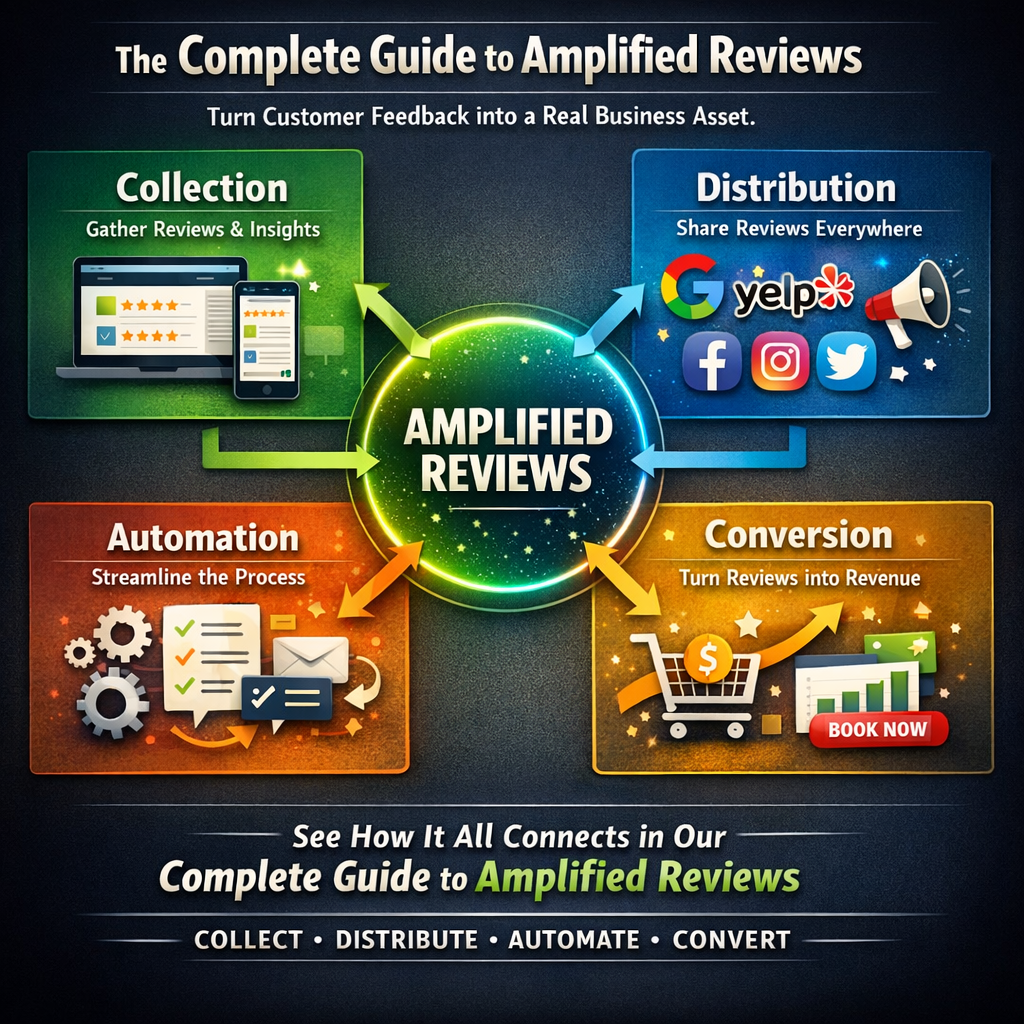
Most entrepreneurs collect reviews and forget about them. They sit on a Google profile or a Yelp page, doing nothing. The real problem is not the reviews themselves — it is the lack of effective online review management.
Understanding what online review management actually means, and how amplified reviews function inside a broader reputation strategy, is the first step toward turning customer feedback into a real business asset.
If you want to see how collection, distribution, automation, and conversion all connect in a proper online review management system, our complete guide to amplified reviews is where the full picture lives.
What are amplified reviews and why they matter for your business
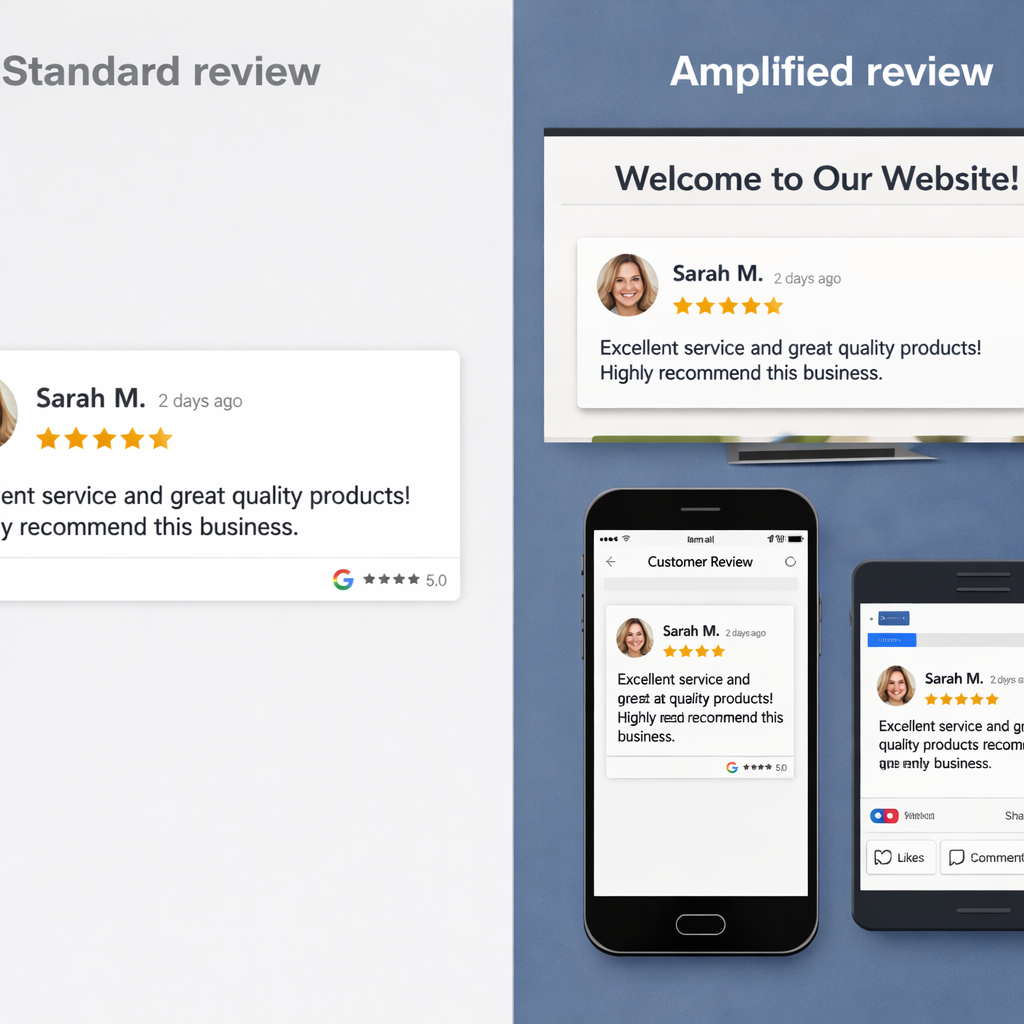
The difference between a review and an amplified review
A review is a customer’s opinion sitting on a platform. An amplified review is that same opinion, distributed strategically across multiple touchpoints to maximize its visibility and influence on buying decisions.
Think about it this way. A five-star review on Google is useful. But that same review embedded on your homepage, featured in a follow-up email sequence, quoted in a LinkedIn post, and referenced in a sales deck — that is amplification. You are taking one piece of authentic social proof and engineering it to do multiple jobs at once.
The word “amplified” is not just marketing language. It describes a deliberate process. You collect the review, you curate it, and then you distribute it through channels your potential customers actually use. The review does not change. The reach does.
This distinction matters because most entrepreneurs treat reviews as a passive outcome. Something that happens after a sale. Amplified reviews are an active strategy. Something you build, manage, and deploy with intention. If you want to understand how this fits into a full reputation system, our complete guide to amplified reviews breaks down every layer of that process online review management.
Why most entrepreneurs leave review value on the table
Here is what typically happens. A customer leaves a glowing review. The business owner feels good about it for a day. Then nothing. The review gets buried under newer content, the algorithm shifts, and that piece of social proof essentially disappears.
online review management There are three reasons this cycle repeats itself.
First, there is no collection system. Reviews come in randomly, whenever a customer feels motivated enough to leave one. Without a prompt or a follow-up sequence, most satisfied customers never say anything publicly. Building a system that collects customer reviews without friction is what separates passive businesses from ones that compound social proof over time.
Second, there is no curation process. Not every review carries the same weight. A 47-word review that describes a specific result is worth ten times more than a generic “great service” post. Entrepreneurs who do not filter for quality end up promoting weak social proof.
Third, there is no distribution strategy. Even entrepreneurs who collect strong reviews rarely publish them beyond the original platform. They stay in silos — Google, Yelp, Trustpilot — where only people already searching for the business will find them. Choosing the right platforms to distribute your reviews is the step that turns a good collection habit into actual visibility.
How amplified reviews build trust at scale

Trust is the actual product you are selling. Every piece of marketing, every sales conversation, every onboarding email — all of it exists to build enough trust for someone to hand you money. Reviews accelerate that process because they are not coming from you.
Third-party validation, which is what a customer review represents, carries more credibility than any claim a business can make about itself. Buyers know you are biased toward your own product. They know another customer has no financial reason to lie.
Amplified reviews scale this trust-building process. Instead of relying on a prospect to stumble across your Google profile, you bring the social proof directly into their path. You meet them where they already are — on your website, in their inbox, on the platforms they scroll through every day.
The mechanic here is exposure frequency. A prospect who sees consistent positive feedback across multiple independent touchpoints develops trust faster than one who reads a single review in isolation. The repetition signals reliability. It communicates that your results are not an accident.
The business case: what the data actually shows
The numbers behind review behavior are not ambiguous. Consumers read reviews before making purchasing decisions at a rate that has been climbing consistently for over a decade. For local businesses and SaaS products alike, a strong review profile directly correlates with conversion rates.
What the data also shows is that recency matters. A business with 200 reviews from three years ago is less persuasive than one with 40 reviews from the last 90 days. Buyers interpret recent reviews as a signal that the business is still active, still delivering, and still accountable.
Volume matters too, but not in isolation. A business with 500 reviews averaging 3.8 stars loses to a competitor with 80 reviews averaging 4.7 stars in most buying scenarios. Quality and recency outperform raw numbers.
For entrepreneurs specifically, this creates a focused priority. You do not need to be everywhere. You need consistent, high-quality, recent reviews on the platforms your customers actually check — and then you need to push that social proof into every relevant touchpoint in your funnel. Automating that entire review cycle is where the real efficiency gains live for growing businesses.
Where amplified reviews fit inside your growth strategy
Amplified reviews are not a standalone tactic. They sit at the intersection of reputation management, content strategy, and conversion optimization. Understanding where they connect to your broader business helps you prioritize where to invest first.
At the top of your funnel, amplified reviews improve discoverability. Platforms like Google factor review volume and recency into local search rankings. More reviews, distributed across the right platforms, means more visibility to buyers who are not yet aware of you.
In the middle of your funnel, reviews handle objection removal. A prospect comparing you to a competitor will use reviews as a tiebreaker. If your social proof is more specific, more recent, and more visible, you win that comparison without having to say a word. Knowing how to handle negative reviews professionally is just as important here — one poorly handled response can undo dozens of five-star ratings.
At the bottom of your funnel, reviews close deals. Embedding strong testimonials near your pricing page, your call-to-action buttons, or your checkout flow reduces last-second hesitation. The buyer is already interested — the review gives them permission to commit. Turning those reviews into active marketing assets is the final step that closes the loop between reputation and revenue.
Conclusion
Why Online Review Management Is Your Secret Growth Channel in 2026
Amplified reviews are not about gaming the system or chasing stars. Effective online review management is about building a structured process that takes your most credible asset — what your actual customers say about you — and putting it in front of the right people at the right moment.
The entrepreneurs who treat reviews as a passive byproduct will always be at a disadvantage compared to those who implement a proactive online review management strategy. The gap is not talent or budget. It is strategy.
Start by understanding what you have. Audit your current reviews across every platform, identify which ones carry real specificity and weight, and map where your funnel currently has no social proof present. That audit is your starting point for world-class online review management.