
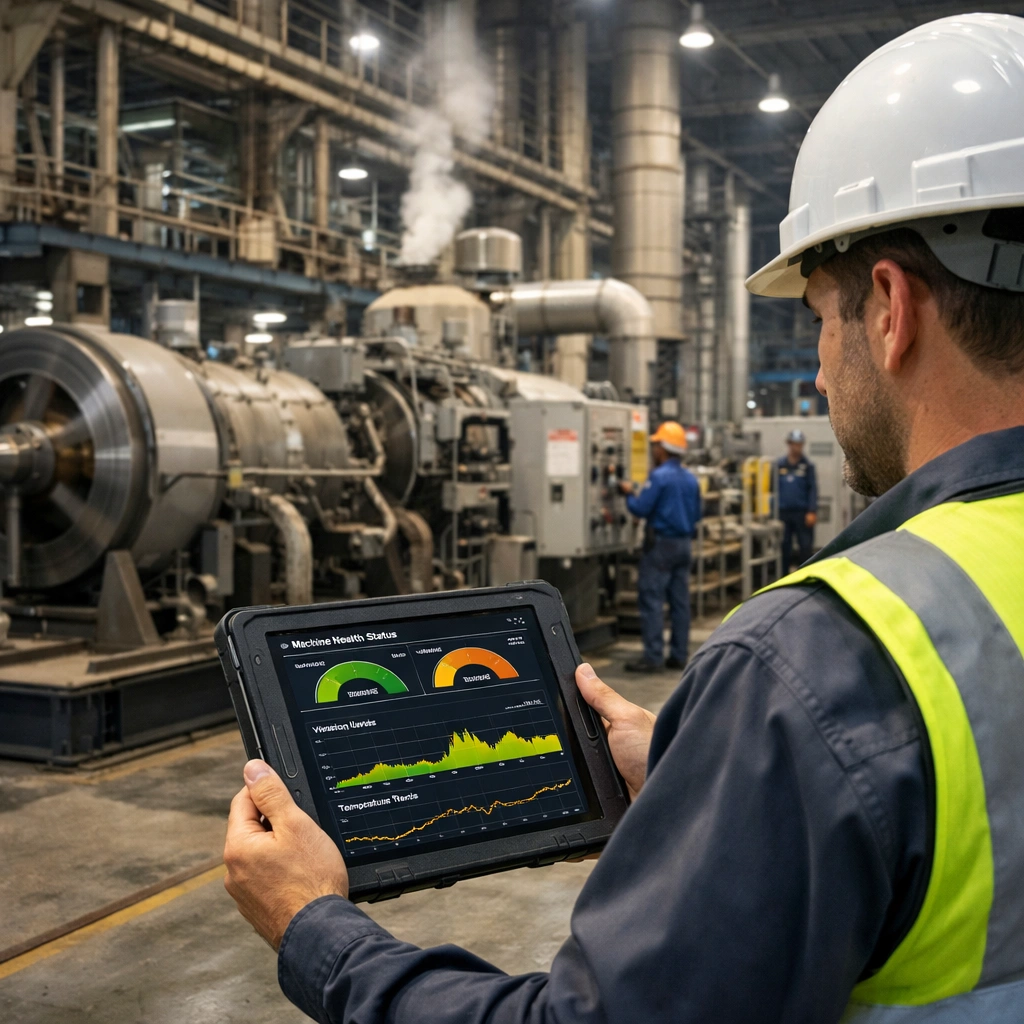
Unplanned equipment failure is one of the most expensive problems in any production environment, and predictive maintenance AI exists specifically to eliminate it. Unlike scheduled maintenance, which replaces parts on a fixed calendar, predictive maintenance AI monitors real-time machine data to flag failures before they happen. Entrepreneurs who have mapped this approach inside a broader AI in industrial automation: what actually works in 2026 strategy consistently report faster payback periods than almost any other automation investment. This page breaks down exactly how that works.
Every unplanned breakdown carries two price tags. The first is the repair bill. The second — and usually the larger one is the cost of everything that stops while you wait for the fix. Lost production hours, idle labor, delayed shipments, and the downstream customer fallout that follows. For most operations, this is not an occasional problem. It is a recurring drain that compounds quietly until someone decides to do something about it.
Predictive maintenance AI is that something. And in 2026, it is one of the most accessible and fastest-paying industrial AI applications available to entrepreneurs who run asset-heavy operations predictive maintenance AI.
What predictive maintenance AI actually does
The term gets used loosely, so it is worth being precise. Predictive maintenance AI is a system that continuously collects data from operating equipment — through sensors measuring vibration, temperature, pressure, electrical current, and acoustic output — and uses pattern recognition to identify when a machine’s behavior is drifting toward a failure state.
predictive maintenance AI The distinction that matters for entrepreneurs is the difference between three maintenance models:
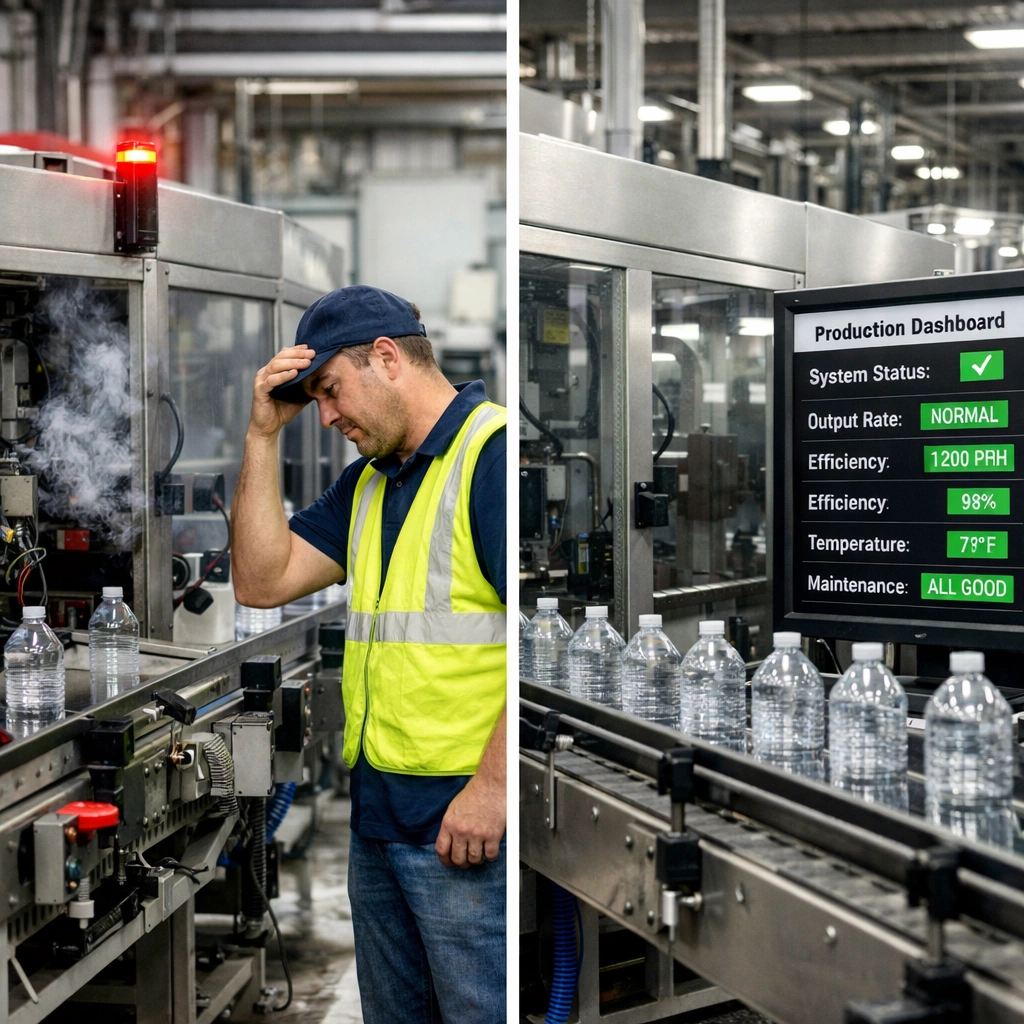
Reactive maintenance means you fix things after they break. This is the most expensive model in the long run because breakdowns are unpredictable and the collateral damage is rarely limited to the failed component.
Preventive maintenance means you service equipment on a fixed schedule regardless of its actual condition. This is an improvement, but it is inefficient. You end up replacing parts that had useful life remaining and occasionally missing failures that occur between service windows.
Predictive maintenance AI means you service equipment when the data tells you it needs attention — not before, not after. This is the model that consistently produces the lowest total maintenance cost and the highest equipment uptime.
The data predictive maintenance AI runs on
Understanding the data layer helps you evaluate whether your operation is ready to deploy. Predictive maintenance AI systems require a continuous feed of sensor data from the equipment being monitored. In modern facilities, this often already exists through existing SCADA systems, programmable logic controllers (PLCs), or IoT-enabled machinery predictive maintenance AI.
In older facilities — and this is the situation many entrepreneurs actually face — the machines themselves are not instrumented. The first step in those cases is retrofitting sensors onto existing equipment. This is more accessible than it sounds. Clip-on vibration sensors, wireless temperature probes, and current transducers can be attached to most legacy machines without modifying the equipment itself.
The data collected flows to an edge computing device, a local gateway that processes signals close to the source before sending relevant information to a cloud platform where the predictive models run. This architecture keeps latency low and reduces the volume of raw data being transmitted, which matters in facilities with limited bandwidth.
Where predictive maintenance AI delivers the clearest ROI
Not every asset in your facility justifies the investment equally. The strongest business cases cluster around equipment that shares a few characteristics: high replacement or repair cost, significant production dependency, and a failure mode that produces detectable early signals.
Rotating machinery — motors, pumps, compressors, fans, gearboxes — is the most common starting point. Bearing wear, shaft imbalance, and lubrication degradation all produce vibration signatures that predictive maintenance AI can detect weeks before a failure occurs.
HVAC and cooling systems in data centers, food processing, and pharmaceutical manufacturing are high-value targets because temperature excursions can damage product or violate compliance requirements in addition to the equipment damage itself.
CNC machines and industrial robots benefit from monitoring spindle load, axis motor current, and cycle time consistency. Deviations from established baselines indicate tooling wear, calibration drift, or mechanical fatigue before they produce scrap or downtime.
For entrepreneurs who have already explored the broader landscape ofindustrial AI applications: the uses you can’t ignore, predictive maintenance consistently ranks as the entry point with the fastest documented payback period.
Platforms worth evaluating in 2026
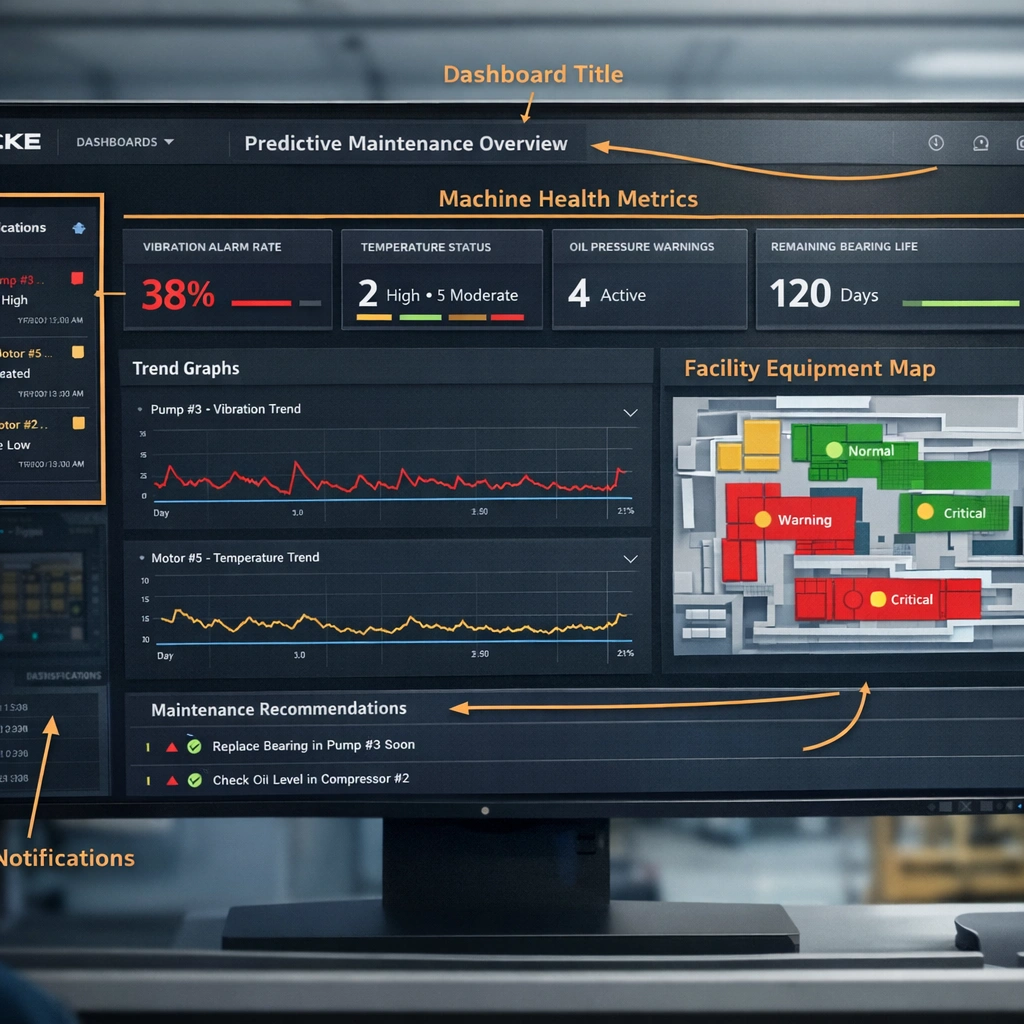
The market has consolidated around a set of platforms that have moved beyond early-stage and now offer documented deployment track records across industrial sectors.
Uptake is purpose-built for asset-intensive industries. It connects directly to existing equipment data sources and offers pre-built models for common rotating machinery failure modes, which shortens the time from deployment to first insight significantly.
SparkCognition takes a broader industrial intelligence approach, with predictive maintenance as one module within a larger operational platform. This makes it a stronger fit for operations that want to expand into process optimization and energy management after the initial deployment.
Aspentech is the dominant player in process industries — chemicals, oil and gas, refining — where the equipment complexity and the cost of failure are both extremely high. It is an enterprise-grade solution with pricing to match, but for the right operation it delivers a level of model sophistication that lighter platforms cannot match.
Augury has built a strong position in mid-market manufacturing by focusing specifically on machine health for motors and rotating equipment, with a sensor-as-a-service model that lowers the upfront hardware cost.
The right choice depends on your equipment type, your existing data infrastructure, and the scale of your operation. A platform evaluation that skips those three variables is not an evaluation — it is a sales conversation.
What a first deployment actually looks like
The entrepreneurs who get predictive maintenance AI running fastest follow a consistent sequence. They pick one asset class — typically their highest-criticality rotating equipment — and deploy sensors on a defined set of machines rather than attempting facility-wide coverage from day one.
The first 30 to 60 days are a baseline period. The system learns what normal looks like for each monitored asset under real operating conditions. This is not a passive waiting period — your maintenance team should be actively reviewing the data and correlating alerts with what they observe on the floor. That feedback loop is what calibrates the models to your specific environment.
By day 90, a well-deployed system should be generating actionable alerts with enough lead time to schedule repairs during planned downtime windows rather than scrambling during production hours. That shift — from reactive to scheduled — is where the financial impact becomes visible on your P&L.
For entrepreneurs mapping out the full sequence of industrial automation investments,AI in industrial automation: what actually works in 2026provides the strategic framework for prioritizing and phasing these decisions.
The metrics that tell you if it is working
Setting measurement criteria before deployment is not a formality. It is how you distinguish a successful implementation from one that produces dashboards but no decisions.
The core metrics for predictive maintenance AI are:
Mean time between failures (MTBF): Is the average time between breakdowns on monitored equipment increasing? This is your primary effectiveness indicator.
Planned vs. unplanned maintenance ratio: A healthy operation targets 80 percent or more of maintenance activity being planned. Track this ratio monthly from deployment onward.
Alert-to-action rate: Of the alerts the system generates, what percentage result in a maintenance action that prevents a confirmed failure? This tells you whether the model is calibrated well or generating noise.
Cost per maintenance event: Compare the average cost of a maintenance intervention before and after deployment. Planned repairs are almost always cheaper than emergency ones.
Conclusion
Predictive maintenance AI is not a future investment for when your operation gets bigger. It is a present-tense decision for any entrepreneur running equipment where unplanned failure has a real cost. The platforms are mature, the deployment path is well-mapped, and the payback timeline — typically 12 to 18 months for a focused first deployment — is faster than most capital investments you will make this year.
Start with your highest-criticality assets. Get your data flowing. Set your baseline metrics before you go live. And measure honestly at the 90-day mark. That sequence, executed with discipline, is what separates the operations that gain a durable competitive advantage from the ones that buy software and wonder why nothing changed.