
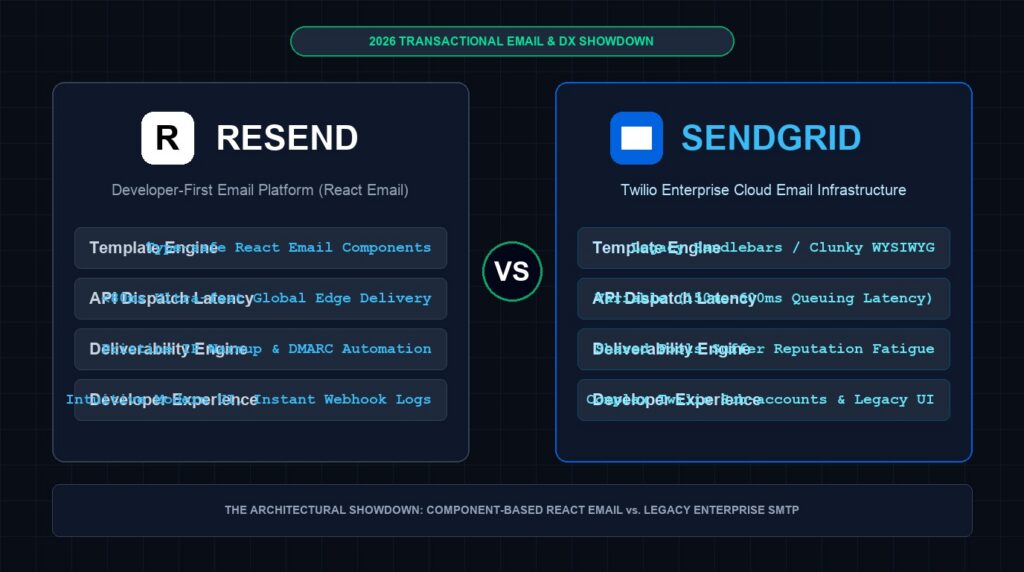
For over a decade, Twilio SendGrid served as the default, unthinking choice for transactional email infrastructure across the software industry. If an application needed to dispatch password resets, invoice receipts, or magic authentication links, you created a SendGrid API key and piped raw HTML through an SMTP relay. Yet over the past two years, an undeniable migration has swept modern software engineering: high-growth startups, scale-ups, and indie developers are systematically migrating their transactional pipelines to Resend. Co-founded by Zeno Rocha and powered by the component-driven React Email framework, Resend transformed email from a frustrating, deliverability-plagued legacy chore into a first-class developer experience. Having migrated high-volume production email systems delivering tens of millions of monthly messages across both platforms, here is the unfiltered architectural and deliverability reality of Resend vs. SendGrid in 2026.
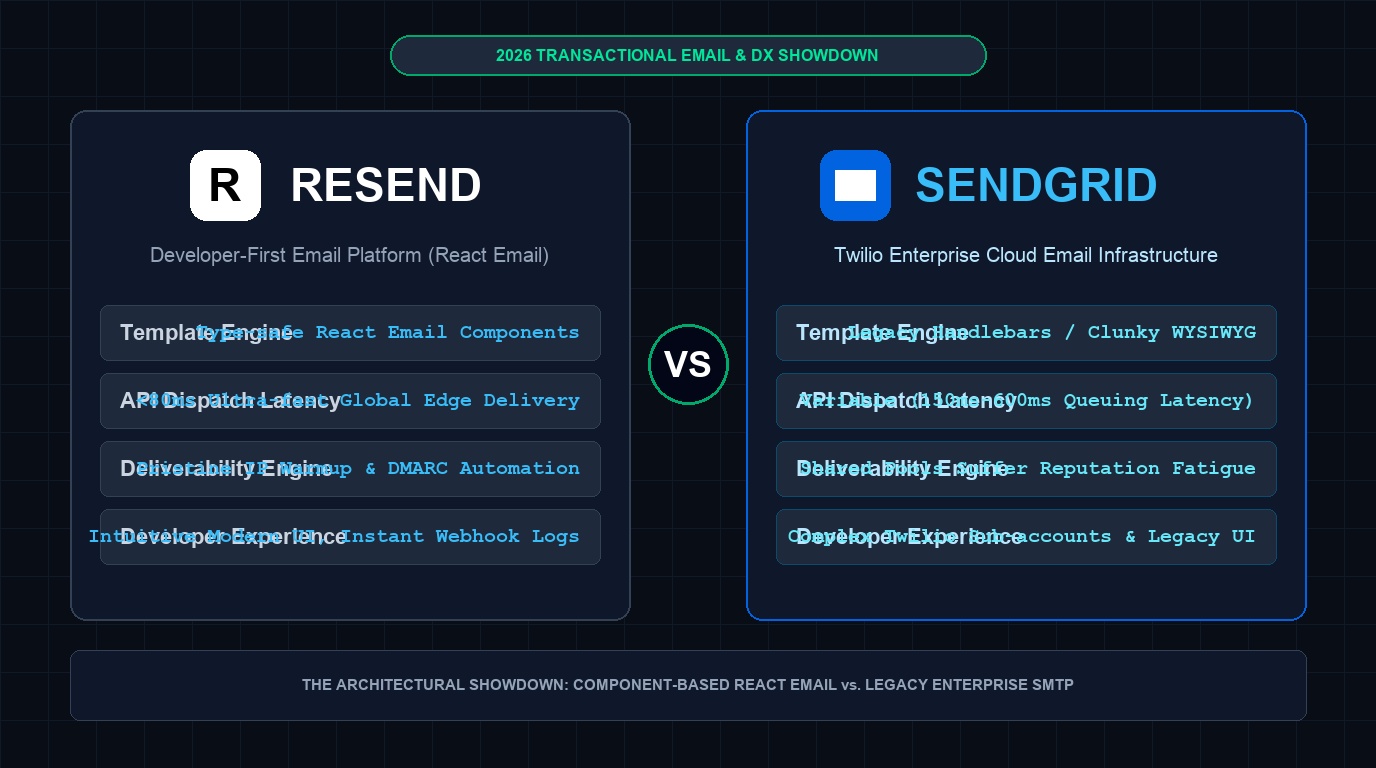
For engineering leaders and full-stack developers, the battle between Resend and SendGrid is not merely about sleek dashboard aesthetics. It directly impacts your inbox deliverability rates, your vulnerability to shared IP pool spam penalties under strict Gmail and Yahoo DMARC authentication standards, and whether your developers spend days debugging table-nested HTML email layouts or build clean, type-safe React components in minutes.
The Core Architectural Divergence: Modern React Components vs. Legacy String Concat
To understand why engineering velocity skyrockets when switching to Resend, you must examine how each platform approaches email authoring, testing, and rendering.
1. Resend: The React Email Ecosystem
Resend was conceived around a fundamental realization: developers should build emails using the exact same declarative, component-driven paradigms they use to build modern web applications:
- React Email Native: Instead of writing fragile, inline-styled HTML tables or wrestling with clunky Handlebars templates, you write standard TypeScript React components using React Email (
<Button>,<Container>,<Text>,<Tailwind>). - Local Development Preview Server: With React Email, you run a local development server (
npm run email:dev) that provides real-time hot-reloading in your browser. You can test dark mode, view mobile viewport responsiveness, and validate client rendering across Apple Mail, Gmail, and Outlook before sending a single test email. - Edge-Optimized REST API: Built to run seamlessly on edge runtimes like Vercel and Cloudflare Workers, Resend’s Node/TypeScript SDK dispatches requests in sub-80ms with native streaming and typed response objects.
2. SendGrid: The Legacy Enterprise Monster
Acquired by Twilio for \$2 billion in 2019, SendGrid carries over fifteen years of legacy enterprise architecture:
- Fragmented Template Engines: In SendGrid, dynamic transactional templates rely on legacy Handlebars syntax (
{{first_name}}) managed inside SendGrid’s web console. Version-controlling templates alongside application code in Git is notoriously difficult, requiring fragile CLI scripts or manual dashboard copy-pasting. - The Clunky Visual Builder: SendGrid offers a drag-and-drop design editor intended for non-technical marketing teams. However, when developers attempt to inject dynamic conditional loops or nested data structures, the visual builder frequently corrupts the underlying HTML markup.
- Multi-Second Queuing Delays: Under peak loads, SendGrid’s shared processing pipelines can introduce seconds or even minutes of queuing latency between when your server calls the
/mail/sendendpoint and when the SMTP handshake actually initiates with recipient mail transfer agents (MTAs).
Inbox Deliverability & IP Reputation: The Shared Pool Reality
An email service is fundamentally useless if your critical transactional messages—such as two-factor authentication (2FA) verification codes or password resets—land in your customers’ Spam or Promotions folders.
| Deliverability Metric | Resend | Twilio SendGrid |
|---|---|---|
| Shared IP Pool Health | Strictly Vetted: Aggressive anti-abuse screening prevents spam spillovers | Severely Degraded: Massive volume of marketing spammers soils shared pools |
| DKIM, SPF & DMARC Setup | Instant 1-click DNS record verification; automated guidance for Gmail/Yahoo rules | Complex multi-step domain authentication; easily misconfigured |
| Dedicated IP Availability | \$29.95 / month add-on with automated progressive warmup | Requires Pro Plan (\$89.95/mo+) + manual IP warmup scripts |
| Real-Time Event Webhooks | Sub-second delivery of delivered, bounced, and complained events with payload replays |
Batch event webhooks prone to lag during high-volume spikes |
The single greatest operational complaint driving teams away from SendGrid in 2026 is shared IP contamination. Because SendGrid hosts millions of accounts—including legacy marketing newsletters and affiliate blast campaigns—bad actors frequently burn through shared IP pools. If a spammer on your assigned SendGrid shared IP triggers a Spamhaus listing or exceeds Google’s strict 0.3% spam complaint threshold, your transactional password reset emails get routed straight to Spam through no fault of your own.
Resend protects its shared IP reputation with uncompromising algorithmic scrutiny. Spam, cold outbound sequences, and unverified bulk mailing are aggressively prohibited. As a result, Resend’s shared IP tiers consistently maintain 99%+ inbox placement rates across Google Workspace, Microsoft 365, and iCloud Mail without requiring a costly dedicated IP upfront.
Developer Experience (DX) & Code Comparison
Let’s compare sending a transactional email with dynamic data on both platforms in a modern Next.js or Node.js environment.
Sending with Resend (React Email Native)
import { Resend } from 'resend';
import { WelcomeEmail } from '@/emails/welcome-email';

const resend = new Resend(process.env.RESEND_API_KEY);

await resend.emails.send({
  from: 'Team <onboarding@saasglance.com>',
  to: 'founder@startup.com',
  subject: 'Welcome to SaaSGlance Pro',
  react: WelcomeEmail({ firstName: 'Alex', teamName: 'Acme Corp' }),
  headers: {
    'X-Entity-Ref-ID': 'user_98241',
  },
});
Notice how WelcomeEmail is a pure, type-safe React component. If a developer accidentally renames a prop or passes an invalid data type, TypeScript throws a compile-time error. You never send an email with broken string templates like Hello {{user.fist_name}}.
Sending with SendGrid (Legacy Handlebars String Injection)
const sgMail = require('@sendgrid/mail');
sgMail.setApiKey(process.env.SENDGRID_API_KEY);

const msg = {
  to: 'founder@startup.com',
  from: 'onboarding@saasglance.com',
  templateId: 'd-12a84b39c84e493bb398f821948d39c0', // Unreadable remote template ID
  dynamicTemplateData: {
    first_name: 'Alex', // No compile-time validation
    team_name: 'Acme Corp',
  },
};

await sgMail.send(msg);
In SendGrid, your codebase is littered with opaque GUID string identifiers (d-12a84b...). If an engineer modifies the template inside SendGrid’s web dashboard, production code has no way of verifying whether required fields match until an email fails silently in production.
Pricing & Total Cost of Ownership (TCO)
How do the economics compare as your monthly email dispatch volume scales from early launch to multi-million user scale?
Plan Breakdown & Pricing Sizing:
- Resend Pricing:
- Free Tier: 3,000 emails/month (100/day limit), 1 custom domain, full React Email access.
- Pro Plan (\$20/mo): 50,000 emails/month included (\$0.90 per additional 1,000 emails), unlimited domains, multi-region webhooks, 3-day log retention.
- Scale Tier (\$100/mo): 200,000 emails/month included (\$0.75 per additional 1k), 30-day log retention.
- Dedicated IP: \$29.95/month flat add-on with automated warming.
- SendGrid Pricing:
- Free Tier: 100 emails/day forever (3,000/month).
- Essentials Tier (\$19.95/mo): 50,000 emails/month included (shared IP only; limited support).
- Pro Plan (\$89.95/mo): 100,000 emails/month included + 1 dedicated IP included. Additional tiers jump to \$249/mo (300k emails) and \$449/mo (700k emails).
For early-stage startups sending under 50,000 emails per month, both platforms cost roughly \$20/month. However, once you require a dedicated IP or cross into the 100k–300k monthly tier, Resend offers significantly more flexible modular add-ons without forcing you into expensive enterprise contracts. When coupled with modern auth providers like Clerk or billing infrastructure like Stripe, Resend integrates seamlessly into the modern Jamstack and Next.js developer workflow.
Feature-by-Feature Showdown
| Feature / Capability | Resend | Twilio SendGrid |
|---|---|---|
| Primary Template Paradigms | Type-safe React Email, HTML, or Markdown | Legacy Handlebars strings & WYSIWYG builder |
| Local Development Previews | Real-time local browser server with hot-reload | None (Must send live test emails or view in web dashboard) |
| Edge Runtime Compatibility | Native support for Vercel Edge, Cloudflare Workers, Deno, Bun | Node.js oriented; requires custom fetch wrappers for edge |
| Sub-Account & Multi-Domain Management | Clean multi-domain switching; instant API key scoping | Complex sub-account hierarchy; easily causes permission confusion |
| Audits, Logs & Payload Inspection | Inspect full sent email HTML, headers, and webhook payloads in UI | Activity feed shows event statuses; HTML body inspection requires extra storage add-on |
| Inbound Email Routing | Built-in incoming webhook forwarding (receive emails via API) | SendGrid Inbound Parse Webhook (functional but complex MX setup) |
When to Choose Resend vs. SendGrid
Choose Resend If:
- Your engineering stack uses TypeScript, React, Next.js, or modern serverless: Building transactional templates with React Email eliminates email layout bugs and keeps all template code version-controlled in Git.
- Inbox deliverability is a high-stakes metric: You cannot afford to have password resets, invitations, or transaction receipts buried in spam due to dirty shared IP neighbors.
- You value rapid debugging and observability: When a user claims they never received a magic login link, Resend allows you to view the exact HTML delivered, SMTP handshake response codes, and recipient MTA logs in seconds.
- You want clean multi-tenant domain routing: Managing 50 client sending domains from a single dashboard with zero friction.
Choose Twilio SendGrid If:
- You send massive multi-million marketing blasts: If your company sends 10+ million marketing promotional emails per month and requires traditional marketing automation tools (drip campaigns, list segmentation, visual un-subscription centers) inside the same platform.
- You are heavily locked into Twilio’s enterprise billing: Your enterprise already consolidates SMS, Voice, and Flex services on a single Twilio master services agreement (MSA) with negotiated enterprise volume discounts.
- You rely on legacy backend frameworks with zero Node/React presence: If your core backend is pure legacy Java, C++, or older PHP monoliths and you exclusively require raw SMTP relay credentials without component templating.
The 4-Step Migration Blueprint: Moving from SendGrid to Resend
Migrating a live SaaS transactional email pipeline from SendGrid to Resend can be completed in an afternoon without dropping a single message:
- Domain Verification: Add Resend’s DKIM, SPF, and DMARC TXT/MX records to your DNS provider (Cloudflare, Route53). Verification takes under two minutes.
- Convert Templates to React Email: Port your old SendGrid HTML templates into React Email components. Test them locally using
npm run email:devto verify responsive layouts. - Dual-Dispatch Feature Flag: Wrap your email sending service in a feature flag. Route 10% of transactional traffic through Resend while monitoring delivery rates, then scale to 100%.
- Webhook Cutover: Update your bounce and unsubscribe webhook listeners to consume Resend’s structured webhook payloads, ensuring automatic suppression list synchronization.
Frequently Asked Questions
Can I use Resend with languages other than React/Node.js?
Yes. While React Email is Resend’s flagship feature, Resend provides official SDKs for Python, Go, Ruby, PHP, and Java, as well as a standard REST API and SMTP relay credentials. You can send plain text, raw HTML, or markdown from any backend language.
Is Resend compliant with the latest Google & Yahoo bulk sender requirements?
Yes. Resend enforces strict SPF, DKIM, and DMARC alignment on all custom sending domains. Additionally, Resend automatically injects RFC-compliant List-Unsubscribe headers with one-click unsubscribe links, ensuring 100% compliance with Gmail and Yahoo 2024+ sender mandates.
Can I send marketing newsletters with Resend?
Yes. Resend features Resend Broadcasts, allowing teams to upload contact audiences, manage opt-in subscription lists, and send targeted email newsletters using the same React Email templates and high-reputation delivery infrastructure.
Does Resend offer dedicated IP addresses?
Yes. For high-volume senders dispatching more than 100,000 emails per month, Resend offers dedicated IP addresses for \$29.95/month. Resend includes automated progressive warmup to build IP reputation gradually without manual volume throttling.