
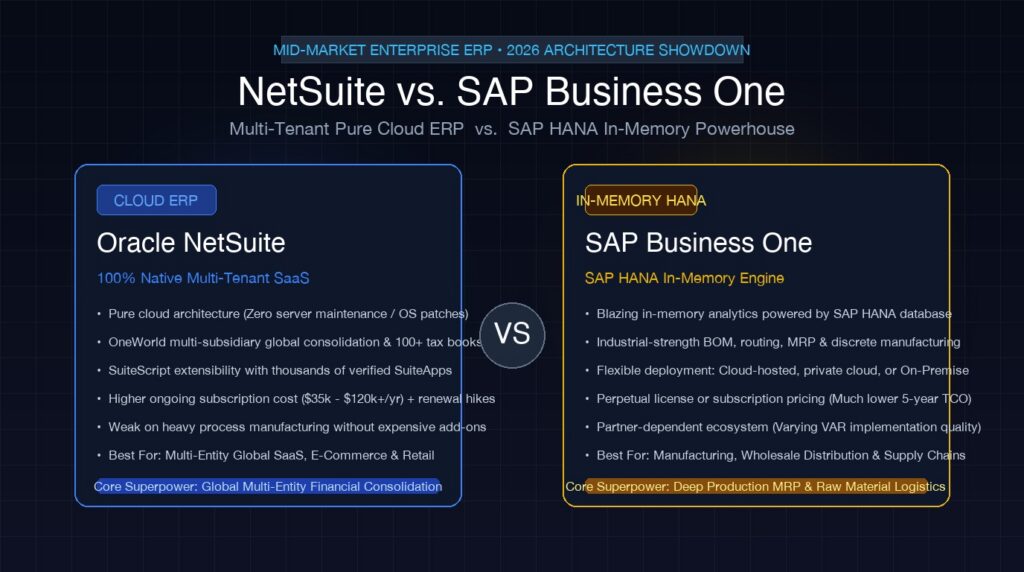
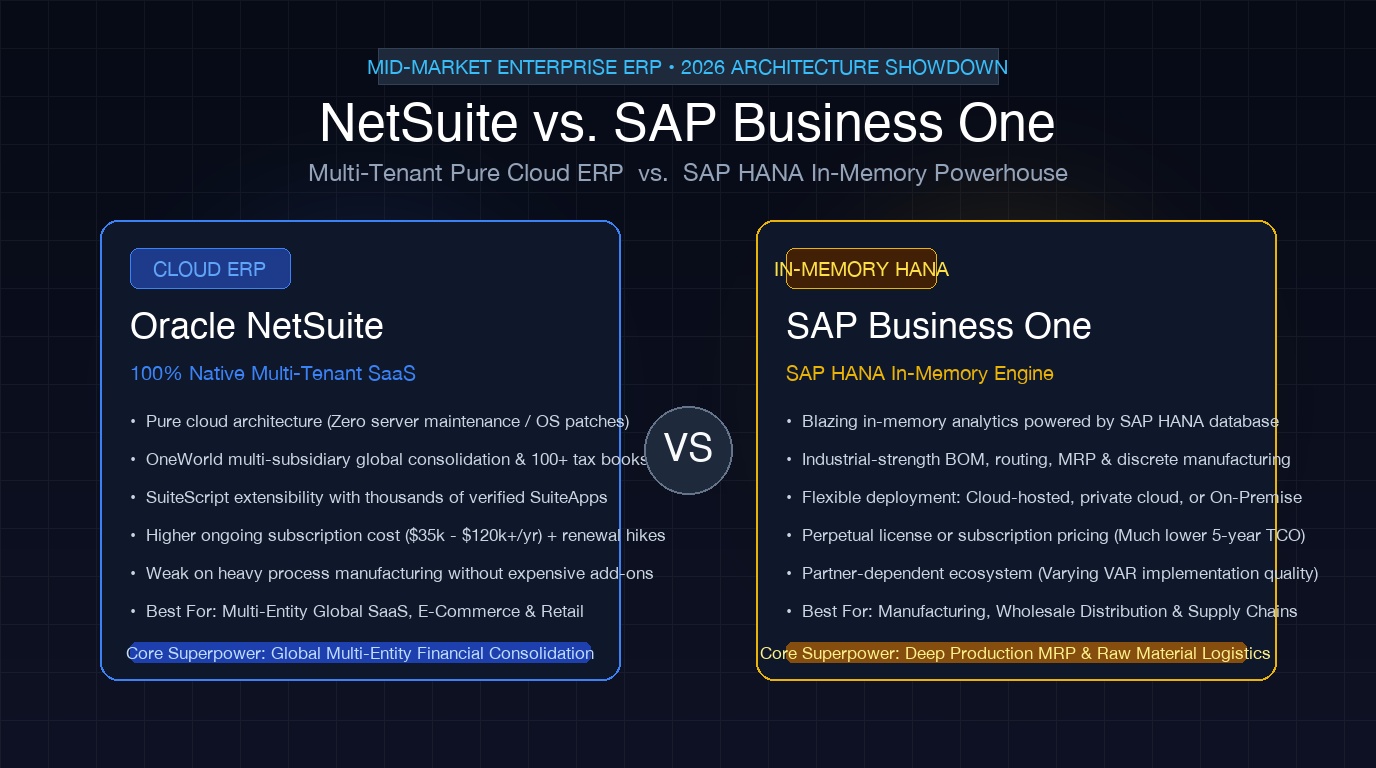
When a manufacturing, distribution, or wholesale enterprise crosses $15M to $100M in annual revenue, its legacy accounting software collapses under operational strain. At this critical mid-market inflection point, two enterprise titans invariably collide on the executive shortlist: Oracle NetSuite and SAP Business One (SAP B1). While both systems claim comprehensive enterprise resource planning (ERP) dominance, they belong to fundamentally different technological generations. NetSuite is a native, multi-tenant cloud monolith built to deliver unified financials and global multi-subsidiary consolidation. SAP Business One, supercharged by the in-memory SAP HANA database engine, is an industrial workhorse built from the factory floor up—delivering deep discrete manufacturing, advanced material requirements planning (MRP), and flexible on-premise or private-cloud hosting.
As Principal Enterprise ERP Architect Nathan Peterson, I have spearheaded more than forty mid-market ERP selections and digital turnarounds across North America and Europe. Having previously analyzed Sage Intacct vs. NetSuite, Dynamics 365 vs. NetSuite, and Acumatica vs. NetSuite, I have watched dozens of CFOs and COOs buy the wrong system: either purchasing NetSuite for a complex job-shop factory only to discover its light manufacturing requires hundreds of thousands of dollars in third-party SuiteApps, or purchasing SAP Business One for a high-velocity digital eCommerce brand only to drown in complex partner-led customizations. Here is an honest, production-tested 2026 architectural breakdown of NetSuite versus SAP Business One.
Core Architectural Philosophies: Pure Multi-Tenant Cloud vs. In-Memory HANA Engine
The philosophical divide between NetSuite and SAP Business One begins at the underlying database and hosting infrastructure:
Oracle NetSuite: The Native Multi-Tenant Cloud Monolith
NetSuite was architected in 1998 as one of the world’s first true Software-as-a-Service (SaaS) applications. It runs strictly in Oracle Cloud data centers on a shared, multi-tenant database infrastructure:
- Zero Infrastructure Maintenance: You never provision a virtual machine, configure an operating system, manage database backups, or install software patches. All customers run on the exact same version of the core platform.
- Automatic Semi-Annual Upgrades: NetSuite rolls out two mandatory upgrades per year (Release .1 in Spring, Release .2 in Autumn). While convenient, custom SuiteScripts must be tested during pre-release sandbox cycles to prevent regression errors.
- Strict Subscription Model: You never own a software license. You rent access via annual or multi-year user licenses, exposing your balance sheet to vendor price hikes at contract renewal.
- Global OneWorld Engine: Out of the box, NetSuite can manage hundreds of consolidated legal subsidiaries, multi-currency transactions, and localized tax books across 100+ nations within a single login.
SAP Business One: The Hybrid In-Memory Enterprise Workhorse
Acquired by SAP in 2002 to capture the small-to-midsize enterprise (SME) sector, SAP Business One was originally a client-server application that has been completely modernized around SAP HANA:
- SAP HANA In-Memory Computing: Unlike standard relational databases that read and write to disk, SAP B1 running on HANA holds its entire transactional and operational dataset directly in RAM. Complex inventory valuations, forecasting models, and multi-tier MRP runs compute in seconds rather than hours.
- Deployment Sovereignty: You can run SAP Business One in the public cloud (AWS, Azure, Google Cloud), inside a managed private cloud hosted by an SAP Value-Added Reseller (VAR), or fully on-premise behind your corporate firewall for maximum security.
- Licensing Flexibility: You can purchase SAP B1 via traditional perpetual licenses (own the software forever and pay annual maintenance) or via modern SaaS subscription licenses.
- Partner-Centric Ecosystem: SAP does not sell or implement Business One directly. You contract through a regional certified SAP Gold Partner (VAR), making your partner’s engineering pedigree critical to project success.
Deep Functional Showdown: Head-to-Head Technical Analysis
1. Manufacturing, Bill of Materials (BOM) & MRP
If your enterprise produces physical goods, this single category will dictate your purchasing decision:
| Manufacturing & Supply Chain Feature | Oracle NetSuite (Standard / Advanced) | SAP Business One (on HANA) | Operational Winner |
|---|---|---|---|
| Bill of Materials (BOM) Depth | Assembly BOMs native; complex multi-level requires Advanced Manufacturing module | Multi-level production BOMs, phantom BOMs, and sales BOMs native | SAP Business One |
| Material Requirements Planning (MRP) | Basic supply/demand planning native; Advanced MRP is an expensive add-on module | Sophisticated multi-scenario MRP wizard with dynamic lead-time calculations native | SAP Business One (Decisive) |
| Shop-Floor Routing & Work Centers | Requires NetSuite Advanced Manufacturing (Adds $10k–$25k/yr) | Native resource management, capacity planning, and labor cost tracking | SAP Business One |
| Quality Control & Batch/Lot Tracking | Batch and serial tracking native; strict inspection requires QC SuiteApp | Comprehensive batch/serial traceability with full audit trees native | SAP Business One |
| Process / Recipe Manufacturing | Poor native fit; requires heavy custom SuiteScript or third-party add-ons | Excellent native fit; specialized industrial extensions (Beas Manufacturing) | SAP Business One |
The Factory Floor Reality: NetSuite was born as an accounting and wholesale distribution system. While its standard inventory capabilities handle basic kitting and assembly, mid-market manufacturers running multi-stage assembly lines, scrap management, and capacity scheduling find NetSuite’s native tools inadequate. In contrast, SAP Business One was built for industrial operations; its native MRP wizard simulates demand spikes, inventory buffers, and purchase order timing with unmatched mathematical rigor.
2. Multi-Subsidiary Financials & Global Consolidation
When the operational focus shifts from shop-floor logistics to international corporate holding structures, the tables turn dramatically:
NetSuite OneWorld Supremacy: NetSuite is arguably the greatest multi-entity financial consolidation platform ever built for the mid-market. A corporate controller can open a unified dashboard displaying live consolidated financials across twenty subsidiaries in twenty different currencies. Intercompany transactions, automated eliminations, and real-time currency revaluations execute seamlessly. Similar to our findings in NetSuite vs. Odoo, NetSuite’s compliance with global GAAP, IFRS, and local tax authorities (UK HMRC, EU VAT, US state sales taxes via SuiteTax) is peerless.
SAP Business One Multi-Branch Limitations: While SAP B1 features a “Multi-Branch” capability within a single database, managing multiple distinct legal entities with different currencies and chart of accounts requires separate database instances. Consolidating reports across those separate databases requires the SAP B1 Intercompany Integration Solution, which introduces integration synchronization lag and administrative overhead compared to NetSuite’s unified single-ledger structure.
3. Customization, Extensibility & Developer Ergonomics
How easily your internal IT team or external partners can customize the system determines your long-term operational velocity:
- NetSuite (SuiteCloud, SuiteScript & SuiteFlow): NetSuite exposes a robust JavaScript API (SuiteScript 2.1). Developers can intercept UI events, build scheduled background jobs, and trigger custom workflows via visual point-and-click SuiteFlow builders. Everything lives inside the cloud sandbox. However, high-volume SuiteScript environments frequently battle governance limits (script execution concurrency caps), causing API throttling during peak operational bursts.
- SAP Business One (Service Layer, DI-API & B1 Usability Package): SAP B1 provides the high-performance Service Layer (an OData/REST API running on Apache/Linux) and the legacy COM-based DI-API. For UI modifications, over 80% of SAP B1 customers utilize the third-party Boyum B1 Usability Package (B1UP), which allows administrators to redesign forms, create dynamic validation rules, and build custom buttons without writing custom compiled code.
Implementation Realities & The 5-Year Total Cost of Ownership (TCO)
Software licensing is merely the tip of the enterprise iceberg. CFOs must model the true 5-year financial trajectory, accounting for implementation consulting, customizations, and annual software inflation:
| 5-Year TCO Cost Component (35 Full Users, $40M Revenue Firm) | Oracle NetSuite (Mid-Market Cloud Edition) | SAP Business One (Cloud-Hosted on HANA) |
|---|---|---|
| Year 1 Software Licensing | $38,000 (after 45% introductory discount) | $32,000 (Subscription) or $75,000 (Perpetual outright) |
| Initial Implementation & Data Migration | $85,000 – $130,000 | $55,000 – $85,000 |
| Year 2–5 Software Licensing (4 Years) | $240,000 (Reflects 15% – 25% renewal step-ups) | $128,000 (Subscription) or $56,000 (Perpetual maintenance) |
| Mandatory SuiteApps / Specialized Add-ons | $60,000 (Advanced Manufacturing + WMS add-ons) | $25,000 (B1UP + specialized shipping connectors) |
| Dedicated In-House Admin / Partner Retainer | $180,000 ($45k/yr external consulting or full admin) | $100,000 ($25k/yr partner support retainer) |
| Total 5-Year TCO Investment | $603,000 – $648,000 | $340,000 – $398,000 |
The Renewal Shock Trap: NetSuite’s sales reps routinely discount Year 1 licensing to win RFPs. However, because NetSuite is a proprietary cloud trap with zero exportable database runtime, customers have virtually zero leverage at contract renewal. Over a 5-year horizon, SAP Business One consistently delivers a 35% to 45% lower total cost of ownership, particularly if capitalized via perpetual licensing.
Comprehensive Feature Comparison Table (2026)
| Evaluation Metric | Oracle NetSuite | SAP Business One (HANA) |
|---|---|---|
| Core Architecture | 100% Multi-tenant SaaS (Oracle Cloud) | Hybrid: Hosted Cloud, Private Cloud, or On-Premise |
| Database Technology | Oracle Relational Cloud Database | SAP HANA (In-memory columnar database) |
| Manufacturing Muscle | Light assembly native; heavy discrete requires add-ons | Industrial-grade multi-level BOM, routing & MRP native |
| Financial Consolidation | Exceptional OneWorld single-ledger multi-entity engine | Good multi-branch; requires intercompany add-on for multi-DB |
| eCommerce & Retail | SuiteCommerce native + rich Shopify/Magento connectors | Relies on third-party eCommerce connectors |
| Reporting & Analytics | SuiteAnalytics workbooks & saved searches | Interactive Pervasive Analytics & SAP Crystal Reports |
| Licensing Model | Strict annual SaaS subscription only | Subscription or Perpetual purchase with maintenance |
| Ideal Industry Profile | SaaS, Professional Services, Wholesale, Multi-Channel Retail | Discrete Manufacturing, Food & Beverage, Industrial Distribution |
The Final Architectural Verdict: How to Choose
Choosing between NetSuite and SAP Business One is not a battle of brand prestige—it is a reflection of your physical supply chain versus digital financial complexity.
Choose SAP Business One if:
- You are a discrete manufacturer, batch process producer, machine builder, or industrial distributor with complex Bill of Materials, shop-floor routings, and scrap tracking requirements.
- You demand native, deep Material Requirements Planning (MRP) that recalculates procurement schedules and capacity bottlenecks in seconds via in-memory SAP HANA.
- You want deployment sovereignty: the freedom to host on AWS, private cloud, or on-premise without forced public cloud upgrades.
- You want predictable software economics, lower 5-year total costs, or the option to purchase perpetual software assets.
- You operate in supply chains where parent companies run tier-1 SAP S/4HANA (allowing seamless corporate-to-subsidiary integration).
Choose Oracle NetSuite if:
- You are a high-velocity digital business, SaaS company, multi-channel direct-to-consumer (D2C) brand, or global holding group with multiple legal subsidiaries.
- Your primary operational pain point is multi-entity financial consolidation, automated intercompany eliminations, and global multi-tax compliance.
- You have zero interest in managing servers, database tuning, or partner hosting environments and want a turnkey, multi-tenant cloud SaaS.
- Your supply chain consists primarily of finished-goods distribution, drop-shipping, or light contract manufacturing rather than complex shop-floor fabrication.
- You are planning an IPO or venture capital exit, where NetSuite’s ubiquity and auditor familiarity streamline financial due diligence.
Frequently Asked Questions
Can SAP Business One be upgraded to SAP S/4HANA later?
Not directly as a simple database migration. SAP Business One and SAP S/4HANA share the SAP brand and HANA database technology, but they feature completely different underlying codebases, database schemas, and business logic. Transitioning from SAP B1 to S/4HANA is treated as a full enterprise ERP reimplementation.
Does NetSuite require a full-time in-house administrator?
For companies with more than 30 active users and custom business workflows, yes. Maintaining custom SuiteScripts, user roles, saved searches, and testing semi-annual Oracle release upgrades almost always requires a certified NetSuite Administrator ($130,000–$160,000/yr salary) or an ongoing managed services retainer with an external consultancy.
Why is SAP Business One on HANA so much faster at analytics?
SAP HANA is a columnar, in-memory database. Traditional relational databases (like those underlying standard ERPs) store data in rows on disk and must scan millions of records into memory to compute aggregate reports. SAP HANA keeps all operational data compressed in server RAM and processes analytical queries directly at memory bus speeds, enabling real-time dashboard calculations across millions of historical transactions with zero indexing lag.