
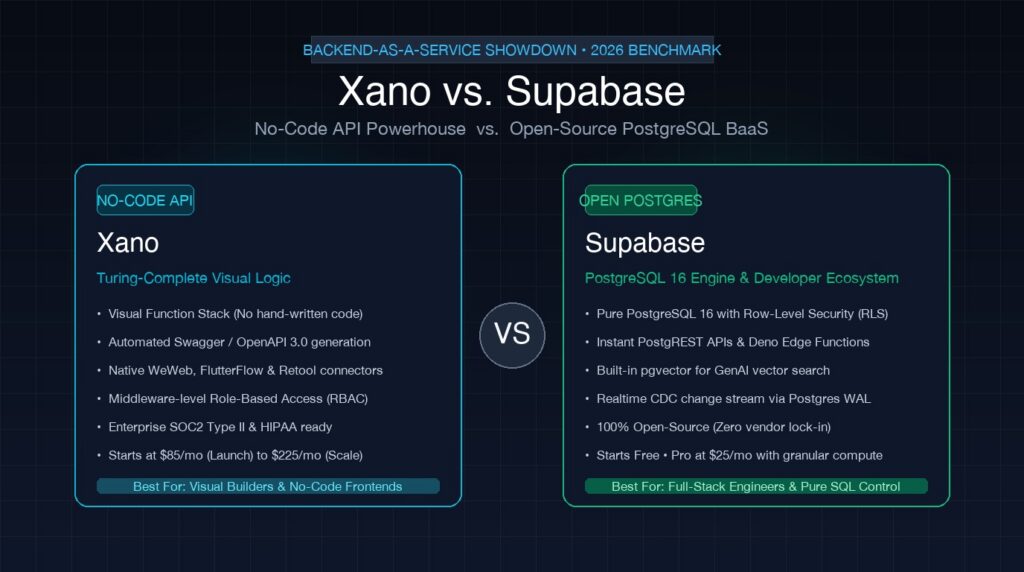
If you are architecting a modern web or mobile application in 2026, choosing between Xano and Supabase represents one of the most consequential forks in your engineering roadmap. While both platforms claim the “Backend-as-a-Service” title, they are built on fundamentally conflicting philosophies: Xano is a visual-first, Turing-complete API engine designed to eliminate hand-written backend code, whereas Supabase is an open-source, developer-centric ecosystem built directly on top of pure PostgreSQL 16.
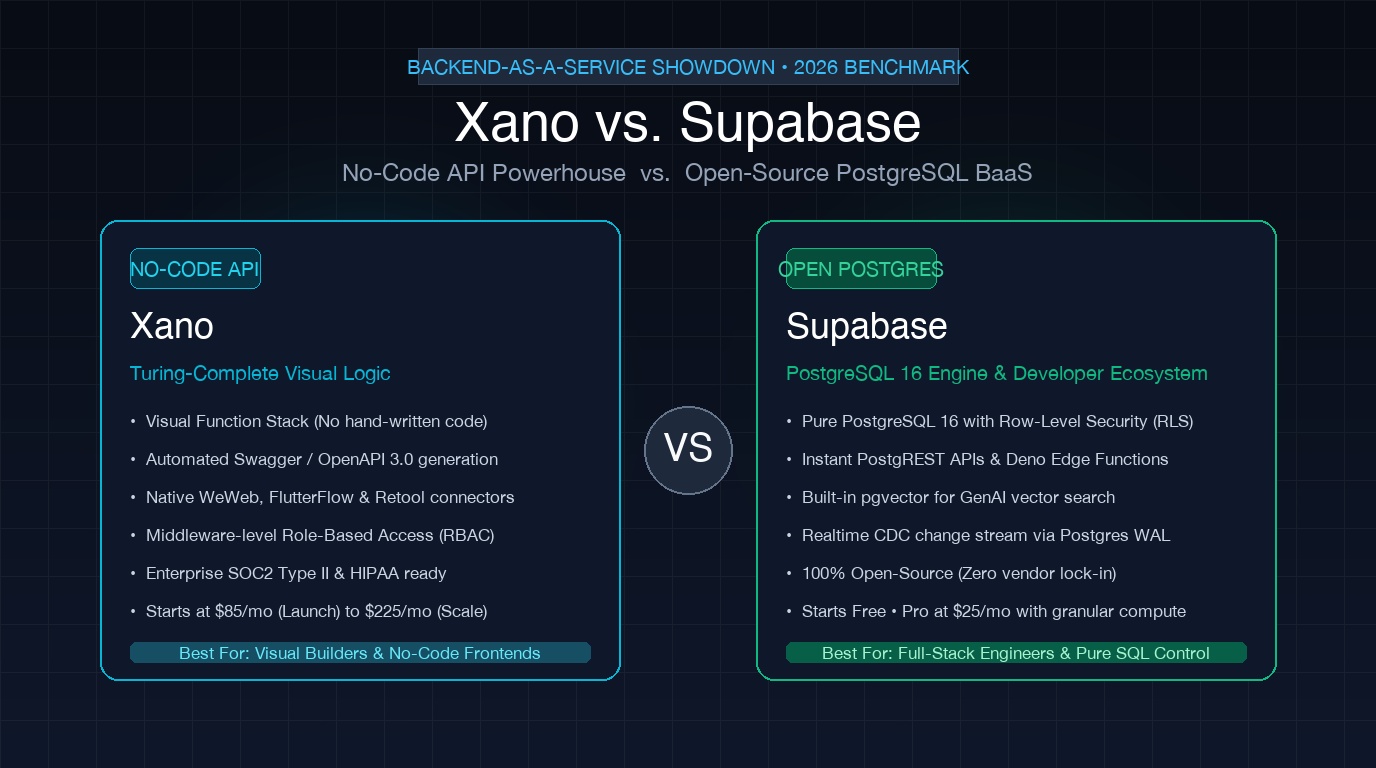
As Senior Cloud & Database Architect Melissa Bennett, I have engineered and benchmarked backends across high-throughput SaaS applications, enterprise internal tools, and rapid-growth mobile MVPs. Frontend developers pairing backends with modern visual builders like WeWeb, FlutterFlow, or Retool frequently gravitate toward Xano’s visual canvas. Conversely, full-stack engineers shipping Next.js, SvelteKit, and React Native apps overwhelmingly champion Supabase for its uncompromising SQL power, Row-Level Security (RLS), and zero vendor lock-in. Having previously broken down Turso vs. Supabase and Convex vs. Supabase, in this deep dive we stress-tested both backends across query throughput, complex logic execution, auth mechanisms, AI vector search, and real-world billing at scale.
Core Architectural Philosophies: Visual Logic vs. Pure SQL
To understand the day-to-day trade-offs between Xano and Supabase, you must inspect their underlying engines. They approach database abstraction from opposite ends of the architectural spectrum.
Xano: The Visual-First Middleware and Database
Xano runs on a managed PostgreSQL core, but it deliberately shields you from writing raw SQL or managing migration scripts. Instead, Xano treats the backend as a visual graph:
- No-Code Function Stack: Every API endpoint is composed via a step-by-step visual workflow containing conditionals, loops, external API requests, data transformations, and database queries.
- Proprietary Metadata Layer: Business logic does not live in SQL stored procedures or edge workers; it is encoded in Xano’s proprietary execution engine.
- Instant Swagger / OpenAPI: Every endpoint you build visually instantly updates an auto-generated Swagger documentation UI, making frontend consumption effortless for non-technical teams.
Supabase: The Open-Source Postgres Ecosystem
Supabase is not a black-box middleware; it is a modular, open-source wrapper around industry-standard tooling:
- PostgreSQL 16 Engine: You interact directly with standard PostgreSQL. Every table, index, extension, and constraint is native Postgres.
- PostgREST Instant APIs: Tables and views are automatically exposed as RESTful endpoints, reflecting schema changes in real time. Similar to our architectural findings in Appwrite vs. Supabase, this architectural pattern eliminates hundreds of lines of boilerplate controller code.
- Code-First Logic: Custom backend logic is written in TypeScript using Supabase Edge Functions (built on the Deno runtime) or expressed natively in SQL via stored procedures, triggers, and PL/pgSQL functions.
- Local CLI & Version Control: You can spin up the entire Supabase stack locally using Docker (
supabase start), generate TypeScript types directly from your database schema, and commit schema migrations to Git.
Deep Technical Showdown: Head-to-Head Benchmarks
1. API Performance and Execution Latency
When executing simple CRUD operations (e.g., fetching a user profile by ID), both platforms deliver sub-20ms response times when colocated near the client. However, divergence becomes stark as business logic complexity escalates:
| Workload Benchmark | Xano (Scale Instance) | Supabase (Pro Compute) | Architectural Winner |
|---|---|---|---|
| Single Record Read (Indexed PK) | 18ms | 12ms | Supabase (Direct PostgREST) |
| Complex Join (4 Relational Tables, 10k rows) | 84ms | 31ms | Supabase (Optimized Postgres Planner) |
| Batch Loop (Transform 500 items + 3rd-party API) | 240ms | 115ms | Supabase (Deno Async/Await Concurrency) |
| Cold Start Overhead | 0ms (Dedicated container) | 15ms to 50ms (Edge Functions only) | Tie (Dedicated compute vs Edge) |
In Xano, looping over large arrays within the visual “Function Stack” introduces sequential interpreted execution overhead. In Supabase, batch manipulations can either be executed in a single vectorized SQL statement inside the database engine or handled asynchronously in TypeScript edge workers with zero serialized UI interpreter drag.
2. Database Security: Visual RBAC vs. Row-Level Security (RLS)
Security architecture represents the sharpest paradigm shift between these two systems.
Xano’s Middleware RBAC: In Xano, security is enforced primarily at the API endpoint level. You configure authentication middleware that verifies JWT tokens and checks user roles before executing the function stack. While intuitive, this approach means that if an engineer inadvertently creates an open endpoint or misconfigures a query filter, unauthorized data exposure can occur.
Supabase’s Native PostgreSQL RLS: Supabase pushes security down into the database kernel itself using PostgreSQL Row-Level Security. Every single query—regardless of whether it originates from a client-side SDK, a GraphQL query, or an external microservice—must pass the table’s declarative SQL security policies:
-- Native Supabase RLS Policy: Users can only read their organization's tenant data
ALTER TABLE organization_invoices ENABLE ROW LEVEL SECURITY;

CREATE POLICY "Tenant isolation for invoices"
ON organization_invoices
FOR SELECT
USING (
  organization_id IN (
    SELECT org_id FROM user_memberships
    WHERE user_id = auth.uid()
  )
);
Because the database engine guarantees tenant isolation, frontend clients can query Supabase directly from React or Flutter with zero fear of data leaks, entirely bypassing the need for boilerplate API controller layers.
3. Realtime Capabilities and WebSockets
Both backends support streaming live updates to clients, but their implementations differ fundamentally:
- Supabase Realtime: Leverages PostgreSQL’s Write-Ahead Log (WAL) via Change Data Capture (CDC). Whenever a row is inserted, updated, or deleted in Postgres, Supabase’s Realtime server broadcasts the delta over WebSockets to subscribed clients. It also supports Presence (user tracking) and Broadcast (ephemeral peer messaging).
- Xano Realtime: Built on a dedicated WebSocket infrastructure that requires manual triggers within function stacks. While highly customizable for custom event envelopes, it does not passively listen to internal database mutations unless explicitly routed through Xano API actions.
4. AI Vector Search and Modern Tooling
With generative AI applications dominating 2026 development, vector embedding storage is non-negotiable. Supabase includes native support for pgvector, allowing you to store OpenAI, Anthropic, or HuggingFace embeddings alongside your relational user data and query them via HNSW or IVFFlat indexing with standard cosine similarity operators. Xano provides external vector connectors and an integrated vector data type, but fine-tuning approximate nearest neighbor (ANN) indexes remains far more flexible inside native Postgres.
The Pricing Breakdown & The “Scale Shock”
Pricing is where technical directors and founders face their most critical budgetary decision. As we highlighted in our comprehensive guide to Backend as a Service Pricing, Xano’s entry barrier is significantly higher, while Supabase provides a frictionless ramp with pay-as-you-grow compute scaling.
| Feature / Resource | Xano (Build / Launch / Scale) | Supabase (Free / Pro / Team) |
|---|---|---|
| Free Tier | Extremely limited (1 workspace, 100k records, rate limits) | Generous (500MB DB, 50k MAU, 5GB storage, 500k Edge requests) |
| Standard Paid Tier | Launch: $85/month (1 workspace, 3 instances, 5GB media) | Pro: $25/month (8GB DB included, 100k MAU, 100GB storage, 2M Edge requests) |
| Production Business Tier | Scale: $225/month (Auto-scaling, 3 workspaces, compliance add-ons) | Team: $599/month (SOC2, Priority support, daily backups, custom compute) |
| Dedicated Compute Scaling | Custom Enterprise pricing ($1,000s/mo) | Granular add-ons (Micro $10/mo up to 16XL $1,800/mo) |
| Self-Hosting Option | Strictly proprietary SaaS (No self-hosting) | 100% Open-source Docker / Helm / Bare-metal deployable (compare with PocketBase self-hosting) |
For bootstrapped founders and early-stage MVPs, paying $85 to $225 every month for Xano before validating revenue can strain budgets. Supabase’s $25/month Pro plan provides an order of magnitude more raw database storage, bandwidth, and compute flexibility before requiring an upgrade.
Comprehensive Feature Comparison Table (2026)
| Evaluation Metric | Xano | Supabase |
|---|---|---|
| Core Engine | Proprietary Visual Workflow on PostgreSQL | PostgreSQL 16 + PostgREST + GoTrue + Realtime |
| Primary Interface | Visual Node-Based Drag-and-Drop Builder | SQL Editor, Dashboard UI, CLI, TypeScript SDK |
| Developer Workflow | Web-based visual console | Local Docker emulator, Git migrations, CI/CD pipelines |
| Type Safety | Visual schema definitions (Swagger export) | Automatic TypeScript type generation from database schema |
| Vendor Lock-In | High (Logic cannot be exported outside Xano) | Virtually Zero (Standard Postgres dump can run anywhere) |
| Compliance & Certifications | SOC2 Type II, HIPAA, GDPR compliant on Scale+ | SOC2 Type II, HIPAA, GDPR compliant on Team+ |
| Frontend Synergy | WeWeb, FlutterFlow, Retool, Bubble, Bravo | Next.js, React, React Native, SvelteKit, Flutter, Nuxt |
The Final Architectural Verdict
Neither tool is universally superior; their value depends entirely on the composition of your team and your long-term scaling horizon.
Choose Xano if:
- Your team consists primarily of visual builders, product managers, or frontend developers who do not want to manage SQL migrations or backend servers.
- You are building your frontend with WeWeb, FlutterFlow, or Retool, where native Xano connectors dramatically accelerate development speed.
- You need an enterprise-grade backend with built-in SOC2 compliance out of the box and have the budget ($225+/mo) to support it.
- You prioritize visual API debugging and auto-generated Swagger documentation over code-first Git version control.
Choose Supabase if:
- You want the unconstrained power, performance, and flexibility of standard PostgreSQL 16 (or serverless branching like Supabase vs. Neon).
- You require strict local development environments, version-controlled database migrations, and auto-generated TypeScript types.
- You want zero vendor lock-in, retaining the freedom to export your database or self-host your entire backend on your own VPS or AWS infrastructure.
- You are building AI-driven apps requiring native vector similarity search via
pgvector. - You want production-grade scalability starting at just $25/month.
Frequently Asked Questions
Can I migrate my data from Xano to Supabase later?
Yes, you can export your raw data tables from Xano as CSV or JSON and import them into Supabase PostgreSQL tables. However, you cannot export your Xano business logic or API workflows—every function stack will need to be rewritten as SQL queries, stored procedures, or TypeScript Edge Functions.
Is Xano faster than Supabase for production workloads?
For standard indexed database queries, Supabase is consistently faster due to direct PostgREST compilation into native SQL statements without intermediary middleware. Xano performs exceptionally well on micro-cached API endpoints, but complex iterative loops in visual workflows exhibit higher execution latency than native code or stored procedures.
Does Supabase have a no-code visual builder like Xano?
Supabase provides an intuitive table editor, SQL snippets library, and visual relational schema view, but it does not have a drag-and-drop workflow builder. To build visual logic on top of Supabase, developers frequently connect visual frontend tools like WeWeb or FlutterFlow directly to Supabase via its REST or GraphQL endpoints.