
Every entrepreneur hits a point where the tools that got them to their current size start working against them. Spreadsheets become liabilities. Disconnected software stacks create data gaps. Manual processes that were manageable at ten employees become bottlenecks at thirty. That’s the moment the ERP conversation starts.
But the market in 2026 presents a choice that didn’t exist five years ago with the same clarity. You’re not just choosing between ERP vendors anymore — you’re choosing between two fundamentally different philosophies of how business software should work. The AI ERP vs traditional ERP debate isn’t a technical one. It’s a strategic one, and the answer has direct consequences for how fast your business can move and how much operational weight lands on your shoulders personally.
If you’re still building your baseline understanding of the category, what is AI ERP software and how it’s changing the way businesses operate is the right starting point before this comparison makes full sense.
What traditional ERP was actually built to do
To understand the AI ERP vs traditional ERP gap clearly, you need to understand what traditional ERP was designed for — and when it was designed.
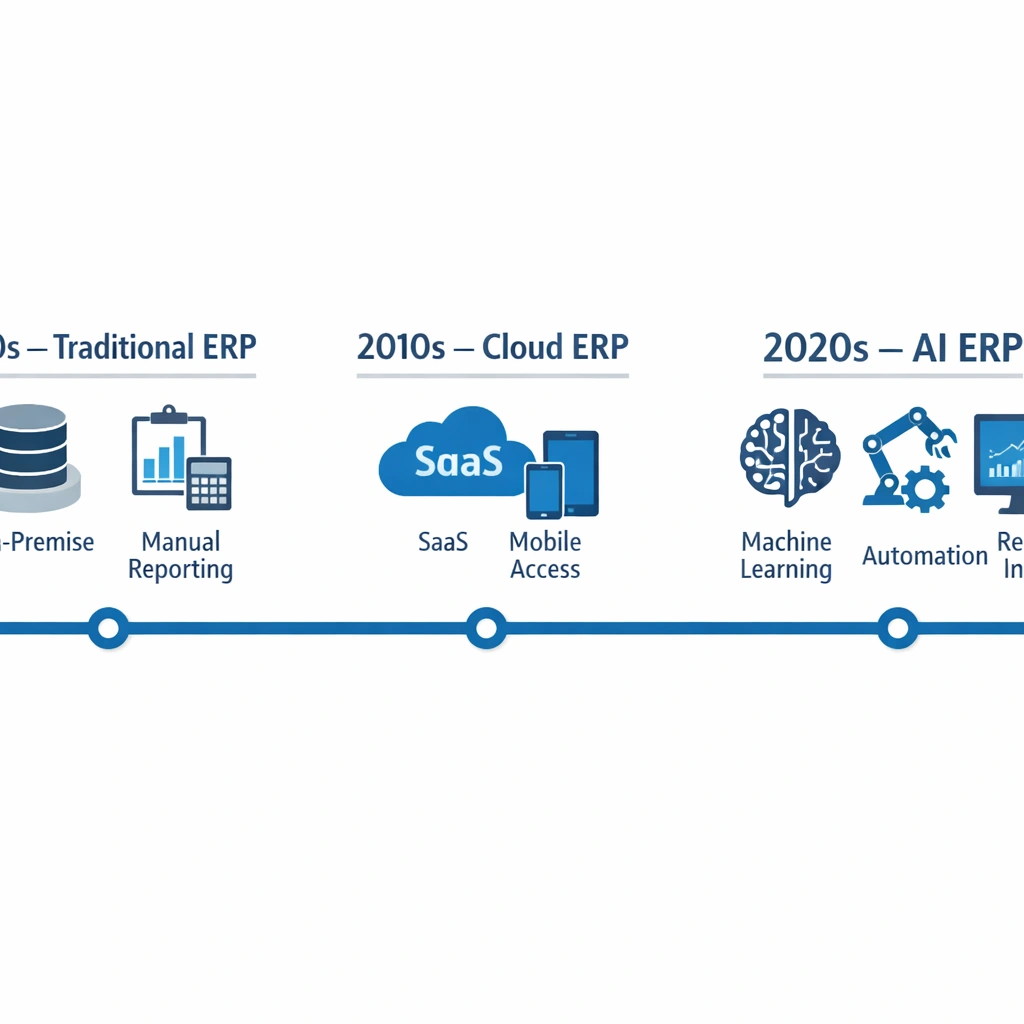
The first generation of ERP systems emerged in the 1990s. They were built for large manufacturing companies that needed to connect their production, procurement, and finance functions in a single database. The core promise was data centralization: instead of each department running its own records, everything fed into one system.
That was genuinely transformative at the time. But the architecture reflected the assumptions of its era. Data was historical. Reporting was scheduled. Decisions were made by people who reviewed the reports and acted on them manually. The system’s job was to store and display. The human’s job was to interpret and respond.
Traditional ERP platforms operating today are largely built on that same foundation, even if they’ve added modern interfaces on top. The database logic, the reporting structure, and the workflow model are all rooted in a reactive posture: something happens, it gets recorded, a human reviews it and decides what to do next.
Where traditional ERP breaks down for entrepreneurs
The AI ERP vs traditional ERP conversation gets concrete when you look at where legacy systems create friction for lean, fast-moving businesses.
Reporting lag. Traditional ERP systems generate reports on a schedule — daily, weekly, monthly. By the time a report lands in front of a decision-maker, the data is already old. For an entrepreneur managing cash flow tightly or responding to demand shifts in real time, that lag is a structural problem.
Manual exception handling. When something falls outside the normal workflow — a supplier ships late, a customer disputes an invoice, inventory counts don’t reconcile — traditional ERP flags it and stops. A human has to investigate, decide, and manually update the system. In a busy operation, these exceptions stack up and become a full-time job.
Implementation rigidity. Traditional ERP systems are notoriously difficult to customize post-implementation. Workflows get locked in during setup, and changing them later requires either expensive consulting hours or a workaround that creates technical debt over time.
Scalability cost. Adding users, modules, or locations to a traditional ERP typically means significant additional licensing fees and another round of implementation work. Growth creates cost spikes rather than smooth scaling.
For entrepreneurs who are evaluating whether the switch makes financial sense, AI ERP software cost — what you’ll actually pay in 2026 gives you a direct comparison of total cost of ownership across both categories.
What AI ERP actually changes
The AI ERP vs traditional ERP gap isn’t about flashy features. It’s about the system’s default posture toward your business data.
Traditional ERP is reactive. AI ERP is anticipatory.
That distinction plays out across every major function.
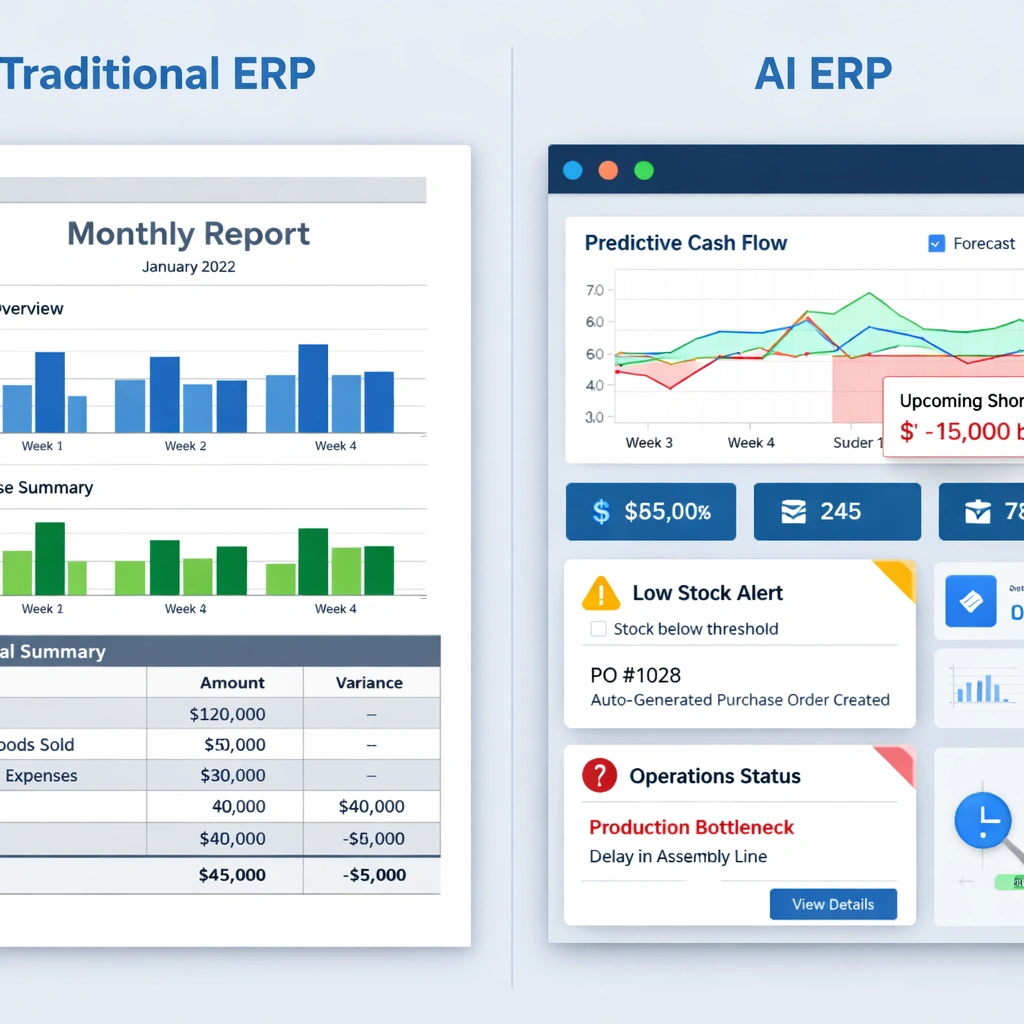
In inventory management: a traditional ERP tells you when stock has dropped below a threshold. An AI ERP predicts when it will drop below that threshold based on current demand velocity, supplier lead times, and historical patterns — and triggers the reorder before the problem occurs.
In financial management: a traditional ERP records transactions and generates a cash flow statement. An AI ERP monitors your receivables aging, your upcoming payables, and your current burn rate simultaneously — and surfaces a cash flow gap two weeks before it becomes a crisis, with a suggested response.
In operations: a traditional ERP logs workflow completions. An AI ERP identifies which steps in your workflow are creating bottlenecks, quantifies the downstream impact, and recommends process adjustments based on what’s actually slowing your operation down.
The compounding effect of these differences is significant. An entrepreneur running on an AI ERP platform is making decisions with more current information, spending less time on manual exception handling, and operating with a system that gets more accurate over time as it learns the specific patterns of their business.
The honest case for staying on traditional ERP
The AI ERP vs traditional ERP decision isn’t automatically in favor of the newer category for every business. There are legitimate reasons some entrepreneurs should stay on a traditional platform, at least in the near term.
Highly regulated industries. If your business operates under strict compliance frameworks — certain healthcare, financial services, or government contracting environments — the auditability and predictability of a traditional ERP may be a regulatory requirement, not just a preference. AI-driven automation introduces variability that some compliance frameworks don’t accommodate cleanly.
Stable, low-complexity operations. If your business has a small product line, a predictable demand cycle, and minimal supplier complexity, the intelligence layer of an AI ERP may simply not have enough variability to act on. You’d be paying for capability you don’t need.
Existing deep customization. If your current ERP has years of custom configuration built into it — specific workflows, integrations, and reporting structures that your team depends on — the migration cost may outweigh the operational benefits of switching, at least until a natural inflection point like a new ERP contract cycle or a major operational expansion.
The key is to evaluate the AI ERP vs traditional ERP question against your specific operational reality, not against a general argument for modernization.

The migration question: when to make the move
Assuming the analysis points toward AI ERP, the timing of the transition matters as much as the platform selection. Moving during a high-growth phase creates unnecessary risk — your team is already stretched, and a system migration adds operational complexity at exactly the wrong moment.
The best window for migration is typically during a period of relative operational stability — after a growth phase has plateated, before the next one begins. Use that window to map your current workflows thoroughly, identify the processes you want to automate first, and run a structured pilot on the new platform before cutting over fully.
A phased approach works better than a big-bang migration for most small businesses. Start with one or two modules — finance and inventory are typically the highest-impact starting points — and migrate the remaining functions in subsequent phases once the team is comfortable with the new system.
For a detailed walkthrough of how to structure that process, how to implement AI ERP software without disrupting your business covers the sequencing step by step.
What the data says about outcomes
The performance gap between AI ERP and traditional ERP implementations has become measurable enough that industry analysts track it consistently. Businesses running AI-native ERP platforms report faster financial close cycles, lower inventory carrying costs, and significantly reduced time spent on manual data reconciliation compared to those on traditional systems.
The productivity gains tend to concentrate in two areas: finance teams that previously spent significant time on manual reconciliation and reporting, and operations teams that managed reordering, fulfillment exceptions, and supplier communication manually. In both cases, the AI layer absorbs the routine volume and leaves the human team focused on the work that actually requires judgment.
For entrepreneurs who are also evaluating which specific platforms deliver on these outcomes, best AI ERP software for small business that actually delivers covers the top options with an honest assessment of where each one performs best.
Conclusion
The AI ERP vs traditional ERP debate resolves differently for every business, but the direction of the market is clear. Systems that anticipate problems, automate routine decisions, and surface intelligence proactively are replacing systems that record history and wait for human interpretation.
For entrepreneurs who are building for scale, the operational advantage of moving to an AI-native platform compounds over time. The businesses that make that transition thoughtfully — with a clear understanding of their workflows, a realistic implementation plan, and the right platform for their specific operation — are the ones that come out with a structural edge that’s genuinely difficult for slower-moving competitors to close.