Running a business today means making dozens of decisions before lunch. Inventory levels, cash flow, team assignments, customer orders — the list doesn’t stop. Most entrepreneurs are managing all of this across four or five disconnected tools, and the cracks show up as missed deadlines, duplicate data entry, and decisions made on outdated information.
That’s the exact problem what is AI ERP software answers at its core.what is AI ERP software? An ERP, or enterprise resource planning system, is a centralized platform that connects every major function of your business finance, operations, supply chain, HR, and sales — into a single source of truth. When you layer machine learning and predictive logic on top of that foundation, you get something fundamentally different from the legacy systems most companies are still running on.
This article breaks down what AI ERP software actually is, how it works under the hood, and why the entrepreneurs who adopt it early are building a structural advantage that compounds over time.
What is AI ERP software, really
Traditional ERP systems were built to store and organize data. They were a step up from spreadsheets, but they still required a human to interpret the numbers and decide what to do next. What is AI ERP software in contrast? It’s a system that doesn’t just hold your data — it reads it, learns from it, and acts on it.
The AI layer inside these platforms typically handles three categories of work:
Prediction. The system analyzes historical patterns — sales cycles, supplier lead times, seasonal demand — and generates forecasts that update in real time. You’re not looking at last month’s report. You’re looking at what’s likely to happen next week.
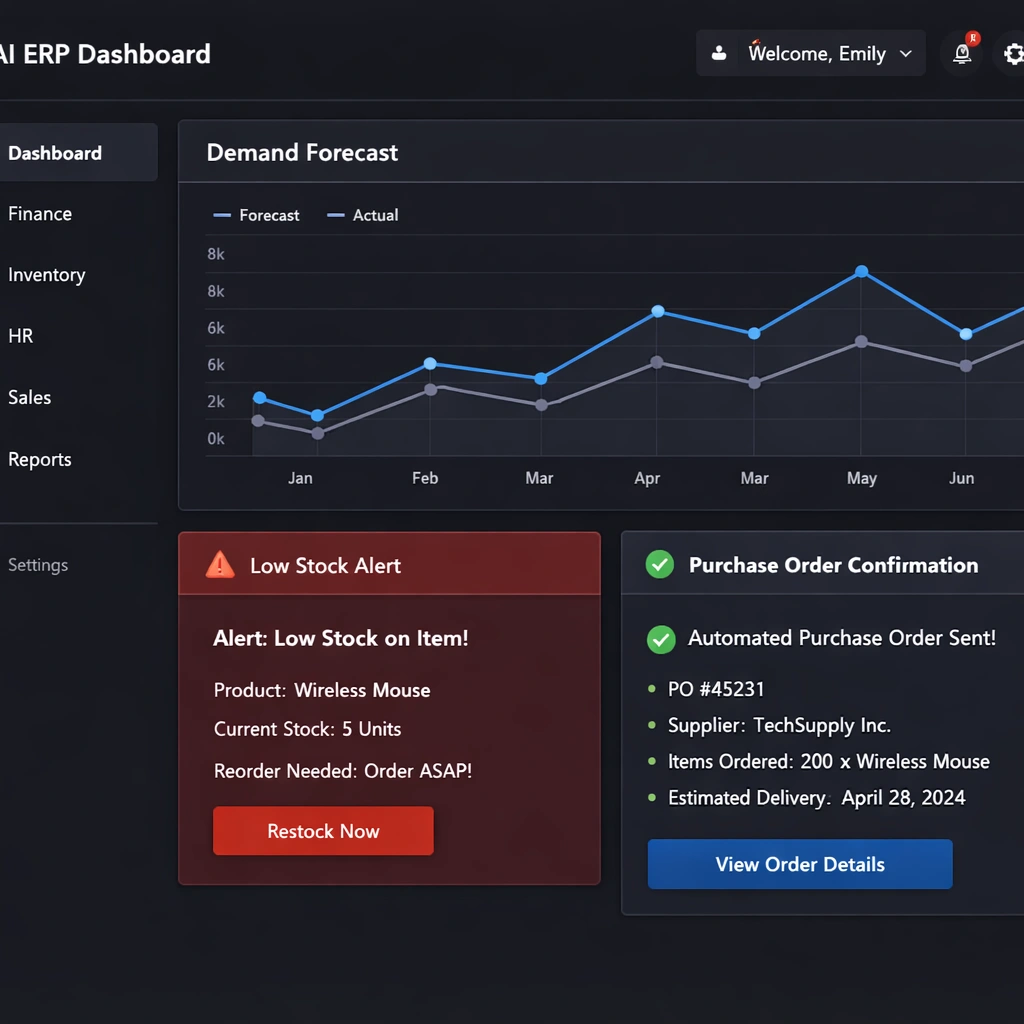
Automation. Repetitive decisions get handed off entirely. Reorder thresholds trigger purchase orders automatically. Invoice approvals route based on pre-set rules. Payroll runs without a manual kickoff. The system handles the process; your team handles the exceptions.
Recommendation. When something unusual happens — a supplier delay, a sudden spike in returns, a cash flow gap — the system surfaces it with context and suggests a response. It’s less like software and more like a very organized operations advisor sitting inside your dashboard.

How it actually works inside your business
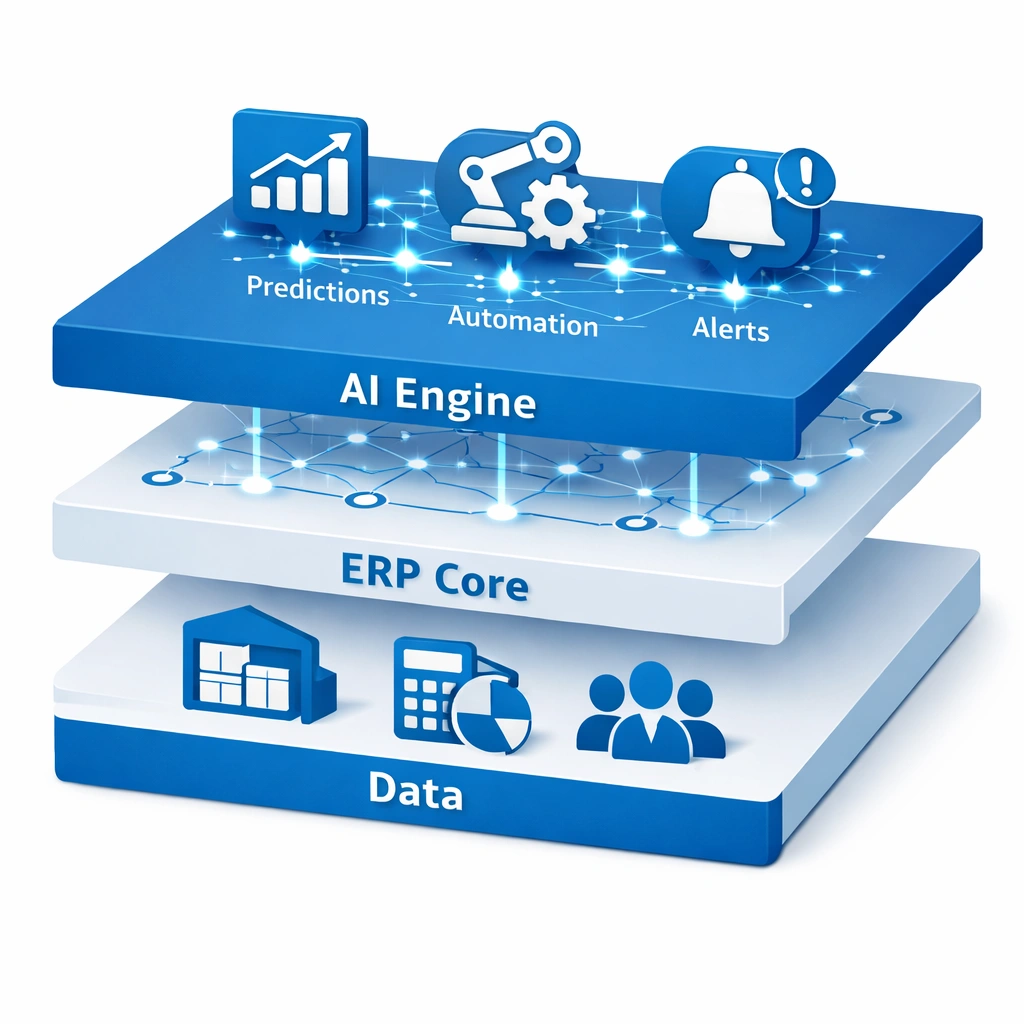
The architecture behind what is AI ERP software is less complicated than most vendors make it sound. At the foundation, you have a database that aggregates data from every department. Every transaction, every employee record, every customer interaction feeds into one place.
On top of that database sits the automation layer. This is where workflows get defined — if inventory for product X drops below 50 units, trigger a purchase order to supplier Y. These rules are configurable, and once they’re set, the system runs them without human input.
The intelligence layer sits above that. It’s trained on your historical data and on broader industry datasets, depending on the platform. Over time, it calibrates its predictions to your specific business patterns. A retail entrepreneur in New York will see different demand signals than a manufacturer in Ohio, and the system accounts for that.
What connects all of it is the user interface — typically a dashboard that surfaces only the information that requires your attention. Everything else runs in the background.
Why entrepreneurs specifically benefit from this
Enterprise companies have had access to ERP systems for decades. The reason what is AI ERP software matters specifically for entrepreneurs is that it closes a gap that used to require a full operations team to manage.
A ten-person company running on an AI ERP platform has the same operational visibility as a 200-person company with a dedicated analyst team. The system does the monitoring, the reporting, and a significant portion of the decision-making that would otherwise require headcount.
For entrepreneurs who are scaling, this matters for three reasons.
First, it removes the bottleneck of the founder being the operational hub. When the system handles routine decisions automatically, the founder stops being the person who needs to approve every reorder or reconcile every invoice.
Second, it creates consistency. Human-managed operations drift — processes get skipped when people are busy, data entry gets sloppy under pressure. An automated system runs the same process every single time.
Third, it scales without proportional cost. Adding a new product line or a new sales channel doesn’t require hiring another coordinator. The system absorbs the complexity.
For a complete picture of how this technology fits into a broader automation strategy, AI ERP software — the full guide to automating your business operations walks through every major use case in one place.
The difference between AI ERP and basic automation tools
A common mistake entrepreneurs make is equating what is AI ERP software with simpler automation tools like Zapier or basic accounting software. The distinction matters.
Point-solution automation tools handle isolated tasks. They connect two apps and trigger a specific action when a condition is met. That’s useful, but it’s narrow. Each tool only knows what happens inside its own connection.
An AI ERP platform has visibility across your entire operation. It doesn’t just automate one task — it understands the relationship between tasks. A delay in your supply chain triggers an update in your production schedule, which adjusts your sales team’s delivery commitments, which updates your cash flow projection. That chain of connected responses is what separates a true ERP from a stack of disconnected automations.
If you’re currently running on a traditional system and wondering whether the upgrade is worth it, AI ERP vs traditional ERP — which one actually wins for your business breaks down that comparison directly.

What to look for when evaluating platforms
Not every platform that calls itself an AI ERP actually delivers on the intelligence side. Some are traditional ERPs with a chatbot bolted on. Others use the term loosely to describe basic rule-based automation.
When you’re evaluating options, focus on four things.
Native AI vs. integrated AI. Is the intelligence built into the core platform, or is it a third-party add-on? Native AI means the system was designed from the ground up to learn and adapt. Integrated AI is often shallower and slower to update.
Data transparency. Can you see why the system made a recommendation? A credible platform explains its logic. Black-box recommendations are a liability — you need to understand the basis of every automated decision your business acts on.
Customization depth. Your business has specific workflows that no generic template will cover. The platform needs to let you define custom rules, thresholds, and escalation paths without requiring a developer every time.
Implementation support. The most capable platform is worthless if your team can’t adopt it. Look for vendors who offer structured onboarding, not just a knowledge base and a ticket system.
If pricing is your next concern, AI ERP software cost — what you’ll actually pay in 2026 gives you a transparent breakdown before you ever talk to a sales rep.
The real question isn’t whether to adopt it
The conversation around what is AI ERP software has shifted. A few years ago, the question was whether the technology was mature enough for small and mid-size businesses. That question is settled. The platforms exist, the pricing has come down, and the implementation timelines have shortened considerably.
The question now is sequencing. Which parts of your operation benefit most from centralization first? Where are you losing the most time to manual processes? What decisions are you making today that a well-configured system could make for you?
Entrepreneurs who answer those questions clearly before they evaluate vendors end up with better implementations and faster returns. Those who shop for software before they understand their own workflows end up with a very expensive tool they underuse.
Conclusion
What is AI ERP software comes down to this: it’s the infrastructure layer that lets a small team operate with the precision and consistency of a much larger organization. It centralizes your data, automates your routine decisions, and gives you the visibility to make better calls on the ones that still require human judgment.
The technology isn’t new. The accessibility is. And for entrepreneurs who are serious about building something that scales without breaking, getting clear on what this category of software actually does is the right place to start.