

If you’ve been hearing the term what is an LLM everywhere lately and still aren’t sure what an LLM actually means for your business, you’re not alone. Most of the noise around this technology is either too technical or too vague to be useful. This page cuts through both.
Understanding what is an LLM — and more importantly, what it can do for your operation — is the first step toward using it as a real competitive advantage. For a full picture of how this technology translates into working products, check out the complete guide to building LLM apps for business, covering the entire stack from strategy to deployment.
What is an LLM, really

LLM stands for large language model. At its core, it is a type of software trained on massive amounts of text data — books, articles, code, conversations, documentation — so that it learns patterns in language well enough to generate coherent, contextually relevant responses.
Think of it less like a database and more like a reasoning engine. When you ask it a question, it does not look up a stored answer. It predicts, word by word, the most statistically and contextually appropriate response based on everything it was trained on.
The “large” part refers to scale. These models are trained on billions of parameters — the internal numerical values that shape how the model interprets and generates language. More parameters, more nuance. More nuance, more useful outputswhat is an LLM.
How LLMs process language and generate output
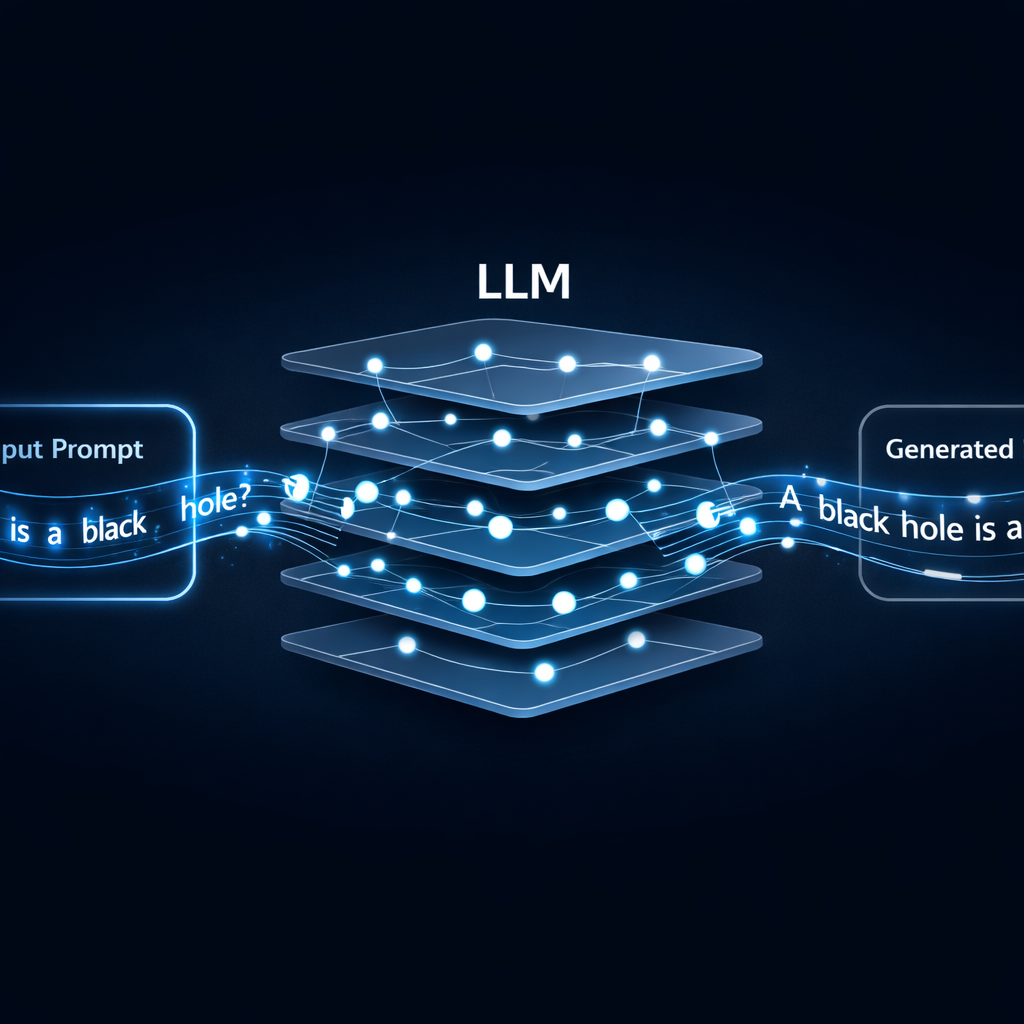
When you send a message to an LLM-powered app, the model breaks your input into tokens — small units of text, roughly equivalent to parts of words — and processes them through layers of mathematical transformations. Each layer refines the model’s understanding of context, intent, and meaning.
The output is generated one token at a time. The model assigns probabilities to possible next tokens and selects the most appropriate one given the full context of the conversation. This process happens in milliseconds.
What makes this powerful for business is that you can shape that context. You can give the model a persona, a set of rules, a knowledge base, or a specific task — and it will operate within those boundaries consistently. That is the foundation of every LLM app built for business use.
Why this matters specifically for entrepreneurs
Corporate teams with hundreds of employees can absorb inefficiency. Entrepreneurs cannot. Every hour spent on repetitive tasks, every slow customer response, every missed follow-up is a direct cost to growth.
LLMs change the math. A single LLM-powered workflow can handle tasks that previously required a part-time hire: answering customer questions, drafting email responses, summarizing documents, qualifying leads, generating reports. Not perfectly — but consistently, at scale, and at a fraction of the cost.
The entrepreneurs who are moving fastest right now are not the ones with the biggest budgets. They are the ones who understood early that this technology is an operations multiplier, not just a chatbot upgrade.
What entrepreneurs are building with LLMs right now
The range of what is being built is wider than most people expect. Here is what is actually happening across small and mid-size businesses:
Customer support automation. LLM agents handle tier-one support questions 24/7, escalating only what requires human judgment. For a deeper breakdown of how this works end-to-end, the guide to building an LLM-powered customer service agent walks through the full build process.
Lead qualification pipelines. Prospects come in through a form or chat widget. An LLM agent asks the right questions, scores the lead based on predefined criteria, and routes hot leads directly to a calendar booking link.
Internal knowledge assistants. Entrepreneurs are feeding their SOPs, product documentation, and past client communications into LLM systems so their team — or they themselves — can query that knowledge in seconds instead of digging through folders.
Content operations. First drafts, outlines, email sequences, and social content are being generated from structured prompts, then reviewed and refined by a human. The output is not published raw — it is a starting point that cuts production time significantly.
Automated reporting. Sales data, support ticket summaries, and weekly performance snapshots are being generated automatically and delivered to inboxes without anyone touching a spreadsheet.
If you are wondering what any of this costs to build, the LLM app development cost breakdown gives you real numbers — not estimates pulled from theoretical scenarioswhat is an LLM.
The gap between curiosity and action
Most entrepreneurs who understand what an LLM is still do not build anything with it. The gap is not knowledge — it is activation.
The three most common blockers are:
Perceived complexity. People assume building with LLMs requires engineering skills. In many cases, it does not. The no-code tooling available today is sophisticated enough to build production-ready workflows without writing a line of code. The best no-code tools for LLM apps covers exactly which platforms make this accessible.
Unclear starting point. Knowing that LLMs are useful does not tell you where to plug them into your specific business. The answer is almost always: start with your highest-volume, lowest-complexity task. That is your first automation candidate.
Fear of getting it wrong. LLM outputs are not always perfect. But the standard is not perfection — it is whether the output is good enough to reduce your workload or improve your customer experience. In most cases, it is.
The window between early adoption and mainstream saturation is still open. Not for much longerwhat is an LLM.
Conclusion
Large language models are not just a trend for enterprises with deep pockets. They are a practical toolset for any entrepreneur willing to learn the basics and apply them to real operational problems. The technology is accessible, the use cases are proven, and the cost of entry has dropped dramatically.
So, to recap: what is an LLM ? It’s a powerful AI foundation you can leverage today. The question isn’t whether LLMs belong in your business — it’s which problem you solve first with **what an LLM** can offer.