
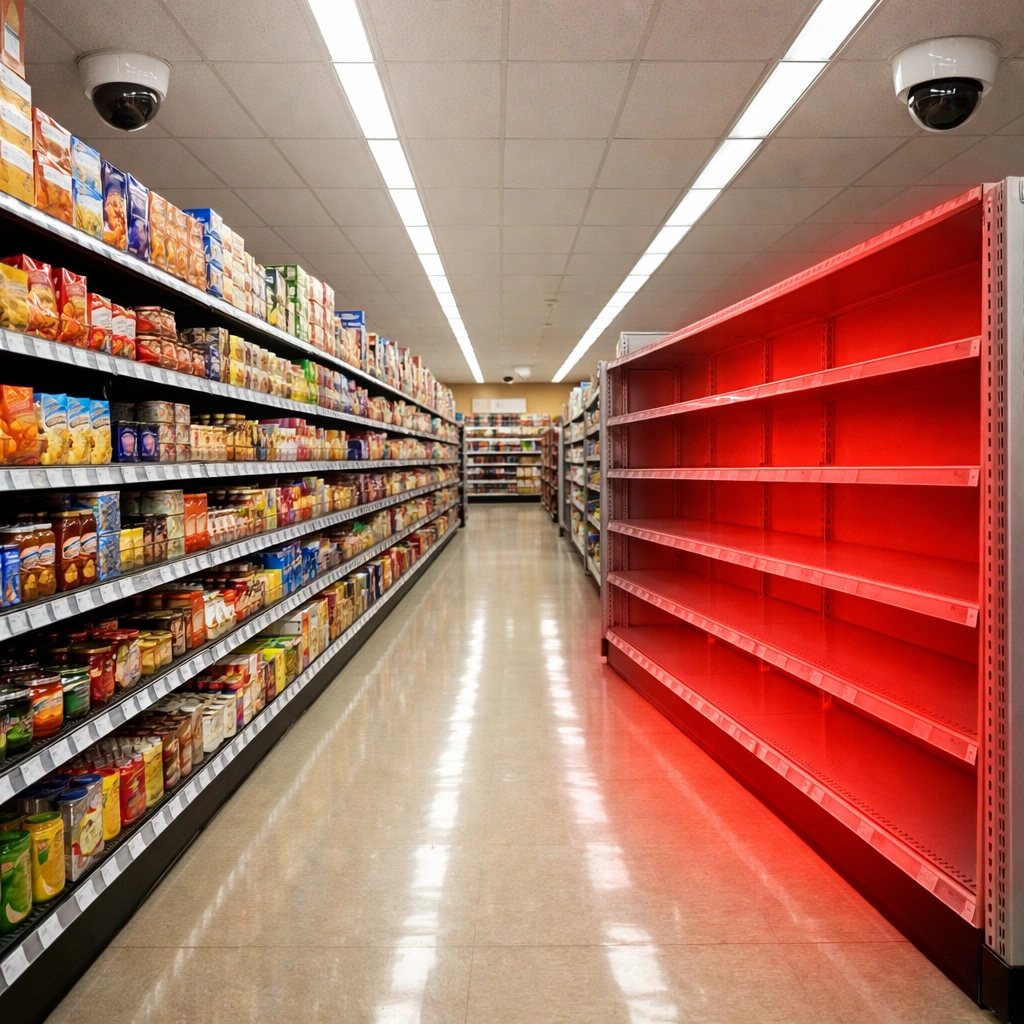
An empty shelf is a silent revenue leak — one that most store managers only catch during a manual walk, hours after a customer already left empty-handed. AI shelf monitoring retail systems use overhead or aisle-level cameras to detect out-of-stock conditions, misplaced products, and planogram violations the moment they happen. This capability sits at the core of what makes retail AI vision automation a practical operations upgrade for entrepreneurs in 2026. Getting shelf intelligence right is often the single fastest way to see a measurable return after deploying a vision system in your store AI shelf monitoring retail.
The stockout problem is bigger than most store owners realize
The industry average for on-shelf availability in grocery and general merchandise retail sits somewhere between 92 and 95 percent. That number sounds acceptable until you do the math. If 5 to 8 percent of your shelf slots are empty or incorrectly stocked at any given time, and your store generates $50,000 in weekly revenue, you are potentially leaving $2,500 to $4,000 on the table every single week — not from theft, not from poor marketing, but from a shelf that nobody restocked in time.
The problem compounds because most stockouts are invisible at the management level. Your staff catches some of them during scheduled walks. Customers catch others and leave without telling anyone. The rest show up as a quiet dip in category sales that you might not connect to a shelf execution problem for weeks.
AI shelf monitoring retail systems exist specifically to close this gapAI shelf monitoring retail .
What AI shelf monitoring actually does inside your store
AI shelf monitoring retail is not a smarter barcode scanner or a fancier inventory spreadsheet. It is a continuous visual observation layer that watches your shelves the way a highly attentive store manager would — except it never takes a break, never misses a section, and processes every camera feed simultaneously.
Here is how the core process works in a modern deployment.
Continuous image capture
Cameras positioned at shelf level or mounted overhead capture images of your product displays at regular intervals — typically every few minutes, though some systems operate closer to real time. The frequency depends on the platform and the camera configuration.
Model-based shelf analysis
Each image is analyzed by a vision model trained to recognize your specific planogram — the layout that defines where every product should be, how many facings it should have, and what the shelf should look like when correctly stocked. The model compares what it sees against that reference state and flags any deviation.
Automated alert and task generation
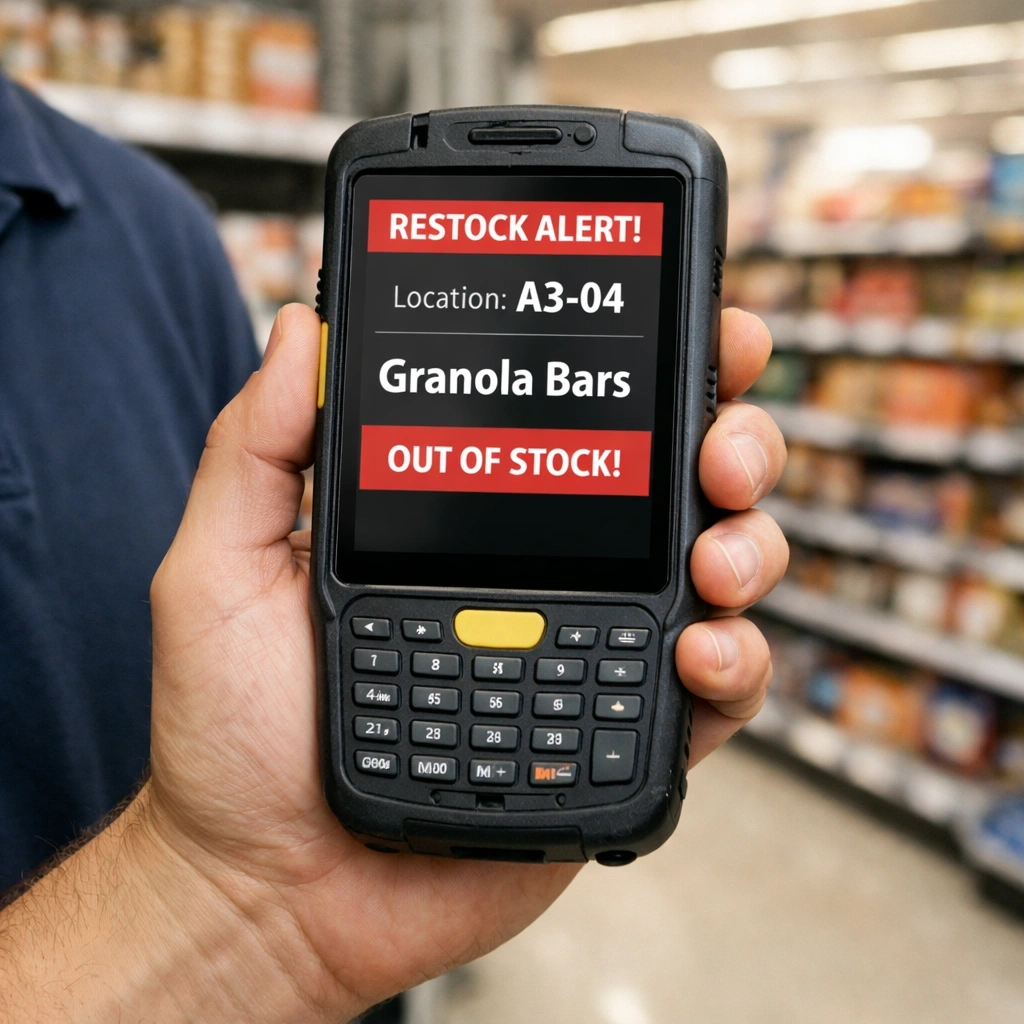
When the system detects an out-of-stock slot, a misplaced product, or a planogram violation, it generates an alert. Depending on your platform configuration, that alert goes to a staff member’s handheld device, a store management dashboard, or directly into your inventory system as a restocking task with the exact shelf location attached.
The entire cycle from empty slot to staff alert can happen in under five minutes. In a traditional operation, the same gap might go undetected for two to four hours.
The three stockout scenarios AI shelf monitoring catches that manual walks miss
Not all shelf execution problems look like a completely empty slot. The most costly ones are often more subtle and they are exactly the ones that fall through the cracks in a manual monitoring routine.
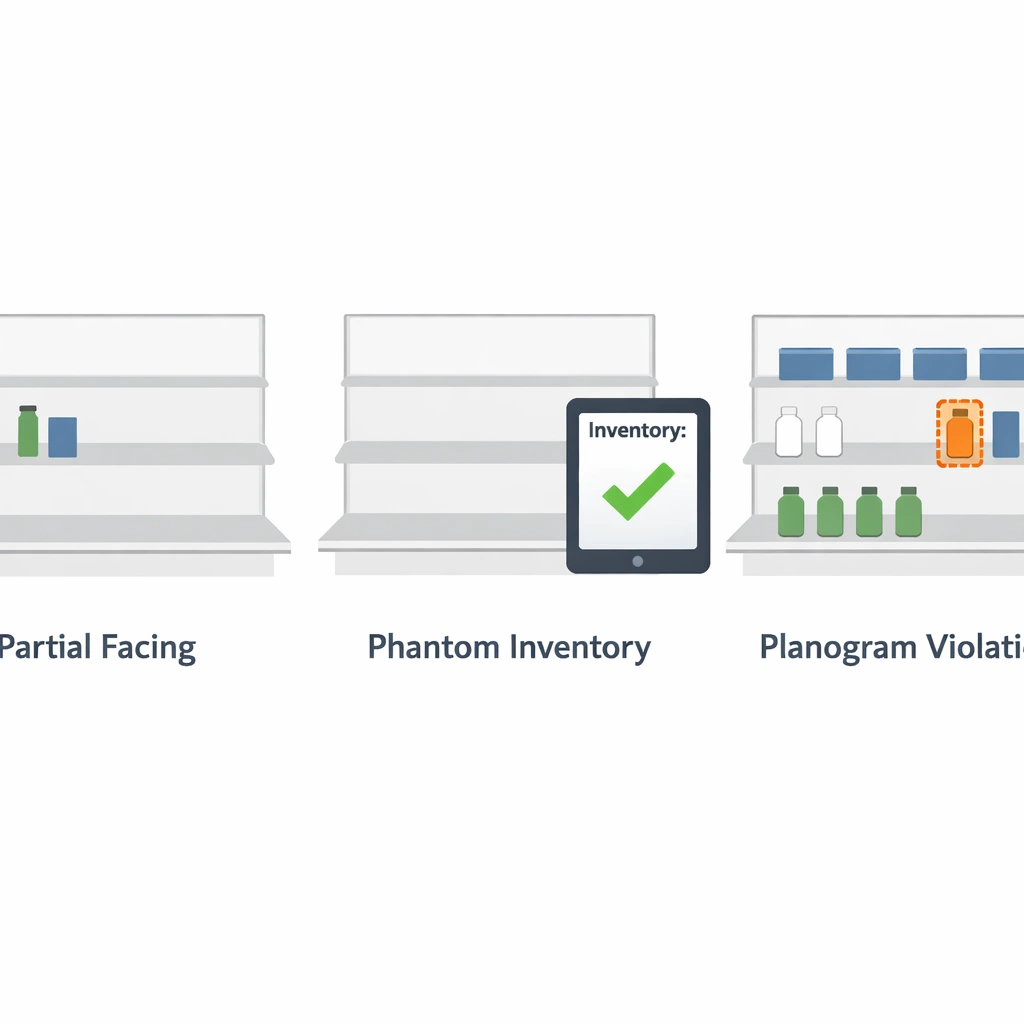
Partial facings that look stocked from a distance
A shelf with two units remaining where there should be twelve looks occupied from the end of the aisle. A staff member doing a quick visual check will pass it without flagging it. An AI shelf monitoring retail system measures facing count against the planogram specification and alerts on the deviation regardless of whether the shelf appears visually occupied.
Phantom inventory
Phantom inventory occurs when your point-of-sale system shows units in stock but the product is not actually on the shelf it is in the back room, misplaced in another section, or unaccounted for due to a receiving error. This is one of the most persistent causes of lost sales in retail because the inventory system tells you everything is fine while customers are looking at an empty slot.
AI shelf monitoring detects the physical absence of the product regardless of what the system says, giving you ground truth data that your inventory records alone cannot provide.
Planogram violations that suppress sales
A product placed in the wrong location — even if it is physically present in the store — effectively disappears for most shoppers. AI shelf monitoring retail systems trained on your planogram flag misplaced products as a category of shelf execution error, not just stockouts. This is particularly valuable in stores where staff turnover is high and planogram compliance tends to drift over time.
How AI shelf monitoring retail connects to your broader operations stack
Shelf monitoring data becomes significantly more powerful when it is integrated with the rest of your operations infrastructure rather than sitting in a standalone dashboard.
The most valuable integrations are with your inventory management system and your staff task management tool. When a shelf monitoring alert automatically creates a restocking task in the tool your team already uses whether that is a dedicated retail operations platform or something as simple as a shared task list the friction between detection and resolution drops to near zero.
Some platforms also integrate shelf monitoring data with your point-of-sale system to create a correlation layer. When a product goes out of stock on the shelf at 2:00 PM and category sales drop between 2:00 and 4:00 PM, the system can surface that relationship automatically. Over time, this gives you a data-driven picture of exactly how much each stockout event costs you in real revenue not an estimate, but a measured figure tied to actual transaction data.
For entrepreneurs evaluating platforms with this kind of integration depth, the comparison in the best AI vision systems for retail that actually deliver ROI covers which vendors offer native integrations versus open API connections and what the implementation difference looks like in practice.
What to measure to know if your shelf monitoring deployment is working
Deploying an AI shelf monitoring retail system without a measurement framework is one of the most common implementation mistakes. The technology generates a significant amount of data, and without clear KPIs established before launch, it is easy to track the wrong things and miss whether the system is actually improving your business outcomes.
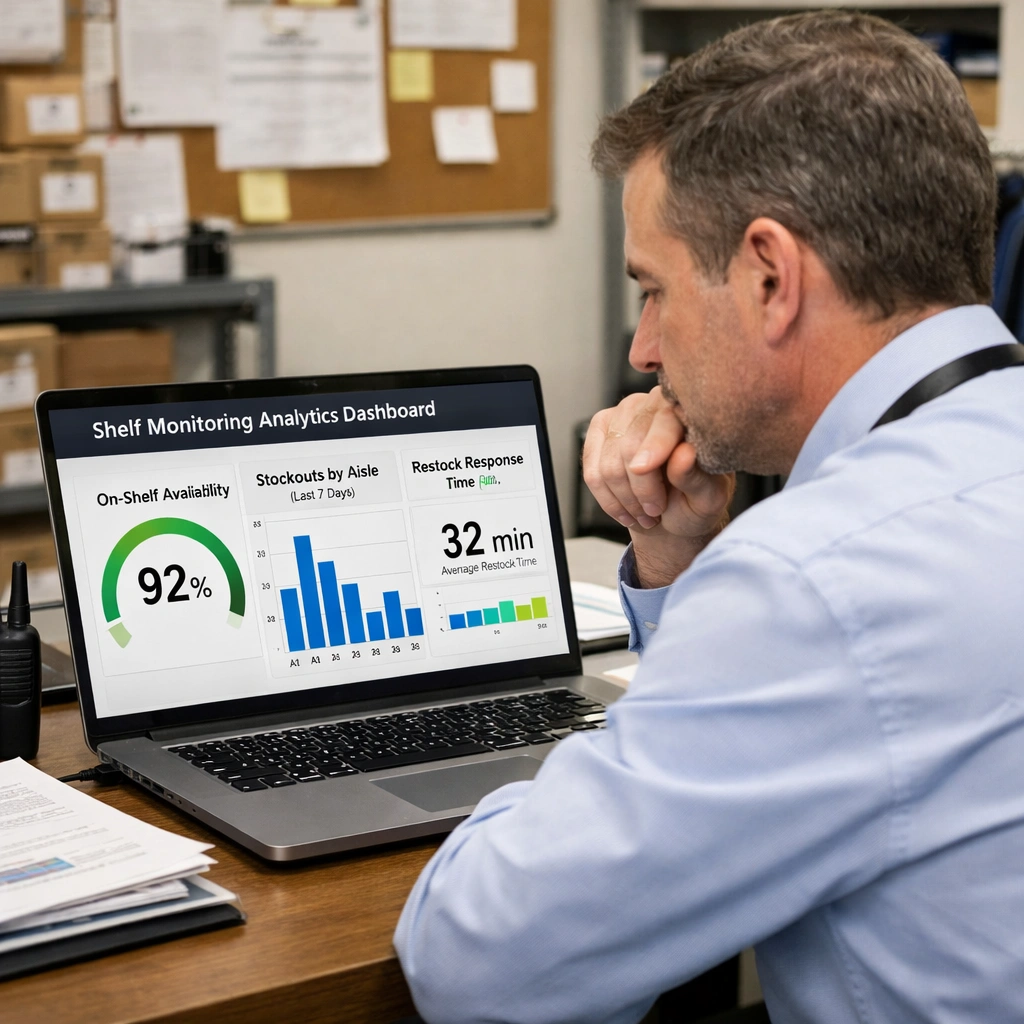
The four metrics worth tracking from day one are on-shelf availability rate, average time to restock after an alert, planogram compliance percentage, and category sales lift in monitored sections compared to pre-deployment baseline.
On-shelf availability rate is the foundational metric — the percentage of shelf slots that are correctly stocked at any given point in the day. Most retailers who deploy AI shelf monitoring see this number improve by three to seven percentage points within the first ninety days, which translates directly to recovered revenue in high-velocity categories.
Average time to restock measures operational responsiveness. A system that detects stockouts instantly but takes ninety minutes to generate a completed restock is not delivering on its promise. This metric tells you whether the alert-to-action workflow is functioning correctly or needs process adjustment.
The stores that benefit most from AI shelf monitoring retail
AI shelf monitoring delivers the strongest return in stores that share a few common characteristics. High SKU count typically above 2,000 active products — creates more surface area for shelf execution errors than any manual monitoring routine can reliably cover. High product velocity in key categories means that stockouts happen faster and cost more per incident. And stores with moderate to high staff turnover benefit from the planogram compliance enforcement that the system provides automatically, reducing dependence on individual staff knowledge.
Single-location independent retailers can absolutely benefit from AI shelf monitoring, particularly in the grocery, health and beauty, and pet supply categories where on-shelf availability has a direct and measurable impact on basket size and customer retention.
For entrepreneurs who are ready to move from evaluation to deployment, how to implement AI vision retail without wasting your budget outlines the scoping process that determines camera placement, integration sequencing, and the realistic timeline from installation to first actionable alert.
Conclusion
Empty shelves are a solvable problem. The technology to detect them in real time, alert the right person immediately, and measure the revenue impact of every restocking delay exists today and is deployable in stores of all sizes.
AI shelf monitoring retail is not about replacing the judgment of your store team. It is about giving them better information faster so that judgment can be applied where it matters most. The stores that close the gap between a shelf going empty and a staff member knowing about it are the stores that stop losing sales to a problem that was always preventable.