
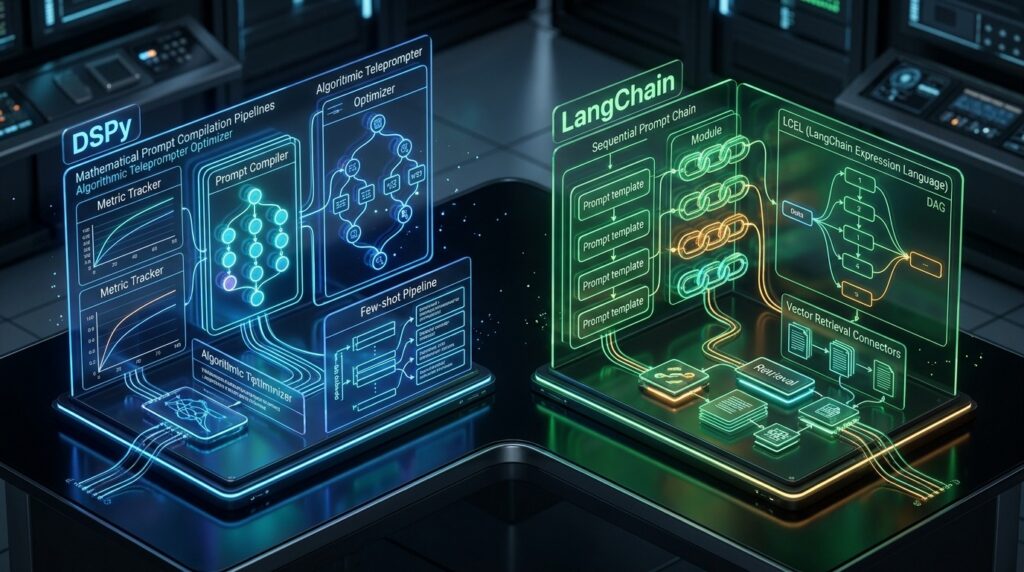
If you have built an enterprise LLM application over the past three years, you have undoubtedly experienced the “Prompt Fragility Trap.” You spend weeks hand-crafting intricate system prompts, adjusting adjectives, and formatting XML tags for GPT-4o. The moment OpenAI or Anthropic updates their model weights—or the moment your CFO asks you to migrate to an open-weight Llama 3 or DeepSeek model to cut inferencing bills—your carefully tuned prompts collapse, accuracy plummets, and your team is forced back to manual trial-and-error prompt tinkering. In 2026, AI engineering is undergoing its most significant architectural shift since the transformer: moving away from brittle, string-based prompt chaining (LangChain) toward programmatic, declarative prompt compilation (DSPy).
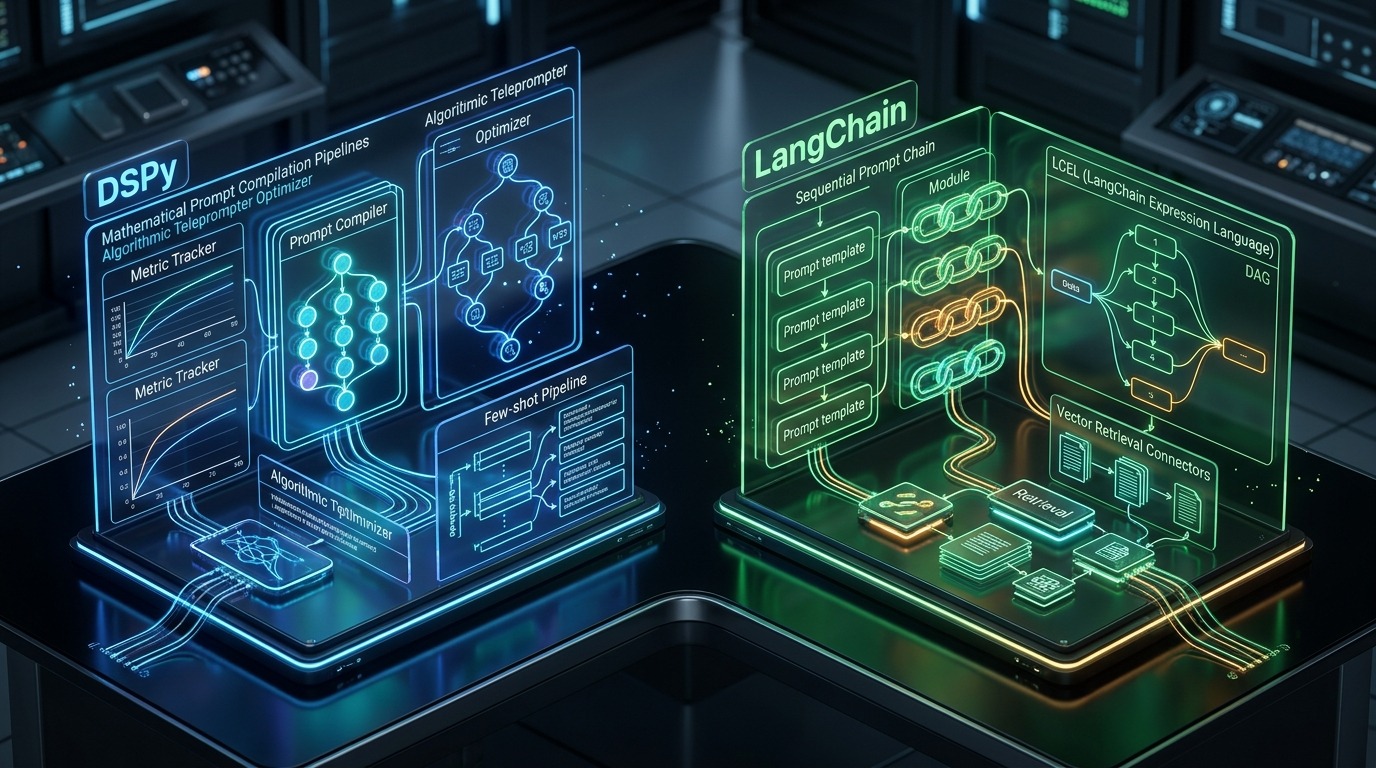
As Principal AI & Systems Architect Brian Walsh, I have deployed production retrieval-augmented generation (RAG) and autonomous agent systems across high-throughput enterprise infrastructure. While LangChain remains the undisputed giant of tooling integrations, document parsers, and ecosystem breadth, its core abstraction—treating prompts as static text templates stitched together with pipes—has become a massive liability in production. Stanford’s DSPy (Declarative Self-improving Language Programs) treats language models not as magical conversationalists, but as programmable compute engines where prompts and few-shot exemplars are compiled algorithmically against objective metrics. Here is an architectural deep dive into why compiling prompts is replacing prompt engineering.
Core Philosophy: String Formatting vs. PyTorch for Language Models
To understand the fundamental divide between DSPy and LangChain, you have to look at the mental model each framework imposes on the developer:
LangChain (and LCEL – LangChain Expression Language): LangChain views AI development through the lens of Unix pipelines and web framework middleware. You define static prompt templates (f-strings with variables), connect them to an LLM, pass the output to a parser, and pipe the result into the next step. If your RAG pipeline returns hallucinations or fails to adhere to JSON schemas, your only recourse is to manually rewrite the prompt string, invent more coercive instructions (“YOU MUST ALWAYS OBEY THIS FORMAT OR BE PENALIZED”), or manually select better few-shot examples. You are essentially doing manual hyperparameter tuning on raw text.
DSPy: Developed by Stanford NLP, DSPy discards prompt templates entirely. Instead, it borrows the exact architecture of PyTorch. In DSPy, you define Signatures (declarative input/output specifications like "context, question -> answer") and assemble them into Modules (like dspy.Predict, dspy.ChainOfThought, or dspy.ReAct). You never write a prompt string. Instead, you provide a dataset of training examples (as few as 20 to 50 samples) and an objective Metric (semantic accuracy, schema compliance, or answer faithfulness). DSPy’s Teleprompter / Optimizer (such as MIPROv2 or BootstrapFewShot) then runs an optimization loop that programmatically tests, scores, and compiles the ideal system instructions and optimal few-shot demonstrations for your specific target model.
| Architectural Dimension | DSPy (Stanford NLP) | LangChain (LCEL) |
|---|---|---|
| Core Abstraction | Declarative modules & algorithmic optimizers | Sequential prompt templates & runnable chains |
| Prompt Generation | Algorithmic compilation (Optimizers search text space) | Manual hand-crafted string engineering |
| Few-Shot Selection | Automated bootstrapping based on validation metrics | Manual hardcoded examples or vector similarity |
| Model Portability | 1-line re-compilation across any model weights | Manual rewriting and re-testing of prompt strings |
| Ecosystem & Loaders | Focused on logic, optimization, and evaluation | Vast ecosystem (1,000+ connectors, loaders, agents) |
| Observability | Native optimization telemetry & trace inspection | Deeply integrated with LangSmith & LangGraph |
| Production Reliability | Deterministic metric-driven benchmarked accuracy | Heuristic prompt trial-and-error |
Code Comparison: Building a Production RAG Pipeline
Examining code implementations of the exact same multi-hop RAG pipeline reveals the structural difference:
LangChain (LCEL): Brittle String Plumbing
In LangChain, the developer must carefully construct prompt strings and wire data through chain operators:
# LangChain LCEL RAG Pipeline
from langchain_core.prompts import ChatPromptTemplate
from langchain_core.runnables import RunnablePassthrough
from langchain_core.output_parsers import StrOutputParser
from langchain_openai import ChatOpenAI

template = """You are an expert enterprise software analyst.
Answer the question based only on the following context.
Context: {context}
Question: {question}
Answer:"""

prompt = ChatPromptTemplate.from_template(template)
llm = ChatOpenAI(model="gpt-4o", temperature=0)

rag_chain = (
    {"context": retriever, "question": RunnablePassthrough()}
    | prompt
    | llm
    | StrOutputParser()
)

response = rag_chain.invoke("What are the governance limits in SuiteScript 2.1?")
If you switch llm from gpt-4o to meta-llama/Llama-3.1-8B-Instruct, the static prompt will almost certainly degrade in accuracy or hallucinate formatting because Llama responds differently to token phrasing than GPT-4o.
DSPy: Declarative Module & Algorithmic Compilation
In DSPy, the code defines the pure logical contract. Prompts are never written manually:
# DSPy Declarative RAG Pipeline with MIPROv2 Optimization
import dspy
from dspy.teleprompt import MIPROv2

lm = dspy.LM('openai/gpt-4o', temperature=0)
dspy.configure(lm=lm)

# 1. Define the input/output signature (Pure Contract)
class GenerateAnswer(dspy.Signature):
    """Answer technical questions using verified retrieval context with step-by-step reasoning."""
    context = dspy.InputField(desc="Retrieved technical documentation chunks")
    question = dspy.InputField(desc="User architectural question")
    answer = dspy.OutputField(desc="Accurate technical response with zero hallucinations")

# 2. Build the Module (Chain of Thought Reasoning)
class RAGModule(dspy.Module):
    def __init__(self, num_passages=3):
        super().__init__()
        self.retrieve = dspy.Retrieve(k=num_passages)
        self.generate_answer = dspy.ChainOfThought(GenerateAnswer)

    def forward(self, question):
        context = self.retrieve(question).passages
        return self.generate_answer(context=context, question=question)

# 3. Compile against objective validation metrics
teleprompter = MIPROv2(metric=validate_answer_accuracy, auto="medium")
optimized_rag = teleprompter.compile(RAGModule(), trainset=train_dataset)

result = optimized_rag(question="What are the governance limits in SuiteScript 2.1?")
The Magic of Compilation: When you execute teleprompter.compile(), DSPy generates candidate system instructions, runs inference across your validation split, evaluates answers against your metric function, and selects the exact prompt tokens and few-shot examples that maximize the mathematical score. If you switch to an open-weight model like Qwen or DeepSeek, you simply run compile() once with the new model, and DSPy automatically adapts the prompt strategy to the new model’s latent space.
Accuracy & Benchmark Comparison: The 8B vs. 70B Reality
The most compelling business justification for DSPy in 2026 is cost reduction. In standardized academic and enterprise RAG evaluations (such as HotpotQA and complex financial Extraction benchmarks):
- Unoptimized Prompts (LangChain baseline): An open-weight 8B model (e.g., Llama-3.1-8B-Instruct) typically achieves 52% to 61% accuracy on multi-hop question answering. Teams conclude the model is “too dumb” and upgrade to GPT-4o or Claude 3.5 Sonnet at 20x higher inferencing costs.
- Compiled Prompts (DSPy MIPROv2): When the exact same 8B model is compiled with DSPy’s multi-prompt optimizer and bootstrapped few-shot selection, accuracy surges to 78% to 84%—matching or exceeding the accuracy of unoptimized zero-shot GPT-4o.
By compiling prompts algorithmically, companies are deploying lightweight 8B and 14B models on local 24GB GPUs (like an RTX 4090 or Mac Studio) and achieving enterprise-grade reliability without sending proprietary data to cloud API providers.
Where LangChain Still Wins: Ecosystem & Connectors
Despite DSPy’s mathematical superiority for prompt optimization, LangChain remains an essential piece of the AI engineering landscape for several reasons:
1. The Universal Connector Catalog: LangChain has integrations for virtually every document format (PDF, Notion, Confluence, Salesforce, Airtable, Jira) and every vector database on earth (Pinecone, Qdrant, Chroma, Weaviate, Milvus). DSPy does not attempt to reinvent document chunking or OCR parsing; it focuses strictly on program logic and optimization.
2. LangSmith Tracing & Observability: For large enterprise teams, LangSmith provides industry-leading trace visualization, cost tracking, token latency analytics, and production dataset curation. While DSPy pipelines can be traced in LangSmith via OpenInference, LangChain’s native observability integration remains the smoothest developer experience.
3. Complex Cyclic State Machines (LangGraph): As detailed in our LangGraph architecture review, building cyclical agent networks with human-in-the-loop checkpoints, persistent thread memory, and time-travel rollbacks is exceptionally mature in LangGraph. Many top engineering teams actually combine both: using LangGraph to orchestrate agent state flows while using DSPy inside individual agent nodes to compile and optimize the prompts executed at each step.
The Definitive Decision Matrix for 2026
Choose DSPy If:
- You are building production RAG pipelines, classification engines, or structured data extraction systems where accuracy and reliability are paramount.
- You want to migrate from expensive closed-source APIs (GPT-4o, Claude 3.5) to cost-effective open-weight models (Llama 3.1, DeepSeek-V3, Qwen 2.5) without losing accuracy.
- You are tired of hand-crafting 500-word prompt templates and want automated, algorithmic prompt optimization based on real validation datasets.
- You demand reproducible, test-driven AI development with objective evaluation metrics rather than subjective “vibes-based” prompt tinkering.
Choose LangChain / LCEL If:
- You are prototyping an MVP and need off-the-shelf connectors to ingest dozens of disparate document sources (PDFs, Google Drive, Notion, Slack).
- You are building complex agentic systems with human-in-the-loop approval workflows, where LangGraph’s state persistence is required.
- Your organization is heavily invested in the LangSmith enterprise monitoring and evaluation ecosystem.
- Your tasks are purely creative, open-ended conversational chatbots where formal mathematical accuracy metrics cannot be easily defined.
Frequently Asked Questions
Do I need a massive training dataset to use DSPy?
No. Unlike fine-tuning model weights which requires thousands of labeled examples, DSPy optimizers like BootstrapFewShot work effectively with as few as 20 to 50 labeled examples. The teleprompter tests combinations of those few examples to find the optimal prompt configuration.
Can I use DSPy and LangChain together?
Yes. Many production architectures use LangChain for data ingestion, document parsing, and vector retrieval, and pass the retrieved context into a compiled DSPy module for synthesis, reasoning, and schema adherence.
Is prompt compilation expensive in terms of token usage?
During the initial compilation phase, DSPy executes dozens or hundreds of candidate prompt iterations against your validation set, consuming token credits. However, once compiled, the resulting optimized prompt is saved as a static artifact that runs with zero additional overhead in production, paying for itself within days through higher accuracy and smaller model requirements.