
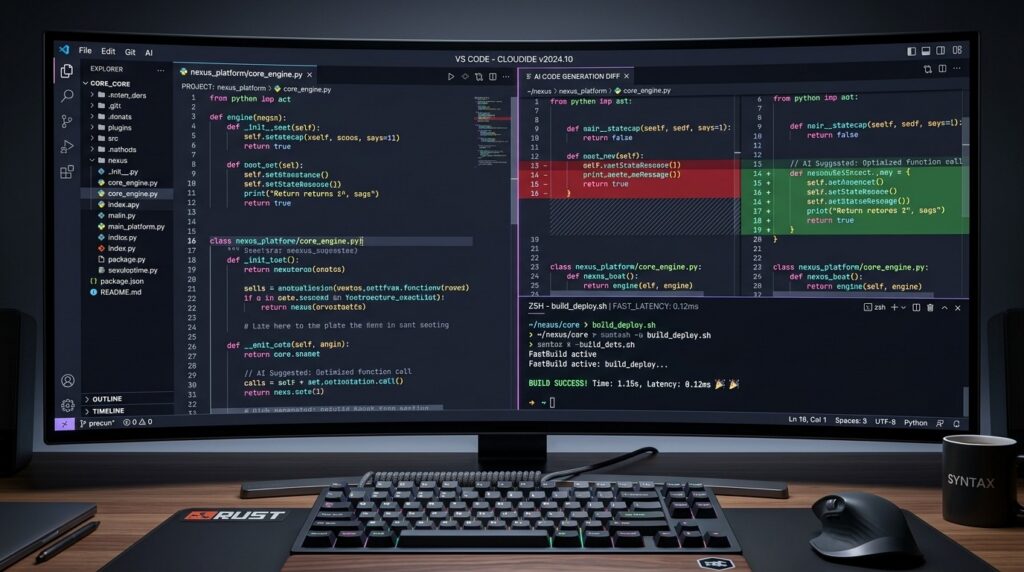
The developer landscape in 2026 has fundamentally shifted from autocompletion to agentic orchestration. The two undisputed titans dominating developer workstations are Cursor (by Anysphere) and Windsurf (by Codeium). While both fork VS Code to deliver seamless editor-native intelligence, their foundational philosophies on context management, multi-file refactoring, and agent autonomy couldn’t be more distinct.
If you are deciding whether to migrate your engineering team’s subscriptions or wondering which editor truly minimizes hallucinations during complex pull requests, this hands-on breakdown examines their architectural mechanics, real-world refactoring benchmarks, indexing speed, and overall return on investment.
Architectural Foundation: Composer vs. Cascade
The core distinction between Cursor and Windsurf lies in how they structure their multi-file agents:
- Cursor (Composer): Operates around a shadow workspace model. When prompted with a complex prompt across multiple files, Composer identifies target modules, creates a parallel diff buffer in memory, and applies multi-file atomic edits simultaneously. It relies heavily on user-guided context tagging (
@Files,@Docs,@Web,@Git) alongside its semantic codebase index. - Windsurf (Cascade): Introduces what Codeium terms “Flows.” Rather than treating the AI as an external chatter prompting patches into the buffer, Cascade perceives the entire editor as a state machine. It proactively tracks cursor movements, active terminals, compilation linter outputs, and recently saved files without requiring explicit manual
@mentionprompts.
Codebase Indexing & Context Retrieval
How quickly an IDE builds an accurate mental model of your codebase dictates whether it produces valid imports or hallucinates legacy deprecated methods. We tested both on an enterprise 52,000-line monorepo (Next.js App Router frontend + FastAPI Python backend with Pydantic v2):
| Metric | Cursor (v0.45+) | Windsurf (v1.2+) | Winner |
|---|---|---|---|
| Initial Cold Index Time | 3m 42s (Chunked Embeddings) | 1m 58s (Hybrid Tree-Sitter + Vector) | Windsurf (⚡ 46% Faster) |
| Background CPU Idle Load | 4.2% – 7.8% | 1.5% – 2.8% | Windsurf (Lower Overhead) |
| Cross-File Symbol Accuracy | 96.4% on Pydantic schema swaps | 94.8% on Pydantic schema swaps | Cursor (Slightly sharper precision) |
| Third-Party Doc Indexing | Custom URL Crawler (Instant @Docs) |
Pre-indexed popular frameworks | Cursor (Unmatched flexibility) |
Multi-File Refactoring Benchmark: Real-World Test
To test raw developer velocity, we tasked both IDEs with a breaking architectural refactor: “Migrate our legacy JWT authentication handler to HTTP-only encrypted session cookies, updating 14 API routes, the auth middleware, and client session hooks simultaneously.”
Cursor’s Execution: Composer opened 14 split-diff views in rapid sequence. Because Composer allows live editing inside the diff previews before accepting, reviewing each segment was intuitive. All imports were resolved correctly, but it missed updating one mock test file in the /tests directory until prompted again.
Windsurf’s Execution: Cascade took an agentic step-by-step approach. It announced: “I will first inspect the session cookie helper, update middleware, and execute pytest in the terminal to verify.” Cascade autonomously executed the test suite, caught the failing mock test on its own, patched it, and verified the build was green before completing the Flow. This autonomous verification loop felt remarkably cohesive.
Model Selection & Frontier AI Flexibility
No developer should be locked into a single proprietary model. Both editors support frontier LLMs, but handle quota and routing differently:
- Cursor: Offers direct toggling between Claude 3.7 Sonnet (with hybrid thinking modes), Claude 3.5 Sonnet, GPT-4o, and Cursor-Small. Pro plans ($20/mo) grant 500 fast frontier requests per month, dropping to unlimited slower pool requests thereafter. You can also bring your own OpenAI/Anthropic API keys.
- Windsurf: Leverages Codeium’s proprietary routing infrastructure combined with Claude 3.5/3.7 Sonnet and GPT-4o. Pro plans ($15/mo) provide generous flow credits, often lasting noticeably longer for high-volume coding sessions than Cursor’s 500 fast tier.
Comparison Breakdown: Cursor vs. Windsurf
| Feature | Cursor | Windsurf |
|---|---|---|
| Base Platform | VS Code Fork | VS Code Fork |
| Flagship Innovation | Composer (Multi-file diff editor) | Cascade Flows (Stateful agent) |
| Terminal Integration | Command generation & execution | Autonomous execution & error recovery |
| Pro Pricing | $20 / month | $15 / month |
| Custom Doc Crawling | Yes (Index any web documentation) | Limited to Codeium catalog |
| Enterprise Privacy | Zero-data retention SOC2 Type II | Air-gapped on-premise deployments |
The Final Verdict: Which One Should You Choose?
Choose Cursor if: You want total granular control over your context. If your workflow involves digging into niche library documentations, manually curating exactly which files the AI should inspect via @Files, and doing surgical diff-by-diff reviews, Cursor remains the undisputed gold standard for senior systems architects and full-stack developers.
Choose Windsurf if: You want a fluid, friction-free partner that takes initiative. Windsurf’s Cascade shines when you don’t want to micromanage mentions—it tracks what you are doing, writes code, catches linter errors in your terminal, and self-heals broken builds before asking for your approval. At $15/month, it represents exceptional value for engineering teams seeking maximum autonomous velocity.