
Most store owners still rely on manual walkthroughs and gut instinct to catch operational gaps — and it’s costing them more than they realize. Retail AI vision is a category of machine-learning-powered camera systems that automatically monitor, analyze, and act on what happens inside a physical store in real time. If you’ve been researching how retail AI vision automation is reshaping store operations in 2026, what is retail AI vision? this page breaks down the foundation you need before evaluating any platform or tool. Understanding what retail AI vision is and what it is not will save you from buying the wrong system or underestimating its setup requirements .
The gap between what you see and what your store is actually doing
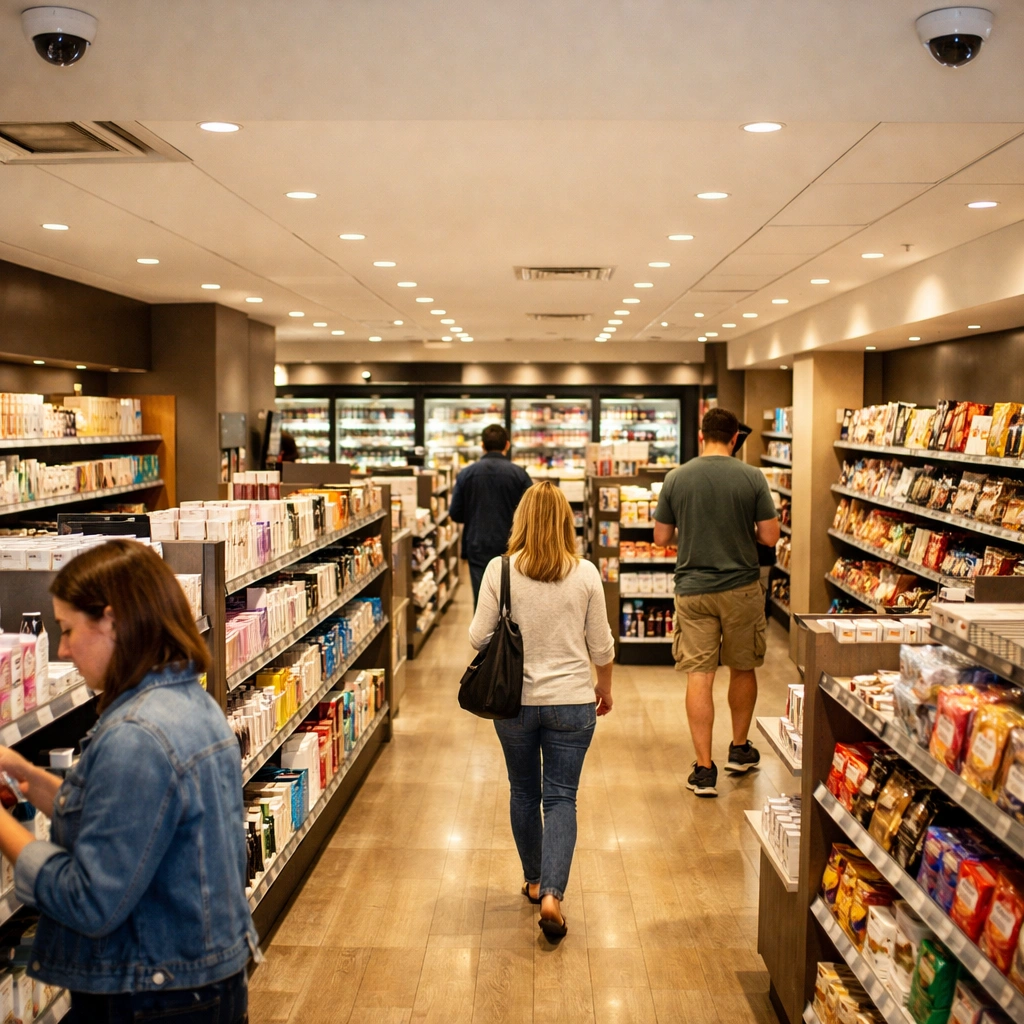
Walk your store floor on a Tuesday afternoon and everything looks fine. Shelves appear stocked. Staff are at their stations. The checkout line is moving. But somewhere in that same hour, a high-margin item ran out in aisle four, a customer spent six minutes looking confused near the entrance and left without buying, and a cart was abandoned at self-checkout after a scanning error. You missed all of it.
This is not a staffing problem. It is an information problem. And it is exactly the problem that retail AI vision was built to solve.
What is retail AI vision, exactly
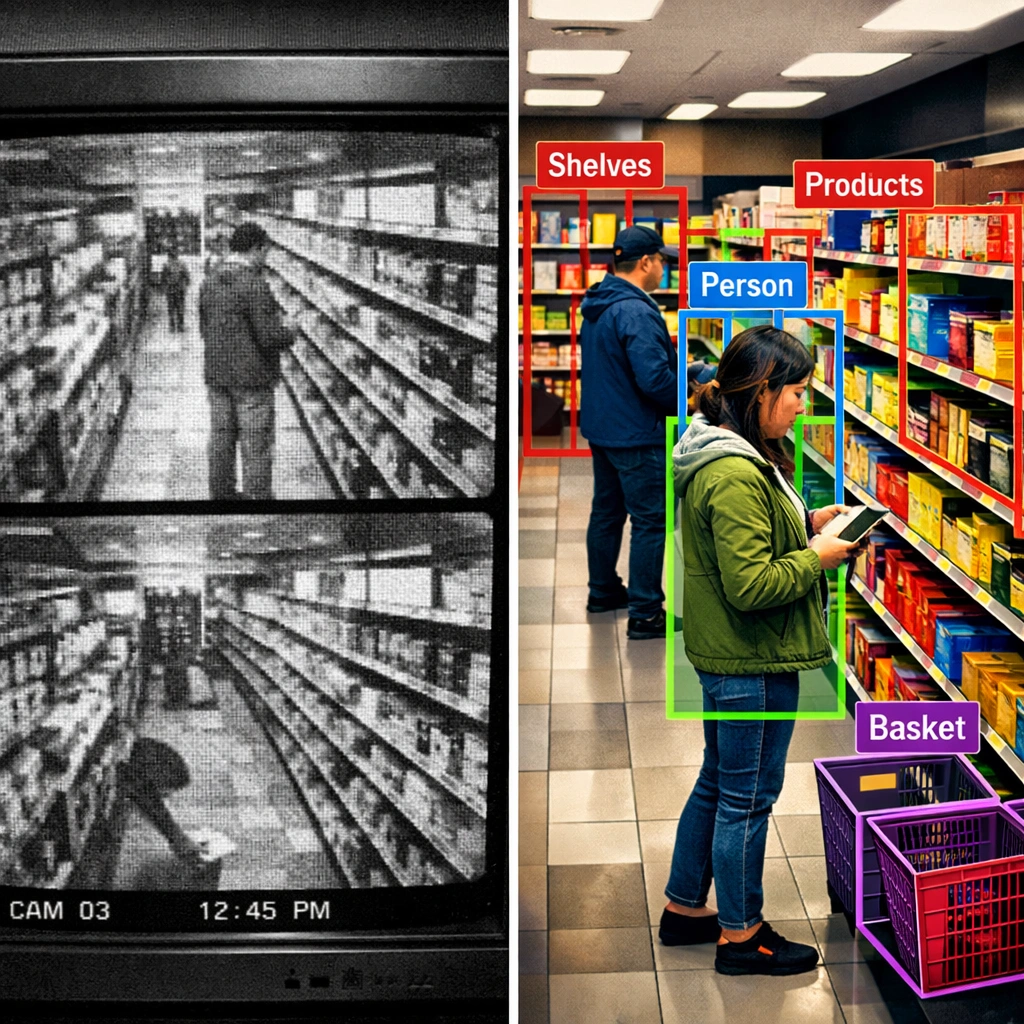
what is retail AI vision Retail AI vision is the use of camera hardware combined with machine-learning software to automatically observe, interpret, and report on physical activity inside a retail environment. Unlike a standard security camera that records footage for later review, a retail AI vision system processes what it sees in real time — identifying objects, people, behaviors, and conditions without requiring a human to watch the feed.
The camera captures a continuous stream of visual data. The software layer, trained on thousands of retail scenarios, analyzes that stream frame by frame. When it detects something meaningful — an empty shelf slot, a shopper standing in one spot for an unusual amount of time, a product placed in the wrong location — it generates an alert, logs an event, or triggers an automated workflow.
The result is a store that reports on itself.
The three core functions every retail AI vision system covers
Not every platform on the market offers the same feature set, but virtually all retail AI vision systems are built around three foundational capabilities.
Shelf and inventory monitoring
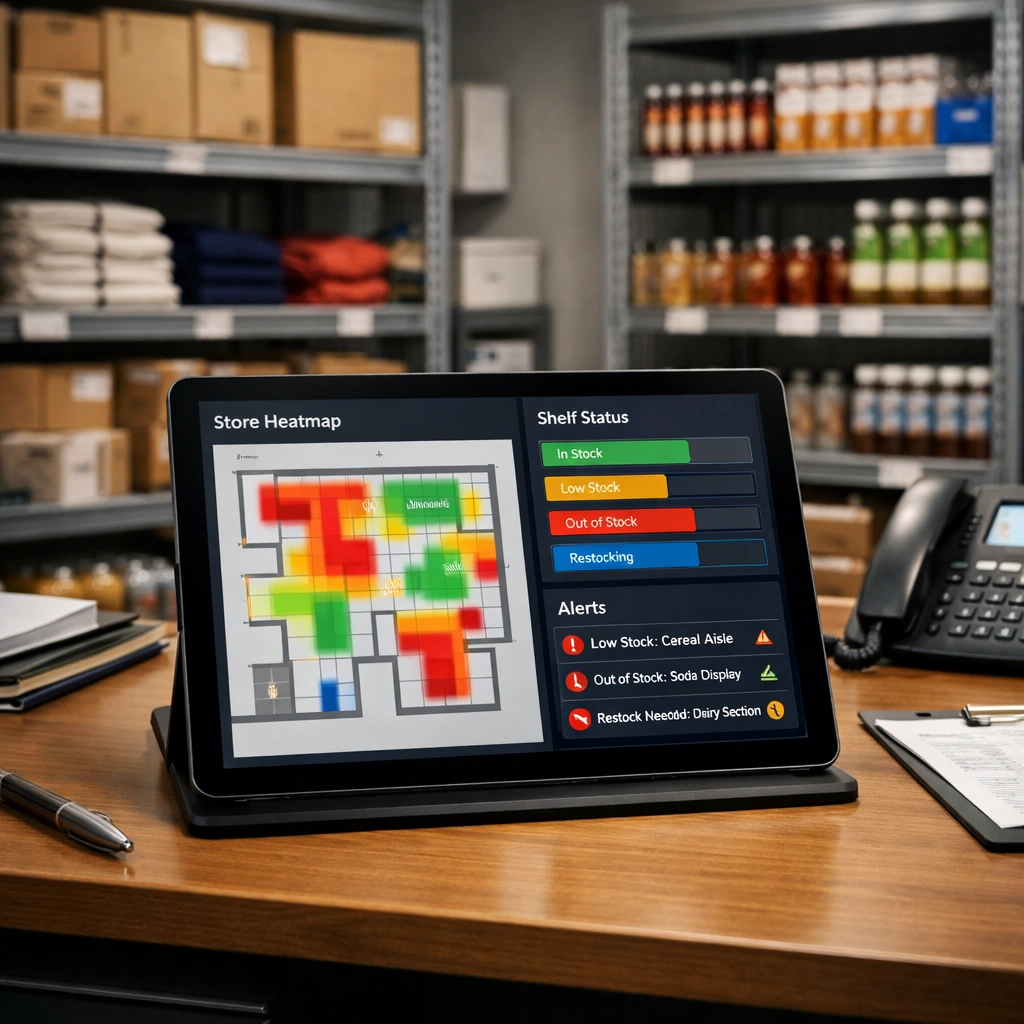
The system watches product placement continuously. When a shelf slot empties or a product is placed in the wrong section, an alert is sent to a staff member or logged into your inventory management tool. This eliminates the lag between a stockout happening and someone catching it during a manual walkthrough — a gap that often runs two to four hours in a typical store.
Entrepreneurs exploring the best AI vision systems for retail will find that shelf monitoring is almost always the highest-ROI use case to start with, particularly for stores with high SKU counts or fast-moving consumer goods.
Shopper behavior analysis
The system tracks how customers move through the store — which zones they enter, how long they stay, which displays they interact with, and where they exit without purchasing. This is not surveillance in the traditional sense. The data is aggregated and anonymized. What you get is a behavioral map of your store that shows you exactly where attention concentrates and where it drops off.
Loss prevention and anomaly detection
The system flags behavior patterns associated with theft, what is retail AI vision checkout fraud, or policy violations. This goes beyond motion detection. A well-trained model can distinguish between a customer reading a label and a customer concealing merchandise and it can do this across every camera feed simultaneously, something no human security team can match at scale.
How retail AI vision is different from what you already have
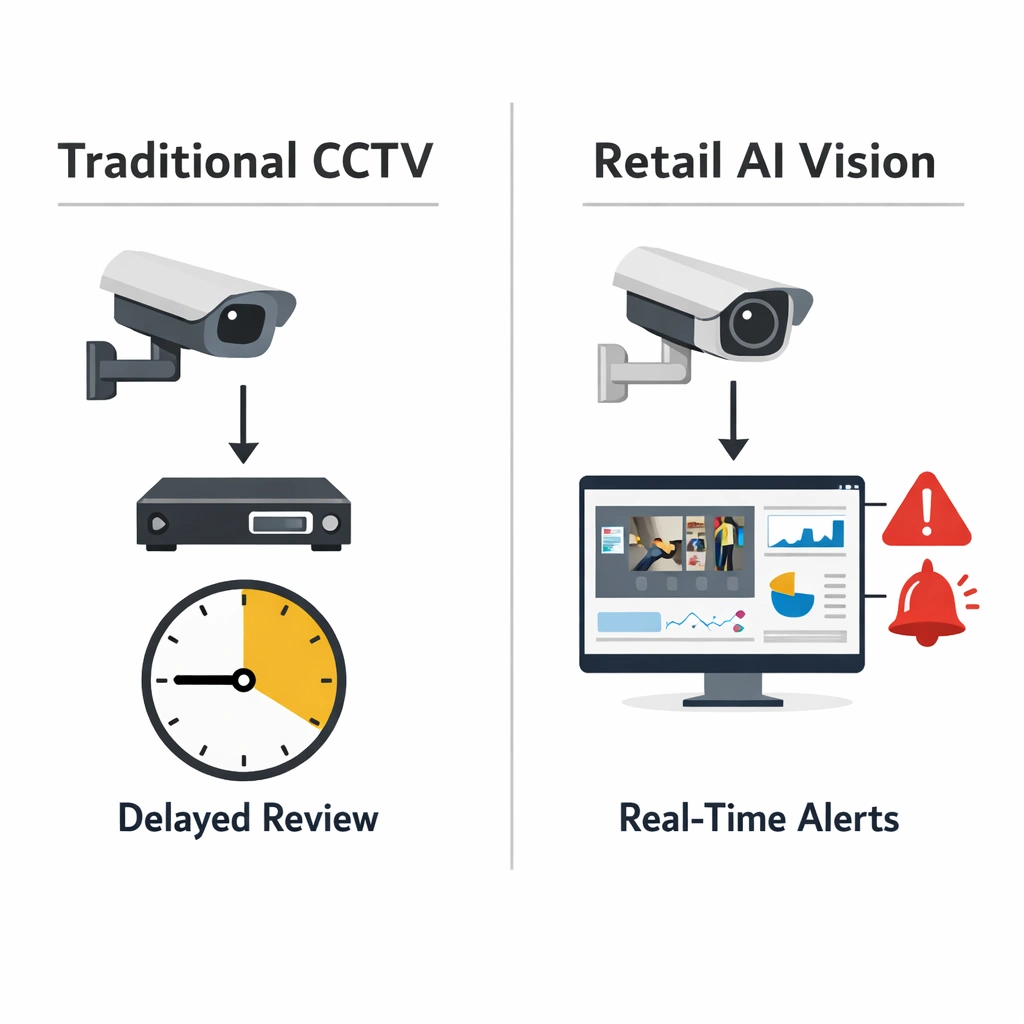
Most retail entrepreneurs already have cameras in their stores. The distinction worth understanding is the difference between recording and analyzing.
A traditional CCTV setup captures footage. That footage sits on a hard drive until someone pulls it to investigate an incident that already happened. The value is entirely retrospective.
A retail AI vision system does not wait for an incident. It operates in a continuous present tense, comparing what it sees against a model of what normal looks like and surfacing deviations the moment they appear. The operational gap this closes is significant especially for independent store owners who cannot afford a dedicated loss prevention team or full-time operations analyst.
Why 2026 is the turning point for adoption
Three factors converged in the last two years that moved retail AI vision from enterprise-only infrastructure to something a single-location entrepreneur can realistically deploy.
The first is hardware cost. Edge computing devices, the small processors that run vision models directly on-site without sending data to a cloud server, dropped significantly in price as production scaled. A system that required a $40,000 server cabinet in 2021 can now run on a device the size of a thick paperback book.
The second is model accuracy. Computer vision models trained specifically on retail environments have matured to the point where false positive rates the alerts that fire when nothing is actually wrong — are low enough to be operationally manageable. Early systems generated so many false alerts that staff started ignoring them. That problem is largely solved in the current generation of platforms.
The third is integration. Modern retail AI vision platforms are built to connect with the tools store owners already use point-of-sale systems, inventory software, staff communication apps. The data does not live in a separate silo. It flows into the workflows your team already operates in.
For entrepreneurs who want to understand how all of this translates into a working deployment, how to implement AI vision retail without wasting your budget is a practical starting point that walks through scoping, vendor selection, and rollout sequencing.
What retail AI vision is not
There are two misconceptions worth clearing up before you start evaluating platforms.
First, retail AI vision is not a replacement for staff. It is a reporting and alerting layer that makes the staff you already have significantly more effective. Your team still stocks the shelves. The system just tells them exactly which shelf needs attention right now instead of waiting for the next scheduled walkthrough.
Second, retail AI vision is not only for large chains. The narrative around this technology was shaped by early enterprise deployments at Walmart, Amazon, and similar companies. But the current market includes platforms purpose-built for independent retailers, boutique stores, and regional chains — with pricing models that reflect smaller operating budgets.
The foundation everything else builds on
Understanding what retail AI vision is gives you a stable foundation for every decision that follows — which platform fits your store type, which use case to prioritize first, how to build a business case for the investment, and how to set expectations with your staff before installation.
The broader strategic picture — including how shelf monitoring, loss prevention, and customer analytics work together as an integrated operations layer — is covered in how retail AI vision automation is transforming store operations in 2026.
The stores that wait will catch up eventually. The ones that act now will be harder to compete with.
The technology is no longer experimental. The price is no longer prohibitive. The question is not whether retail AI vision will become standard infrastructure for physical stores — it is how much operational ground you want to cover before your competitors get there first.
Start with one use case. Pick the one where the cost of inaction is most visible in your current numbers. Build from there.
Conclusion
Retail AI vision is not a futuristic concept reserved for companies with enterprise budgets and dedicated tech teams. It is a practical, what is retail AI vision deployable operations layer that gives store owners the kind of real-time visibility that manual processes have never been able to deliver consistently.
The three core functions shelf monitoring, shopper behavior analysis, and loss prevention each solve a problem that costs independent retailers measurable revenue every single week. When those three functions run together on a single platform, the compounding effect on store performance is significant.
What matters most at this stage is clarity. Knowing what retail AI vision is, how it differs from legacy camera setups, and why the current generation of platforms is accessible to stores of all sizes removes the guesswork from the evaluation process that comes next.
The foundation is now in place. The next step is identifying which system fits your store, your budget, and your most urgent operational gap.