

Every month, thousands of entrepreneurs wire money to Firebase, Supabase, or AWS Amplify for backend infrastructure they will never fully own. The bill starts small — $25 here, $49 there — and by the time your app gets traction, you are locked into pricing tiers, storage limits, and vendor roadmaps you had no say in.
Self-hosted backend as a service is the alternative that a growing number of founders are choosing instead. It gives you authentication, databases, file storage, and serverless functions running on your own infrastructure — a setup you control completely, with no usage caps and no surprise invoices, self-hosted backend as a service.
This is not a setup reserved for senior engineers with a DevOps background. Platforms like Appwrite, Nhost, and Parse have made self-hosting accessible enough that a solo founder with basic command-line familiarity can have a production backend running on a $6 VPS inside an afternoon.
What self-hosted backend as a service actually means
A backend as a service, or BaaS, is a pre-packaged server-side system that handles the infrastructure work most apps need user login, data storage, file uploads, push notifications, and API management. Instead of building those systems from scratch, you connect your frontend to the BaaS and focus on the productself-hosted backend as a service.
The self-hosted” part means you run that system on a server you control. It could be a VPS from Hetzner or DigitalOcean, a dedicated machine in a data center, or even a local server in your office. The software is open-source, so there is no license fee and no vendor who can pull the rug out from under you.
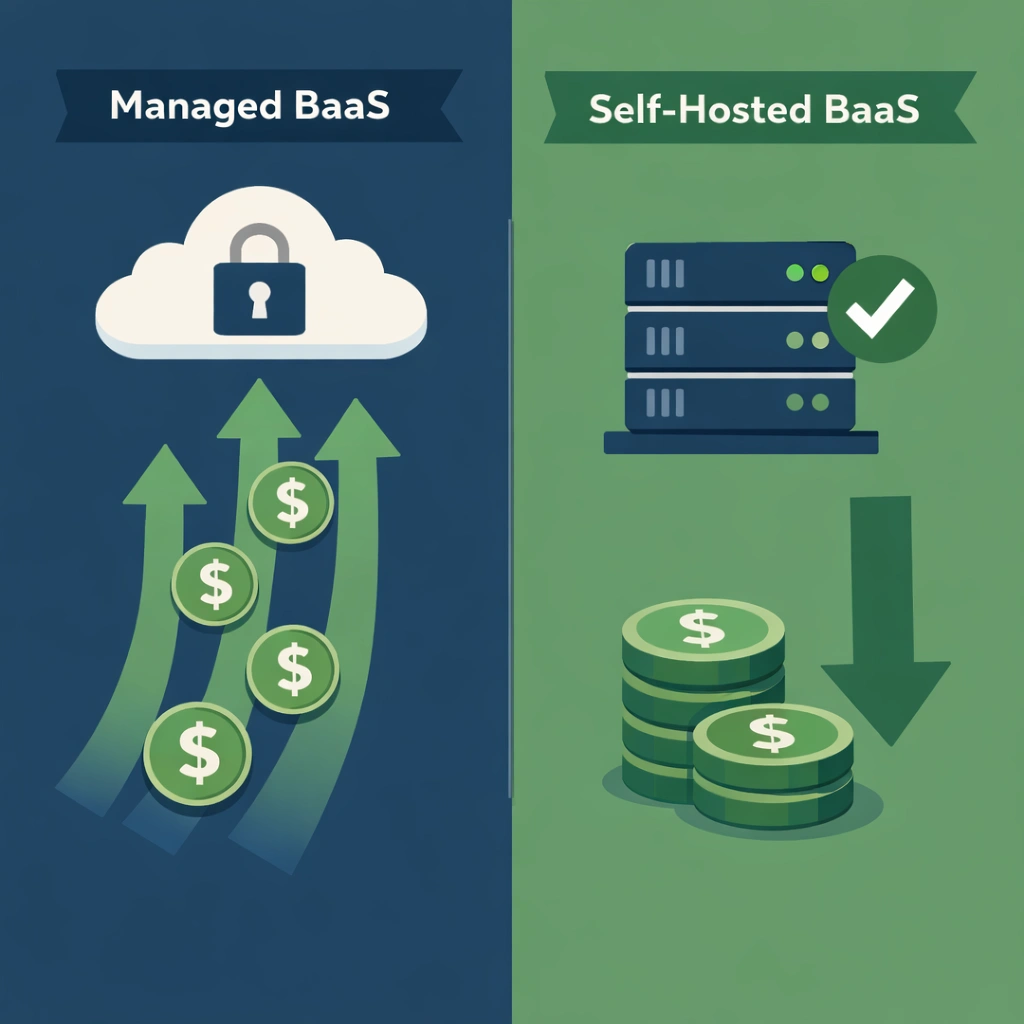
The distinction matters more than it sounds. When you use a managed platform, the vendor controls uptime decisions, pricing changes, feature deprecations, and data residency. When you self-host, those decisions are yours. That is not just a philosophical preference — it has real consequences for compliance, cost predictability, and long-term product sustainability.
Why the managed BaaS model is breaking down for early-stage startups
The managed BaaS pitch made sense in 2017. Developers got a generous free tier, fast onboarding, and zero infrastructure headaches. That deal has quietly changed.
Firebase’s Blaze plan charges per read, write, and delete operation. At scale, those costs compound in ways that are genuinely hard to predict from a spreadsheet. Supabase, one of the more founder-friendly options, still ties your data to their cloud and introduces pricing complexity as your database grows. Auth0 — a popular authentication layer — charges per monthly active user in a way that punishes growth rather than rewarding itself-hosted backend as a service .
For an entrepreneur building a SaaS product, a marketplace, or a mobile app with real user traction, these pricing models create a ceiling. You either absorb the escalating cost, migrate your entire backend at the worst possible time, or raise prices on your own customers to compensate.
Self-hosted backend as a service removes that ceiling entirely. Your cost becomes the fixed price of a server — predictable, scalable on your terms, and independent of how many users sign up this month.
The open-source platforms making self-hosting practical
Three platforms dominate this space right now, and each takes a different approach worth understanding before you commit.
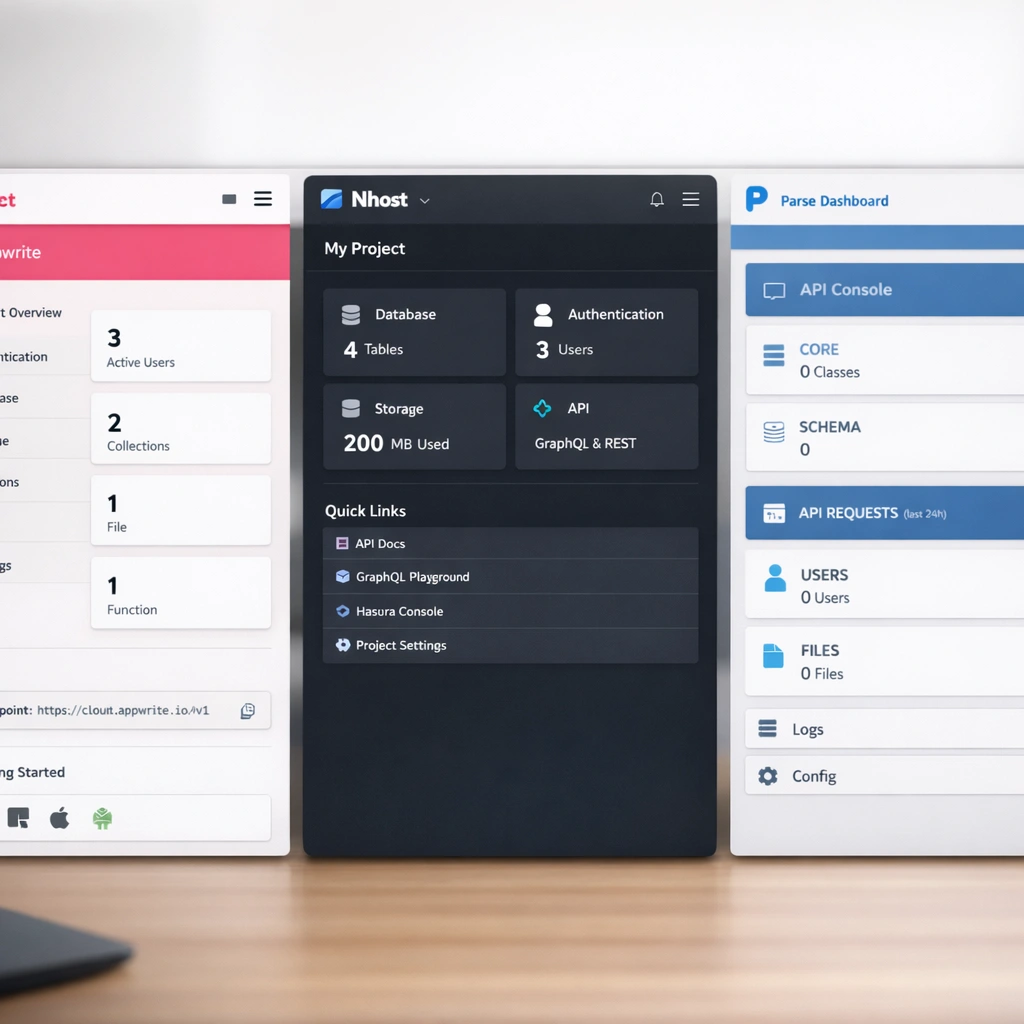
Appwrite is the most beginner-accessible option. It ships as a single Docker container, covers authentication, databases, storage, functions, and realtime features, and has SDKs for every major frontend framework. If you want the fastest path from zero to a working self-hosted backend, Appwrite is where most founders start. The full setup walkthrough is covered in depth in the complete guide to open-source BaaS self-hosting: Appwrite, Nhost, and Parse.
Nhost is built around Postgres and GraphQL. It bundles Hasura a GraphQL engine that auto-generates an API from your database schema with authentication, storage, and serverless functions. If your product has complex relational data or your frontend team already works with GraphQL, Nhost gives you a cleaner architecture than Appwrite’s REST-first approach.
Parse Server is the oldest of the three and the most battle-tested. Originally built at Facebook and open-sourced in 2016, it has been running production applications for a decade. It supports both MongoDB and Postgres, offers a mature cloud functions system, and has a community that has weathered every shift in the backend landscape. For entrepreneurs migrating from a legacy system or building something that needs proven stability over cutting-edge features, Parse is still a serious option.
What you actually need to get started
The technical barrier to self-hosting is lower than most entrepreneurs assume. Here is what a basic production setup requires self-hosted backend as a service.
A VPS with at least 2GB of RAM is enough to run Appwrite or Nhost in a single-node configuration. Hetzner’s CX22 plan and DigitalOcean’s basic droplet both sit around $6 to $12 per month. Docker and Docker Compose need to be installed — both are free and take under five minutes to set up on any Ubuntu server. A domain name pointed at your server’s IP address rounds out the essentials.
That is the entire infrastructure requirement for a self-hosted backend as a service setup capable of supporting thousands of users. No load balancer, no Kubernetes cluster, no DevOps team. You can add those layers as your product grows, but they are not prerequisites for launch.
The self-hosted BaaS VPS deployment process — including which plan sizes match which traffic levels — is covered step by step in the guide to deploying a self-hosted BaaS on a VPS for under $10 a month.
The real tradeoff: ownership comes with responsibility
Self-hosting is not free of friction. There are tradeoffs worth naming honestly before you commit.
You are responsible for backups. Managed platforms handle automated backups by default — on a self-hosted setup, that responsibility shifts to you. Configuring a daily backup to an S3-compatible bucket takes about thirty minutes and costs almost nothing, but it is a step you have to take self-hosted backend as a service .
You are also responsible for updates. Appwrite, Nhost, and Parse all release security patches and feature updates regularly. Keeping your instance current requires a deliberate process — not complicated, but not automatic either.
And if your server goes down, you are the first line of support. A managed platform has an SRE team responding to incidents around the clock. A self-hosted setup has you and whatever monitoring you have configured.

For most early-stage SaaS products, these responsibilities are manageable and the cost savings more than justify the added ownership. The founders who struggle with self-hosting are usually those who skip the backup and monitoring setup — not those who chose the wrong platform.
Who this setup is built for
Self-hosted backend as a service is the right move if you are building a product where data ownership matters — healthcare, legal tech, fintech, or any vertical with compliance requirements that make storing user data in a third-party cloud complicated.
It is also the right move if you are bootstrapped and need to keep your infrastructure cost predictable from day one. A fixed $10 server bill is a completely different financial model than a usage-based invoice that scales with your growth.
And it is the right move if you are building something with real long-term ambition. Vendor dependency is a liability that compounds over time. The sooner you own your infrastructure, the more options you have when your product reaches the scale where those decisions start to cost serious money.
Conclusion
The managed BaaS era gave founders a fast on-ramp, but the exit ramp has gotten expensive. self-hosted backend as a serviceSelf-hosted backend as a service is not a workaround for developers who cannot afford the real thing — it is a deliberate infrastructure strategy that puts ownership, cost control, and compliance back in the hands of the people building the product. The platforms available today make that shift more accessible than it has ever been, and the server costs to run them are genuinely trivial compared to what managed alternatives charge at scale.